

Last reviewed: October 2026 | For device users, engineers and OEM buyers comparing CR2032 coin-cell batteries.
Quick Answer: What Is a CR2032 Battery?
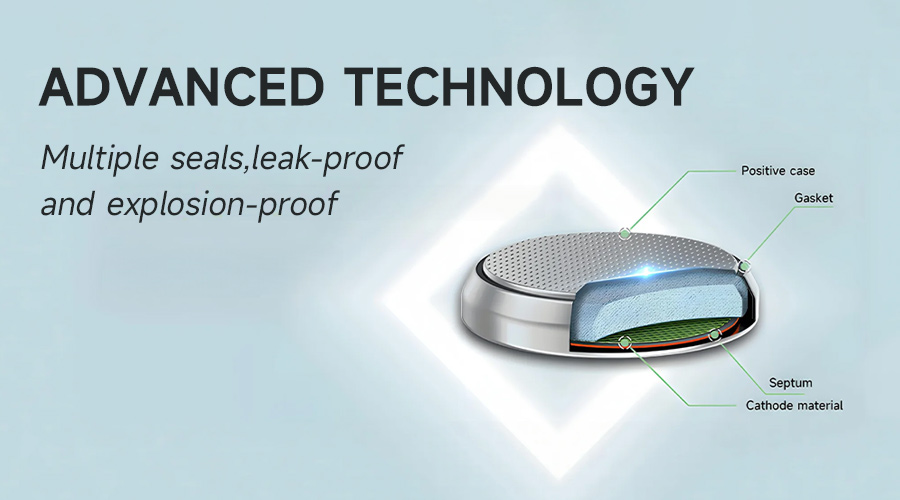
A CR2032 is a non-rechargeable 3V lithium manganese dioxide (Li-MnO2) coin cell battery measuring approximately 20 mm in diameter and 3.2 mm thick. It powers many car key fobs, computer motherboard clocks, thermometers, calculators, sensors and other compact electronics.
Its useful battery life depends on the device's current draw, wireless transmission pulses, operating temperature and cutoff voltage. For reference, PKCELL lists a 210 mAh CR2032 model; this is a model-specific capacity figure, not a guarantee for every CR2032 or every load condition.
Replacement rule: use the exact coin-cell model required by your device. CR2032, CR2025 and CR2016 are all nominally 3V and 20 mm in diameter, but their different thicknesses mean they are not automatically interchangeable.
CR2032 Battery Specifications: Voltage, Size and Capacity
The specifications below distinguish the standard CR2032 format from an example PKCELL product listing. Always use the datasheet for the precise cell variant you intend to purchase.
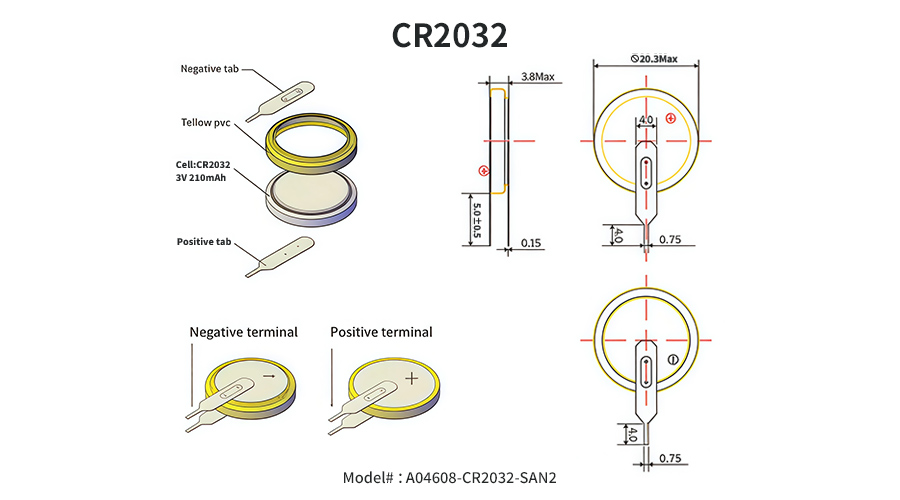
Capacity reference: PKCELL 3V CR2032 lithium button cell product page. Its catalog also lists other CR2032 variants; obtain the current, model-specific datasheet and its discharge-test conditions for engineering comparisons.
What Does CR2032 Mean, and How Does the Battery Work?
In the CR2032 designation, CR identifies a round lithium manganese dioxide primary cell, 20 indicates an approximately 20 mm diameter, and 32 indicates a 3.2 mm nominal thickness. The battery supplies electricity through a one-time electrochemical discharge reaction; it is not designed for recharging.
The nominal 3V rating does not mean the cell maintains exactly 3.0V under every condition. The terminal voltage varies with load, temperature and state of discharge. This matters when a device shuts down at a defined cutoff voltage.
How Long Does a CR2032 Battery Last?
A CR2032 may last a long time in a low-current memory-backup device, but far less time in a device that transmits frequently or draws high current pulses. No single lifespan applies to all CR2032 batteries.
Runtime (hours) = nominal capacity (mAh) ÷ average current (mA)
Example: assuming 210 mAh and a constant average current of 0.02 mA, 210 ÷ 0.02 = 10,500 hours (approximately 438 days, or 14.4 months) as a theoretical starting point.
This is not a promised runtime. Rated capacity may be measured under different discharge conditions. Real service life can be shorter because of voltage cutoff, current pulses, temperature, cell aging and storage history.
For wireless devices and transmission pulses, see our CR2032 pulse-current testing guide, which covers the topic in more engineering detail.
What Is a CR2032 Battery Used For?
CR2032 batteries are commonly selected for compact products that need a replaceable 3V coin cell and typically operate at low average current.
CR2032 vs CR2025 vs CR2016: Can They Be Replaced?
These models share a nominal 20 mm diameter and 3V rating but differ in thickness. A matching voltage alone does not establish safe or reliable replacement compatibility.
For detailed compatibility guidance, read CR2025 vs CR2032 or CR2032 vs CR2016. This article remains the general CR2032 reference rather than duplicating those specialized comparisons.
CR2032 With Tabs, Leads or a Battery Holder
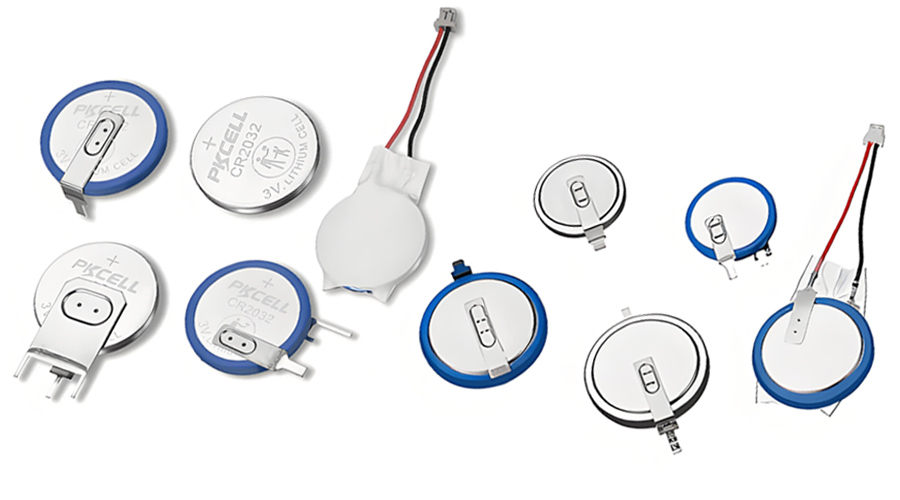
For replacement use, a loose CR2032 cell normally fits into a suitable battery holder. OEM products may need a CR2032 with factory-attached solder tabs, leads or a connector, depending on the PCB and enclosure design.
Do not solder wires directly to a standard loose CR2032 cell. Soldering heat can damage the seal or internal structure. Use an approved holder or a factory-prepared termination.
For the mounting decision and mechanical trade-offs, see CR2032 with tabs vs battery holder for OEM PCBs.
How to Choose the Right CR2032 Battery
For general battery information, this page covers the essentials. For production orders, ask the supplier to confirm model availability, sample tests, terminal drawings, applicable documentation and delivery requirements for the selected configuration.
CR2032 Safety, Handling and Storage
- Never recharge a standard CR2032 primary battery.
- Do not short-circuit, puncture, crush, heat, burn or disassemble the cell.
- Do not solder directly to a loose coin cell.
- Follow the device's polarity and battery-type instructions.
- Keep cells in protective packaging during storage and transport.
- Do not mix new and depleted cells or dissimilar chemistries in the same assembly.
- Dispose of used batteries promptly according to applicable local regulations.
PKCELL CR2032 Batteries for Replacement and OEM Projects
PKCELL offers CR2032 lithium coin cells, including a listed 3V 210 mAh model. OEM buyers can ask about available tabbed or leaded configurations, documentation and sample evaluation for their specific assembly.
For an accurate technical review, share: device application, average and pulse current, operating temperature, battery-holder or termination drawing, required quantity and destination market.
Frequently Asked Questions About CR2032
What is the voltage of a CR2032 battery?
A standard CR2032 has a nominal voltage of 3V. Actual loaded voltage varies with discharge current, temperature and remaining capacity.
What is the capacity of a CR2032 battery?
Capacity depends on the specific battery and test conditions. PKCELL lists a 210 mAh CR2032 model; review the model datasheet rather than treating one capacity figure as universal.
How long does a CR2032 battery last?
Service life depends on average current, pulse demand, voltage cutoff, temperature and aging. A capacity divided by average-current calculation is only a first-pass estimate.
Can a CR2032 battery replace a CR2025 or CR2016?
Do not assume so. All have a nominal 20 mm diameter and 3V voltage, but their thicknesses differ. Follow device-manufacturer instructions and never force a cell into a holder.
Can you recharge a CR2032 battery?
No. Standard CR2032 lithium manganese dioxide cells are non-rechargeable. Do not use a rechargeable 2032-size substitute unless the device was specifically designed for its chemistry and charging requirements.
Can a CR2032 be soldered directly to a PCB?
Do not solder directly to a loose CR2032. Use an approved coin-cell holder or a factory-prepared cell with attached tabs or leads.
Conclusion
CR2032 is a 3V, 20 × 3.2 mm primary lithium coin cell used in a wide range of low-power electronic devices. The right choice depends on the exact model, holder fit, usable capacity and load requirements—not nominal voltage alone.
Use the specified replacement cell for consumer devices. For engineering or purchasing projects, validate the model's loaded voltage, temperature behavior and termination before approving the battery for production.
Post time: Feb-21-2025


