

Technical comparison for consumers, engineers and OEM buyers evaluating CR2016 and CR2032 lithium coin cells.
Quick Answer: CR2016 vs CR2032
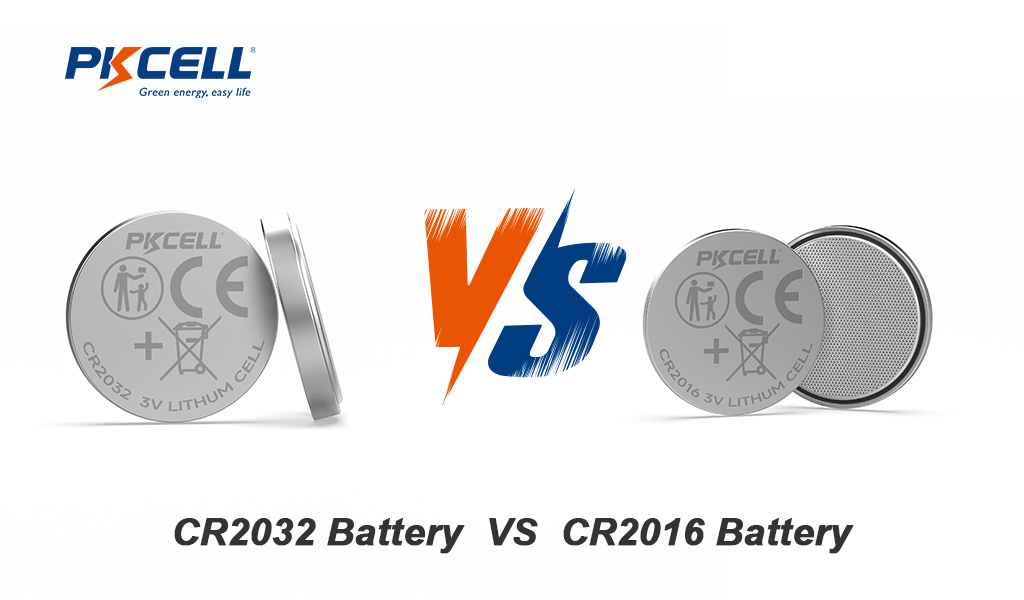
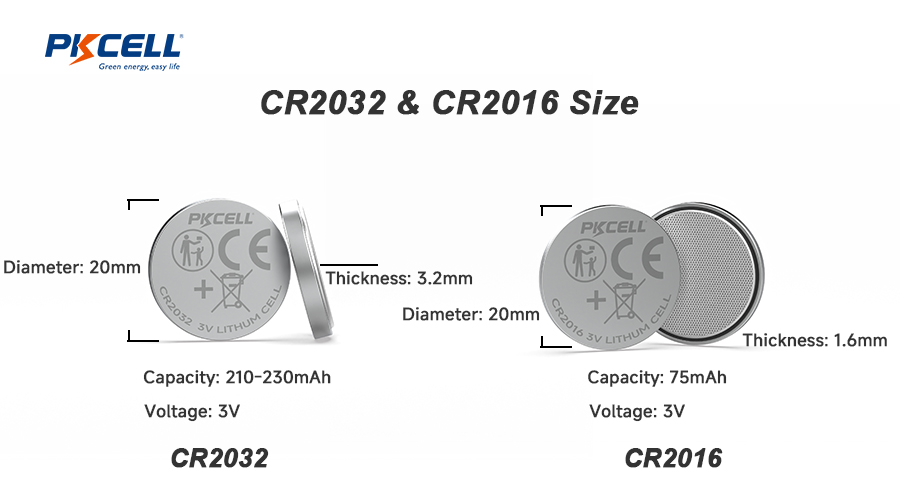
CR2016 and CR2032 are both non-rechargeable 3V lithium manganese dioxide coin cells with a 20mm diameter, but they differ in thickness and model-specific capacity. CR2016 is approximately 1.6mm thick, while CR2032 is approximately 3.2mm thick.
The listed PKCELL CR2016 model is rated at 75mAh and the listed CR2032 model at 210mAh. These values apply to the specified models; actual usable capacity and runtime depend on test conditions, load profile, temperature and device cutoff voltage.
They are not automatically interchangeable. Follow the device manufacturer's specified battery model and verify holder depth and contact pressure before considering a substitution.
Important: Do not force a CR2032 into a compartment designed for CR2016. Do not stack two CR2016 cells to replace one CR2032; two cells in series can produce approximately 6V and may damage a device designed for a single 3V cell.
CR2016 vs CR2032: Size, Voltage and Capacity Comparison
The most important differences are battery thickness, the capacity of the specific model and whether the device's battery holder can safely accommodate the cell. The table below uses the published specifications for the listed PKCELL models where model-specific values are available.
Capacity values refer to the linked PKCELL models, not every CR2016 or CR2032 battery on the market. Compare datasheets only when discharge current, cutoff voltage, temperature and test method are comparable.
See the specific product data for PKCELL CR2016 75mAh and PKCELL CR2032 210mAh.
Can CR2032 Replace CR2016?
Not automatically. Both cells have a nominal 3V voltage and 20mm diameter, but CR2032 is 1.6mm thicker than CR2016. A CR2032 may only be considered if the device manufacturer permits the substitution and the holder can accommodate the thicker cell without stressing the cover, contacts or enclosure.
Can CR2016 Replace CR2032?
CR2016 is not a guaranteed substitute for CR2032. Its thinner profile may result in insufficient contact pressure in a CR2032 holder, and the listed PKCELL CR2016 model has a lower rated capacity than the listed CR2032 model. Even if the device powers on, runtime and reliability may not meet the original design requirements.
For normal use, use the battery model specified by the device manufacturer. For medical, safety-related, access-control or industrial equipment, do not use an improvised replacement unless the substitution has been formally approved and validated.
Can Two CR2016 Batteries Replace One CR2032?
No. Do not stack two CR2016 batteries to replace one CR2032. One CR2032 is a nominal 3V cell. Two CR2016 cells connected in series can produce approximately 6V, which may damage equipment designed for a single 3V coin cell. Stacking also creates mechanical and contact risks.
Which Lasts Longer: CR2016 or CR2032?
The listed PKCELL CR2032 model has a higher rated capacity than the listed CR2016 model, so it may provide longer runtime when both are used in compatible devices under comparable conditions. However, capacity ratio is not a guaranteed runtime ratio.
Actual service life depends on average current, pulse current, pulse duration and frequency, operating temperature, device cutoff voltage, storage history and battery condition. A simple first-pass estimate is:
Estimated runtime (hours) = usable capacity (mAh) ÷ average current (mA)
This is a theoretical estimate, not a guaranteed service life. For wireless devices, measure voltage under real pulse loads and validate the battery in the actual device.
For more detail about CR2032 pulse performance, see CR2032 pulse current and wireless devices.
Which Battery Should You Choose?
Choose based on the device specification first, then check the physical space, load profile and expected service life. Do not choose solely because one cell has a higher capacity rating.
CR2016 and CR2032 for OEM Design
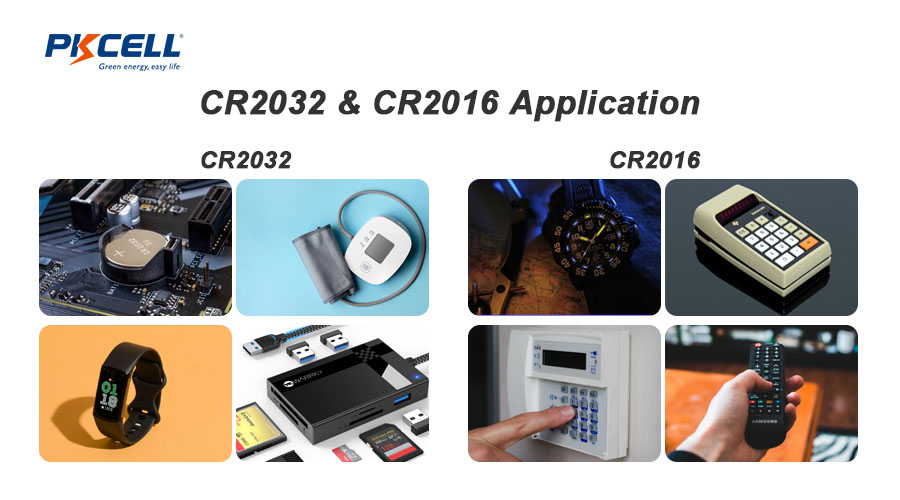
For OEM projects, the choice between CR2016 and CR2032 should be documented as a design decision, not treated as a casual substitution. Confirm the selected cell's datasheet, mechanical drawing, load profile, target service life and mounting method before approving production.
- Confirm the exact battery model and its rated capacity test conditions.
- Check compartment depth, tolerance, contact pressure and polarity.
- Measure voltage under expected continuous and pulse loads.
- Validate performance at the intended operating temperature.
- Record the approved model, supplier documentation and lot traceability requirements.
For product-specific data, review the CR2016 product page and CR2032 product page. If the design requires factory-welded tabs or lead wires, see lithium coin cells with leads or tabs.
Safety Tips for CR2016 and CR2032
- Do not recharge standard CR2016 or CR2032 primary lithium coin cells.
- Do not stack two CR2016 cells to replace one CR2032.
- Do not force a thicker cell into a battery compartment.
- Do not short-circuit, puncture, crush, heat or open coin cells.
- Install the cell with the correct polarity and follow the device instructions.
- Keep coin cells away from children and pets. Suspected ingestion requires immediate medical attention.
- Dispose of used batteries according to local regulations.
Frequently Asked Questions
Need CR2016 or CR2032 Cells for an OEM Project?
Share your specified model, device space, current profile, temperature range, mounting requirements and estimated order quantity. PKCELL can help you review the listed coin-cell models and discuss product documentation or OEM options subject to project requirements.
Conclusion
CR2016 and CR2032 are both 3V lithium coin cells with a 20mm diameter, but their thickness and rated capacity differ. CR2016 is designed for low-profile compartments, while CR2032 is thicker and the listed PKCELL model has a higher rated capacity.
For replacement, follow the device manufacturer's specification. For OEM design, verify mechanical fit, load profile, cutoff voltage and model-specific datasheet conditions before approving a substitution.
Post time: Jul-04-2025


