

Last updated: October 14 2026 | For consumers, engineers, OEM buyers and product developers choosing between CR2025 and CR2032 lithium coin cell batteries.
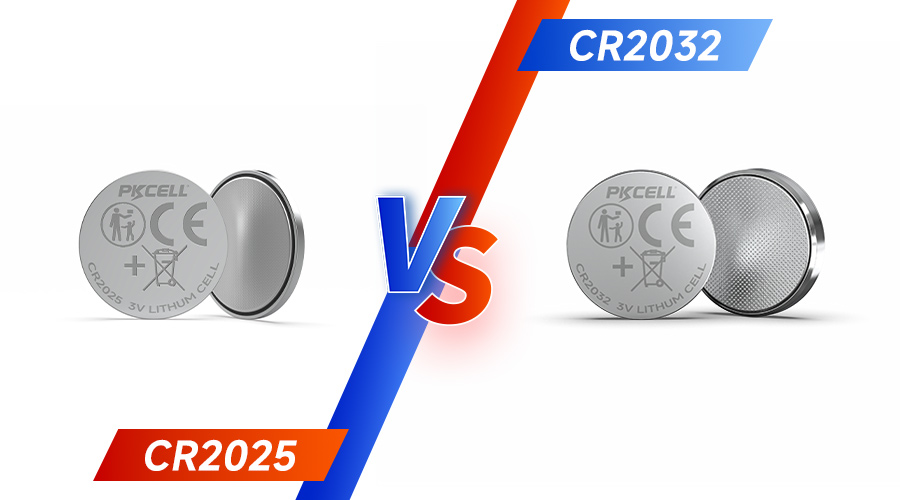
Quick Answer: Are CR2025 and CR2032 Interchangeable?
CR2025 and CR2032 are both non-rechargeable 3V lithium manganese dioxide coin cells with a 20 mm diameter, but they are not automatically interchangeable. CR2025 is 2.5 mm thick; CR2032 is 3.2 mm thick, a difference of 0.7 mm.
For PKCELL's referenced standard models, CR2025 is rated at 150 mAh and CR2032 at 210 mAh. Capacity depends on the specified model and test conditions; a larger rating does not guarantee the same improvement in operating life.
Replacement answer: Use the exact model specified by your device. A swap should be considered only if the device manufacturer approves it and the holder dimensions, contact pressure, load profile and voltage requirements have been checked.
Safety first: Do not force the thicker CR2032 into a CR2025 holder or add improvised conductive spacers to support a thinner CR2025. A 3V nominal rating alone does not prove safe mechanical or electrical compatibility.
CR2025 vs CR2032: Main Differences in Size and Capacity
The two batteries share their nominal voltage and diameter. The key physical difference is 0.7 mm of thickness, which changes battery-holder fit and often available capacity.
Capacity source: These 150 mAh and 210 mAh figures refer to specific PKCELL models, not every CR2025 or CR2032 sold in the market. Compare manufacturer datasheets under the actual load, temperature and cutoff voltage.
Product details: PKCELL CR2025 150mAh and PKCELL CR2032 210mAh.
Which Battery Should You Choose: CR2025 or CR2032?
If you are replacing a battery, follow the model printed on the original cell or specified in the device manual. For a new product design, consider both the mechanical fit and measured current profile.
Choose CR2025 for a Device Designed Around a 2.5 mm Cell
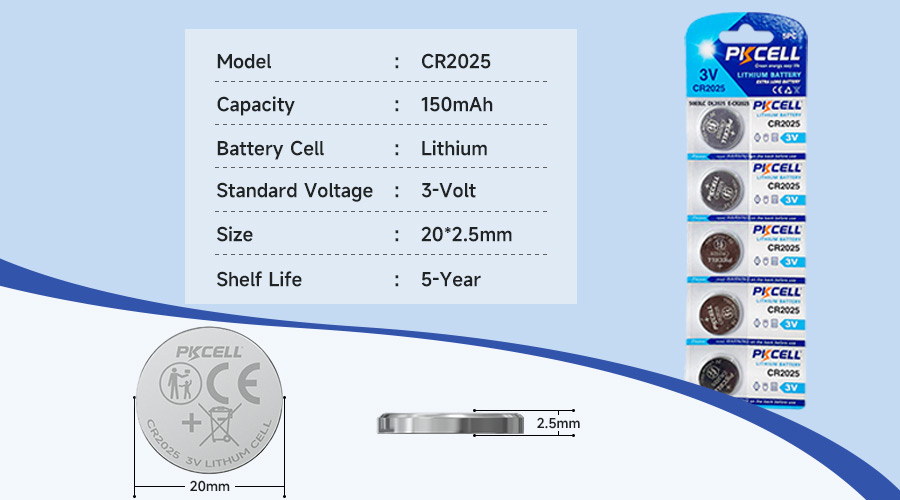
CR2025 is usually relevant where the approved holder and enclosure require a thinner coin cell. Evaluate its rated capacity against the operating duty cycle rather than assuming all low-drain devices require CR2025.
Choose CR2032 When the Approved Design Accepts a 3.2 mm Cell
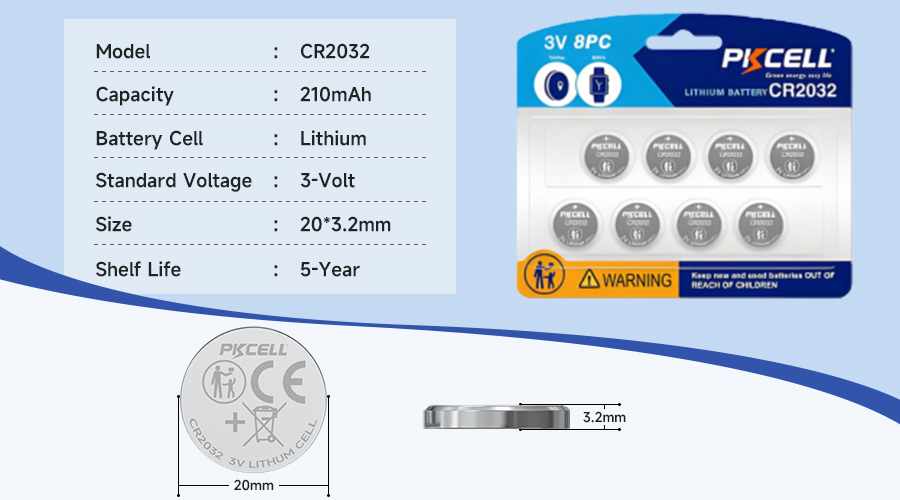
CR2032 can offer a higher capacity in a compatible device. However, its extra thickness requires a correctly specified holder and enclosure, and effective battery life depends on the actual load and voltage cutoff.
Can CR2032 Replace CR2025, or Vice Versa?
Neither direction is a guaranteed drop-in substitution. The same 3V voltage and 20 mm diameter do not ensure adequate fit, terminal pressure, pulse performance or reliability. Evaluate each replacement direction separately.
Before Considering a Replacement, Check These Four Items
- Device instructions: Is an alternative part explicitly approved?
- Holder geometry: Does the compartment accommodate the cell without deforming contacts?
- Electrical demand: Is loaded voltage sufficient during the actual pulse and standby profile?
- Service-life requirement: Will the selected cell satisfy the cutoff voltage and replacement interval?
CR2025 vs CR2032: Typical Applications and Fit
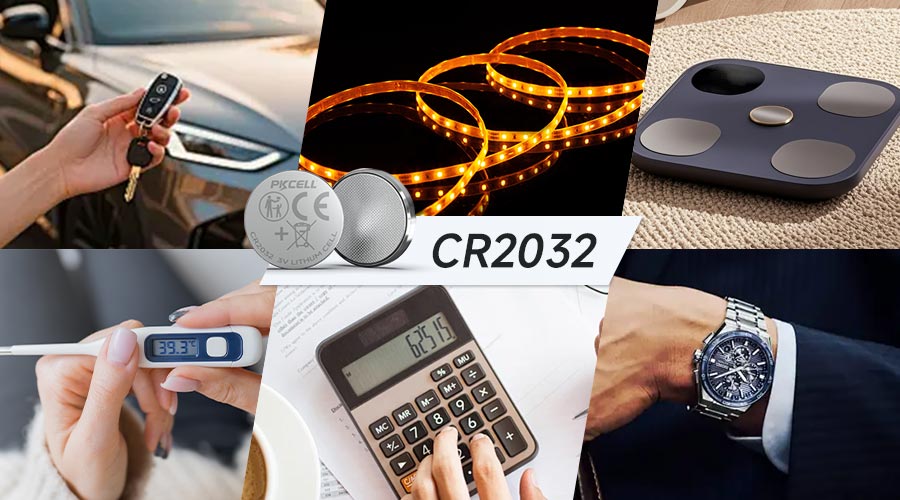
Both models appear in compact electronics, such as key fobs, wireless remotes, meters and sensors. The correct model is determined by the device's approved compartment, electrical demand and service-life target, not the device category alone.
Which Lasts Longer: CR2025 or CR2032?
Under comparable test conditions and a compatible design, CR2032 generally provides more capacity and can last longer than CR2025. For the referenced PKCELL 150 mAh and 210 mAh versions, the nominal capacity rating of CR2032 is 40% higher, but this is not a guaranteed 40% increase in device runtime.
Usable battery life also depends on pulse current, operating temperature, storage history and the minimum voltage at which the device stops working. Check the specific product datasheets and test samples in the finished device.
CR2025 vs CR2032 for OEM Device Design and Procurement
For OEM engineers, model selection is a trade-off between allowed device thickness, realistic load behavior, mounting configuration and maintenance interval. Specify the exact cell and approved terminal configuration before mass production.
- Electrical requirements: nominal voltage, average/sleep current, peak pulse current, pulse duration and device cutoff voltage.
- Mechanical requirements: holder drawing, enclosure clearance, contact pressure, tab or lead requirements.
- Qualification requirements: temperature range, duty-cycle validation, sample testing and model-specific documentation.
- Commercial requirements: estimated annual quantity, packaging, traceability and destination market.
For a soldered or wired integration, review coin cells with factory-welded tabs or leads. Direct soldering to a loose lithium coin cell is not recommended.
For more CR-series sizes, see the PKCELL lithium button battery range.
Safety Tips for CR2025 and CR2032 Batteries
- Do not recharge CR2025 or CR2032 batteries. They are non-rechargeable lithium coin cells.
- Do not short-circuit the positive and negative terminals.
- Keep coin cell batteries away from children and pets.
- Do not mix old and new batteries in one device.
- Do not force CR2032 into a compartment designed only for CR2025.
- Store batteries in a cool, dry place away from heat and moisture.
- Dispose of used batteries according to local recycling regulations.
PKCELL CR2025 and CR2032 for OEM and Bulk Orders
Need CR2025 or CR2032 Cells for a Device Project?
Compare specific models and send the device's required voltage, current profile, battery-holder dimensions, mounting method, operating temperatures and expected annual demand for a suitable recommendation.
View CR2025 150mAh | View CR2032 210mAh
Request Samples or an OEM Quote
Frequently Asked Questions
Conclusion
CR2025 and CR2032 share a 3V rating and a 20 mm diameter, but differ by 0.7 mm in thickness and by model-specific capacity. Neither should be treated as a universal replacement for the other.
For replacement use, follow the device manufacturer's specified model. For OEM projects, compare datasheet conditions and validate holder fit, loaded voltage and service life before production approval.
Post time: Feb-17-2025


