

Primary Lithium Battery Storage and Inventory Management Guide for OEM Buyers
Primary lithium battery inventory needs more control than a shelf, a quantity count, and a first-in-first-out rule. OEM buyers must preserve product identity, storage history, remaining qualified life, packaging integrity, lot traceability, and release status from receipt through device assembly.
This is an operational guide for purchasing, warehouse, quality, and production teams. It complements PKCELL’s article on Li-SOCl2 shelf life versus service life, which explains calendar history, temperature, passivation, and remaining-life planning. Instead of repeating those fundamentals, this guide focuses on how to turn them into daily warehouse transactions and release controls.
Why Battery Inventory Is an Engineering-Controlled Asset
Two cartons can carry the same commercial model and still require different decisions if they have different production dates, storage histories, packaging condition, or release status. A later delivery may even contain an older production lot. That is why a generic material code and on-hand quantity are not enough.
Battery inventory also exists in more places than the central warehouse. It may be held by the supplier, freight forwarder, customs broker, OEM, contract manufacturer, regional assembly site, distributor, service depot, or inside unsold finished products. Every location adds time and potential loss of traceability.
Good inventory control answers four questions for every unit: what is it, how old is it, what happened to it, and where was it used?
The controls should be proportionate to product risk. A battery used in a serviceable consumer product may not need the same retention plan as one installed in a remote meter, alarm, tracking unit, or industrial sensor. PKCELL’s primary lithium battery solution hub provides application and chemistry starting points for these different use cases.
Define Inventory Requirements Before the Purchase Order
The warehouse cannot enforce information that purchasing never requested. Put the critical inventory requirements in the approved specification, quality agreement, or purchase order before the supplier ships.
- Exact chemistry, manufacturer, model, and approved specification revision
- Cell or pack drawing revision and approved connector configuration
- Required production date, permitted age at shipment, or minimum remaining qualified life
- Lot-code and date-code format
- Rules for the number of production lots allowed per shipment
- Carton, inner-pack, barcode, and label requirements
- Supplier storage and shipment-history declarations where required
- Applicable documents for the exact model and configuration
- Quantity tolerance, delivery schedule, and approved ship-to location
- Change-notification and nonconformance communication requirements
For a custom pack, the purchasing record should also control wire, connector, pinout, polarity, insulation, label, and packaging. PKCELL’s custom primary battery pack RFQ checklist can help teams organize these technical and commercial inputs before requesting samples or volume pricing.
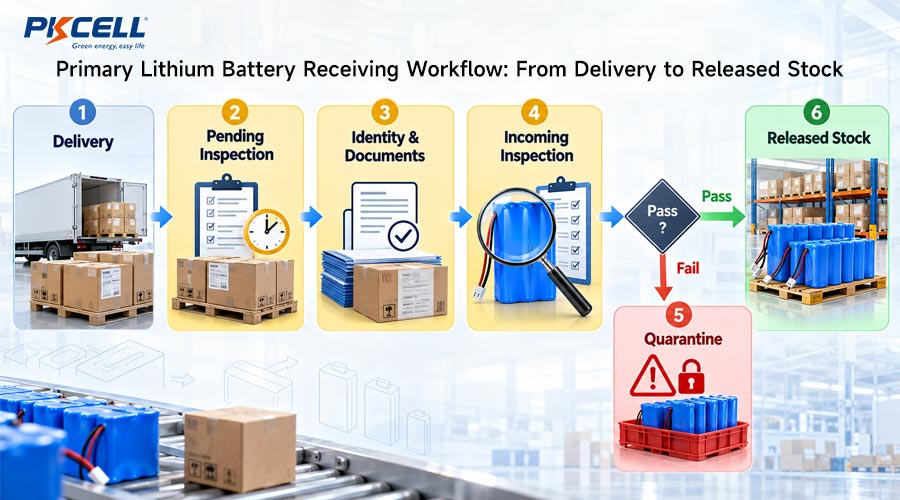
Use a Controlled Receiving-to-Release Workflow
1. Receive into a Pending-Inspection Area
Do not place an unverified delivery directly into available production stock. Receive it into a clearly marked pending-inspection location. Check carton count, shipment identity, visible handling damage, water exposure, crushing, unusual odor, heat indication, and label readability before opening inner packaging.
If a shipment appears damaged or has experienced a suspected transport incident, stop routine handling and follow the company’s safety, dangerous-goods, and supplier-notification procedures. Do not return, dispose of, or transport questionable lithium batteries without the appropriate review.
2. Match the Shipment to the Order and Approved Item
Verify the purchase order, packing list, manufacturer, model, chemistry, pack revision, quantity, lot code, date code, and destination documentation. For customized packs, compare the label and physical interface with the controlled drawing.
A similar-looking battery is not necessarily an approved substitute. Hold any model, manufacturer, connector, label, or revision mismatch until engineering and quality provide a written disposition.
3. Perform the Agreed Incoming Inspection
The inspection plan should be model- and risk-specific. It may include packaging, appearance, dimensions, polarity, connector and pinout, label, open-circuit voltage, and an approved loaded test. Open-circuit voltage is only one screen; it cannot confirm retained capacity or dynamic pulse performance. See PKCELL’s guide explaining why OCV alone is insufficient for Li-SOCl2 battery testing.
Record which units were sampled and whether any test changes their condition. Do not return a partially discharged or conditioned sample to untouched inventory without a defined status and identification method.
4. Assign an Explicit Inventory Status
The physical label, warehouse location, and inventory-system status must agree. A digital hold is weak if a picker can still access the carton; a quarantine cage is weak if the WMS still shows the material as available.
Capture the Right Data in the ERP or WMS
A warehouse management system should distinguish a commercial SKU from a traceable lot. The following fields provide a practical starting point:
| Data field | Purpose | Example control |
|---|---|---|
| Approved item number | Connects inventory to the controlled specification | Block unapproved substitutions |
| Manufacturer and model | Preserves exact product identity | Require both fields, not a generic description |
| Production lot and date code | Supports age control, traceability, and investigation | Prevent receipt without a readable verified code |
| Pack assembly date or revision | Tracks customized battery assemblies | Link to the approved pack drawing |
| Receipt and release dates | Separates warehouse time from inspection delay | Report long pending-inspection holds |
| Qualified-use or review date | Enables FEFO and aging alerts | Calculate from approved model-specific rules |
| Storage location | Connects inventory to environmental controls | Restrict moves to approved battery locations |
| Status and reason code | Prevents unintended issue | Require approval to remove a hold |
| Packaging state | Identifies sealed, opened, or repacked material | Create a new container ID after opening |
| Excursion or deviation record | Preserves unusual storage or handling history | Link disposition before release |
| Quantity by container | Supports cycle counts and partial-carton control | Use unique IDs for inner packs and partials |
| Device-build allocation | Links battery lots to production output | Record device lot or serial-number range |
Barcode scanning reduces manual transcription, but it does not prove that the encoded data are correct. Validate label formats during supplier approval and keep a controlled method for resolving unreadable or conflicting codes.
Control the Warehouse Environment and Physical Layout
Use the current model-specific datasheet, safety information, packaging instructions, and applicable site rules to define storage conditions. Do not treat a battery’s operating-temperature range as its preferred long-term warehouse range.
As general controls, keep approved batteries in their protective packaging in a clean, dry, ventilated, access-controlled area away from direct sunlight, heat, flame, water, conductive objects, and incompatible materials. Protect terminals from contact and prevent cartons from being crushed, dropped, or loaded beyond their packaging limits.
The layout should visibly separate:
- Pending-inspection, released, quarantine, rejected, and return stock
- Different chemistries, models, revisions, and polarity configurations
- Sealed cartons, opened containers, retained samples, and engineering samples
- New stock and returned material
- Normal inventory and damaged or suspect items awaiting trained review
Monitor the conditions that matter to the approved storage specification. Records should be attributable to a location and period, reviewed at a defined frequency, and retained long enough to support inventory and field investigations.
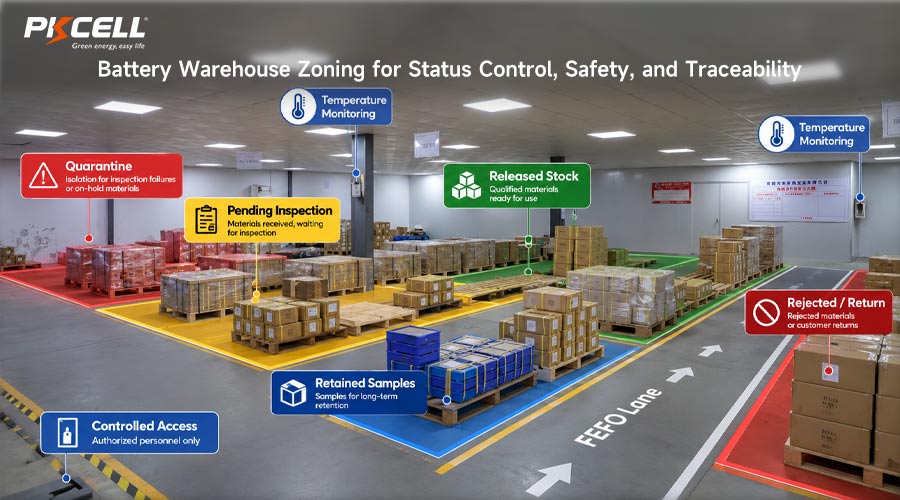
Use FEFO with a Qualified Review Date
FIFO issues the first material received. FEFO issues the material with the earliest qualified end or review date. For primary lithium batteries, FEFO is usually more informative when production-date data and model-specific storage rules are reliable.
FEFO should not be an automatic permission to use any aging lot. The system needs decision thresholds:
- Normal issue window: the lot meets all age and storage requirements.
- Advance alert: purchasing and production are warned before the lot becomes difficult to consume.
- Engineering review: the lot requires additional confirmation or testing before use.
- Blocked: the lot cannot be issued without formal disposition.
Set these limits from the exact product specification, supplier agreement, device-life plan, and storage history. Do not invent a generic expiration period for every primary lithium chemistry or model.
Control Opened and Partial Containers
Once a carton or inner pack is opened, preserve the original lot identity and protective packaging. Assign a container ID, record the opening date and quantity, protect exposed terminals, and return the partial quantity to an approved location. Do not consolidate similar-looking partial lots into one unlabeled box.
If repacking is necessary, use an approved method and reproduce all information needed for identity, polarity, lot, quantity, status, and handling. Repacking should not erase the relationship to the original supplier container.
Manage Temperature Excursions and Other Exceptions
An alarm does not automatically mean the batteries are unusable, and a return to normal temperature does not automatically release them. Move affected inventory to quarantine and preserve the evidence.
An excursion record should include:
- Affected locations, SKUs, lots, containers, and quantities
- Minimum and maximum recorded conditions
- Start time, end time, duration, and data gaps
- Packaging state and position within the storage area
- Known transport or previous-excursion history
- Supplier and engineering assessment
- Inspection or test plan, acceptance criteria, and results
- Final release, restriction, return, or disposal decision
The same hold-and-review logic applies to dropped cartons, crushed packages, water exposure, unreadable lot labels, polarity discrepancies, mixed lots, suspected terminal shorting, leakage, deformation, unusual heat, or returns from production.
Preserve Traceability Through Production and Finished Goods
Record which battery lot or pack lot was supplied to each device work order, production lot, or serial-number range. Where more than one battery lot is used in one device build, record the boundaries rather than listing every possible lot against the entire production run.
At the production line:
- Verify the issued model, revision, lot, status, and quantity before use.
- Prevent mixed material at the workstation during changeover.
- Return unused batteries through a controlled transaction.
- Identify dropped, damaged, tested, or rejected units separately.
- Reconcile issued, installed, returned, scrapped, and sampled quantities.
Inventory age does not stop when the battery is installed in an unsold product. Add the battery production or assembly history to finished-goods planning, especially when devices may remain at a contract manufacturer, regional warehouse, distributor, or project site before activation.
Extend the Same Controls to Contract Manufacturers
An OEM remains exposed to inventory risk even when another company stores and installs the battery. Define approved locations, environmental records, status codes, FEFO rules, line-clearance practices, lot-to-device traceability, return handling, cycle counts, and change notification in the manufacturing agreement.
Regular inventory reports should show quantities by exact lot and status, not only a total balance. Compare contract-manufacturer records with purchase, shipment, build, scrap, and finished-goods data.
Plan Aging Inventory Before It Becomes Obsolete
Slow-moving battery inventory is usually a planning signal before it becomes a quality question. Review demand changes, engineering revisions, product end-of-life plans, regional stock, and finished-goods balances while there is still time to act.
Possible controlled actions include using the lot in the originally approved product, adjusting future releases, transferring stock between approved locations, requesting supplier or engineering review, conducting agreed retesting, or documenting an authorized disposition. Commercial pressure should not bypass technical acceptance or traceability.
For Li-SOCl2 batteries, do not treat normal passivation behavior as proof of depletion, and do not apply an uncontrolled conditioning procedure simply to clear old stock. PKCELL’s Li-SOCl2 passivation guide explains why first-pulse response must be evaluated under the real application load and storage condition.
Track Inventory Metrics That Reveal Risk
A useful dashboard should help teams act, not merely count stock. Consider monitoring:
- Quantity and value by model, lot, age band, location, and status
- Lots approaching internal review or issue limits
- Average and maximum time in pending inspection
- Inventory without verified date or lot data
- Opened or partial containers by age and location
- Quarantine quantity and average disposition time
- Temperature or handling excursions still awaiting closure
- Cycle-count variance and unexplained adjustments
- Inventory at contract manufacturers and in finished goods
- Forecast coverage, excess stock, and potential shortage by approved SKU
Review metrics across purchasing, warehouse, quality, engineering, production, and program management. A shortage can encourage unauthorized substitution, while excess inventory can create age and obsolescence risk.
Primary Lithium Battery Warehouse Checklist
- Approved model, revision, date-code, and lot requirements are defined before ordering.
- New deliveries enter a pending-inspection area, not released stock.
- Incoming identity, packaging, inspection, and documents are recorded.
- Physical location and system status always match.
- Storage conditions follow the exact model’s approved information.
- Released, quarantine, rejected, returned, and engineering stock are segregated.
- FEFO uses verified production-age or qualified-review data.
- Opened containers retain lot identity and terminal protection.
- Excursions and damaged material are blocked pending disposition.
- Battery lots are linked to device work orders or serial-number ranges.
- Contract-manufacturer and finished-goods inventory are included in age planning.
- Cycle counts, retained samples, change control, and aging alerts are defined.
Plan Your OEM Battery Supply and Inventory
Send PKCELL your approved chemistry or model, device application, annual forecast, expected warehouse time, target field life, pack requirements, destination, delivery schedule, and batch-control needs for a project-specific recommendation and quotation.
Request an OEM Battery Quote
View Primary Lithium Battery Packs
Frequently Asked Questions
Should OEM battery inventory use FIFO or FEFO?
Use FEFO when verified production-age and qualified-review information are available. It prioritizes the lot with the earliest approved use or review date. FIFO may remain a secondary rule when two lots have equivalent qualified dates.
Can batteries be stored anywhere within their operating-temperature range?
No. Operating and recommended storage conditions are different concepts. Use the current model-specific datasheet and supplier instructions to establish warehouse limits.
Can OCV confirm that aging inventory is still acceptable?
No. OCV may identify some abnormalities but cannot prove retained capacity, loaded voltage, pulse response, or device suitability.
What should happen after a temperature excursion?
Place the affected material on hold, preserve the environmental record, identify every affected lot and container, and obtain an authorized technical disposition.
Should opened cartons keep the original lot number?
Yes. Partial quantities and repacked units must remain traceable to the original production lot, approved item, status, and packaging history.
What documents should an OEM buyer request?
The answer depends on chemistry, model, configuration, destination, device category, and shipping method. Review PKCELL’s certificate information, then request current documents matching the quoted cell or pack.
Conclusion
Primary lithium battery inventory management is the practical connection between purchasing requirements and field reliability. An effective system controls identity, age, environment, packaging, status, exceptions, and device-level traceability instead of treating batteries as anonymous units in a quantity balance.
Define those controls before placing the order, apply them at every inventory location, and review aging stock before commercial urgency narrows the options. To discuss model selection, custom packaging, shipment planning, or batch requirements, contact PKCELL’s battery team.
Post time: Sep-30-2026


