

What Information Is Needed for a Custom Primary Lithium Battery Pack Quote?
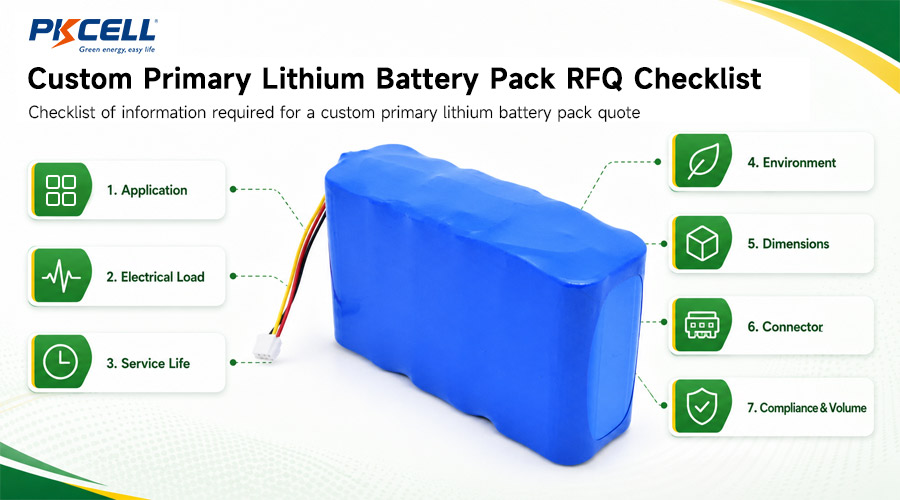
A useful custom battery pack quotation requires more than a voltage and capacity target. The manufacturer also needs to understand how the device draws current, where it will operate, how the pack must fit and connect, and what documentation the project requires.
Providing these details at the beginning helps an engineering team evaluate battery chemistry, cell configuration, pulse capability, mechanical construction, and production requirements together. It can reduce clarification rounds and help you receive a more relevant custom primary lithium battery pack quote.
Already have a device specification or battery drawing? You can send your requirements to PKCELL for a quotation.
Why Detailed RFQ Information Matters
Two devices may both require a 3.6 V battery, yet need very different solutions. A low-current meter that transmits once per day is not the same design problem as a tracker that sends frequent cellular or GPS data bursts. Their average consumption, pulse load, voltage behavior, temperature exposure, and expected service life may differ substantially.
Capacity alone therefore does not define the correct pack. A technically useful request for quotation, or RFQ, should describe the complete operating profile. PKCELL’s primary lithium battery solution hub provides an overview of Li-SOCl2, Li-MnO2, ER plus HPC, and custom pack options for different device types.
| Information category | What to provide | Why it affects the quote |
|---|---|---|
| Application | Device type, function, installation location, and use pattern | Provides the context needed to evaluate chemistry and construction |
| Electrical load | Voltage, average current, peak current, pulse duration, and pulse frequency | Influences cell type, configuration, pulse support, and usable capacity |
| Service-life target | Required operating years, duty cycle, storage period, and cutoff voltage | Supports realistic capacity and runtime evaluation |
| Environment | Minimum and maximum temperature, humidity, vibration, shock, and exposure | Affects cell performance, insulation, housing, and validation needs |
| Mechanical design | Maximum dimensions, shape, mounting method, and weight limit | Determines whether the proposed pack will fit the available space |
| Interface | Wire length, gauge, connector, pinout, polarity, tabs, or contacts | Affects assembly design, tooling, materials, and integration |
| Compliance | Target market, transport documents, certifications, and test requirements | Helps define the required documentation and project scope |
| Commercial plan | Prototype quantity, annual demand, schedule, and delivery country | Influences sampling, production planning, packaging, and pricing |
1. Describe the Device and Its Operating Scenario
Begin with a short explanation of what the product does and how the battery will be used. This context can reveal requirements that are not obvious from an electrical specification alone.
Include:
- The device name and its primary function
- Whether the battery is the main power source, backup source, or emergency supply
- Indoor, outdoor, underground, underwater, mobile, or fixed installation
- Whether replacement will be easy, expensive, or impractical
- Expected storage time before the device is activated
- Communication technology, such as NB-IoT, LoRa, LTE, GPS, Bluetooth, or another radio
If confidentiality allows, attach a device datasheet, block diagram, or brief description of the operating cycle. For example, PKCELL’s grain monitoring case involved a battery pack selected for unattended operation, stable long-term output, harsh conditions, and a customized device interface. You can review the custom Li-SOCl2 grain monitoring solution as a practical reference.
2. Provide the Complete Electrical Load Profile
Required voltage and cutoff voltage
State the device’s nominal input voltage, acceptable voltage range, and minimum operating or cutoff voltage. The minimum voltage matters because a battery may still contain energy when its voltage has already fallen below the level the device can use.
If you already know the desired arrangement, such as 1S2P or 2S1P, include it. Otherwise, provide the device requirements and allow the battery engineer to recommend an appropriate series and parallel configuration.
Average, standby, and peak current
Do not report only the average current. A complete profile should separate the different operating modes:
- Sleep or standby current
- Normal operating current
- Maximum continuous current
- Peak or pulse current
- Pulse duration
- Time between pulses or number of pulses per day
- Startup or inrush current
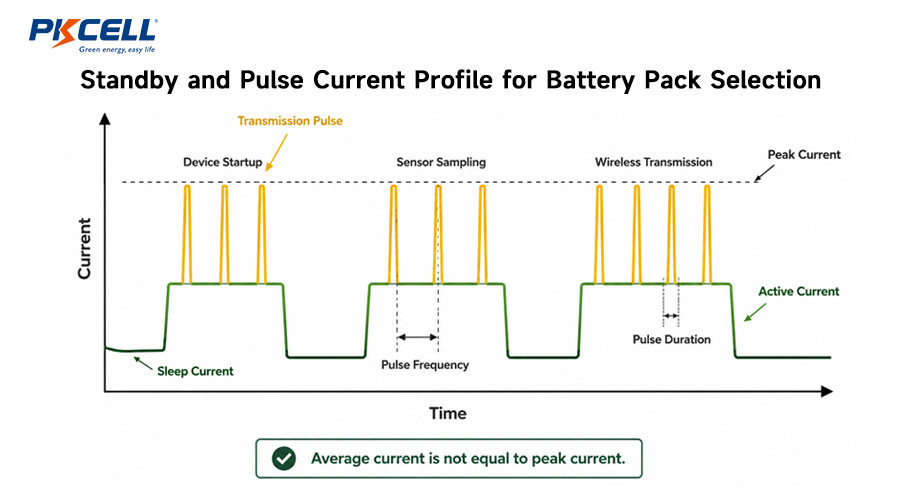
For connected devices that combine long standby periods with high-current transmissions, an ER cell alone may not always be the complete answer. PKCELL offers Li-SOCl2 plus hybrid pulse capacitor battery pack solutions intended for long-life applications with pulse-current requirements.
Share measured data when available
A current-versus-time graph from an oscilloscope, data logger, or power analyzer is especially useful. It shows the magnitude and duration of short events that may disappear in an average-current calculation.
The more accurately the RFQ describes the real load cycle, the more meaningful the proposed battery configuration and runtime discussion can be.
3. Define the Target Service Life
State the number of months or years the device should operate before battery replacement. Then provide the assumptions behind that target:
- Operating hours per day
- Number of measurements, alarms, or transmissions per day
- Seasonal or event-based usage changes
- Expected storage duration before installation
- Device cutoff voltage
- Allowed battery replacement interval
- Required design margin, if specified by your engineering standard
A simple “10-year battery” request can be misleading without these details. Actual service life depends on the load profile, temperature, pulse demand, cutoff voltage, self-discharge, and other application conditions.
For more background on long-life, non-rechargeable lithium technologies, see PKCELL’s guide to primary lithium batteries for IoT and industrial applications.
4. Specify the Operating and Storage Environment
Battery performance and pack construction are influenced by the environment. Provide both typical and worst-case conditions rather than only room-temperature values.
Temperature information
- Minimum and maximum operating temperature
- Typical operating temperature
- Storage and transportation temperature
- How long the device remains at temperature extremes
- Whether high-current pulses occur at the coldest temperature
Mechanical and environmental exposure
- Vibration and shock levels
- Humidity, condensation, or water exposure
- Dust, salt spray, chemicals, or corrosive gases
- Altitude or low-pressure conditions
- Outdoor UV exposure
- Required enclosure or ingress-protection expectations
Do not assume that a suitable cell automatically makes the complete assembly suitable for every environment. The pack’s wiring, insulation, connector, enclosure, strain relief, and mounting method must also match the application.
5. Give Exact Size, Shape, and Installation Constraints
Provide the maximum allowable length, width, and height, including tolerances where they matter. A CAD file, dimensioned drawing, or clear photo of the battery compartment is preferable to a verbal description.
Also specify:
- Maximum weight
- Preferred cell orientation
- Available clearance around the pack
- Mounting holes, clips, brackets, foam, or adhesive requirements
- Hard plastic housing or shrink-wrap preference
- Label position and required label content
- Whether the pack must be removable or permanently installed
6. Identify Wires, Connectors, Tabs, and Polarity
Interface details are a frequent source of delays because a connector family name may cover several housings, terminals, wire gauges, and pin arrangements. Whenever possible, provide the exact manufacturer and part number.
Your specification should include:
- Connector manufacturer and full part number
- Mating connector or device-side connector information
- Wire gauge, insulation type, color, and length
- Length measurement method and tolerance
- Pin assignment and polarity
- Tabs, pins, solder contacts, or flying leads
- Strain relief and routing requirements
- Reference photo or drawing of the existing assembly
PKCELL’s custom primary lithium battery pack service covers pack configurations, wires, connectors, tabs, housing, labeling, and application-specific structures.
7. State Protection and Special Circuit Requirements
Primary lithium batteries are non-rechargeable, so their circuit requirements should not be copied from a rechargeable battery specification. Tell the manufacturer which safety or functional components your design requires, or ask for an engineering recommendation based on the application.
Relevant items may include:
- Fuse or resettable protection device
- Diode for reverse-current or parallel-pack isolation
- Thermal protection
- Capacitor or hybrid pulse capacitor support
- Special PCB or monitoring function
- Separate sense or test leads
- Customer-approved component list
Also disclose whether the device contains another power source, can apply voltage back to the battery terminals, or connects multiple battery packs in parallel. These conditions can affect the proposed circuit.
8. List Compliance, Testing, and Documentation Needs
Certification and documentation requests should be discussed early because requirements vary by product, destination, transport method, and customer approval process.
Include:
- Countries or regions where the finished device will be sold
- Requested transport and product documentation
- Customer-specific qualification or supplier approval requirements
- Required test reports, declarations, datasheets, or material documents
- Environmental, reliability, or incoming-inspection tests
- Packaging, carton label, barcode, and traceability requirements
You can review PKCELL’s available battery certificates and compliance information. Confirm the exact documentation applicable to the proposed cell and completed pack during the quotation process.
9. Include Quantity, Project Stage, and Delivery Information
A quotation should match the stage and scale of the project. Tell the supplier whether you need concept support, engineering samples, a pilot run, or recurring production.
Provide:
- Number of samples required
- Estimated quantity for the first order
- Forecast monthly or annual demand
- Target sample date and mass-production date
- Delivery country and postal code
- Preferred Incoterm, if your purchasing team has one
- Expected product lifetime and supply period
- Whether tooling, special packaging, or private labeling is required
Forecasts can be identified as estimates. Even a reasonable range helps the manufacturer evaluate materials, assembly method, packaging, and production planning.
Ready to Discuss Your Battery Pack?
Send your electrical profile, drawing, connector details, quantity, and destination for engineering review and quotation.
Copy-and-Paste RFQ Template
Use the following template in your inquiry email or purchasing document. If a field is unknown, write “open to recommendation” rather than guessing.
Application or device:
Project stage: Concept / Prototype / Pilot / ProductionELECTRICAL REQUIREMENTS
Nominal device voltage:
Acceptable voltage range:
Device cutoff voltage:
Standby current:
Typical operating current:
Maximum continuous current:
Peak current:
Pulse duration:
Pulse frequency:
Startup/inrush current:
Daily operating cycle:
Target service life:ENVIRONMENT
Operating temperature:
Storage temperature:
Humidity or water exposure:
Vibration/shock:
Other environmental conditions:
MECHANICAL REQUIREMENTS
Maximum pack dimensions:
Maximum weight:
Preferred pack shape:
Housing or shrink wrap:
Mounting method:
Drawing/CAD file attached: Yes / No
CONNECTION AND CIRCUIT
Connector manufacturer and part number:
Wire gauge, color, and length:
Pinout and polarity:
Tabs or terminals:
Fuse/diode/capacitor/PCB requirements:
Reference sample available: Yes / No
COMPLIANCE AND DOCUMENTS
Destination market:
Required certifications/documents:
Required validation tests:
Label and traceability requirements:
COMMERCIAL INFORMATION
Sample quantity:
First-order quantity:
Estimated annual quantity:
Target sample date:
Target production date:
Delivery country and postal code:
Other requirements:
Common Mistakes That Slow Down a Battery Pack Quote
Providing only voltage and capacity
These values do not show pulse demand, usable voltage range, environmental exposure, or physical constraints.
Using average current to represent the entire load
A wireless device may have a low average current but a much higher transmission pulse. Report both the baseline and the peaks.
Requesting a service life without sharing the duty cycle
The target cannot be assessed meaningfully without knowing how often and how long the device operates.
Sending a connector photo without a part number or pinout
Similar-looking connectors may not be interchangeable. Include the exact connector specification and polarity drawing.
Leaving compliance requirements until after sampling
Identify destination markets and required documents at the RFQ stage so they can be considered in the proposed solution.
Confusing primary and rechargeable lithium packs
State clearly that the project requires a non-rechargeable primary lithium battery. Also disclose any possibility of charging or reverse current from the device.
What Happens After You Submit the RFQ?
A typical custom battery pack process includes application review, battery chemistry and cell selection, pack design, sample validation, and preparation for production. Questions from the engineering team are normal: they help confirm assumptions before a sample is built.
For a smoother review:
- Send the completed RFQ template and supporting drawings.
- Confirm open technical questions and any acceptable design tradeoffs.
- Review the proposed cell, configuration, dimensions, connector, and documentation.
- Test samples in the actual device across relevant operating conditions.
- Approve the final specification before production.
You may also review PKCELL’s range of primary lithium battery packs, 3.6 V Li-SOCl2 batteries, and 3 V Li-MnO2 batteries before submitting your project.
Frequently Asked Questions
Can I request a quote if I do not know the correct battery chemistry?
Yes. Describe the application, voltage range, current profile, service-life target, temperature, and size limits. Mark the chemistry as open to recommendation.
Is average current enough to calculate the battery pack?
Usually not. The manufacturer should also know standby current, peak current, pulse duration, pulse frequency, startup current, and the device cutoff voltage.
Do I need a finished drawing before requesting a quote?
No. An initial quotation can begin with maximum dimensions, photos, a compartment sketch, and electrical requirements. A controlled drawing should be approved before production.
Should I send my existing battery sample?
A sample can help verify size, connector, wire routing, mounting, and labeling. However, it should be accompanied by the device requirements because copying an existing pack may repeat an unsuitable design assumption.
What quantity information should be included?
Provide the sample quantity, expected first order, estimated annual volume, project schedule, and delivery destination. Estimates may be given as a range.
How can I get a faster custom battery pack quotation?
Submit one organized RFQ containing the electrical profile, environmental limits, dimensioned drawing, connector part number, polarity, compliance requirements, quantities, and delivery information.
Conclusion
A strong custom primary lithium battery pack quote starts with a clear description of the real application. Voltage and capacity are important, but the load profile, pulse current, cutoff voltage, temperature, service-life target, available space, connector, compliance requirements, and production plan are equally valuable.
When some parameters are still undecided, identify them openly and provide the information you do have. This gives the engineering team a better basis for recommending a suitable chemistry, configuration, and pack structure.
Get a Custom Primary Lithium Battery Pack Quote
Share your RFQ template, current profile, battery compartment drawing, and estimated quantity with PKCELL.
Post time: Aug-18-2026


