

Why Open-Circuit Voltage Is Not Enough for LiSoCl2 Battery Testing
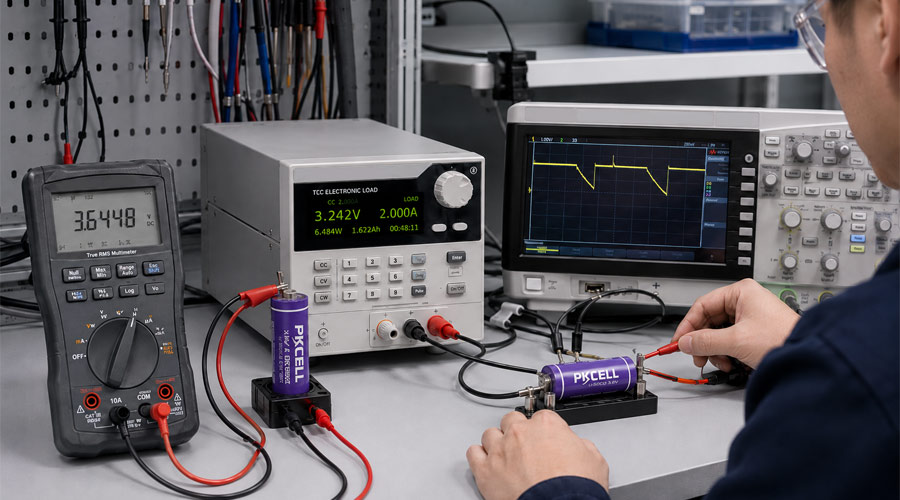
A lithium thionyl chloride battery can show a healthy open-circuit voltage and still fail when your device asks for current. For smart meters, GPS trackers, alarms, and remote sensors, that difference can decide whether the product wakes up reliably after months of sleep or resets during its first data transmission.
Open-circuit voltage, often shortened to OCV, is easy to measure. Touch the probes to the battery terminals, read the voltage, and the cell may appear fine. For LiSoCl2 battery testing, however, that reading only shows battery voltage when almost no current is flowing. It does not prove the battery can support pulse loads, recover from passivation, or keep voltage above your device cutoff during a cold start.
This matters because 3.6V Li-SOCl2 batteries are widely used in long-life industrial and IoT applications. Their strengths are real: high energy density, long shelf life, low self-discharge, and a wide operating temperature range. But the same chemistry also introduces passivation behavior that can mislead simple voltage checks.
What Open-Circuit Voltage Actually Tells You
OCV measures terminal voltage when there is no meaningful load attached. In many LiSoCl2 cells, a fresh or rested battery may read around the expected nominal range, making OCV useful as a quick screening step.
But OCV is only a static snapshot. It does not show the dynamic behavior that matters in real devices, such as:
- How far voltage drops when the device wakes up
- Whether the cell can support a radio transmission pulse
- How long voltage delay lasts after storage
- How the battery behaves at low temperature
- Whether internal resistance has increased enough to cause resets
The Hidden Problem: Passivation and Voltage Delay
LiSoCl2 batteries naturally form a passivation layer on the lithium anode. Technical materials from Tadiran and Saft explain that this layer helps limit unwanted chemical reactions and supports long storage life. That is one reason these cells work well in devices expected to sit in the field for years.
The tradeoff is voltage delay. When a passivated battery is suddenly placed under load, the passivation layer can temporarily increase internal resistance. The device may see a voltage dip before the layer begins to break down and the operating voltage recovers.
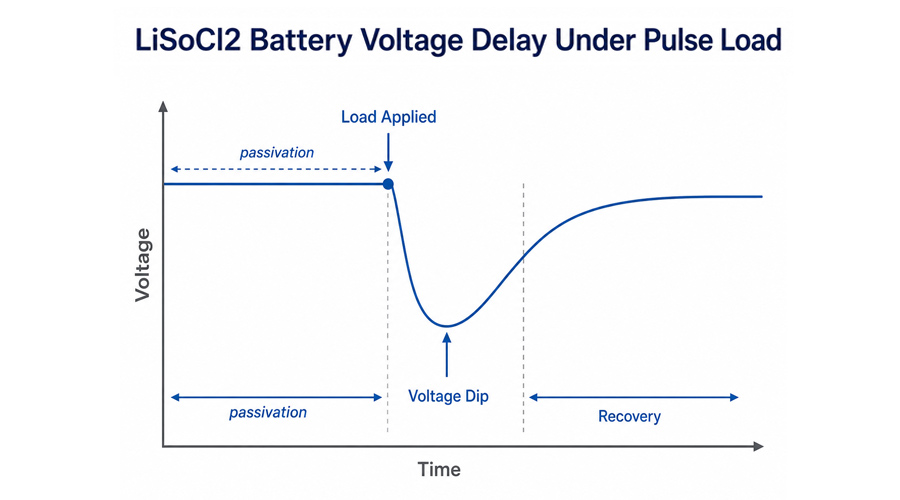
A battery may look normal at rest, then sag under load exactly when the device needs stable power most.
This is why OCV-only testing can be risky. The meter sees a battery at rest. Your product sees a battery under stress.
Why This Matters for IoT and Industrial Devices
Many LiSoCl2-powered products spend most of their life asleep. A smart water meter, gas meter, GPS tracker, LoRaWAN sensor, NB-IoT endpoint, or security device may draw very low current for long periods, then suddenly demand much higher current for a wireless burst, valve actuation, memory write, or startup sequence.
That use pattern is exactly where OCV can give false confidence. The battery may test well on a handheld voltmeter but fail during:
- First startup after long warehouse storage
- Cold-weather transmission events
- High-current wireless network attachment
- Firmware update or data upload bursts
- Motor, valve, relay, or alarm activation
For example, PKCELL’s application article explains why lithium thionyl chloride batteries are widely used in water and gas meters, where long life and stable operation are essential. In these applications, testing only open-circuit voltage is not enough because the real risk often appears during wake-up and communication pulses.
OCV vs. Load Testing: What Each Method Reveals
| Test Method | What It Shows | What It Can Miss |
|---|---|---|
| Open-circuit voltage test | Basic voltage at rest with almost no current draw | Passivation, voltage delay, internal resistance, pulse capability |
| Static load test | Voltage behavior under a defined steady load | Short high-current pulse behavior if the load is too mild |
| Pulse load test | Voltage drop, recovery, and readiness under realistic current bursts | Long-term field aging unless repeated across temperature and storage conditions |
| Temperature-based test | Performance under cold or hot operating conditions | Application-specific current peaks unless paired with pulse profiles |
Better LiSoCl2 Battery Testing: What to Measure Instead
1. Test Voltage Under the Real Application Load
Start by mapping your actual current profile. Do not test only at average current. A device with low average current may still have short peaks that determine whether the battery works.
Measure the minimum voltage during startup, communication, actuation, and any other high-demand event. Compare that minimum voltage with the brownout threshold of the MCU, modem, sensor, or power management circuit.
2. Use Pulse Load Testing
Pulse load testing is one of the most useful methods for LiSoCl2 battery testing because it reflects how many real devices operate. Apply a controlled pulse current that matches or exceeds the expected field demand, then record:
- Initial voltage drop
- Lowest voltage during the pulse
- Recovery behavior after the pulse
- Voltage response across repeated pulses
If voltage improves over repeated pulses, passivation may be part of the issue. If voltage continues to collapse, the cell may be depleted, undersized, too cold, or unsuitable for the current demand.
3. Test After Storage, Not Only on Fresh Cells
Freshly handled cells may not represent real deployment conditions. For long-life products, test batteries after storage periods that mimic production, shipping, warehouse, and field sleep intervals.
This is particularly important when products may sit unused for months before installation. A battery that passes immediately after assembly may behave differently after a long rest.
4. Include Low-Temperature Conditions
Temperature changes battery behavior. Tadiran’s technical brochure notes that severe voltage delay can occur after long storage at elevated temperature followed by discharge at low temperature or high current density. In practical terms, a battery can pass a room-temperature OCV check and still struggle during a cold morning transmission.
5. Consider Battery Packs or Pulse-Support Designs
Some applications need a single cell, while others need a complete battery pack with leads, connectors, capacitors, or a configuration designed around the load profile. For projects with higher pulse demand, engineers can review PKCELL’s custom primary lithium battery packs or compare high-capacity models such as the ER26500M Li-SoCl2 battery.
Need Help Choosing a LiSoCl2 Battery?
PKCELL supplies Li-SOCl2 cells and custom battery packs for smart meters, IoT devices, security systems, GPS trackers, and industrial equipment. Share your voltage, pulse current, temperature range, and expected service life to get model recommendations.
Common Mistakes in LiSoCl2 Battery Qualification
- Using OCV as a pass/fail test: OCV is useful, but it should not be the final proof of battery health.
- Testing only average current: Peak current often causes the real failure.
- Ignoring sleep time: Long rest periods can increase passivation effects.
- Skipping cold testing: Low temperature can magnify voltage drop and recovery issues.
- Testing the cell but not the system: Battery, capacitor, regulator, firmware timing, and cutoff voltage all interact.
A Practical Test Sequence for Engineers
- Measure OCV as an initial screen.
- Apply the expected steady load and record voltage.
- Apply realistic pulse loads for startup, communication, and actuation.
- Repeat the test after rest periods such as 1 hour, 24 hours, and longer storage intervals.
- Run the same profile at the lowest expected operating temperature.
- Compare minimum voltage against every critical device threshold.
- Document recovery time and behavior across repeated pulses.
This approach turns battery testing from a simple voltage check into an application-readiness test. That is the difference between knowing the battery has energy and knowing the product can actually use it.
FAQ: LiSoCl2 Open-Circuit Voltage and Battery Testing
Yes. A LiSoCl2 battery can show normal voltage at rest but drop below the required operating voltage when a load is applied, especially after long storage, low-temperature exposure, or high-current pulses.
Voltage delay is commonly linked to passivation. A protective layer forms on the lithium anode during rest or storage. When current starts flowing, this layer can temporarily increase resistance and cause voltage to dip before recovering.
No. Passivation helps LiSoCl2 batteries achieve long shelf life and low self-discharge. The problem appears when the application needs immediate current and the design has not accounted for voltage delay.
A realistic pulse load test is usually more informative than OCV alone. The test should match the device’s actual current peaks, sleep intervals, temperature range, and minimum operating voltage.
A custom battery pack may be useful when your device needs special connectors, wires, housing, higher capacity, pulse support, or a configuration designed for a specific installation space and current profile.
Conclusion: Test the Battery the Way Your Device Uses It
Open-circuit voltage is a useful first check, but it is not enough for reliable LiSoCl2 battery testing. It cannot reveal passivation, voltage delay, pulse-load weakness, or cold-start risk. For long-life IoT and industrial devices, the better question is not “What voltage does the battery show at rest?” but “Can it keep my system alive during the hardest moment of operation?”
If you are designing a long-life device and need help selecting a suitable cell or pack, explore PKCELL’s Li-SOCl2 battery range or contact PKCELL for a custom quote.
Post time: Jul-24-2026


