

Custom Primary Lithium Battery Solutions: From Customer Requirements to Mass Production
A custom primary lithium battery project succeeds when the finished pack works in the real device, survives its actual environment, and can be reproduced consistently at production volume. That requires more than choosing a cell with enough nominal capacity. Electrical behavior, mechanical fit, interfaces, documentation, validation, and manufacturing controls all have to converge on one approved specification.
This guide explains that journey for engineers, product teams, and procurement professionals sourcing a custom primary lithium battery solution. For a detailed list of information to send at the quotation stage, use PKCELL’s separate custom battery pack RFQ checklist. Here, the focus is what happens after those inputs arrive and how a concept becomes a repeatable production pack.
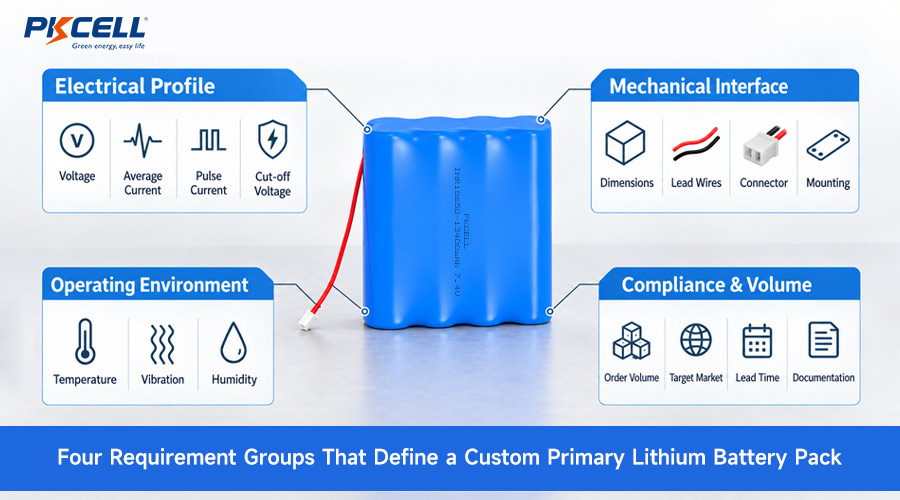
Why Custom Primary Battery Projects Need a Stage-Gate Process
Primary lithium packs are often designed into products expected to operate unattended for long periods: metering equipment, tracking units, alarms, industrial sensors, medical electronics, and remote monitoring systems. In these applications, the battery is not a drop-in commodity. It is part of the device’s electrical and mechanical system.
A requirement that looks small can change the design direction. A short radio transmission may create a peak load far above the average current. A connector housing may fit the compartment but leave insufficient bending radius for the cable. A capacity estimate may look comfortable at room temperature but fail to account for the device’s cutoff voltage under a cold pulse.
A reliable custom pack is defined by the complete use case, not by voltage and capacity alone.
Teams still evaluating the available chemistry families can begin with PKCELL’s primary lithium battery solution hub. It connects common industrial applications with Li-SOCl2, Li-MnO2, ER + HPC, and custom pack directions.
The Seven Stages from Requirements to Mass Production
| Stage | Main engineering question | Typical output | Release gate |
|---|---|---|---|
| 1. Requirements | What must the battery do in the real device? | Requirements baseline and open-issue list | Inputs complete enough for concept work |
| 2. Cell selection | Which chemistry and cell format fit the energy and power profile? | Recommended cell direction and assumptions | Electrical concept accepted |
| 3. Pack design | How will cells, interfaces, insulation, and housing integrate? | Pack architecture and preliminary drawing | Design ready for sample build |
| 4. Design freeze | Is every critical detail controlled? | Approved drawing, BOM, and test plan | Sample configuration released |
| 5. Samples | Does the physical pack match the approved design? | Engineering samples and inspection records | Samples accepted for device validation |
| 6. Pilot validation | Can the design and process meet requirements repeatedly? | Device test results and pilot findings | Production readiness approved |
| 7. Mass production | Can approved output be sustained and traced? | Released production lots and quality records | Shipment authorization |
1. Translate the Use Case into Measurable Requirements
The first stage converts a product description into design inputs. The engineering team needs the operating voltage window, average and peak current, pulse duration and frequency, cutoff voltage, duty cycle, target service life, storage period, temperature range, and available space. Mechanical inputs should include the mounting method, connector and pinout, wire specification, polarity, and dimensional limits.
Environmental and commercial inputs belong in the same baseline. Shock, vibration, moisture exposure, destination market, requested documentation, prototype quantity, forecast volume, and target schedule can all influence construction or project planning. Any possible charging or reverse current from the host device must be disclosed because primary cells are not rechargeable.
2. Select Chemistry and Cell by Load Profile, Not Capacity Alone
Cell selection balances energy, pulse performance, voltage behavior, temperature, physical volume, storage conditions, and expected field life. Li-SOCl2 cells are widely considered for long-life, low-current industrial devices, while Li-MnO2 can suit compact 3 V applications with different load needs. The correct choice still depends on the specific waveform and operating limits.
Wireless devices deserve special attention. If a low average load is interrupted by demanding transmission pulses, the team may evaluate a power-oriented cell or an ER + hybrid pulse capacitor solution. The largest-capacity cell is not automatically the best answer: loaded voltage at the worst operating condition matters more than a headline capacity number.
For a closer look at how size, energy, and pulse behavior interact within one common family, see the comparison of ER14505, ER26500, and ER34615 by device power profile.
3. Engineer the Complete Pack Architecture
Once the cell direction is established, the project becomes an integration exercise. Series or parallel configuration, tabs, welds, insulation, wire routing, connector orientation, strain relief, wrapping, housing, labels, and any required pulse-support or protection components must function as one assembly.
Mechanical decisions affect electrical performance and manufacturability. Longer or thinner wires add resistance. A tight enclosure can place stress on welds or insulation. An ambiguous connector drawing can create a polarity error. The controlled design should therefore specify part numbers, dimensions and tolerances, wire color and length, pinout, polarity, label content, and pack orientation.
PKCELL’s customized battery service outlines available options such as tabs, leads, cables, connectors, pack configurations, and CAD-supported design. Buyers who want to review representative formats can also browse primary lithium battery packs.
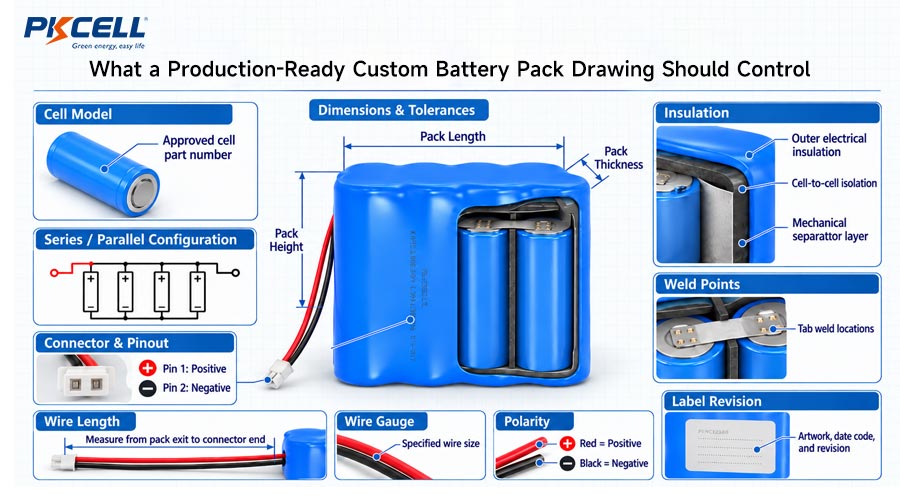
4. Freeze the Drawing, BOM, and Validation Plan
A sample request should not rely on email fragments. Before building, both sides should review one controlled drawing and specification. That document becomes the reference for the bill of materials, workmanship, inspection, testing, packaging, and later changes.
The validation plan should also be agreed before samples arrive. Define what the device team will measure, the conditions to reproduce, the number of units, pass/fail criteria, and how results will be reported. Include loaded voltage during the real pulse waveform, cold and hot operation where relevant, fit and cable routing, connector retention, polarity, device startup, sleep current, and communication events.
5. Build Engineering Samples and Verify the Interface
Engineering samples answer two questions: was the pack built as specified, and does that specification work in the device? Incoming sample checks should compare physical dimensions, wire length, connector, pinout, polarity, labeling, and visible workmanship against the approved drawing before electrical testing begins.
Device testing should use representative firmware and the real load waveform. Bench power calculations alone cannot reveal every interaction among battery impedance, wiring, contact resistance, power-management behavior, and the device’s minimum voltage. Record the test setup and sample identity so failures can be investigated rather than merely repeated.
6. Use Pilot Production to Validate Repeatability
A successful engineering sample proves the concept; it does not by itself prove a stable production process. A pilot build is the bridge. It allows the supplier and customer to check assembly instructions, fixtures, inspection points, workmanship standards, process yield, packaging, and lot traceability using the released design.
This is also the time to close documentation questions for the actual configuration and destination. Cell-level paperwork may not automatically cover every finished pack or shipment scenario. Confirm the relevant product identifiers, configuration, manufacturing location, dates, and destination-market scope. PKCELL publishes a certificates page, but project teams should request and review the model- and shipment-specific documents applicable to their order.
7. Control Mass Production, Traceability, and Change
Mass production is not simply a larger sample build. The released process should preserve the approved materials, assembly method, inspection plan, electrical tests, labeling, and packaging. Lot identification and retained quality records make it possible to connect a shipped pack with its production history.
Change control is equally important. A connector substitution, wire change, label revision, cell update, fixture modification, or process relocation may require customer review and renewed validation. Define notification expectations early, especially for products expected to remain in the field or in production for many years.
What Should Be Validated in the Actual Device?
The exact test matrix depends on risk and application, but a practical device-level plan commonly considers:
- Electrical margin: loaded voltage during startup and peak events, not only open-circuit voltage.
- Real duty cycle: standby, sensing, processing, communication, alarms, and abnormal modes.
- Temperature extremes: the load waveform at relevant hot and cold conditions.
- Storage effects: performance after the expected storage period and under the intended activation procedure.
- Mechanical integration: fit, mounting, wire routing, connector retention, strain relief, and insulation clearance.
- Firmware behavior: brownout handling, retries, current spikes, sleep current, and low-battery thresholds.
- Application stresses: vibration, shock, humidity, or other conditions identified in the requirements.
Accelerated tests can support comparisons, but they should not be presented as a guaranteed field-life shortcut without a justified model. Preserve the assumptions behind every runtime estimate, including duty cycle, temperature, cutoff voltage, self-discharge allowance, and usable-capacity margin.
Common Handover Mistakes That Delay Production
Treating the Sample as the Specification
A physical sample cannot communicate tolerances, approved materials, internal construction, test limits, or revision status. Approve a controlled drawing and written specification even when a reference sample is available.
Changing Firmware After Battery Validation
More frequent transmissions, longer radio-on time, repeated retries, or a higher sleep current can invalidate the original energy model. Recheck the load profile whenever firmware changes device behavior.
Approving Capacity Without Checking Loaded Voltage
A pack may contain sufficient theoretical energy yet fail if voltage falls below the device cutoff during a pulse. Evaluate the real waveform at the relevant temperature and state of life.
Leaving Documentation Until the Shipping Date
Transport and market requirements can affect configuration, schedule, labeling, and paperwork. Identify the destination and required documents during project definition, then confirm applicability again before production shipment.
Allowing Uncontrolled Substitutions
Seemingly equivalent wires, connectors, insulation materials, or cells can change resistance, fit, durability, or compliance status. Use a formal review and approval path for production changes.
How Procurement and Engineering Can Work as One Team
Engineering owns the device behavior and validation evidence. Procurement owns commercial alignment, forecast quality, delivery planning, and supplier communication. Quality teams help translate requirements into inspection, traceability, and change-control expectations. Projects move faster when these functions share the same revision-controlled inputs.
- Nominate one owner for the current technical specification.
- Keep commercial forecasts separate from guaranteed volume commitments, but update both clearly.
- Review technical and documentation risks before fixing a launch date.
- Record decisions, deviations, and approvals against the relevant drawing revision.
- Plan sample, pilot, and production quantities as distinct phases.
Start Your Custom Battery Project
Send PKCELL your device load profile, operating environment, dimensional limits, interface requirements, validation target, forecast, and project schedule. An engineering conversation can then focus on the right cell, pack architecture, sample plan, and path to production.
Request a Custom Battery Consultation
Download the Primary Battery Catalog
Frequently Asked Questions
How early should a battery supplier join the device development process?
As early as practical, ideally before the battery compartment, connector, cutoff voltage, and radio duty cycle are frozen. Early review gives both teams more room to balance runtime, pulse demand, size, assembly, and cost.
Do I need to know the battery chemistry before requesting a custom solution?
No. Provide the device voltage window, current waveform, temperature range, size limits, target life, storage conditions, and interface requirements. The chemistry can remain open to engineering recommendation.
When is an ER + HPC pack worth evaluating?
It may be useful when a device combines long standby periods with short, demanding communication or actuation pulses. The complete pack must still be tested with the real waveform, temperature range, wiring, and device cutoff voltage.
Is sample approval enough to start mass production?
Sample approval confirms the design in a limited build. A pilot phase is valuable for confirming repeatability, work instructions, inspection, packaging, traceability, and closure of production risks before volume release.
Can a custom primary lithium battery pack be recharged?
No. Primary lithium cells are not rechargeable. The device must not apply charging or reverse current unless the complete design has been specifically engineered to prevent it in accordance with the battery supplier’s instructions.
What should I send to get a useful project review?
Send the application, voltage range, average and peak current waveform, pulse timing, cutoff voltage, target life, operating and storage temperatures, maximum dimensions, connector and wire details, destination market, forecast, timeline, and any existing drawings or test data.
Conclusion
A custom primary lithium battery solution becomes production-ready through controlled decisions, not a single cell-selection exercise. Requirements must be measurable, assumptions visible, drawings approved, samples tested in the device, pilot output reviewed, and production changes controlled. That discipline protects runtime, fit, quality, documentation, and supply continuity at the same time.
Use the PKCELL RFQ checklist to organize your inputs, then contact a battery engineer to discuss the shortest credible route from concept to a validated production pack.
Post time: Sep-30-2026


