

Ordering CR2032 batteries for a production program is different from buying a replacement coin cell. An OEM team must qualify not only the cell model, but also the exact specification revision, electrical behavior in the device, terminal assembly, packaging, and consistency between samples and future lots.
This CR2032 OEM sourcing guide is designed for engineers, procurement managers, and contract manufacturers preparing sample evaluations or a bulk CR2032 battery RFQ. It concentrates on the supplier-approval decisions that a general CR2032 battery guide cannot answer.
1. Verify the Exact CR2032 Specification Before Comparing Suppliers
Every supplier may describe its product as a 3V CR2032 lithium coin cell, but a model name alone does not tell you what was tested, how capacity was measured, or whether the proposed terminal variant matches your drawing. Start with a current, model-specific datasheet and confirm its revision, product identification, and test conditions.
| Datasheet item | Question for the supplier | Evidence to request |
|---|---|---|
| Cell identity | Which manufacturer, model, chemistry, capacity version and revision will ship? | Approved datasheet and cell marking or label sample |
| Capacity test | Under what load, cutoff voltage and temperature was capacity measured? | Discharge method and characteristic curve for the quoted model |
| Loaded voltage | Will the cell remain above the device’s minimum voltage during its duty cycle? | Sample results under the project’s real load |
| Dimensions / fit | Do diameter, thickness, terminal tolerances and insulation fit the assembly? | Cell drawing and approved holder or terminal drawing |
| Environment | What are the quoted model’s operating and storage conditions? | Model-specific limits and test conditions |
| Revision control | How will future specification or production changes be managed? | Written revision and change-notification agreement if required |
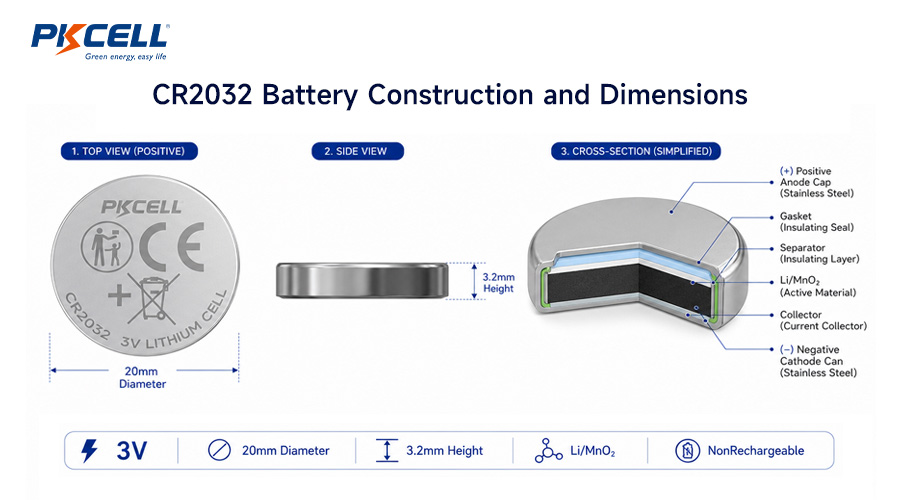
For the published PKCELL model, see the CR2032 210mAh product page. For broader model comparisons and CR2025/CR2016 compatibility, use the general CR2032 guide rather than repeating those topics in an OEM purchasing document.
2. CR2032 Supplier Qualification: Five Checks Before Sampling
A CR2032 battery supplier should be evaluated for its ability to deliver a consistent, documented production item—not simply for the lowest advertised unit price. The questions below help distinguish a sales quotation from a sourcing proposal that can be approved by a project team.
What to ask during supplier screening
- Production responsibility: who manufactures the cell, attaches terminals (if needed), inspects it, and supplies the final shipping paperwork?
- Sample-to-production match: will the eventual production units use the same approved cell model, assembly drawing and materials as the accepted samples?
- Quality evidence: which inspection records, batch identifiers, and test reports are available for the specific order?
- Change management: can specification, terminal, packaging, or production-process changes be governed by written buyer approval where appropriate?
- Commercial fit: can the supplier quote the requested annual volume, sample quantity, packaging, destination market, and repeat-order schedule?
For regulated or high-reliability devices, the buyer’s own quality, regulatory, and engineering teams should set the final supplier-approval criteria. A published company certificate alone does not approve a particular cell or assembly for use in the finished device.
3. CR2032 Sample Testing: Validate the Battery in the Finished Device
A successful datasheet review is only a first step. For OEM use, sample testing should show whether the proposed CR2032 meets the actual electrical load and mechanical constraints of the product. Agree on test conditions, sample count, and acceptance limits before interpreting the results.
| Validation area | Recommended test or review | What to record |
|---|---|---|
| Incoming identity | Compare received labels, model codes and datasheet revision with RFQ | Supplier, model, lot ID, sample quantity, revision |
| Initial electrical | Check open-circuit and specified loaded voltage using approved conditions | Voltage, load, temperature, measuring method |
| Real duty cycle | Run device standby, activation and transmission events | Minimum loaded voltage, event profile, device behavior |
| Temperature fit | Repeat relevant device tests at the project’s expected limits | Temperature, stabilization time, minimum voltage, failures |
| Mechanical assembly | Confirm holder retention or tabs/leads/connector against drawing | Dimensions, orientation, polarity, fit notes, drawing revision |
| Packaging / labeling | Check anti-short-circuit protection, package integrity and traceability labels | Package sample, label photo, quantity, lot reference |
| Decision | Compare all results with agreed project acceptance criteria | Pass/fail disposition, approver, corrective actions |
Example: why a passing voltage check may not mean production approval
Imagine that a CR2032 sample passes a room-temperature voltage check but an OEM sensor resets during a short radio transmission at the lowest operating temperature. The next step is not to assume the cell is defective. Record the loaded voltage and system cutoff during the event, verify contact resistance and sample conditions, and review the result with the supplier. The decision may involve a different approved cell or a redesign of the power system.
This is an illustrative validation scenario, not a reported PKCELL project outcome.
4. From Approved Samples to Repeatable CR2032 Bulk Production
Sample approval and production approval are not identical. An OEM purchasing team should maintain a simple controlled baseline so future shipments can be checked against the exact cell and assembly that the engineering team qualified.
Define the approved production baseline
- Exact CR2032 cell model, manufacturer and latest accepted datasheet revision
- Approved termination type, tab geometry or lead-wire / connector drawing, if relevant
- Target electrical checks, acceptable condition ranges and inspection records
- Label artwork, packing quantities and lot or date-code format
- Commercial terms for repeat orders, agreed documentation and escalation contacts
Establish an incoming inspection and lot-traceability process
At receipt, use a risk-based sample plan agreed with the supplier to verify marking, dimensions, package condition, and electrical checks where appropriate. Retain lot references so any future product issue can be linked to the delivered shipment, the incoming inspection record, and the installed device batch.
For welded tabs, leads and PCB mounting, refer to the existing CR2032 tabs vs holder engineering guide and the lithium coin cell leads/tabs product range. This article intentionally does not duplicate a full solder-tab design guide.
5. CR2032 OEM Packaging, Labeling and Shipping Documents
For volume purchasing, the specified battery and the shipment format must both be acceptable. Confirm how individual cells are separated, how packages are labeled, which batch identifiers will appear, and which shipping documents are relevant to the destination and transport method.
| Item | Specify in the purchase requirements | Reason |
|---|---|---|
| Cell protection | Non-conductive separation and prevention of unintended terminal contact | Reduce short-circuit and handling risks |
| Pack configuration | Inner pack quantity, tray or other agreed packing method, master carton count | Support repeatable receiving and line feeding |
| Label / traceability | Product model, quantity, lot/date reference and approved customer label where required | Enable receipt checks and post-shipment traceability |
| Shipping information | Destination, shipping mode, packaging configuration and responsible importer | Determine applicable transport paperwork |
| Supporting documents | Current datasheet, safety data and applicable transport-test information, including UN 38.3 documentation when required | Confirm shipment requirements for the exact model/packaging |
A supplier’s general certificate list should not be treated as proof that every CR2032 version or pack format has the same approvals. Review the applicable PKCELL certificate information and request model- and shipment-specific records as needed.
6. How to Compare CR2032 Bulk Quotes Without Missing Hidden Costs
Comparing two quotations by cell unit price alone can hide differences in delivered configuration and approval work. Request like-for-like quotations with the same specification, shipment quantity and acceptance criteria.
| Quote component | What should be comparable? | Common source of variation |
|---|---|---|
| Battery model | Cell identity, rated capacity and test conditions | Different models or nominal capacity methods |
| Termination | Loose cell vs factory-welded tabs, leads or connector | Assembly materials, drawings and operations |
| Qualification support | Sample quantity, documentation and agreed test evidence | Prototype quantities and approval activities |
| Packaging | Tray or inner pack, customer label, carton quantity | Custom artwork, packing labor and protection |
| Order structure | MOQ, annual forecast, shipment batches and lead time | One-time order vs scheduled releases |
| Delivery terms | Destination, incoterm and required documents | Freight, duties and compliance responsibilities |
Ask suppliers to separate any non-recurring assembly or tooling charge from cell-unit pricing, where applicable. The lowest initial quote is not necessarily the lowest total procurement cost if revisions, incoming defects, test delays or repacking are later required.
7. CR2032 Battery RFQ Checklist for OEM Buyers
Send enough details for the supplier to quote the correct item and propose a useful sample. Missing mechanical or electrical information often leads to an initial price that must be revised after engineering review.
| RFQ field | What to provide |
|---|---|
| Project and device | Device category, planned use and destination market |
| Target cell | CR2032, primary Li/MnO2, required specification or acceptable alternatives |
| Load profile | Typical and sleep current, peak current, duration/frequency of pulses, minimum operating voltage |
| Environment | Operating/storage temperature and expected storage period before installation |
| Mechanical format | Loose cell, approved holder, tabs, leads or connector with drawing/revision |
| Test and quality | Sample count, validation plan, required reports, lot ID and incoming checks |
| Packaging and documents | Inner pack, labels, delivery location, relevant transport/safety information |
| Commercial plan | Prototype quantity, forecast annual volume, initial order, reorder frequency and timeline |
Sample CR2032 OEM inquiry (copy and adapt)
Subject: CR2032 OEM Sample & Bulk RFQ – [Project Name]
We are evaluating a CR2032 primary lithium coin cell for [device/application]. Please quote [sample quantity] evaluation units and [initial/annual quantity] production units.
Our application requires [temperature range], [average/sleep current], [peak current and duration], [device cutoff voltage], and [target service life]. The requested termination is [loose cell / holder / welded tab / lead wire and connector]; a drawing is [attached/to follow].
Please provide the current model-specific datasheet and discharge test conditions, sample lead time, packaging options, available lot-traceability information, applicable shipment documents, and production quotation including MOQ and lead time.
CR2032 OEM Sourcing: Frequently Asked Questions
What documents should a CR2032 battery supplier provide?
Start with a current model-specific datasheet, the proposed termination drawing (if used), and relevant safety and transport information. Add inspection or traceability records according to the finished device and destination requirements. Confirm document applicability rather than assuming one certificate covers all variants.
What is the difference between a CR2032 datasheet check and sample qualification?
A datasheet describes the supplier’s specified test conditions and rated performance. Sample qualification checks the proposed battery and assembly under the buyer’s actual electrical, temperature, mechanical and production conditions.
How do I know that a mass-production CR2032 matches the approved sample?
Use an approved model/specification revision, terminal or holder drawing, agreed inspection criteria, shipment labeling, lot identification and written change-control terms. Compare incoming lots with that approved baseline.
Can CR2032 batteries with tabs be sourced for OEM assembly?
Tabbed and leaded configurations are available in PKCELL’s coin-cell product range. Confirm the exact cell model and factory-welded termination design with the supplier. Never solder directly onto an unmodified loose cell.
Does a nominal 210mAh rating guarantee device runtime?
No. The published 210mAh example is tied to a specific load, cutoff voltage and temperature. Actual runtime depends on the application duty cycle, minimum required voltage, temperature, aging and device implementation.
What information is needed for a CR2032 bulk quotation?
Provide the model, quantities, sample plan, voltage/current profile, temperature, mounting drawings, packaging, destination market and required documents. Include anticipated reorder schedules if continuity of supply matters.
Request CR2032 Samples or an OEM Bulk Quote
PKCELL lists standard CR2032 cells and lithium coin-cell termination options. Send your duty cycle, target service life, PCB/terminal drawing, sample requirements and expected order quantity so the team can review a suitable quoted configuration and the documents needed for your project.


