

CR2025 vs CR2032 vs CR2450: Coin Cell Selection Guide
CR2025, CR2032 and CR2450 batteries all provide a nominal 3V output and typically use lithium manganese dioxide chemistry. That does not make them interchangeable. Their different diameters, heights and capacities affect enclosure design, runtime, pulse performance, contact reliability and replacement cost.
For replacement users, the safest choice is normally the exact model specified by the device manufacturer. For OEM engineers, the decision should start with available space and the device’s real current profile rather than capacity alone.
Product developers can review the
PKCELL CR2025,
PKCELL CR2032
and PKCELL CR2450
before requesting samples for device testing.
CR2025 vs CR2032 vs CR2450 Specifications
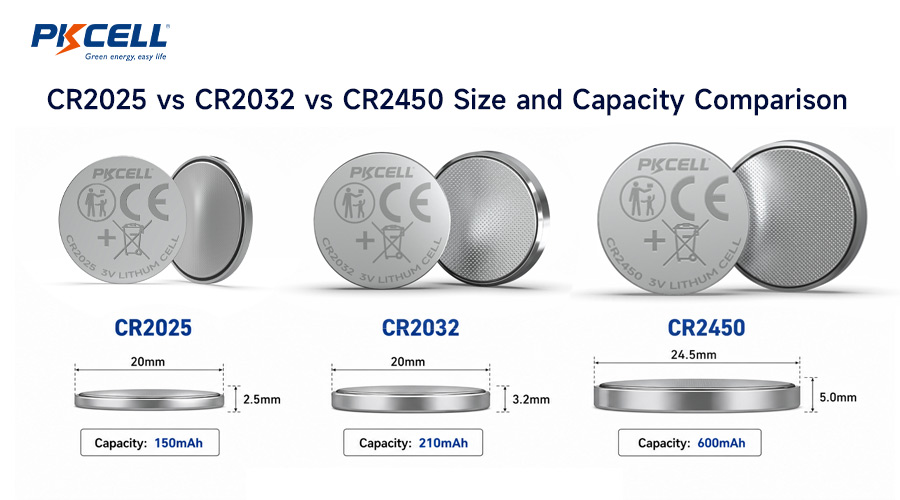
The model number describes the nominal physical size. CR2025 is approximately 20mm in diameter and 2.5mm high. CR2032 is 20mm in diameter and 3.2mm high. CR2450 increases both dimensions to approximately 24.5mm by 5.0mm.
| Specification | CR2025 | CR2032 | CR2450 |
|---|---|---|---|
| Battery type | Primary lithium coin cell | Primary lithium coin cell | Primary lithium coin cell |
| Typical chemistry | Li/MnO2 | Li/MnO2 | Li/MnO2 |
| Nominal voltage | 3V | 3V | 3V |
| Nominal diameter | 20.0mm | 20.0mm | 24.5mm |
| Nominal height | 2.5mm | 3.2mm | 5.0mm |
| PKCELL listed capacity | 150mAh | 210mAh | 600mAh |
| Panasonic reference capacity | 165mAh | 225mAh | 620mAh |
| Relative enclosure demand | Lowest | Moderate | Highest |
| Typical positioning | Thin, low-power devices | General-purpose compact electronics | Longer-life sensors and higher-energy devices |
Capacity values vary by manufacturer and test method. A valid comparison must use the same load, cutoff voltage and temperature. The reference capacities above illustrate the relative energy difference rather than guaranteeing a specific device runtime.
What Is Each Lithium Coin Cell Best For?
CR2025: Best for Thin Designs
Size: 20.0mm x 2.5mm
PKCELL capacity: 150mAh
Best fit: slim remotes, calculators, watches, compact keys and products where enclosure height is tightly limited.
CR2032: Best Overall Balance
Size: 20.0mm x 3.2mm
PKCELL capacity: 210mAh
Best fit: key fobs, CMOS backup, medical electronics, security sensors and general compact devices.
CR2450: Best for Higher Capacity
Size: 24.5mm x 5.0mm
PKCELL capacity: 600mAh
Best fit: IoT sensors, beacons, access-control products and devices designed for longer replacement intervals.
When to Choose CR2025
CR2025 makes sense when the product must remain thin and the expected load is modest. Reducing battery height by 0.7mm compared with CR2032 can be valuable in slim consumer electronics, but the reduced active-material volume usually means shorter runtime.
When to Choose CR2032
CR2032 is often the starting point for new 20mm coin-cell designs because it offers more capacity than CR2025 without requiring a larger diameter. It is widely used in replaceable holders and can support standby circuits with intermittent activity.
For a more detailed explanation of its specifications and formats, read the
CR2032 battery guide.
When to Choose CR2450
CR2450 provides significantly more capacity because it is both wider and thicker. It is a suitable candidate when service access is difficult, maintenance costs are high or the device needs more energy between replacements.
The tradeoff is mechanical. CR2450 requires a larger PCB footprint, a deeper enclosure and a holder specifically designed for a 24.5mm cell. It is not an upgraded drop-in replacement for CR2025 or CR2032.
How Capacity and Size Affect Battery Life
A simple first-pass runtime estimate divides usable capacity by average current:
Estimated runtime in hours = usable capacity in mAh / average current in mA
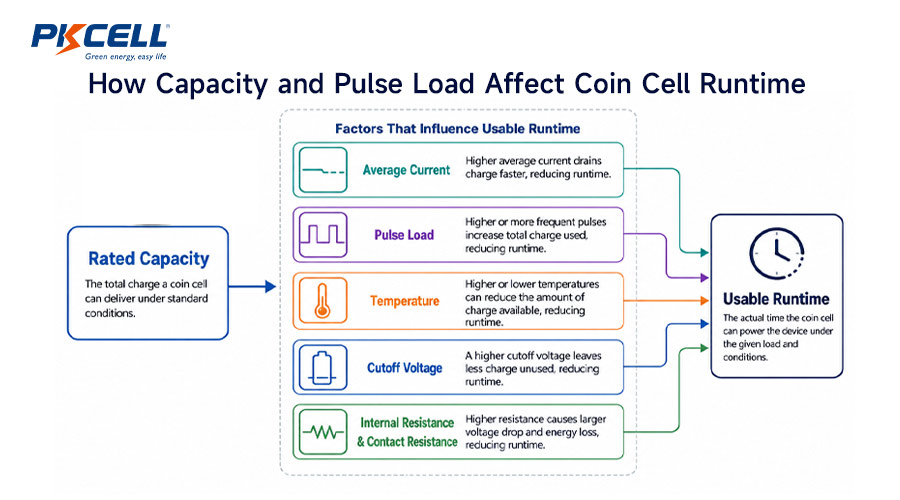
This equation is useful for comparing options, but rated capacity is not the same as usable capacity in a finished product. Engineers should apply allowances for:
- Self-discharge during storage and service
- Temperature-related capacity reduction
- Voltage drop during current pulses
- The device’s minimum operating voltage
- Battery aging and internal resistance growth
- Holder and terminal contact resistance
- Variation between production lots
Choose the smallest battery that meets the validated service-life requirement with enough electrical and mechanical margin. Additional capacity has little value if the cell does not fit reliably or the circuit resets during pulses.
Pulse Loads Need More Than a Capacity Check
Wireless transmission, indicator LEDs and display activation create short periods of higher current. A larger coin cell often provides more pulse headroom, but the maximum supported pulse depends on the exact cell design, state of charge, temperature and pulse duration.
For an RF sensor, record sleep current, transmit current, pulse length and transmission frequency. Test loaded voltage at the coldest expected operating temperature and near the projected end of battery life.
Application-Based Coin Cell Selection
| Application | Likely Starting Point | Why | What to Confirm |
|---|---|---|---|
| Slim remote control | CR2025 | Low profile and modest current demand | Original battery model, pulse current and contact pressure |
| Automotive key fob | CR2025 or CR2032 | Depends on key housing and transmitter design | Vehicle manual and original battery designation |
| Motherboard RTC or CMOS backup | CR2032 | Common holder size and long low-drain operation | Standby current, holder type and replacement access |
| Portable medical electronics | Usually CR2032 | Balance of size, capacity and availability | Approved model, load profile and regulatory requirements |
| Compact security sensor | CR2032 or CR2450 | Depends on alarm pulses and maintenance target | Transmit current, temperature and service interval |
| BLE beacon or IoT sensor | CR2450 | Higher capacity can extend the maintenance interval | Radio pulse profile, enclosure volume and cold performance |
| Electronic shelf label | CR2450 or another validated coin cell | Long standby with periodic display or radio activity | Update frequency, pulse voltage and target calendar life |
Connected products should be evaluated as a complete power system. PKCELL’s
IoT battery solutions
provide additional context for devices combining low standby current with periodic communication.
For safety-sensitive healthcare products, use an approved battery model and complete device validation. See PKCELL’s
medical equipment battery solutions
for related application considerations.
Are CR2025, CR2032 and CR2450 Interchangeable?
They are not direct replacements for one another, even though all three have a nominal voltage of 3V.
CR2025 and CR2032
These two cells have the same 20mm diameter but different heights. CR2032 is 0.7mm thicker. It can fit a CR2025 device only when the holder and enclosure have sufficient space. Forcing it into a tight compartment can damage the cover, holder or contacts.
A CR2025 placed in a CR2032 holder may be loose, resulting in intermittent contact and shorter runtime. Read the detailed
CR2025 vs CR2032 replacement guide
before considering a substitution.
CR2450 Compared With CR2025 and CR2032
CR2450 has a 24.5mm diameter and 5.0mm height, so it cannot fit a holder designed for a 20mm cell. Moving to CR2450 normally requires a new holder, PCB layout and enclosure design.
How to Select a Coin Cell for an OEM Device
- Set the mechanical limits.
Define maximum battery diameter, height, holder footprint and enclosure clearance. - Measure the complete load profile.
Record sleep current, active current, maximum pulse, pulse duration and event frequency. - Define the required service life.
Include storage, assembly, distribution and field-operation time. - Confirm the circuit cutoff voltage.
Evaluate loaded voltage rather than open-circuit voltage alone. - Map the temperature profile.
Include shipping, storage, seasonal extremes and time near the upper limit. - Select the mounting method.
Choose a replaceable holder or factory-welded tabs, leads or connectors. - Test representative samples.
Run the actual duty cycle at room, low and high temperatures. - Approve supply documentation.
Confirm the datasheet revision, traceability, packaging, certification and change-control requirements.
PKCELL supplies standard cells and
lithium coin cells with tabs or leads
for selected PCB and OEM configurations. Factory-welded terminals should be used instead of soldering directly onto a loose cell.
Bulk Purchasing Checklist
Before approving CR2025, CR2032 or CR2450 for volume production, confirm:
- Exact model, capacity and applicable test conditions
- Operating and storage temperature requirements
- Continuous and pulse-current performance
- Battery-holder or terminal drawing
- Production date and remaining shelf life
- Sample and pilot-order availability
- Packaging, labeling and lot traceability
- Required safety and transport documentation
- MOQ, production lead time and long-term availability
Company documentation can be reviewed on the
PKCELL certificates page.
Confirm certification and transport-document availability for the exact model and destination market.
Safety and Storage
- Do not recharge CR2025, CR2032 or CR2450 batteries.
- Do not short-circuit, crush, puncture, open or burn the cells.
- Do not solder directly onto a loose coin cell.
- Install the battery with the correct polarity.
- Do not mix models, brands, production lots, or new and used cells.
- Store batteries in a dry, controlled environment away from conductive objects.
- Dispose of depleted cells according to applicable local regulations.
Frequently Asked Questions
Which is better: CR2025, CR2032 or CR2450?
CR2025 is best when product thickness is limited, CR2032 offers a practical balance of size and runtime, and CR2450 provides much higher capacity when a larger enclosure is available.
Can CR2032 replace CR2025?
Only if the device can safely accept the additional 0.7mm thickness. Do not force CR2032 into a tight CR2025 compartment.
Can CR2450 replace CR2032?
No. CR2450 has a larger diameter and greater height, so it requires a different holder and enclosure design.
Which battery lasts the longest?
CR2450 normally has the highest capacity and may provide the longest runtime under comparable conditions. Actual life depends on current, pulses, temperature, cutoff voltage and storage history.
Which coin cell is best for an IoT sensor?
CR2450 is often a useful starting point for sensors requiring longer service intervals, while CR2032 may suit smaller designs. The radio pulse profile and enclosure size must be tested.
Are these coin cells rechargeable?
No. Standard CR2025, CR2032 and CR2450 batteries are primary, non-rechargeable lithium manganese dioxide cells.
Conclusion
The choice among CR2025, CR2032 and CR2450 is mainly a balance between physical size, capacity and the device’s duty cycle. CR2025 supports thin products, CR2032 offers a versatile middle ground, and CR2450 provides considerably more energy for designs that can accept its larger size.
Replacement users should follow the device manufacturer’s specified model. OEM engineers should compare loaded-voltage performance, temperature behavior, mounting structure and total calendar life before approving a battery for production.
Post time: Aug-28-2026


