

Quiescent Current Budget for 10-Year IoT Devices: Why Every Microamp Matters
A ten-year IoT battery target is often lost while the device appears to be doing nothing. The radio pulse may dominate oscilloscope screenshots, but quiescent current flows through every hour between transmissions. Over 87,600 hours, a few unnoticed microamps can consume a substantial share of the battery.
This is why a quiescent current budget should be treated as a controlled engineering requirement, not a late-stage measurement. The microcontroller, modem, regulator, sensors, pull-up resistors, voltage dividers, protection circuit, capacitors, PCB contamination, and unpowered signal paths can all add current during sleep.
Building a 10-Year IoT Device?
Send PKCELL your measured sleep current, operating-state waveform, reporting interval, radio protocol, pulse profile, minimum voltage, temperature range, target life, and enclosure limits for a cell or battery-pack recommendation.
Request an IoT Battery Recommendation
Explore Primary Lithium Solutions
Quiescent Current Is a System Number
Quiescent current is the current consumed when a circuit is powered but not performing its main active function. Component datasheets may call it standby current, shutdown current, supply current, ground current, leakage current, or retention current. These terms are related, but they are not always measured under the same conditions.
For an IoT product, the number that matters is the current measured at the battery terminals during the real lowest-power state. That system current can be much higher than the microcontroller’s deep-sleep specification because the battery also feeds every component and leakage path around it.
The MCU sleep-current line is not the device sleep current. A credible ten-year budget begins at the battery connector and is then explained subsystem by subsystem.
The Math: Converting Microamps Into Ten-Year Capacity
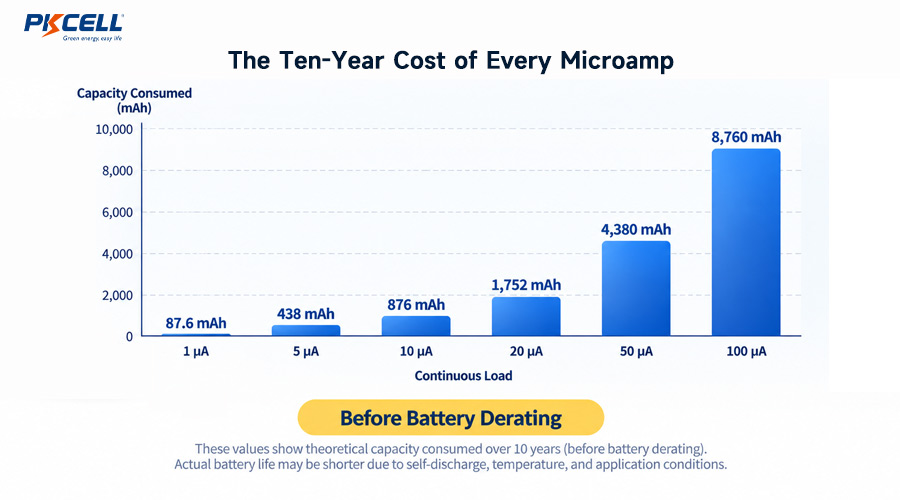
The second equation uses 365 days per year and is a convenient design shortcut. It shows why microamp-level errors become visible at long duration.
| Continuous Baseline | One-Year Consumption | Ten-Year Consumption | Design Interpretation |
|---|---|---|---|
| 1µA | 8.76mAh | 87.6mAh | Small individually, but no longer negligible across many rails. |
| 2µA | 17.52mAh | 175.2mAh | A regulator or sensor bias can consume this continuously. |
| 5µA | 43.8mAh | 438mAh | A meaningful allocation in a compact primary-cell design. |
| 10µA | 87.6mAh | 876mAh | A large fraction of the nominal capacity of some AA-size ER cells. |
| 20µA | 175.2mAh | 1,752mAh | Can dominate a low-duty-cycle node even before radio energy is added. |
| 50µA | 438mAh | 4,380mAh | Exceeds the nominal capacity of many compact industrial cells. |
| 100µA | 876mAh | 8,760mAh | Requires a much larger energy reserve before active states are counted. |
These values are arithmetic charge totals, not promised field life. Practical battery selection must also account for usable capacity above the device cut-off, self-discharge, temperature, storage, pulse response, passivation, aging, and design margin.
Build the Sleep Budget One Rail at a Time
A useful quiescent current budget names an owner, operating condition, target, measured result, and margin for every contributor. Avoid a single line called “electronics sleep current.” That line is difficult to debug and easy to underestimate.
| Subsystem | What to Include | Common Hidden Load | Verification Method |
|---|---|---|---|
| MCU and RTC | Deep sleep, retention RAM, RTC, wake sources | Debug interface, floating GPIO, enabled clocks | Measure each firmware sleep state on production-intent hardware |
| Radio / modem | PSM, shutdown, retention, SIM/eSIM path | Incorrect network mode, UART activity, status pins | Measure after registration and over a complete network cycle |
| Sensors | Standby, heater, bridge bias, analog front end | Sensor never fully powers down or back-power through I/O | Switch sensor rails and compare battery-terminal current |
| Regulators | Input quiescent current, shutdown current, feedback network | Poor light-load mode or always-on enable divider | Measure across input voltage and temperature |
| Supervisors and protection | Reset IC, fuel gauge, load switch, protection circuit | Several “small” always-on parts accumulating | Review maximum values, then isolate and measure each rail |
| Passive networks | Voltage dividers, pull-ups, pull-downs, indicator paths | Permanent battery monitor divider or strong pull resistor | Calculate DC path and confirm with board measurement |
| PCB and interfaces | Connector leakage, contamination, moisture, ESD parts | Flux residue, humidity leakage, unpowered peripheral pins | Environmental test and powered/unpowered interface audit |
| Pulse support | Capacitor or HPC leakage and recharge path | Ignoring the buffer’s continuous leakage | Measure the complete assembled battery architecture |
An Illustrative 10µA IoT Sleep Budget
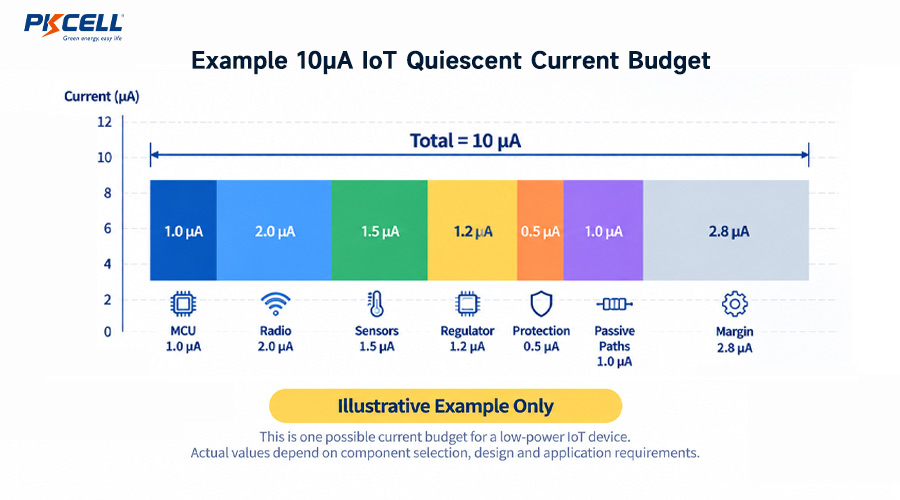
The following example is a design exercise, not a universal target. It shows how a 10µA system limit can be allocated before schematic selection and then verified during bring-up.
| Budget Owner | Allocated Current | Ten-Year Charge | Design Question |
|---|---|---|---|
| MCU + RTC + retention | 1.0µA | 87.6mAh | Which wake sources and memory banks must remain active? |
| Radio retention / PSM | 2.0µA | 175.2mAh | Is the modem truly in the intended network sleep state? |
| Sensor and analog bias | 1.5µA | 131.4mAh | Can the sensor rail be disconnected without back-powering? |
| Regulator quiescent current | 1.2µA | 105.1mAh | Does the regulator stay efficient at the actual sleep load? |
| Supervisor, protection, and switches | 0.5µA | 43.8mAh | Are typical or maximum datasheet values being used? |
| Dividers, pull resistors, and interfaces | 1.0µA | 87.6mAh | Which DC paths can be duty-cycled? |
| Leakage and production margin | 2.8µA | 245.3mAh | Does the allowance cover temperature and unit variation? |
| Total | 10.0µA | 876.0mAh | Baseline only; active events and battery losses remain. |
Why Typical Datasheet Current Is Not Enough
Component selection often begins with typical quiescent current at room temperature. A ten-year design needs a more conservative view. Review maximum current, input-voltage dependence, temperature behavior, lot variation, startup state, and the conditions required to reach the advertised sleep mode.
A regulator specified at low quiescent current may consume more in dropout, during light-load switching, or through its feedback network. A sensor shutdown value may exclude external bias components. A modem power-saving number may require network registration, specific timers, disabled interfaces, and stable coverage.
Budget with at least three columns
- Datasheet target: the value used during component selection.
- Measured result: the current on representative assembled hardware.
- Qualified limit: the maximum allowed across voltage, temperature, firmware, and production variation.
NB-IoT: PSM Does Not End the Energy Discussion
NB-IoT devices may spend long periods in power-saving mode, but the modem, MCU, SIM path, regulators, sensors, and board leakage still determine the battery-terminal baseline. The active cycle can also include network attach, transmit, receive, paging, eDRX behavior, and retries under weak coverage.
NB-IoT budget risks
- Measuring the modem alone instead of the complete device.
- Testing before the network has accepted the intended power-saving configuration.
- Leaving UART, USB, status LEDs, level shifters, or debug circuits active.
- Ignoring failed attach attempts and weak-signal retransmissions.
- Adding pulse support without including its leakage and recharge energy.
PKCELL’s ER14505 + HPC1520 NB-IoT gateway case demonstrates a battery architecture that separates long-term energy storage from cellular pulse support. For projects that need to size the buffer from an actual waveform, see the guide to HPC sizing for NB-IoT.
LoRaWAN: Sleep Current Competes With Join, TX, and RX Energy
A LoRaWAN node can achieve a very low duty cycle, but its lifetime still depends on more than the transmit pulse. Join behavior, spreading factor, payload, confirmed messages, receive windows, retransmissions, sensor warm-up, and gateway coverage all influence the active portion of the budget.
For a node that wakes only a few times per day, the continuous sleep load can rival or exceed scheduled radio energy. For a frequently reporting node, radio activity may dominate. The engineering task is to calculate both rather than assume one category always wins.
The LoRaWAN tracker battery guide breaks the device into deep sleep, GNSS acquisition, and LoRa transmission states, while this quiescent-current method provides a deeper audit of the baseline between those events.
Smart Meters: Always-On Functions Can Be Easy to Miss
Electricity, gas, heat, and water meters may retain clocks, metrology circuits, tamper detection, reed or Hall sensors, displays, memory, valve monitoring, and communication subsystems. Some functions cannot be fully disconnected because they must detect an event at any time.
For each always-on function, ask whether continuous bias is necessary or whether an interrupt, latching circuit, sampling window, or switched divider can provide the same behavior. The goal is not merely to place the MCU in deep sleep; it is to eliminate unnecessary DC paths throughout the meter.
PKCELL’s utility smart meter solutions cover electric, gas, and ultrasonic water metering, while the smart water meter selection guide compares cell size, energy reserve, wireless communication, and valve requirements.
Measure Current Across Six Time Scales
A conventional multimeter may show a stable sleep value but miss short wakeups. A current probe or power analyzer may capture pulses but lack the resolution needed for microamp sleep. Long-life IoT validation often requires more than one instrument or measurement range.
| Time Scale | What It Reveals | Example Failure |
|---|---|---|
| Microseconds to milliseconds | Startup edges, regulator behavior, short radio peaks | Brownout hidden by slow sampling |
| Milliseconds to seconds | Sensor conversion, memory writes, TX/RX, valve pulses | Active duration longer than firmware estimate |
| Minutes | Complete reporting cycle and recovery | Second receive window or retry omitted |
| Hours | Periodic housekeeping, network checks, calibration | Background task wakes the MCU unexpectedly |
| Days | Network variation and scheduled maintenance behavior | Daily rejoin or synchronization cost |
| Weeks / environmental soak | Leakage drift, rare faults, temperature influence | Humidity or cold changes the baseline |
How to Reduce Quiescent Current Without Breaking the Product
Use power domains deliberately
Disconnect sensors, displays, analog front ends, and interface circuits that do not need continuous power. Verify that signal pins do not back-power an unpowered rail.
Audit every resistive path
Increase pull-resistor values where noise and timing allow. Switch battery-monitor dividers rather than leaving them permanently across the cell. Check indicator LEDs, level shifters, and connector detection circuits.
Choose the regulator for the real load profile
Compare input quiescent current, shutdown current, light-load efficiency, output discharge, feedback current, cold behavior, dropout, and transient response. The lowest headline quiescent current is not automatically the most efficient system choice.
Make low power a firmware state with entry criteria
Disable unused clocks and interfaces, configure GPIO states, confirm peripheral shutdown, and log the reason for every wake. Test production firmware, not only a dedicated low-power demo.
Optimize network behavior
Reduce unnecessary joins, confirmed messages, paging, and retries while maintaining application reliability. Measure in representative coverage, including weak-signal locations.
Keep margin for variation
Do not allocate 100% of the sleep budget to nominal component values. Temperature, supplier tolerance, contamination, aging, and firmware changes can all move the final result.
Battery Selection Still Requires Energy and Pulse Analysis
A low quiescent current is essential, but it does not prove that the selected battery can support radio or valve pulses. Conversely, a strong pulse solution does not compensate for an excessive always-on load. The energy and power problems must be solved together.
- ER Energy Type: a starting point for high energy and low long-term current.
- ER Power Type: worth evaluating when stronger current delivery is required.
- ER + HPC: separates long-life energy storage from high-current pulse delivery in wireless IoT devices.
Browse the PKCELL Li-SOCl2 battery range or review ER + HPC IoT battery packs. Projects requiring leads, connectors, fusing, insulation, unusual packaging, or multi-cell structures can also use a custom primary lithium battery pack.
Ten-Year IoT Power Budget Review Checklist
- Define the battery-terminal sleep-current limit. Allocate it across every powered subsystem.
- Use maximum and temperature-aware values. Do not rely only on room-temperature typical specifications.
- Calculate the ten-year charge cost. Multiply every continuous microamp by 87.6mAh.
- Measure production-intent hardware. Include connector, protection, pulse support, and final firmware.
- Capture every operating state. Sleep, sensing, processing, memory, TX, RX, join, retry, and fault behavior all belong in the model.
- Validate weak coverage and cold temperature. These can extend active time and increase voltage drop.
- Apply battery derating separately. Account for self-discharge, cut-off voltage, storage, temperature, aging, and unavailable capacity.
- Retest after every hardware or firmware release. A new sensor driver or network setting can silently consume the lifetime margin.
Frequently Asked Questions
How much battery capacity does 1µA consume over ten years?
A continuous 1µA load consumes 87.6mAh over ten years using 365 days per year. This is an ideal arithmetic total before battery losses and derating.
Is MCU deep-sleep current the same as IoT device quiescent current?
No. Device quiescent current includes the MCU plus the modem, sensors, regulators, supervisors, pull resistors, protection, capacitor leakage, PCB leakage, and any back-powered circuits.
What is a good sleep-current target for a ten-year IoT device?
There is no universal value. Derive the limit from usable battery capacity after reserving energy for active events, self-discharge, storage, temperature, aging, cut-off voltage, and design margin.
Why can an NB-IoT device use more energy than expected in the field?
Coverage, network attach, operator configuration, PSM and eDRX settings, receive activity, retransmissions, and failed connections can increase active time. The complete device should be measured on a representative network.
Does an HPC solve excessive quiescent current?
No. An HPC supports pulse power but also has leakage that belongs in the budget. It cannot correct a high continuous electronics load; sleep-current optimization and pulse-power design solve different problems.
Which battery chemistry is commonly used for long-life industrial IoT devices?
Li-SOCl2 primary batteries are commonly considered for long-standby industrial IoT, smart-meter, and remote-monitoring applications. Final selection must match usable energy, pulse current, temperature, cut-off voltage, enclosure, and safety requirements.
Conclusion: Treat Every Microamp as a Ten-Year Commitment
A ten-year device spends most of its life accumulating small losses. One microamp looks insignificant on a bench, but it costs 87.6mAh across the deployment. Ten microamps cost 876mAh before the first sensor reading, transmission, retry, or battery loss is counted.
Set a battery-terminal quiescent-current limit early, allocate it across the architecture, measure it over multiple time scales, and protect it through hardware and firmware changes. Then combine that verified baseline with active-state energy, pulse-current validation, and realistic battery derating.
Turn Your Current Waveform Into a Battery Shortlist
PKCELL can support Li-SOCl2 cell selection, ER + HPC evaluation, custom pack design, samples, datasheets, leads, connectors, and OEM quotations for NB-IoT, LoRaWAN, and smart-meter projects.
Post time: Sep-20-2026


