

How to Size a Hybrid Pulse Capacitor for NB-IoT Battery Applications
NB-IoT devices are low-power most of the time, but they can demand sharp current pulses during network attach, data transmission, receive windows, and weak-signal retries. A hybrid pulse capacitor helps the battery support those bursts without voltage collapse.
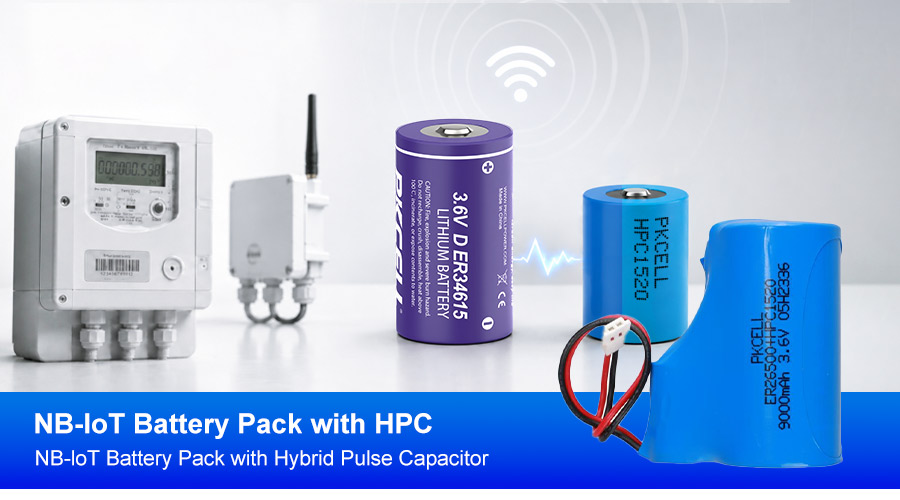
For smart meters, asset trackers, industrial sensors, parking nodes, and remote monitoring devices, choosing the right capacitor is not just a matter of selecting a large capacitance value. The real sizing work must include pulse current, pulse duration, voltage sag, ESR, recharge time, temperature, aging, and battery chemistry.
In many long-life IoT designs, a LiSOCl2 battery provides high energy density and long standby life, while an ER + HPC battery pack supplies the short high-current burst required by NB-IoT communication.
Why NB-IoT Battery Applications Need Pulse Support
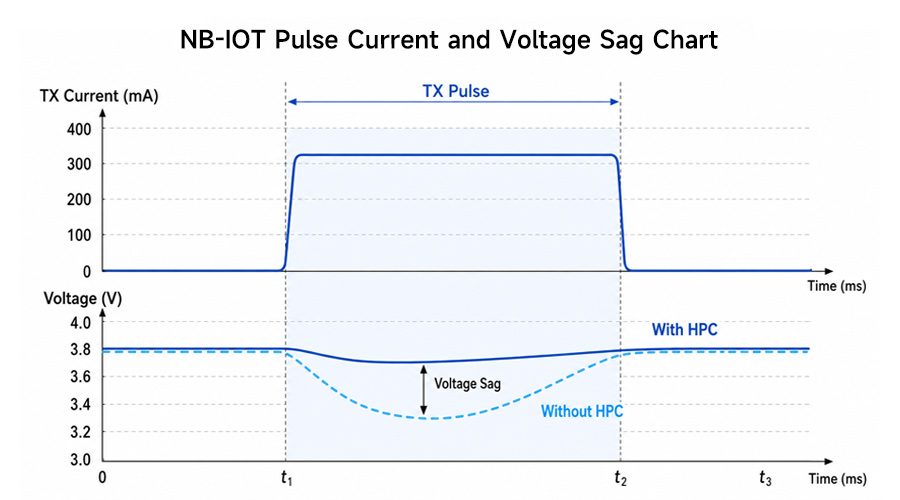
NB-IoT is optimized for low average energy consumption, but the radio does not draw a flat current. A device may sleep for hours, then wake up and draw a much higher current during communication. If the battery cannot support that pulse, the input voltage may drop below the module’s minimum operating voltage.
This is especially important in:
- Smart water, gas, and heat meters
- Industrial IoT sensors
- Remote monitoring devices
- Asset tracking devices
- Outdoor sensors operating in cold environments
- Devices installed in weak-signal areas with repeated transmissions
What a Hybrid Pulse Capacitor Does
A hybrid pulse capacitor, often called an HPC, is used as a pulse helper. During sleep or low-load operation, the battery slowly charges the capacitor. During NB-IoT transmission, the capacitor delivers the high pulse current that would otherwise stress the battery.
PKCELL also explains this principle in its article on ER26500 batteries with Hybrid Pulse Capacitors for smart water and heat meters, where the ER cell provides long-term energy and the HPC supports communication bursts.
Inputs You Need Before Sizing the Capacitor
Before calculating the required capacitor size, collect the actual power profile of your device. Do not rely only on average current or nominal module current.
| Input | Why It Matters |
|---|---|
| Peak NB-IoT current | Defines the maximum current the power system must support. |
| Pulse duration | Determines how much charge the capacitor must deliver. |
| Minimum module voltage | Sets the lowest acceptable voltage at the NB-IoT module input. |
| Battery internal resistance | Creates voltage sag under pulse load, especially at low temperature or end of life. |
| Capacitor ESR | Creates instant voltage drop at the start of the pulse. |
| Recharge interval | Determines whether the capacitor can recover before the next transmission. |
| Operating temperature | Cold conditions increase resistance and reduce usable pulse performance. |
Basic Hybrid Pulse Capacitor Sizing Formula
For a first-pass estimate, use the charge balance formula:
Where:
- I_cap is the pulse current supplied by the capacitor.
- t_pulse is the worst-case pulse duration in seconds.
- ΔV_allowed is the maximum voltage drop the system can tolerate.
However, this formula is only the starting point. In a real NB-IoT design, the total voltage drop includes battery sag, capacitor ESR drop, and capacitor discharge droop.
Step-by-Step Sizing Method
1. Measure the Worst-Case NB-IoT Pulse
Use a power analyzer or oscilloscope-based current measurement setup to capture the actual current waveform. Test strong signal, weak signal, cold temperature, long sleep recovery, and repeated transmission conditions.
2. Decide How Much Current the Battery Can Safely Supply
The capacitor does not always need to supply the full pulse current. In many designs, the battery supplies a controlled portion and the capacitor supplies the rest.
Capacitance determines available charge, but ESR determines the instant voltage drop when the pulse begins.
If ESR is too high, the module can reset even when the capacitor has enough stored energy. Always check ESR at the lowest operating temperature.
5. Confirm Recharge Time
After the pulse, the battery must recharge the capacitor before the next communication event.
I_recharge_average ≈ Q_removed / t_recharge_available
If the device reports frequently or retries many times in weak coverage, the capacitor may not fully recover. This can cause failure after several transmissions, even if the first pulse succeeds.
6. Apply Temperature and Aging Derating
Field devices should be sized for the harshest real operating condition, not only room-temperature test data. Derate for cold temperature, cell aging, passivation, capacitor tolerance, leakage, and end-of-life battery voltage.
Worked Example: First-Pass HPC Estimate
Assume the NB-IoT device has the following measured profile:
- Peak communication current: 300 mA
- Battery allowed pulse contribution: 50 mA
- Capacitor-supported current: 250 mA
- Worst-case pulse duration: 8 seconds
- Allowed capacitor voltage droop after ESR margin: 0.4 V
This does not mean the final design must use exactly 5 F. The selected part still needs ESR validation, low-temperature derating, recharge testing, leakage review, safety confirmation, and physical pack design.
When to Choose an ER + HPC Battery Pack
An ER + HPC battery pack is often a good choice when the application needs both long standby life and high pulse current. This is common in NB-IoT meters, valve-control devices, GPS trackers, and industrial sensors.
For device manufacturers comparing battery options, PKCELL’s Primary Lithium Battery Solution Hub provides a useful starting point for LiSOCl2 and Li-SOCl2 + HPC applications. You can also review the ER34615 IoT battery solution for high-capacity wireless sensing devices.
Need Help Selecting an NB-IoT Battery Pack?
PKCELL can help OEM engineers evaluate LiSOCl2 cells, ER + HPC battery packs, tabs, connectors, custom assemblies, and pulse-current requirements for NB-IoT devices.
Common Mistakes to Avoid
- Using average current for pulse sizing. Average battery life calculations cannot replace peak-current testing.
- Ignoring weak-signal retries. Poor coverage can increase active time and total pulse energy.
- Checking capacitance but not ESR. A large capacitor can still fail if ESR is too high.
- Testing only at room temperature. Low-temperature resistance often drives the real design limit.
- Assuming the capacitor is always fully charged. Frequent transmissions may leave it partially depleted.
- Forgetting leakage current. Leakage matters in devices expected to operate for 10 years or more.
Conclusion
Sizing a hybrid pulse capacitor for NB-IoT is a system-level power design task. Start with the measured transmission pulse, decide how much current the battery can safely provide, calculate the capacitor requirement, then validate ESR, recharge time, low-temperature behavior, and aging margin.
For long-life NB-IoT devices, an ER + HPC battery pack can provide a strong balance of energy density, pulse capability, and field reliability. To discuss your device’s pulse profile, working temperature, and expected service life, contact PKCELL for a custom battery recommendation.
Post time: Jul-27-2026


