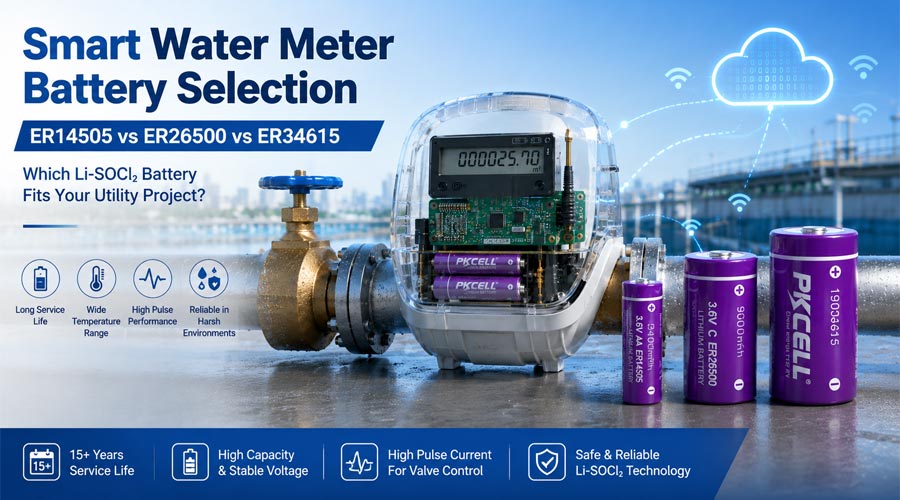
Smart water meters are expected to operate for years in remote, sealed, and often outdoor environments. Choosing the wrong battery can lead to short service life, failed wireless communication, valve-control failure, data loss, and expensive field maintenance.
Key takeawayER14505, ER26500, and ER34615 are all 3.6V LiSoCl2 ER batteries used in smart metering and industrial IoT. The best battery is not always the largest one. The right choice depends on the meter’s current profile, reporting interval, target lifetime, mechanical space, communication technology, valve-control requirement, temperature range, and cut-off voltage.
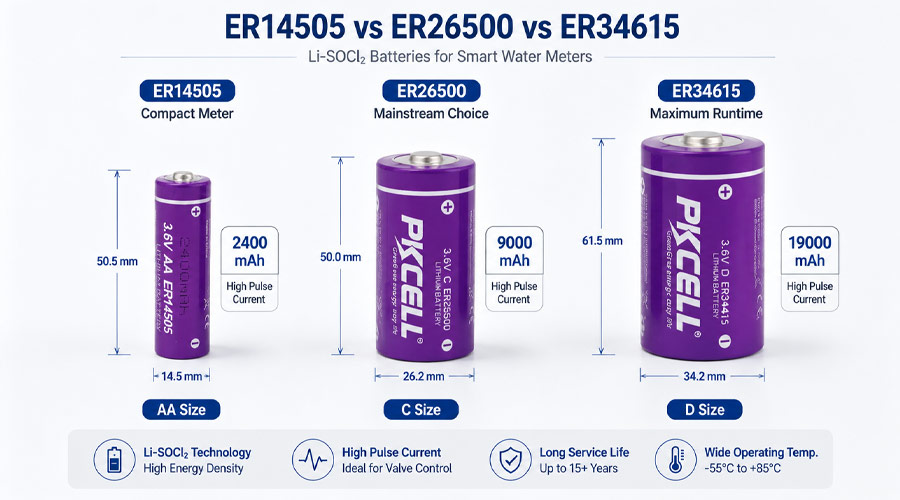
As a simple rule, ER14505 is suitable for compact and low-power meters, ER26500 is a balanced choice for mainstream smart water meters, and ER34615 is suitable for long-life, high-reserve, outdoor, or demanding utility deployments.
1. What Power Requirements Do Smart Water Meters Have?
A smart water meter is not a continuously high-current device. Most of the time, it stays in sleep mode. It wakes up periodically to measure water flow, process data, store records, transmit information, and sometimes control a valve. This duty cycle is why average current and pulse current must be evaluated together.
Typical Smart Water Meter Power Cycle
Sleep
Meter Reading
MCU Processing
Data Storage
Wireless Upload
Optional Valve
Sleep Again
Main Power Consumers in Smart Water Meters
Power Consumer
Battery Impact
MCU sleep current
Determines long-term standby consumption and is critical for 5-year, 10-year, or 15-year projects.
Metering sensor
Affects each measurement cycle, especially when the sensor requires long sampling time.
Wireless module
Often creates pulse current during LoRaWAN, NB-IoT, AMR, RF, or cellular transmission.
Valve motor
Creates high pulse current and can strongly influence battery pack design.
Memory and display
Usually smaller loads, but repeated operation should still be included in lifetime calculation.
Temperature
Low temperature can reduce usable capacity and increase voltage drop during pulse events.
Why Nominal Capacity Is Not Enough
Nominal capacity is only the starting point. A 2400mAh, 9000mAh, or 19000mAh cell will not deliver the same practical lifetime under every meter design. Engineers must evaluate average current, self-discharge, temperature derating, communication retries, valve pulses, device cut-off voltage, and storage time before installation.
For a detailed calculation method, see PKCELL’s guide: How to Calculate Battery Life for LoRaWAN and NB-IoT Devices.
2. Why LiSoCl2 ER Batteries Are Commonly Used in Smart Water Meters
Smart water meters usually need long service life, low self-discharge, stable voltage, and reliable performance across changing field conditions. This is why 3.6V lithium thionyl chloride batteries are commonly used in utility metering. PKCELL offers a wide range of LiSoCl2 batteries and ER energy type batteries for smart meters and industrial IoT devices.
Advantages of LiSoCl2 ER Batteries
- High energy density for long service life.
- Low self-discharge for long-term deployments.
- Stable 3.6V nominal voltage platform.
- Wide operating temperature capability.
- Suitable for remote utility meters where replacement is expensive.
- Available as single cells or customized battery packs with wires, tabs, connectors, and housing.
ER LiSoCl2 Battery vs Alkaline Battery for Water Meters
Item
ER LiSoCl2 Battery
Alkaline Battery
Nominal Voltage
3.6V per cell
1.5V per cell
Self-Discharge
Very low, suitable for long storage and field deployment
Higher, less ideal for long maintenance-free deployment
Low Temperature
Generally stronger for industrial applications
Performance can drop significantly in cold environments
Smart Meter Suitability
High for long-life utility meters
Limited for long-life smart metering projects
Maintenance Cost
Lower over long deployments
Can be higher due to more frequent replacement
When LiSoCl2 + HPC May Be Needed
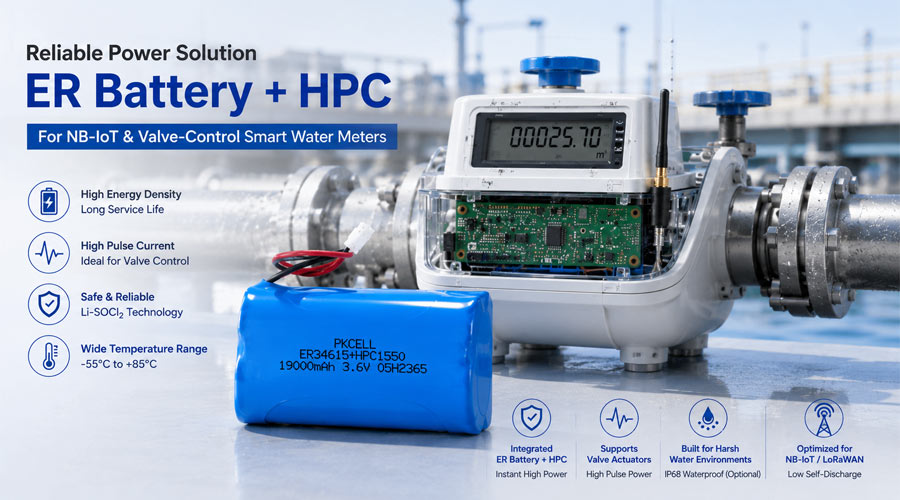
If the smart water meter uses NB-IoT communication, valve control, high-power RF transmission, or must operate in a weak-signal outdoor environment, a standard ER cell may not be enough. In these cases, an ER + HPC IoT battery pack or Hybrid Pulse Capacitor battery pack can help support pulse current and reduce voltage drop.
3. Quick Comparison: ER14505 vs ER26500 vs ER34615
ER14505, ER26500, and ER34615 all use LiSoCl2 chemistry, but they serve different smart water meter design goals. The main differences are capacity, size, energy reserve, mechanical integration, and suitability for long-life or high-demand deployments.
Basic Specification Comparison
Model
Size Class
Nominal Voltage
Typical Capacity
Best Fit
AA
3.6V
2400mAh
Compact smart meters and low reporting frequency designs
C
3.6V
8500/9000mAh
Mainstream smart water meters and medium-to-long service life
D
3.6V
19000mAh
Long-life, high-reserve, outdoor, or demanding utility deployments
Selection Summary
ER14505Choose ER14505 when the meter is compact, the current demand is low, and the reporting interval is not aggressive.
ER26500Choose ER26500 when the meter needs a strong balance of capacity, size, cost, and long service life.
ER34615Choose ER34615 when the project needs maximum runtime, larger reserve capacity, or operation in demanding field conditions.
4. ER14505 for Smart Water Meters
The ER14505 is an AA-size 3.6V LiSoCl2 battery with compact dimensions and moderate capacity. It is suitable for smart water meter designs where space is limited and the power profile is carefully optimized.
When ER14505 Is a Good Choice
- Compact smart water meters with limited battery compartment space.
- Low reporting frequency and low wireless transmission demand.
- Low sleep current and optimized MCU firmware.
- No valve motor or high pulse mechanical load.
- Indoor or protected installation environments.
- Shorter or moderate target service life.
- Backup power or memory support applications.
Advantages and Limitations of ER14505
Advantages
- Compact AA size.
- Easy mechanical integration.
- Lower cost than larger ER cells.
- Suitable for low-power metering modules.
- Available with pack customization options.
Limitations
- Lower capacity than ER26500 and ER34615.
- Less energy reserve for long deployments.
- Less margin for frequent wireless retries.
- May need ER14505 + HPC/SPC1520 if pulse current is significant.
5. ER26500 for Smart Water Meters
The ER26500 is often a balanced choice for mainstream smart water meters. It provides much higher capacity than ER14505 while remaining smaller than ER34615, making it suitable for many AMR, AMI, LoRaWAN, and utility meter projects.
Why ER26500 Is Often the Balanced Choice
- Higher capacity than ER14505.
- Smaller and easier to integrate than ER34615.
- Good fit for 5-year to 10-year smart meter targets, depending on the load profile.
- More reserve for communication retries and outdoor operation.
- Can be paired with HPC for higher pulse applications.
Best Application Scenarios
- Standard smart water meter.
- AMR / AMI water meter.
- LoRaWAN water meter.
- Outdoor utility meter with moderate reporting frequency.
- Meter projects requiring balanced cost, capacity, and mechanical size.
6. ER34615 for Smart Water Meters
The ER34615 is the high-capacity option among the three. It is suitable for smart water meter projects that require long service life, high reserve capacity, outdoor operation, or greater tolerance for communication retries and aging.
When ER34615 Is the Better Choice
- 10-year to 15-year service life targets.
- Outdoor deployment in demanding environments.
- Cold-region water meters.
- Higher reporting frequency or larger data upload demand.
- Larger meter enclosures with enough battery space.
- Valve-control water meters and high-reliability projects.
- Utility-scale projects where field replacement is expensive.
Advantages and Limitations of ER34615
Advantages
- Highest capacity among the three models.
- Strongest energy reserve for long-life deployment.
- Better margin for retries, low temperature, and aging.
- Can be combined with HPC for high-pulse packs.
Limitations
- Larger D-size cell.
- Higher cost than smaller cells.
- Requires more enclosure space and mechanical planning.
- Not necessary for every water meter design.
7. How Communication Technology Affects Battery Selection
Communication technology is one of the most important factors in smart water meter battery selection. The same meter reading function can have very different energy requirements depending on whether the device uses LoRaWAN, NB-IoT, AMR, RF, or another wireless technology.
LoRaWAN Water Meters
LoRaWAN water meters often have low average current, but battery life depends on uplink interval, spreading factor, payload size, confirmed messages, gateway coverage, and retry behavior.
LoRaWAN Project Type
Recommended Direction
Compact, low reporting frequency
ER14505 or ER26500 depending on target life and enclosure size
Mainstream long-life meter
ER26500
Outdoor or harsh environment
ER26500 or ER34615 with temperature validation
High pulse add-on or weak coverage
ER + HPC battery pack after pulse testing
NB-IoT Water Meters
NB-IoT water meters may experience higher peak current during network attach, data upload, paging, or weak-signal retries. For this reason, ER + HPC battery packs are often considered for NB-IoT smart meter designs.
NB-IoT Project Type
Recommended Direction
Compact and low-frequency
ER14505 only if real network current is low and fully validated
Standard NB-IoT water meter
ER26500 + HPC, depending on pulse current and target life
Long-life outdoor NB-IoT meter
ER34615 + HPC or custom high-reserve battery pack
AMR / RF Water Meters
AMR and RF meter battery selection depends on communication distance, transmission power, reporting interval, and field coverage. Short-range low-power designs may use ER14505, while mainstream AMR deployments often use ER26500. Utility-scale or long-life deployments may require ER34615.
8. How Valve Control Changes Battery Selection
Valve-control water meters require more careful battery design because the valve motor can create short high-current pulses. A meter may consume very little current during sleep but still need a strong pulse for valve opening, valve closing, or emergency shut-off.
Valve-Control Parameters to Confirm
- Valve open current and valve close current.
- Pulse duration and stall current.
- Low-temperature valve friction.
- End-of-life battery voltage.
- Emergency shut-off behavior and repeated actuation interval.
Recommended Battery Direction for Valve-Control Meters
Valve Scenario
Recommended Direction
Small valve and low pulse current
ER26500 may be tested if target life and voltage margin are sufficient
Higher valve current
ER26500 + HPC battery pack
Long life + valve + outdoor
ER34615 + HPC battery pack
Compact meter with valve
Custom ER + HPC pack design and full pulse validation
9. Smart Water Meter Battery Life Estimation Method
Battery life should be calculated from the full power cycle, not only from the cell capacity. This is especially important for water meters that use wireless communication, valve control, or outdoor deployment.
Basic battery life formula Battery Life = Usable Battery Capacity / Average Current Average Current = Total Charge Consumption per Cycle / Cycle Time
What to Include in the Calculation
Device Consumption
- Sleep current
- Metering current
- MCU current
- Wireless TX current
- RX or listening current
- Valve actuation current
Field Derating
- Network retry margin
- Low-temperature derating
- Self-discharge
- Cut-off voltage
- Storage time before installation
- Battery aging and production variation
Do not calculate with 100% nominal capacityA 10-year smart water meter should be designed with enough margin for self-discharge, low temperature, network retries, battery aging, production variation, and meter-to-meter current differences.
Simple Smart Water Meter Battery Life Estimator
Estimate Battery Life
Battery life estimate will appear here.
10. Selection Matrix: Which Battery Should You Choose?
The following matrix can be used as a first screening tool. Final selection should always be validated with real meter hardware, real firmware, real communication conditions, and environmental tests.
Project Requirement
Recommended Battery Direction
Compact meter, low reporting frequency
ER14505
Standard smart water meter
ER26500
5-year to 10-year service life
ER26500, depending on power profile and derating
10-year to 15-year service life
ER34615
Outdoor or cold environment
ER26500 or ER34615 with low-temperature validation
NB-IoT communication
ER26500 + HPC or ER34615 + HPC
Valve control
ER26500 + HPC or ER34615 + HPC
Maximum reliability and low maintenance
ER34615 or custom high-reserve battery pack
Space-limited but high pulse
Custom ER + HPC pack design
When to Choose a Custom Battery Pack
Choose a custom battery pack when the water meter requires special wires, tabs, connectors, waterproof structure, housing, multiple cells, ER + HPC integration, higher pulse capability, certification support, or traceability. PKCELL provides custom primary lithium battery packs and project-specific battery solutions for utility metering.
11. Testing Checklist Before Final Battery Selection
Electrical Tests
Open circuit voltage
Check initial battery condition and storage status
Loaded voltage
Check voltage stability under normal meter operation
Pulse current test
Verify wireless transmission, NB-IoT attach, RF burst, or valve actuation
Cut-off voltage test
Determine how much capacity is usable before the device stops working
End-of-life simulation
Verify communication and valve actuation near the expected end of service life
Environmental and Application Tests
- Low-temperature operation test.
- High-temperature storage test.
- Temperature cycling test.
- Humidity and waterproof sealing test.
- Outdoor installation simulation.
- Real meter reading and real wireless upload test.
- Network retry simulation.
- Valve open and close test.
- First startup after storage.
- Full enclosure and connector reliability test.
12. Common Mistakes in Smart Water Meter Battery Selection
Specification Mistakes
- Choosing by nominal capacity only.
- Ignoring communication retries in weak signal areas.
- Ignoring valve pulse current.
- Using indoor room-temperature test data for outdoor projects.
- Not considering storage time before installation.
Validation Mistakes
- No low-temperature pulse testing.
- No end-of-life voltage validation.
- No real modem or real network testing.
- No waterproof sealing impact review.
- No pack-level wire and connector resistance check.
13. Recommended PKCELL Battery Solutions for Smart Water Meters
ER14505 for Compact Smart Water MetersRecommended for compact smart water meters, low-power AMR modules, low reporting frequency devices, backup power, and space-sensitive meter designs.
View ER14505 View ER14505 + HPC/SPC1520
ER26500 for Standard Smart Water MetersRecommended for mainstream smart water meters, AMR/AMI meters, LoRaWAN water meters, outdoor utility meters, and medium-to-long lifetime projects.
View ER26500 View ER26500 + HPC1520
ER34615 for Long-Life Smart Water MetersRecommended for 10-year to 15-year deployment targets, outdoor meters, utility-scale projects, cold-region installations, and high reserve capacity requirements.
View ER34615 View ER34615 + HPC1520
14. What Information Should You Provide to a Battery Supplier?
A reliable smart water meter battery recommendation requires a real power profile. Before requesting samples, prepare the following information.
Meter design
Water meter type, enclosure size, battery compartment size, waterproof requirement
Communication
LoRaWAN, NB-IoT, AMR, RF, uplink interval, payload size, retry behavior
Power profile
Sleep current, active current, TX current, RX current, valve current, pulse duration
Environment
Minimum temperature, maximum temperature, storage time, outdoor exposure, humidity
Electrical limits
Operating voltage, cut-off voltage, peak current, voltage drop tolerance, DC-DC input range
Commercial needs
Target service life, connector requirement, certification, annual volume, sample testing plan
15. FAQs About Smart Water Meter Battery Selection
What battery is used in smart water meters?
Many smart water meters use 3.6V LiSoCl2 ER batteries because they offer high energy density, low self-discharge, stable voltage, and long service life for remote utility metering.
Is ER14505 suitable for smart water meters?
Yes. ER14505 can be suitable for compact, low-power smart water meters with low reporting frequency, low sleep current, and no high pulse valve or modem load.
When should I choose ER26500 for a water meter?
ER26500 is suitable for standard smart water meters that need a balance between capacity, size, cost, and long service life. It is often a practical starting point for mainstream AMR, AMI, and LoRaWAN water meter projects.
When should I choose ER34615 for a water meter?
ER34615 is suitable for long-life, high-capacity, outdoor, cold-region, or utility-scale water meter projects that require a larger energy reserve and lower maintenance risk.
Do NB-IoT water meters need HPC?
Many NB-IoT water meters may benefit from ER + HPC because NB-IoT modules can require high peak current during network attach, transmission, paging, and weak-signal retries.
Do valve-control water meters need special battery design?
Yes. Valve motors can create high pulse current. Battery selection should include valve current, pulse duration, low-temperature performance, voltage drop, and end-of-life validation.
Is a larger battery always better?
No. A larger battery provides more capacity but also requires more space and higher cost. The best choice depends on the meter’s load profile, target life, enclosure design, and field environment.
How long can a smart water meter battery last?
Battery life depends on capacity, average current, reporting interval, communication technology, valve load, temperature, self-discharge, cut-off voltage, and derating. Some projects target 5, 10, or 15 years, but this must be validated with real testing.
What is the difference between ER26500 and ER34615?
ER26500 is a C-size battery with balanced capacity and size, while ER34615 is a D-size battery with higher capacity and larger size. ER34615 is better for longer-life or higher-reserve projects.
Can PKCELL customize smart water meter battery packs?
Yes. PKCELL can provide ER batteries, ER + HPC battery packs, wires, connectors, tabs, pack structure, waterproof sealing support, and customized solutions based on the smart water meter design.
Conclusion: Choose the Battery Based on the Meter’s Real Load Profile
ER14505, ER26500, and ER34615 are all useful LiSoCl2 battery options for smart water meters, but they serve different design goals. ER14505 is best for compact, low-power water meters. ER26500 is a balanced option for mainstream smart water meters. ER34615 is suitable for long-life, high-capacity, outdoor, or utility-scale deployments.
For NB-IoT or valve-control water meters, engineers should also consider ER + HPC battery pack design because pulse current and voltage drop can become more important than nominal capacity alone.
Sources and Further Reading