

Quick answer: Li-SOCl2 battery shelf life describes how long an unused battery can remain in storage under specified conditions while retaining acceptable performance. Service life describes how long it can power a particular device after installation. Storage consumes part of the battery’s total calendar history, but service life cannot be calculated simply by subtracting storage years from a catalog shelf-life figure.
- 1Cell production
- 2Transport
- 3OEM inventory
- 4Device assembly
- 5Field service
Many industrial projects begin with a statement such as “the battery has a 10-year shelf life” or “the device must operate for 10 years.” These statements describe different requirements.
A cell may spend months in international transport, more time in the OEM warehouse, additional time inside a finished product and then many years in service. Every stage contributes to its temperature and aging history. Long-life battery planning must therefore cover the complete calendar timeline, not only the period after installation.
PKCELL publishes a range of 3.6V Li-SOCl2 batteries for long-life industrial applications. However, the applicable shelf-life, storage conditions and test requirements must always be confirmed against the final datasheet for the exact model ordered.
Li-SOCl2 Battery Shelf Life vs Service Life
| Term | What it describes | Main influencing factors | What an OEM should specify |
|---|---|---|---|
| Shelf life | Storage period before the battery is placed into active service | Storage temperature, time, sealing, self-discharge, passivation and packaging | Maximum cell age at shipment and required remaining shelf life |
| Service life | Time the battery can operate in a defined device and environment | Load profile, pulse current, temperature, cut-off voltage, retries, leakage and usable capacity | Target field life under an agreed operating profile |
| Calendar history | Total time from cell production through storage and field operation | All pre-installation and service conditions | Complete project timeline plus engineering margin |
| Remaining shelf life | The qualified unused storage period remaining when the cells reach the buyer | Production date, shipment date, storage history and model-specific specification | Acceptance limit at delivery, not merely a generic catalog claim |
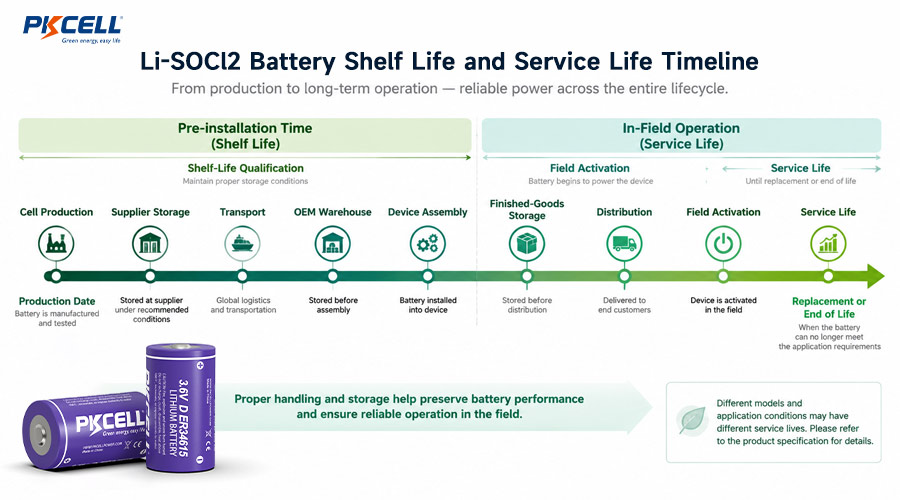
Shelf life is a storage qualification. Service life is an application result. Neither should be treated as an unconditional expiration promise.
A battery does not suddenly become unusable on an arbitrary anniversary. Equally, an old battery should not be assumed suitable merely because its open-circuit voltage remains close to nominal. Acceptance must reflect the manufacturer’s specification and the device’s actual requirements.
Why Li-SOCl2 Batteries Can Be Stored for a Long Time
Li-SOCl2 chemistry is well suited to long-term storage because of its low self-discharge and hermetically sealed construction. Many PKCELL ER-series materials describe long storage life under room-temperature conditions, but the exact value and applicable test conditions vary by model.
A lithium chloride-based passivation layer forms on the lithium anode. This layer limits unwanted reactions and supports low self-discharge. It is therefore one of the mechanisms that makes long battery storage life possible.
Passivation also creates a tradeoff. During long storage or extended low-current standby, the layer can increase initial impedance. When the device first demands current, the battery voltage may dip before recovering. A battery can retain substantial energy and still fail a high-current startup if the power system has insufficient voltage margin.
For a detailed explanation of this behavior, read Li-SOCl2 battery passivation for OEM engineers.
OEM implication: long storage capability and instant high-pulse readiness are separate qualification items. Incoming inspection should not rely on open-circuit voltage alone.
How Storage Temperature Changes the Calculation
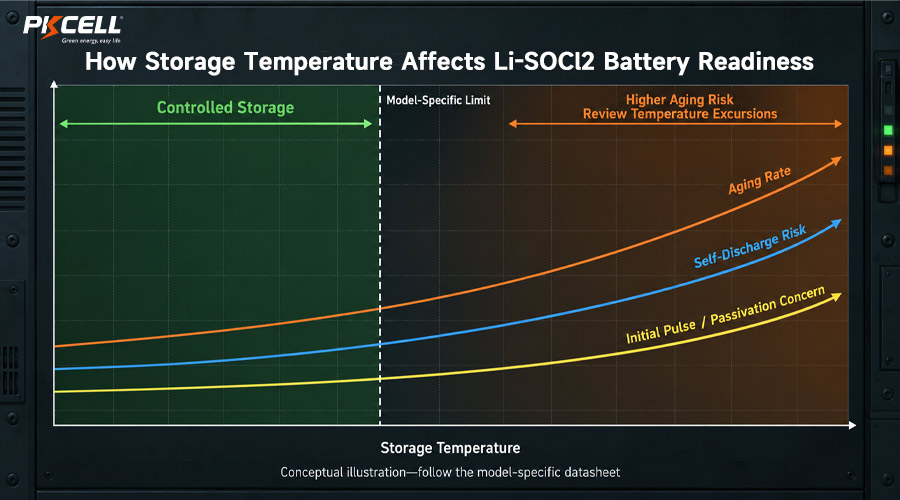
A shelf-life statement applies only under defined storage conditions. High storage temperature can accelerate self-discharge, aging and other chemical processes. Temperature fluctuations may also affect packaging, seals and condensation risk if batteries are moved between environments improperly.
Low storage temperature may slow aging, but a cold battery should not be evaluated or installed without considering condensation and temperature stabilization. Storage limits are also different from operating limits. A cell’s wide operating-temperature range does not mean every point within that range is recommended for long-term warehouse storage.
OEM teams should therefore record:
- Minimum, maximum and average warehouse temperature
- Duration of temperature excursions
- Humidity and condensation controls
- Distance from heaters, sunlight and exterior walls
- Transport conditions before warehouse receipt
- Temperature history of off-site and contract-manufacturer inventory
Always use the model-specific storage limit. As one industry reference point, a Saft Li-SOCl2 datasheet specifies a maximum recommended storage temperature of +30°C for the referenced model. PKCELL model specifications commonly describe long storage life under room-temperature conditions. These statements should not be generalized beyond their respective products.
For the broader relationship between temperature, impedance and available energy, see PKCELL’s guide to Li-SOCl2 temperature, capacity and pulse performance.
Do Storage Years Directly Subtract From Service Years?
Not in a simple one-to-one calculation.
Storage can consume capacity through self-discharge and aging, but field service also depends on current, pulse demand, temperature, cut-off voltage and device behavior. A cell stored correctly for several years may retain much of its energy, yet its initial pulse response may differ from a recently produced cell because of passivation. A poorly stored cell may lose more performance in a shorter period.
Suppose an OEM wants a device to operate for 10 years but expects up to 18 months between battery production and field activation. The battery qualification must cover the full pre-installation period plus the required service interval and a suitable engineering margin. It is not enough to purchase any cell carrying a generic “10-year shelf life” statement.
The service-life model should include measured sleep current, active events, transmission retries, self-discharge allowance, temperature effects and the device’s minimum voltage. PKCELL’s battery-life calculation guide for LoRaWAN and NB-IoT devices provides a useful cycle-based framework.
Seven-Step OEM Inventory Planning Process
Build a Complete Calendar-Life Budget
Start with the cell production date rather than the device installation date. Estimate the maximum duration of every supply-chain stage, including supplier stock, transport, customs, OEM inventory, contract manufacturing, finished-goods storage and distribution.
Use maximum credible time rather than the average. A delayed product launch or slow-moving regional inventory can add months to the timeline.
Put Battery Age Requirements in the Purchase Specification
“New battery” is not a measurable purchasing requirement. A stronger specification defines:
- Exact cell model and approved datasheet revision
- Permitted production-date range at shipment
- Minimum remaining shelf life at delivery
- Maximum storage temperature before shipment
- Lot-code format and traceability requirements
- Packaging, carton labels and barcode information
- Required safety and transport documents
- Rules for combining production lots within an order
For custom assemblies, also define the cell date-code policy, pack assembly date, connector drawing and whether multiple cell lots may be used in one production lot. PKCELL’s custom primary battery pack quotation checklist helps organize these requirements.
Record Battery Lots at Incoming Inspection
Incoming inspection should connect the physical shipment to its quality records. Record the manufacturer, model, quantity, production code, delivery date, purchase order, carton number and inspection result.
Inspect packaging condition, labels, polarity, terminals, dimensions and visible damage. Electrical sampling should follow a model-specific, supplier-approved plan.
Open-circuit voltage can identify some abnormalities, but it does not fully reveal stored capacity, passivation state or pulse capability. For more detail, review why OCV alone is insufficient for Li-SOCl2 battery testing.
Store Cells in Controlled Original Packaging
Follow the exact product datasheet and safety documentation. As a general warehouse practice, keep batteries in a clean, dry, ventilated and temperature-controlled location, away from direct sunlight, heat, flames, water and conductive objects.
- Keep lot labels readable and associated with the cells.
- Avoid loose storage that can allow terminal contact or short circuits.
- Do not place heavy objects on cartons or battery terminals.
- Separate damaged, dropped, leaking or overheated products.
- Control access so cells cannot be mixed without a transaction record.
- Monitor and retain warehouse temperature records.
Use FEFO Instead of Relying Only on FIFO
FIFO means first in, first out. FEFO means first expired, first out. For long-life battery inventory, FEFO is usually the better decision rule because production date and remaining qualified shelf life matter more than the date a carton entered one particular warehouse.
For example, a later delivery could contain an earlier production lot. A simple FIFO system might issue the younger cells first and leave the older lot in storage.
Configure the inventory system to flag:
- Lots approaching the internal age limit
- Stock without a readable or verified production code
- Lots exposed to an unapproved temperature excursion
- Opened cartons awaiting disposition
- Inventory that requires retesting before release
Maintain Traceability Through Device Assembly
Record which battery lot was installed in each device lot or serial-number range. This allows field data to be compared with cell production history, warehouse conditions and assembly records.
Avoid mixing new and old cells in one pack. Do not combine different models, brands or unapproved production lots merely to consume aging inventory. For multi-cell configurations, cell matching and lot-control rules should be agreed with the battery supplier.
When selecting among common ER formats, use the device’s energy and power requirements rather than inventory convenience. See the ER14505 vs ER26500 vs ER34615 selection guide.
Retain Samples and Review Aging Data
For high-volume or critical projects, retain identified samples from relevant production lots under controlled conditions. Define review intervals and tests before the project begins.
The plan may include visual inspection, open-circuit voltage, model-approved load testing and device-level first-start or transmission tests. Compare results with original lot-acceptance data.
Accelerated-aging tests may help compare designs, but elevated-temperature data should not be converted into field years through an unsupported linear rule. Agree on the method, acceptance limits and interpretation with the cell supplier.
Recommended OEM Procurement Checklist
- Exact chemistry and cell model
- Approved datasheet revision
- Production date or lot-code format
- Maximum age at shipment
- Minimum remaining shelf life
- Supplier storage conditions
- OEM warehouse limits
- Expected pre-installation duration
- Target device service life
- Device cut-off voltage
- Continuous and pulse-current profile
- Passivation validation requirements
- Incoming inspection plan
- Packaging and carton labeling
- Batch and serial-number traceability
- Retained-sample requirements
- Applicable transport documentation
- Long-term supply forecast
Common Shelf-Life Planning Mistakes
- Treating shelf life as guaranteed field life: the installed device introduces load, temperature and cut-off requirements.
- Starting the age calculation at goods receipt: cell production and supplier storage occurred earlier.
- Accepting “new” without a measurable date requirement: purchase orders need a defined age or remaining-life limit.
- Using OCV as the only incoming test: it cannot fully characterize pulse behavior or retained capacity.
- Storing batteries at any temperature within the operating range: operating and recommended storage conditions are different.
- Ignoring finished-goods inventory: a battery continues aging after it is installed in an unsold device.
- Using FIFO without production-date data: delivery order may not match battery age.
- Mixing lots to consume old stock: this weakens traceability and can increase pack variation.
- Assuming passivation means depletion: voltage delay and lost capacity are not the same condition.
- Using uncontrolled depassivation: conditioning must follow model-specific manufacturer guidance.
Safety notice: Li-SOCl2 cells are primary lithium batteries and must not be recharged. Do not short-circuit, crush, puncture, disassemble, incinerate or expose them to temperatures outside the approved specification. Isolate damaged products and follow the manufacturer’s safety, transport and disposal instructions.
Plan Your Battery Inventory Before Placing a Bulk Order
Send PKCELL your annual forecast, expected warehouse time, operating profile, temperature range, target service life and batch-control requirements. The team can help evaluate Li-SOCl2 cell options, samples, custom packs, packaging and delivery planning for your OEM project.
Frequently Asked Questions
What is the typical shelf life of a Li-SOCl2 battery?
Many Li-SOCl2 products are specified for long storage, and some PKCELL model documents state 10 years under room-temperature conditions. The applicable value depends on the exact model, storage temperature, test method and acceptance criteria. Always use the current model-specific datasheet.
Is battery shelf life the same as battery service life?
No. Shelf life concerns an unused battery stored under specified conditions. Service life concerns operation inside a particular device and depends on current consumption, pulses, temperature, cut-off voltage and other application factors.
Does five years in storage remove five years of service life?
Not automatically. Storage affects remaining capacity and passivation, but service life is not a simple subtraction. The answer requires the cell’s storage history, retained performance and the device’s complete load profile.
Does passivation mean a stored Li-SOCl2 battery is defective?
No. Passivation is a normal part of Li-SOCl2 chemistry and supports low self-discharge. Excessive voltage delay under the device’s actual startup or pulse load must still be managed and tested.
Can open-circuit voltage confirm that an old battery is suitable?
No. OCV is useful but cannot confirm retained capacity, dynamic impedance or pulse performance. A model-approved load test and device-level validation may also be required.
Should OEM battery inventory use FIFO or FEFO?
FEFO is generally more useful when reliable production-date and remaining-life data are available. It releases the lot with the earliest qualified end date first, even if delivery order does not match production order.
What battery date information should an OEM request?
Request the production date or traceable lot code, permitted age at shipment, remaining shelf-life requirement, pack assembly date where applicable and the supplier’s storage-history controls.
Conclusion
Li-SOCl2 battery shelf life is valuable only when it is connected to the complete OEM timeline. Production date, shipping, warehouse storage, assembly, finished-goods inventory and field service must be treated as one lifecycle plan.
Control storage temperature, define remaining shelf life in purchasing documents, use FEFO, preserve batch traceability and validate first-use performance after representative storage. These steps help turn a catalog shelf-life claim into a more reliable field deployment.
For model selection, sample planning or bulk-order requirements, contact PKCELL and share your storage period, annual forecast and target device life.


