

CR2032 vs CR2450 vs CR123A: 3V LiMnO2 Battery Selection Guide
CR2032, CR2450 and CR123A are all primary, non-rechargeable 3V lithium manganese dioxide batteries. However, they are not interchangeable.
CR2032 and CR2450 are coin or button cells. CR123A is a cylindrical battery with substantially more capacity and much stronger current capability. It is included in this comparison to help designers determine when a coin cell is no longer sufficient.
This guide compares their dimensions, capacity, electrical load capability and applications, then explains how to select the correct LiMnO2 battery for an OEM device.
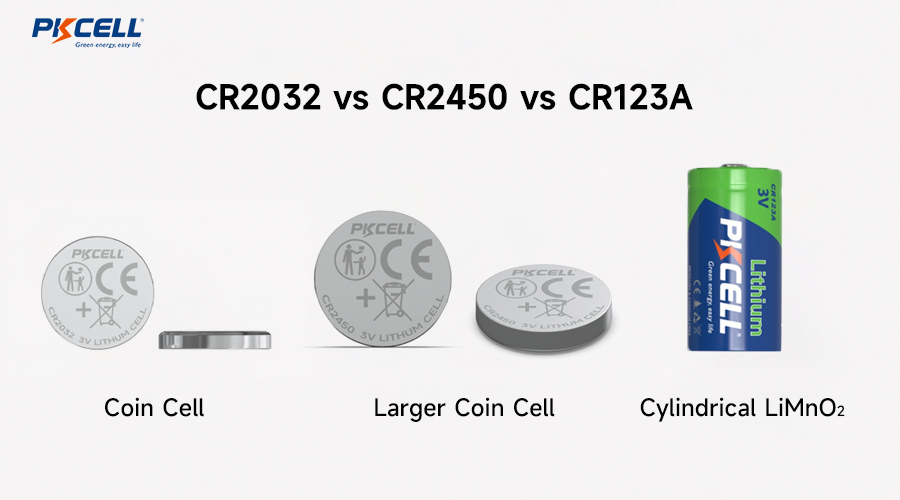
Quick Answer: Which 3V Lithium Battery Should You Choose?
Choose CR2032: For very compact, low-current devices that require a 20mm coin cell.
Choose CR2450: When the device can accept a larger coin cell and needs more capacity than CR2032.
Choose CR123A: When the device needs substantially more energy, stronger continuous current or high pulse current.
Do not substitute by voltage alone: Confirm dimensions, current, cutoff voltage, terminals and battery chemistry.
What Do CR2032 and CR2450 Battery Numbers Mean?
In these model names, “CR” generally identifies a round lithium manganese dioxide primary battery. For common coin cells, the numbers describe the approximate physical dimensions.
- CR2032: Approximately 20mm in diameter and 3.2mm thick.
- CR2450: Approximately 24.5mm in diameter and 5.0mm thick.
- CR123A: A cylindrical model designation; its name does not follow the same four-digit coin-cell dimension format.
Voltage is only one compatibility factor. A CR2450 cannot replace a CR2032 in a holder designed for a 20mm × 3.2mm cell, and CR123A requires a completely different battery compartment.
CR2032 vs CR2450 vs CR123A Comparison Table
| Parameter | CR2032 | CR2450 | CR123A |
|---|---|---|---|
| Battery shape | Coin/button cell | Coin/button cell | Cylindrical cell |
| Chemistry | LiMnO2 | LiMnO2 | LiMnO2 |
| Rechargeable | No | No | No |
| Nominal voltage | 3.0V | 3.0V | 3.0V |
| Reference capacity | 210mAh | 600mAh | 1500mAh |
| Capacity test condition | 15kΩ load to 2.0V at 23 ± 3°C | 7.5kΩ load to 2.0V at 23 ± 3°C | 10mA discharge to 2.0V at 20 ± 3°C |
| Dimensions | 20.0 × 3.2mm | 24.5 × 5.0mm | Approximately 17 × 34.5mm |
| Reference weight | 3.0g | 6.2g | Approximately 16g |
| Operating temperature | -20°C to +60°C | -20°C to +60°C | -40°C to +65°C |
| Reference current information | 3mA recommended constant; 20mA recommended pulse | Confirm the exact model datasheet for the intended load | 1500mA maximum continuous; 3000mA maximum pulse |
| Best starting point | Compact, low-current electronics | Larger coin-cell devices requiring more energy | Higher-energy or higher-current 3V products |
Capacity values cannot be compared without considering the stated test conditions. Available capacity also depends on load, temperature, cutoff voltage and pulse behavior.
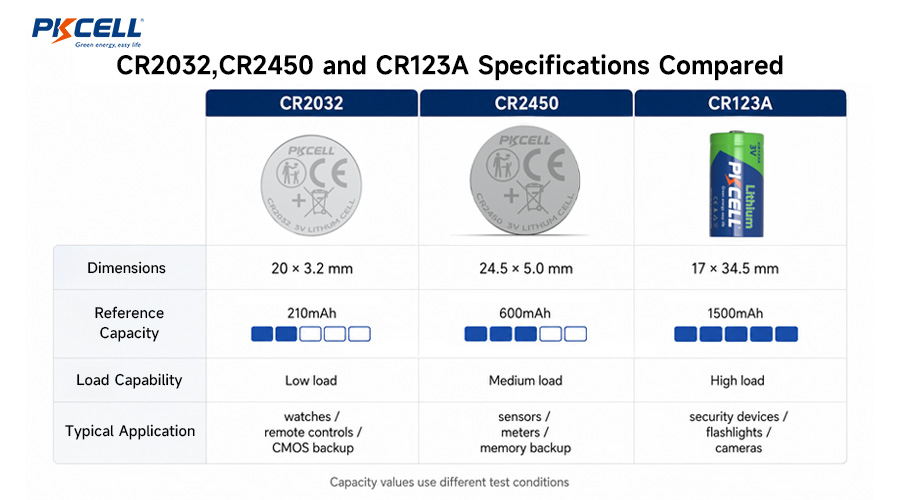
CR2032, CR2450 and CR123A Product Profiles
CR2032 3V Coin Cell
20 × 3.2mm
210mAh
Low-current devices
CR2032 is one of the most widely used lithium coin cells. Its thin 20mm format makes it suitable for compact products with low average current and limited battery space.
Potential applications:
- Computer CMOS and real-time clock backup
- Car key fobs and compact remote controls
- Calculators and small electronic displays
- Memory backup
- Compact medical electronics
- Low-power wireless sensors
Main limitation: CR2032 should not be selected for a device with sustained high current or large repeated pulses simply because it supplies 3V.
CR2450 3V Coin Cell
24.5 × 5.0mm
600mAh
Larger energy reserve
CR2450 is wider and thicker than CR2032. The larger format provides a substantially higher nominal capacity while retaining a flat coin-cell shape.
Potential applications:
- Medical and monitoring devices
- Automotive keyless-entry electronics
- Home automation controls
- Industrial memory backup
- Remote controls and electronic displays
- Sensors requiring more energy than CR2032 can provide
Main limitation: CR2450 does not fit a CR2032 holder. Its higher capacity does not automatically mean it can supply the same current as a cylindrical CR123A.
CR123A 3V Cylindrical LiMnO2 Battery
Cylindrical
1500mAh
Higher current
CR123A uses the same general LiMnO2 primary chemistry but has a cylindrical construction. It offers much more nominal capacity and substantially stronger current capability than CR2032 or CR2450.
Potential applications:
- Security sensors and alarm equipment
- Medical devices
- Utility-meter electronics
- Industrial monitoring equipment
- Professional lights and optical devices
- Devices requiring stronger pulses or higher continuous current
Main limitation: CR123A requires a cylindrical battery compartment and cannot replace a coin cell mechanically.
Which Battery Fits Different Applications?
CMOS and Memory Backup
CR2032 is a common starting point because the load is typically low and the holder must remain compact.
Automotive Key Fobs
CR2032 may suit compact fobs. CR2450 may be considered when the enclosure supports a larger coin cell and the energy budget is higher.
Medical Electronics
CR2032 or CR2450 may suit low-power portable designs. CR123A may be more relevant when the device needs substantially more energy or current.
Wireless Sensors
Selection depends on sleep current, radio pulse, transmissions per day and cutoff voltage. CR123A may be necessary when coin-cell pulse performance is insufficient.
Security and Alarm Devices
CR123A is often more suitable when the device combines long standby operation with stronger alarm or wireless-transmission loads.
Smart Home Controls
CR2450 can provide a larger energy reserve than CR2032 while maintaining a flat coin-cell format.
Utility Meter Electronics
CR123A may suit selected meter or communication designs that require 3V LiMnO2 chemistry and stronger load performance.
Professional Lighting
A cylindrical CR123A is generally more relevant than a coin cell because lighting can require significantly greater current.
How to Choose the Right 3V LiMnO2 Battery
- Confirm the battery shape. Decide whether the product needs a flat coin cell or can accommodate a cylindrical battery.
- Check exact dimensions. CR2032, CR2450 and CR123A require different holders and mechanical layouts.
- Calculate the energy budget. Include sleep current, active current, event duration and expected service interval.
- Measure pulse current. Wireless communication, alarms, motors and lights may exceed coin-cell capability.
- Review cutoff voltage. The device may stop operating before the battery reaches the datasheet’s capacity-test endpoint.
- Define temperature conditions. Use the operating range specified for the exact model.
- Select the termination. Confirm whether the design needs a holder, solder tabs, pins, wires or a connector.
- Test the complete device. Record minimum voltage during startup, transmission and other maximum-load events.
| Design Requirement | Recommended Starting Point | Reason |
|---|---|---|
| Smallest practical 20mm coin-cell profile | CR2032 | Compact and widely supported |
| More capacity in a flat coin-cell format | CR2450 | Larger diameter and thickness provide more stored energy |
| Higher continuous current or pulse current | CR123A | Cylindrical construction supports much stronger loads |
| Security, alarm or professional lighting load | CR123A | Higher energy and current capability |
| Low-power CMOS or clock backup | CR2032 | Low load and compact holder |
| Low-power device with a larger energy budget | CR2450 | More nominal capacity than CR2032 |
A battery with the same nominal voltage is not automatically a compatible replacement. Mechanical fit, capacity test conditions and current capability must all match the device.
LiMnO2 Battery Options Beyond Coin Cells
CR2032 and CR2450 are only two formats within the broader LiMnO2 battery family. When a coin cell cannot provide enough capacity or current, engineers can evaluate cylindrical LiMnO2 models.
PKCELL’s LiMnO2 range includes:
- CR2032, CR2450 and other lithium coin cells
- CR123A and CR2 compact cylindrical batteries
- CR14250, CR14505 and CR17335
- CR17450, CR17505 and CR26500
- CR34615 for higher-capacity industrial applications
- Cells with solder tabs, pins, wires or connectors
- Customized primary lithium battery assemblies
Safety and Handling
- CR2032, CR2450 and CR123A are non-rechargeable batteries. Do not recharge them.
- Do not short-circuit, crush, disassemble, heat or incinerate the batteries.
- Install the battery with the correct polarity.
- Do not mix old and new cells or different models in the same device.
- Keep coin cells away from children because ingestion can cause severe internal injury.
- Use child-resistant battery compartments where applicable.
- Follow local regulations for lithium battery disposal and recycling.
Need a CR2032, CR2450 or CR123A for an OEM Project?
Send PKCELL your required voltage, average current, pulse current, temperature range, service-life target, dimensions and termination requirements. The team can help evaluate a coin cell, cylindrical LiMnO2 battery or customized assembly.
Request a LiMnO2 Battery Recommendation
View LiMnO2 Batteries
View Coin Cell Batteries
Frequently Asked Questions
Is CR123A a button cell battery?
No. CR123A is a cylindrical 3V LiMnO2 primary battery. CR2032 and CR2450 are coin or button cells.
Can CR2450 replace CR2032?
No, not directly. Both provide a nominal 3V output, but CR2450 is wider and thicker. It requires a compatible holder and enclosure.
Which has more capacity, CR2032 or CR2450?
In the referenced PKCELL specifications, CR2032 is rated at 210mAh and CR2450 at 600mAh. The ratings use different load conditions, so verify the applicable datasheet.
When should I use CR123A instead of a coin cell?
Consider CR123A when the device needs substantially more stored energy, higher continuous current or stronger pulse-current performance than CR2032 or CR2450 can provide.
Are CR2032, CR2450 and CR123A rechargeable?
No. The standard CR2032, CR2450 and CR123A batteries discussed here are primary, non-rechargeable LiMnO2 batteries.
What does CR mean on a lithium battery?
CR commonly identifies a round lithium manganese dioxide primary battery. For coin cells such as CR2032 and CR2450, the number also indicates approximate dimensions.
Conclusion
CR2032, CR2450 and CR123A share a nominal 3V LiMnO2 chemistry platform, but they solve different device requirements.
Choose CR2032 for compact, low-current electronics. Choose CR2450 when the product can accommodate a larger coin cell and needs more energy. Choose cylindrical CR123A when substantially greater capacity or current capability is required.
Final selection should be based on dimensions, load profile, pulse current, cutoff voltage, temperature and the exact model datasheet.
Sources and Verification Notes
Product performance depends on the exact model and test conditions. Use the technical specification supplied for the production battery as the final reference.
- PKCELL CR2032 210mAh Datasheet — capacity, dimensions, weight and temperature.
- PKCELL CR2450 600mAh Datasheet — capacity, load condition and operating temperature.
- PKCELL CR123A 1500mAh Datasheet — capacity, current and temperature specifications.
- PKCELL CR2032 Product Page — product and application information.
- PKCELL CR123A Product Page — cylindrical LiMnO2 product information.
- PKCELL LiMnO2 Battery Range — coin-cell and cylindrical product categories.
Post time: Jun-06-2025


