

Lithium Coin Cell Battery Size Chart: CR927 to CR2450 Compared
Lithium coin cells can share the same 3V nominal voltage while differing substantially in diameter, thickness and capacity. This size chart compares 15 common PKCELL CR-series models from CR927 to CR2450, helping replacement buyers and OEM engineers narrow the options without mistaking similar-looking batteries for direct substitutes.
Quick answer: Read a lithium coin cell code as a size identifier, then confirm the exact datasheet. In common four-digit CR models, the first two digits indicate nominal diameter and the last two indicate thickness in tenths of a millimeter. For example, CR2032 is approximately 20.0 mm in diameter and 3.2 mm thick. All models in this chart are nominal 3V Li-MnO2 primary cells, but they are not automatically interchangeable.
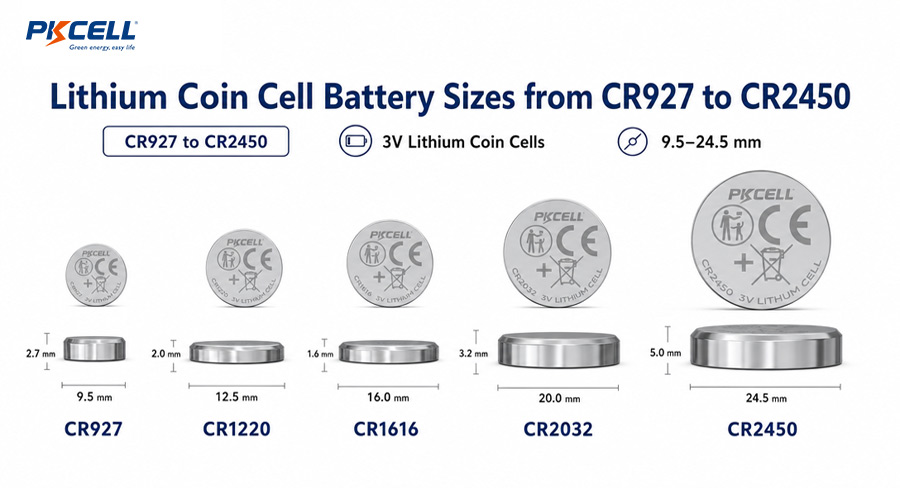
Lithium Coin Cell Battery Size Chart
The table uses capacity and dimension values listed in PKCELL’s current lithium button cell product overview. Capacity is manufacturer- and test-condition-specific, so confirm the final datasheet before design approval or volume purchasing.
| Model | Voltage | Diameter | Thickness | PKCELL Capacity | Typical Starting Applications |
|---|---|---|---|---|---|
| CR927 | 3.0 V | 9.5 mm | 2.7 mm | 30 mAh | Mini devices, compact remotes, LED products |
| CR1216 | 3.0 V | 12.5 mm | 1.6 mm | 25 mAh | Mini electronics, calculators, small instruments |
| CR1220 | 3.0 V | 12.5 mm | 2.0 mm | 40 mAh | Compact sensors, LED products, mini devices |
| CR1225 | 3.0 V | 12.5 mm | 2.5 mm | 50 mAh | Small remotes, watches, portable electronics |
| CR1616 | 3.0 V | 16.0 mm | 1.6 mm | 50 mAh | Slim remotes, wearables, compact electronics |
| CR1620 | 3.0 V | 16.0 mm | 2.0 mm | 70 mAh | Car keys, remotes, medical electronics |
| CR1632 | 3.0 V | 16.0 mm | 3.2 mm | 120 mAh | Automotive keys, remotes, wearables |
| CR2016 | 3.0 V | 20.0 mm | 1.6 mm | 75 mAh | Ultra-thin devices, calculators, small remotes |
| CR2025 | 3.0 V | 20.0 mm | 2.5 mm | 150 mAh | Thin electronics, remotes, medical devices |
| CR2032 | 3.0 V | 20.0 mm | 3.2 mm | 210 or 220 mAh* | Car keys, CMOS backup, instruments, medical devices |
| CR2320 | 3.0 V | 23.0 mm | 2.0 mm | 130 mAh | Meters, instruments, industrial electronics |
| CR2325 | 3.0 V | 23.0 mm | 2.5 mm | 190 mAh | Sensors, security devices, backup circuits |
| CR2330 | 3.0 V | 23.0 mm | 3.0 mm | 260 mAh | Industrial electronics, instruments, IoT devices |
| CR2430 | 3.0 V | 24.5 mm | 3.0 mm | 270 mAh | Security devices, sensors, meters |
| CR2450 | 3.0 V | 24.5 mm | 5.0 mm | 600 mAh | IoT sensors, security and industrial electronics |
*PKCELL lists standard CR2032 versions with 210 mAh and 220 mAh ratings. Confirm the exact part number, construction and applicable test conditions when requesting samples.
How to Read a CR Coin Cell Battery Number
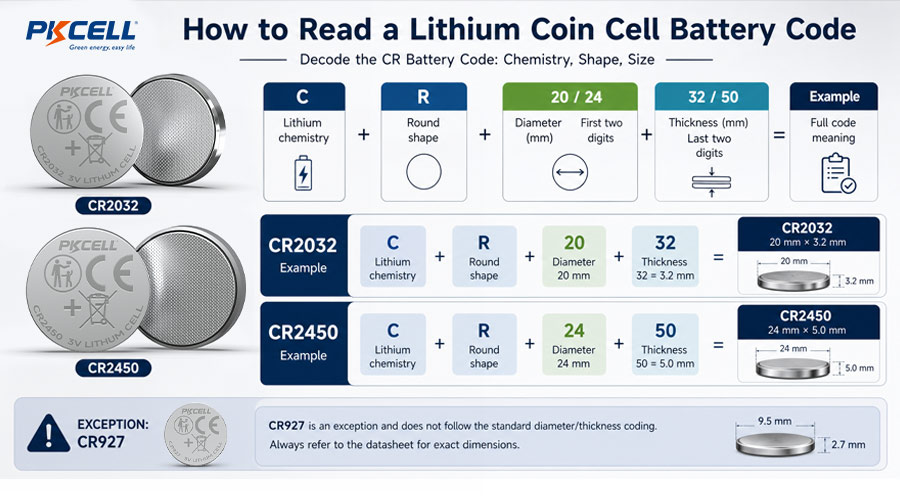
A battery code is a compact starting point for identifying chemistry and size:
- C indicates lithium chemistry in the IEC designation.
- R indicates a round cell.
- For common four-digit models, the first two digits indicate nominal diameter in millimeters.
- The last two digits indicate thickness in tenths of a millimeter.
CR2450, for example, is approximately 24.5 mm in diameter and 5.0 mm thick. The compact CR927 designation corresponds to PKCELL’s listed 9.5 × 2.7 mm cell, so the datasheet remains the final dimensional reference rather than a calculation from the printed code alone.
Coin Cell Sizes Grouped by Diameter
Grouping cells by diameter makes the chart easier to scan, but thickness must still be checked within each family.
9.5 mm family
CR927
Smallest footprint in this chart; 2.7 mm thick.
12.5 mm family
CR1216, CR1220, CR1225
Same diameter with 1.6, 2.0 and 2.5 mm thickness options.
16 mm family
CR1616, CR1620, CR1632
Capacity rises from 50 to 120 mAh as listed thickness increases.
20 mm family
CR2016, CR2025, CR2032
Common formats balancing slim enclosures and higher capacity.
23 mm family
CR2320, CR2325, CR2330
Larger footprint for instruments, sensors and backup applications.
24.5 mm family
CR2430, CR2450
The CR2450 is the largest-capacity cell included in this chart.
How Size Affects Capacity and Battery Life
A larger internal volume can hold more active material, so wider or thicker cells generally offer greater capacity within the same chemistry family. The chart illustrates that relationship, but it is not perfectly linear. Construction, formulation and the manufacturer’s test method also matter.
Within the 20 mm family, PKCELL lists 75 mAh for CR2016, 150 mAh for CR2025 and 210 or 220 mAh for CR2032. Moving to CR2450 raises listed capacity to 600 mAh, but it also requires a 24.5 mm diameter and 5.0 mm enclosure height. PKCELL’s CR2025, CR2032 and CR2450 comparison explores that size-versus-runtime tradeoff in more detail.
Choose the smallest cell that meets the validated service-life requirement with adequate margin. Extra capacity is not useful if the battery does not fit or cannot support the device’s pulse load.
Why rated capacity does not equal guaranteed runtime
- Test conditions: Capacity ratings depend on discharge load, cutoff voltage and temperature.
- Pulse demand: Wireless transmissions, LEDs and displays can create short current peaks.
- Device cutoff: Electronics may stop operating before all rated capacity is delivered.
- Temperature: Cold and heat can change loaded voltage and usable capacity.
- Contact resistance: Holder pressure, contamination and oxidation can cause voltage drop.
- Storage history: Time and storage temperature affect energy remaining at installation.
Are Coin Cell Batteries with the Same Voltage Interchangeable?
No. Matching 3V voltage is only one requirement. A direct replacement should also match chemistry, diameter, thickness, polarity, terminal arrangement and the device manufacturer’s approved model.
Cells in the same diameter family are especially easy to confuse. CR2016, CR2025 and CR2032 all measure 20 mm across, but their thicknesses are 1.6, 2.5 and 3.2 mm. A thicker battery may prevent the cover from closing, while a thinner one may sit loosely and create intermittent contact. Batteries from different diameter families will not fit the same holder correctly.
Do not force a larger cell, bend holder contacts, insert a conductive spacer or stack cells to imitate another size. Stacking can also change the supplied voltage. Use the exact model printed on the old battery, compartment or device manual.
Cross-reference prefixes such as DL or ECR may identify another brand’s version of the same nominal CR size. The complete number still matters: DL2032 may cross-reference CR2032, but it does not replace CR2025 or CR2450. For a practical replacement workflow, see PKCELL’s guide to choosing the correct button cell battery.
Choosing a Lithium Coin Cell by Application
| Design Need | Possible Starting Models | Why | What to Validate |
|---|---|---|---|
| Very small footprint | CR927, CR1216, CR1220 | Compact diameter and low profile | Minimum capacity, pulse current and holder availability |
| Slim wearable or remote | CR1616, CR1620, CR2016, CR2025 | Thin formats with several footprint options | Enclosure height, contact force and service interval |
| General compact electronics | CR1632, CR2025, CR2032 | Balance of size and energy | Original model, load profile and cutoff voltage |
| Memory or RTC backup | CR2032 or a validated tabbed model | Common low-drain format | Standby current, mounting method and shelf time |
| Sensor or security device | CR2325, CR2330, CR2430, CR2450 | Larger footprint can support more capacity | Radio or alarm pulses, cold voltage and maintenance target |
| Longer-life IoT device | CR2450 or another engineered solution | Highest listed capacity in this chart | Pulse performance, PCB area, enclosure depth and field temperature |
These are screening suggestions, not universal assignments. Two products in the same category can require different cells. Replacement users should follow the manual; engineers should test the complete duty cycle in the actual circuit and enclosure.
OEM Coin Cell Selection and Validation Checklist
- Set the mechanical envelope: maximum diameter, height, holder footprint, tolerances and cover clearance.
- Measure the load profile: sleep current, average current, peak current, pulse length and event frequency.
- Define voltage limits: startup voltage, brownout threshold and minimum loaded operating voltage.
- Set the service target: storage, assembly, distribution and field-operation time.
- Map the environment: operating and storage temperature, humidity, shock and vibration.
- Select the connection: replaceable holder or factory-welded tabs, pins, leads and connectors.
- Test representative samples: reproduce the real duty cycle at room, low and high temperatures.
- Approve supply details: datasheet revision, documentation, packaging, labeling, traceability and change control.
Projects requiring PCB mounting, special construction or nonstandard environmental performance can review PKCELL special lithium button cells. Include your available space, current profile, temperature range, target life and forecast volume when requesting a recommendation.
Need Help Selecting a CR Coin Cell?
Send PKCELL your required dimensions, current profile, operating temperature, mounting method, annual demand, packaging and documentation needs. The team can help compare suitable models and arrange samples for validation.
Safety and Storage Essentials
- Standard CR coin cells are primary batteries and must not be recharged.
- Keep new and used coin cells away from children and secure accessible battery compartments.
- Do not short-circuit, crush, puncture, heat, disassemble or directly solder loose cells.
- Install the correct model with the polarity specified by the device.
- Do not mix different sizes, brands, production lots, or new and used cells in one device.
- Store cells in a dry, controlled location away from conductive objects and dispose of them according to local requirements.
Frequently Asked Questions
What is the smallest battery in this chart?
CR927 has the smallest listed diameter at 9.5 mm and measures 2.7 mm thick. PKCELL lists its nominal capacity at 30 mAh.
Which coin cell in the chart has the highest capacity?
PKCELL lists CR2450 at 600 mAh, the highest value among the CR927-to-CR2450 models shown. It is also one of the largest at 24.5 × 5.0 mm.
Are all CR coin cell batteries 3 volts?
The CR models included here are nominal 3V Li-MnO2 cells. Do not assume every button battery chemistry has the same voltage; confirm the complete battery designation and device requirement.
Can a thicker coin cell replace a thinner one with the same diameter?
Not automatically. It may prevent the cover from closing or damage the holder. A thinner cell in a deeper holder can also make unreliable contact. Use the specified size.
Does a higher mAh rating always mean longer battery life?
Higher capacity can support longer runtime under comparable conditions, but actual life also depends on load, pulse demand, cutoff voltage, temperature, contacts and storage history.
Should OEM buyers choose the largest battery that fits?
No. Choose a cell that meets validated energy and pulse requirements with appropriate margin while respecting cost, enclosure size, holder design, documentation and supply needs.
Conclusion
This lithium coin cell battery size chart spans six diameter families and capacities from 25 mAh to 600 mAh. The printed model code quickly narrows the dimensions, but safe replacement and sound product design require more than matching voltage. Confirm diameter, thickness, chemistry, load capability, mounting method and the exact datasheet.
For replacements, use the battery specified by the device manufacturer. For OEM projects, start with the smallest format that can meet the tested service-life and pulse requirements, then confirm samples in the complete device before volume approval.
Post time: Sep-09-2026


