

Germany’s Battery Market in 2026: Opportunities for Industrial Importers and Distributors
Germany’s battery market in 2026 is not defined by one chemistry or one fast-growing application. It is being reshaped by the expansion of connected infrastructure, stricter product stewardship rules and customers that increasingly expect technical support alongside reliable supply.
For industrial importers and distributors, the opportunity is therefore larger than reselling battery cells. German OEMs need partners that can connect the correct battery architecture with application validation, documentation, local inventory, traceability and end-of-life responsibilities.
Already evaluating a German industrial battery project?
Send your application, expected annual volume and documentation requirements to PKCELL
for an engineering and commercial review.
Germany Battery Market 2026: Key Takeaways
- German demand is moving toward application-qualified batteries for connected equipment rather than undifferentiated cells.
- Smart metering remains a visible opportunity: the Bundesnetzagentur reported 3,172,579 intelligent metering systems installed at German metering locations as of June 30, 2026.
- The EU Batteries Regulation applies to batteries placed on the EU market regardless of their origin.
- Germany’s Battery Law Implementation Act, or BattDG, has formed part of the national enforcement framework since October 2025.
- Importers and distributors must define their legal role before ordering, especially for direct imports, private-label products and modified battery packs.
- Local technical support, lot traceability and controlled inventory can create more durable margins than price-only distribution.
Why 2026 Is a Strategic Entry Point
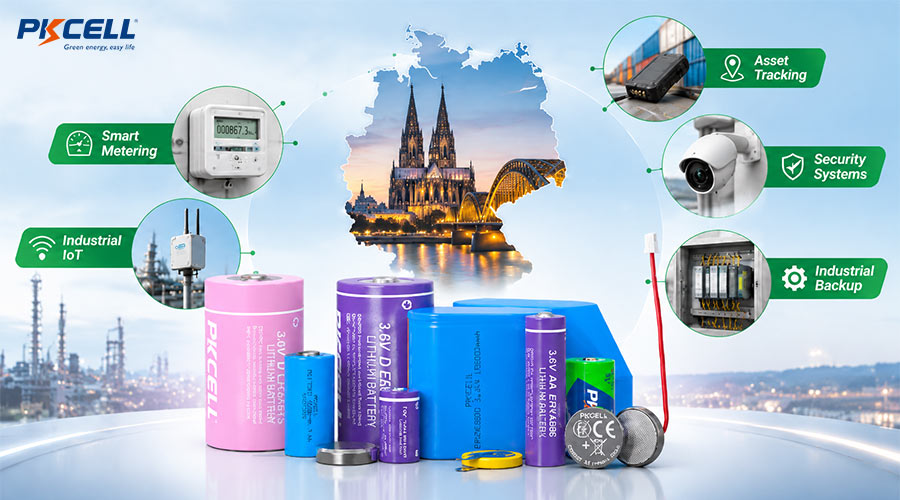
Three developments make 2026 a useful planning year for battery importers and distributors: continuing digital infrastructure deployment, an established German enforcement framework and a transition toward more structured battery data.
Connected infrastructure is expanding the installed base
Germany’s smart meter rollout offers a measurable example. According to the Bundesnetzagentur, 3,172,579 of the country’s reported metering locations had an intelligent metering system installed by June 30, 2026, representing 5.9% of reported locations. The long-term statutory direction is toward much broader deployment.
Not every smart electricity meter uses a primary lithium cell as its main power source. However, the broader digitalisation of utilities creates adjacent demand in gas and water metering, communication modules, shut-off valves, monitoring nodes, backup functions and remote infrastructure.
Distributors targeting this segment can review PKCELL’s
utility meter battery solutions
and its wider range of
3.6 V Li-SOCl2 batteries.
Battery compliance is becoming a commercial capability
The EU Batteries Regulation covers portable, industrial, light means of transport, electric vehicle and starter batteries. Germany supplements the European framework through the BattDG, which replaced much of the previous national battery law.
This changes what German buyers expect from suppliers. A competitive offer may need product classification, applicable conformity documentation, marking information, transport documents, traceability and support for producer-responsibility processes, not merely a datasheet and unit price.
Buyers are reducing field-service risk
A cheap battery that causes premature replacement can become expensive once technician time, travel, access permits and device downtime are included. German industrial buyers therefore tend to examine the complete operating profile: standby current, pulse load, temperature, cutoff voltage, storage history and service accessibility.
The distributor that can reduce qualification uncertainty and field-service risk becomes more valuable than the distributor that only moves inventory.
Where Industrial Battery Distributors Can Find Demand
| Opportunity segment | Typical device requirements | Potential battery architecture | Distributor value proposition |
|---|---|---|---|
| Utility metering and telemetry | Long standby life, low self-discharge, periodic communication and difficult field access | Li-SOCl2 cells or application-specific packs; pulse support where required | Qualified meter models, long-term supply planning and consistent production lots |
| Industrial IoT and predictive maintenance | Low average current with short wireless or sensing peaks | Li-SOCl2 plus a hybrid pulse capacitor, or spiral-type cells for higher loads | Load-profile review, sample testing and connector customisation |
| Asset and logistics tracking | GNSS acquisition, cellular transmission, temperature variation and compact construction | LiMnO2, Li-SOCl2 plus pulse support, or a custom primary lithium pack | Multiple form factors, local samples and duty-cycle validation |
| Security and building systems | Long standby periods followed by alarms, sirens or radio transmissions | LiMnO2, Li-SOCl2, LiFeS2 or button cells depending on the device | Broad SKU availability and support for OEM-specific terminals or leads |
| PLC, CNC and industrial memory backup | Stable backup power, controlled dimensions and dependable replacement availability | Compact Li-SOCl2 cells or assembled replacement packs | Cross-reference management, polarity control and replacement continuity |
| Remote environmental and infrastructure monitoring | Wide temperature exposure, low maintenance and intermittent data transmission | Li-SOCl2 or ER plus hybrid pulse capacitor packs | Application qualification and packaging adapted to the installation environment |
1. Smart meters and utility infrastructure
Utility projects reward predictable service life, traceable product changes and supply continuity. A distributor can add value by maintaining approved battery configurations, synchronising inventory with project phases and helping OEMs validate pulse performance at the lowest expected operating temperature.
2. Industrial IoT and remote sensors
An IoT sensor may sleep at microamp-level current and then request a much larger pulse for LoRaWAN, NB-IoT, LTE or GNSS activity. Selecting a cell from average current alone can produce voltage drop, resets or incomplete transmissions.
PKCELL’s
ER plus hybrid pulse capacitor battery packs
are designed for applications combining long standby periods with short high-current events. German distributors can turn this technical distinction into a specialised IoT product line instead of competing in a generic cell category.
3. Logistics and asset visibility
German manufacturing and logistics networks use tracking devices across pallets, containers, tools, trailers and returnable transport packaging. These deployments create repeat demand, but their power profiles vary widely. Reporting frequency, network coverage and cold-weather operation can matter more than the capacity printed on a cell.
4. Security, alarms and building technology
Wireless detectors, access systems and alarm equipment create opportunities for distributors able to offer several chemistries and formats. Compact devices may favour
3 V LiMnO2 batteries,
while long-life remote nodes may require Li-SOCl2 or a pulse-supported pack.
What Importers and Distributors Need to Know About Compliance
First define your economic-operator role
The words importer, distributor, producer and manufacturer are not interchangeable. A German company importing a battery directly from outside the EU may have different obligations from a reseller buying stock from an already compliant EU supplier.
An importer or distributor may also be treated as a manufacturer under the EU Batteries Regulation when it places a battery on the market under its own name or trademark, or modifies the battery in a way that could affect compliance. Private labelling therefore requires a legal and technical review before artwork or packaging is approved.
Registration and extended producer responsibility
Before placing batteries on the German market, determine who is the responsible producer and whether registration with Stiftung ear is required. Distributors are expected to verify producer registration before making batteries available.
Germany’s rules also connect market access with end-of-life responsibility. The Federal Ministry for the Environment states that distributors supplying industrial batteries must take back corresponding waste industrial batteries free of charge. The operational arrangement should therefore be agreed before commercial launch.
Conformity, documentation and language
Depending on the product and legal role, the compliance file may include an EU declaration of conformity, technical documentation, risk information, labels, CE marking and model-specific supporting records. Importers must retain a copy of the EU declaration of conformity for 10 years after a battery is placed on the market.
Required instructions and safety information must be understandable in the destination market. For Germany, this generally means planning for German-language customer-facing information rather than treating English documents as an automatic substitute.
PKCELL publishes an overview of its
battery certificates and compliance information.
Buyers should still confirm the documents applicable to the exact cell, pack construction and shipment.
Marking and the 2027 QR-code transition
The separate-collection symbol has applied to batteries under the EU framework since August 18, 2025. Additional general labels and non-rechargeable battery information are tied to the dates and implementing measures specified in Article 13 of the regulation.
From February 18, 2027, all batteries are scheduled to carry a QR code providing access to the applicable information. This should not be confused with the battery passport.
The 2027 battery passport applies to LMT batteries, electric vehicle batteries and industrial batteries with a capacity greater than 2 kWh. Small primary cells used in sensors and meters do not become passport batteries simply because they are sold to an industrial customer. Their precise legal classification and applicable QR information must nevertheless be checked.
Battery due diligence is a 2027 preparation issue
EU battery due-diligence obligations are scheduled to apply from August 18, 2027. The regulation includes an exemption for economic operators below the stated EUR 40 million turnover threshold when they are not part of a group exceeding that threshold on a consolidated basis.
Importers should not treat the delay as a reason to wait. Supplier mapping, material-policy review, contract clauses and document ownership all take time to establish.
How Distributors Can Build a Defensible Market Position
Sell application families
Organise inventory around meters, sensors, trackers, alarms and backup systems rather than listing hundreds of unrelated part numbers.
Provide local qualification support
Offer samples, current-profile review, cold-temperature pulse testing and controlled approval documentation.
Control product changes
Use agreed specifications, revision control and notification procedures so an approved battery does not change silently.
Hold strategic stock
Maintain local inventory for qualified high-rotation products while controlling storage conditions, shelf life and batch traceability.
Prepare compliance bundles
Match commercial offers with the correct declarations, transport records, safety documents and label files for each model.
Support custom integration
Add value through connectors, wire lengths, tabs, housings, fuses, insulation and customer-approved pack labels.
For custom projects, review PKCELL’s primary lithium battery pack capabilities and the custom battery pack RFQ checklist.
A Supplier Qualification Checklist for Germany
Before committing to recurring imports, verify the supplier and the exact product rather than accepting company-level claims as proof for every SKU.
- Confirm the battery classification: portable, industrial or another category under the EU Batteries Regulation.
- Identify the responsible operator: document who acts as manufacturer, importer, producer and distributor.
- Check model-specific documentation: request the applicable declaration, test records, technical information and safety documents.
- Review transport readiness: confirm UN 38.3 test-summary availability and the packaging instructions for the planned transport mode.
- Verify markings and labels: review CE marking, separate-collection marking, importer details, language and upcoming QR requirements.
- Define change control: agree how chemistry, materials, construction, terminals, labels or production locations may be changed.
- Validate the real device: test production-intent samples under relevant current, temperature and cutoff-voltage conditions.
- Plan traceability: align cell codes, pack labels, cartons, incoming inspection and complaint records.
- Plan storage and rotation: specify environmental limits, remaining shelf life and first-expiring-first-out processes.
- Set up end-of-life processes: define registration, reporting, take-back and producer-responsibility arrangements before launch.
Procurement teams can also use PKCELL’s guides to pre-production battery testing and primary lithium battery inventory management.
A Practical 90-Day Market-Entry Plan
Days 1-30: Define the market and compliance model
- Select two or three target applications instead of attempting to cover the whole battery market.
- Determine the expected legal role for each purchasing and branding model.
- Map required registrations, documents, labels and take-back responsibilities.
- Shortlist a compact range of cells and packs that addresses identifiable customer problems.
Days 31-60: Build the technical and commercial package
- Obtain controlled datasheets, certificates and transport information for each proposed model.
- Create German-language product pages and application-based selection tables.
- Order samples and test them in representative load profiles.
- Define MOQ, forecast, local stock, lead-time and change-notification arrangements.
Days 61-90: Validate demand
- Approach OEMs, system integrators, maintenance suppliers and specialised electronics distributors.
- Offer an application review rather than leading with a general catalogue.
- Track requests by application, annual volume, chemistry, documentation and customisation requirement.
- Use early qualification projects to decide which products deserve local inventory.
Common Mistakes to Avoid
- Competing only on cell price: this leaves little protection against another supplier offering a lower quote.
- Treating UN 38.3 as complete market compliance: transport testing does not replace product, conformity or producer-responsibility obligations.
- Assuming every industrially used cell is automatically a battery-passport product: the 2027 passport threshold for industrial batteries is greater than 2 kWh.
- Private labelling before reviewing legal responsibilities: putting a distributor’s trademark on a battery can change its regulatory role.
- Quoting battery life from nominal capacity alone: temperature, self-discharge, passivation, pulses and device cutoff voltage affect usable life.
- Holding stock without batch controls: uncontrolled storage can undermine the advantage of local availability.
Frequently Asked Questions
What is the best opportunity in Germany’s battery market in 2026?
For primary lithium distributors, the most accessible opportunities are long-life industrial devices such as utility meters, remote IoT sensors, security equipment, tracking devices and industrial backup systems. The best segment depends on the distributor’s technical expertise and customer network.
Does a German battery importer need to register as a producer?
It may. A company that first places batteries from another country on the German market can fall within the producer definition. The answer depends on the transaction, branding and supply chain, so the role should be confirmed before sales begin.
Do small Li-SOCl2 batteries require a battery passport in 2027?
The battery passport applies from February 18, 2027 to LMT batteries, EV batteries and industrial batteries above 2 kWh. Small Li-SOCl2 cells are normally far below that energy threshold. However, all batteries are scheduled to require a QR code from the same date, with content depending on the applicable category.
Which chemistry is suitable for German industrial IoT devices?
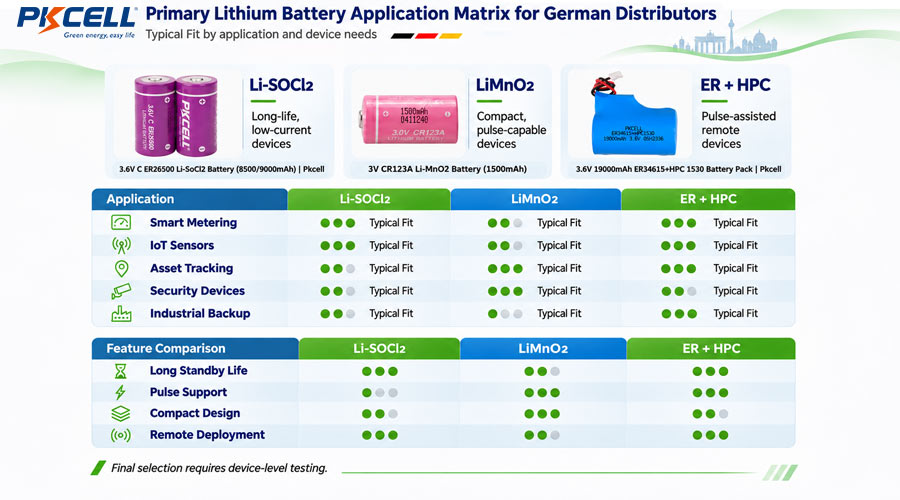
Li-SOCl2 is often considered for long-life, low-average-current devices. LiMnO2 can suit compact 3 V products with stronger pulse requirements. An ER cell combined with a hybrid pulse capacitor may be appropriate when a device sleeps for long periods but requires demanding wireless transmission peaks. The final choice must be validated against the actual load profile.
What information should a distributor include in a battery RFQ?
Include the application, voltage range, standby and peak current, pulse duration, operating temperature, target service life, maximum dimensions, connector, required documents, sample quantity, annual forecast and delivery destination.
Conclusion: The Opportunity Is in Reducing Buyer Risk
Germany’s battery market in 2026 offers room for specialised importers and distributors, but the strongest opportunity is not simply importing more cells. It is building a dependable bridge between battery manufacturing and German industrial requirements.
A distributor that combines application knowledge, controlled documentation, responsible market access, local availability and engineering communication can compete on measurable customer value. Smart meters, industrial IoT, logistics tracking and security equipment all provide potential entry points, especially when the product range is built around real operating profiles rather than catalogue size.
Discuss Your German Battery Distribution or OEM Project
Share your target application, battery model, annual demand, compliance requirements and customisation needs with PKCELL. The team can review suitable primary lithium cells, ER plus HPC solutions and custom pack options.
Editorial note: Compliance dates and delegated or implementing measures may change. Verify the latest official requirements before placing a specific battery model on the German market.
Post time: Nov-10-2026


