

ER Battery With HPC vs Supercapacitor: Key Design Differences for IoT Devices
Choosing between an ER battery with HPC and a conventional supercapacitor
is not simply a matter of comparing capacitance or peak current. The two options represent
different power architectures. An ER + HPC pack combines a long-life lithium thionyl
chloride energy source with a rechargeable pulse-support component, while a conventional
supercapacitor mainly stores short-term energy and still requires a suitable source,
charging path, and often additional voltage-management circuitry.
For smart meters, NB-IoT sensors, LoRaWAN trackers, alarms, and remote monitoring equipment,
the correct choice depends on the complete load profile: standby current, pulse amplitude,
pulse duration, minimum operating voltage, temperature, storage history, and required field life.
Short answer:
Choose an ER battery with HPC when the device needs years of low-power
operation plus periodic communication or actuator pulses. Consider a
conventional supercapacitor when extremely frequent cycling, very rapid
charge acceptance, or short-duration backup is more important and another energy source
is already available.
First, Clarify What Is Being Compared
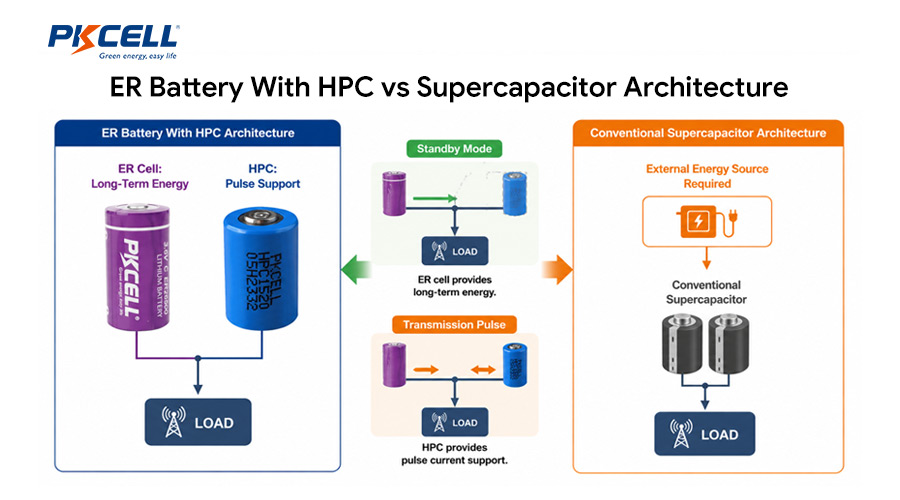
An ER + HPC system is not one large capacitor. It normally places a bobbin-type
Li-SOCl2 ER battery
in parallel with a Hybrid Pulse Capacitor. The ER cell stores most of the energy and supplies
the device’s low continuous current. The HPC accumulates energy between events and supports
brief high-current loads.
A conventional supercapacitor, commonly based on electric double-layer capacitor technology,
is primarily a high-power storage component. It can charge and discharge rapidly, but its
voltage decreases as stored charge is removed. It does not by itself provide the multi-year
energy reserve of a primary ER cell.
The practical comparison is therefore “a complete long-life primary power system with pulse
support” versus “a high-power storage component that must be integrated into a wider power system.”
This distinction is important because the term “HPC” is sometimes used too loosely. An HPC
combines battery-like and capacitor-like electrochemical behavior, but the performance of an
ER + HPC pack comes from the coordinated roles of both components.
ER Battery With HPC vs Supercapacitor: Comparison Table
| Design Factor | ER Battery With HPC | Conventional Supercapacitor |
|---|---|---|
| Primary purpose | Long-term energy plus periodic high-current pulses | Short-term energy storage, peak power, or ride-through |
| Main energy source | The primary Li-SOCl2 ER cell | An external charger, battery, power supply, or energy harvester |
| Standby suitability | Designed for low average current and long unattended service | Leakage current must be checked carefully in ultra-low-power devices |
| Pulse delivery | HPC supports communication, startup, valve, or actuator pulses | Excellent power delivery when correctly sized for ESR and voltage drop |
| Voltage behavior | The ER cell helps maintain the system supply between pulse events | Terminal voltage falls approximately in proportion to discharged charge |
| Single-cell voltage | PKCELL HPC models are commonly specified around 4 V; verify the exact model | Many EDLC cells are rated at 2.7–3.0 V, so series cells may be required |
| Series balancing | Often avoided in a single 3.6 V ER + HPC configuration | May require passive or active balancing when cells are connected in series |
| Cycle priority | Optimized for intermittent pulses over a long device deployment | Strong choice for very frequent charge-discharge cycling |
| System integration | Can be supplied as an engineered pack with leads, connectors, and protection | Requires source selection, charging control, voltage limits, and possible balancing |
| Typical applications | Smart meters, trackers, NB-IoT nodes, LoRaWAN sensors, alarms | Regenerative systems, UPS ride-through, peak shaving, frequent cycling |
These are architecture-level differences. Final performance must always be confirmed from the
exact ER cell, HPC or supercapacitor datasheet and tested with the real device.
Difference 1: Energy Capacity and Pulse Power Serve Different Jobs
An IoT device may consume only microamps during sleep but demand hundreds of milliamps or more
when its radio transmits. Average-current calculations can make such a device appear easy to
power, even though a short pulse may pull the supply below the modem’s cut-off voltage.
In an ER + HPC architecture, the ER cell is selected for total lifetime energy. The HPC is
selected for transient current. Splitting these jobs allows engineers to use a high-energy
bobbin ER cell without expecting it to deliver every pulse directly.
A supercapacitor can also buffer pulses, but it does not eliminate the need for a primary
energy source. Engineers must account for the energy used to recharge it, its leakage current,
voltage swing, and the electrical losses introduced by the charging path.
Difference 2: Voltage Drop Is More Than a Capacitance Problem
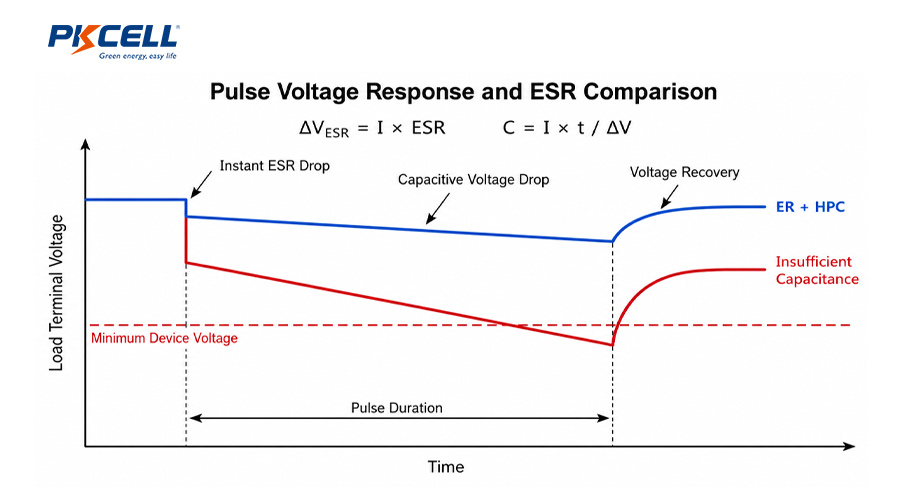
Two voltage-drop mechanisms should be evaluated during a pulse. The first is the gradual
voltage change caused by removing charge from the capacitor. The second is the immediate drop
created by equivalent series resistance, or ESR.
C = (Icap × tpulse) / ΔVallowedImmediate ESR-related drop:
ΔVESR = Ipulse × ESRThe available voltage margin must cover both effects, along with battery resistance, wiring,
connector resistance, temperature variation, aging, and component tolerances.
For example, specifying a large capacitance value does not guarantee a successful design if
ESR creates an instant voltage drop below the radio module’s minimum input voltage. Conversely,
selecting a low-ESR component does not ensure enough stored charge for a long pulse.
PKCELL’s
HPC sizing guide for NB-IoT applications
provides a practical starting point for collecting pulse current, duration, cut-off voltage,
recharge interval, battery resistance, and temperature data.
Difference 3: Passivation Changes the ER Battery Design
Lithium thionyl chloride chemistry naturally forms a passivation layer on the lithium anode.
This layer helps limit self-discharge, which supports long storage and operating life.
However, it can also increase initial impedance and cause voltage delay after prolonged
storage or extended low-current operation.
Passivation becomes particularly relevant when a device wakes from a long sleep and immediately
starts a radio transmission, motor, valve, or sensor heater. The open-circuit voltage may look
normal while the loaded voltage still drops below the system threshold.
In a correctly engineered ER + HPC pack, the HPC supports the demanding pulse while the ER
cell supplies the average energy and replenishes the pulse helper between events. Learn more
in PKCELL’s guide to
LiSOCl2 battery passivation
.
A conventional supercapacitor can also reduce the pulse imposed on the ER cell, but it must
be selected and integrated as part of the circuit. Simply adding a supercapacitor without
calculating inrush current, leakage, ESR, recharge time, and voltage limits can create new
reliability problems.
Difference 4: Leakage Current Can Decide the Real Field Life
In a device expected to operate for five, ten, or more years, every continuous current path
matters. A supercapacitor’s leakage, balancing resistors, DC-DC converter quiescent current,
protection circuit, and sensing network may consume a meaningful share of the total energy budget.
This does not mean a supercapacitor is inherently unsuitable. It means leakage must be measured
at the intended voltage and temperature rather than treated as a minor datasheet detail.
Leakage can also change during initial charging and stabilization.
An ER + HPC solution intended for long-life IoT service can reduce integration uncertainty
because the ER cell and pulse component are selected as a coordinated system. Even so, the
complete pack must still be tested against the device’s sleep-current target.
Difference 5: Cell Voltage and Balancing Affect Circuit Complexity
Many conventional EDLC supercapacitor cells have working-voltage ratings below a 3.6 V ER
battery’s open-circuit level. Connecting multiple EDLC cells in series increases the supported
voltage but introduces voltage-sharing concerns.
Capacitance tolerance and leakage differences can cause one series cell to experience more
voltage than another. Passive balancing adds a continuous current path, while active balancing
adds components and control complexity. Eaton’s supercapacitor application guidance notes that
balancing selection is application-specific and that passive networks must be designed in
relation to capacitor leakage.
PKCELL HPC components are designed for use with pulse-type battery systems. As one model
example, the
HPC1530
is specified with a 4 V nominal voltage, a 4.1 V maximum charge voltage, and a model-specific
pulse-current capability. These figures should not be applied to every HPC model; designers
should select among HPC1520, HPC1530, HPC1550, or other options using the relevant datasheet.
Need an ER + HPC Recommendation?
Send PKCELL your sleep current, peak current, pulse duration, minimum voltage, temperature
range, battery compartment size, and target service life. An engineer can recommend an ER
cell, HPC model, pack structure, leads, and connector for prototype testing.
Request an Engineering Recommendation
View ER + HPC Solutions
Difference 6: Temperature Must Be Evaluated at System Level
Low temperature can increase the internal resistance of the ER cell, the HPC, or a
supercapacitor. High temperature can accelerate leakage and aging. The usable operating range
of a finished pack is therefore determined by the intersection of all component limits, not
by the widest temperature rating printed on one component.
Engineers should repeat pulse tests at the minimum specified temperature, after representative
storage, and near the expected end of battery life. A pulse system that works with fresh
components at room temperature may behave differently after years of low-current service.
Temperature derating is also important. A component may technically tolerate an elevated
temperature while requiring a lower applied voltage or delivering less usable pulse performance.
Always review the model-specific datasheet and test plan.
When an ER Battery With HPC Is Usually the Better Choice
Choose ER + HPC When
- The device must operate unattended for several years.
- Standby consumption is low but wireless pulses are much higher.
- The product uses NB-IoT, LTE-M, LoRaWAN, GNSS, or another burst load.
- Storage before activation could increase passivation-related voltage delay.
- A compact, factory-assembled pack will simplify OEM production.
- Custom wires, connectors, tabs, housing, or protection are required.
Consider a Supercapacitor When
- An external energy source is continuously or frequently available.
- The application performs a very high number of deep charge-discharge cycles.
- Rapid energy recovery or regenerative energy capture is a main requirement.
- Short ride-through time matters more than multi-year stored energy.
- The design can accommodate charging, balancing, and voltage-conversion circuitry.
- The system team can manage leakage and state-of-charge behavior.
For a broader view of long-life industrial battery choices, visit PKCELL’s
Primary Lithium Battery Solution Hub
.
OEMs requiring finished assemblies can also review
custom primary lithium battery packs
.
Engineering Checklist Before Selecting Either Solution
A supplier cannot select a reliable pulse solution from nominal capacity alone. Prepare the
following information before requesting samples:
- Sleep current: Include the actual board-level value, not only the MCU specification.
- Peak current: Capture the worst transmission, startup, actuator, or retry event.
- Pulse duration: Record the complete waveform, including repeated sub-pulses.
- Minimum voltage: Identify the cut-off of the modem, MCU, regulator, and other critical loads.
- Recharge interval: Confirm whether the pulse component recovers before the next event.
- Temperature range: Include transport, storage, startup, and operation conditions.
- Pre-deployment storage: State how long the finished device may remain inactive.
- Target lifetime: Define both expected and worst-case communication frequency.
- Mechanical limits: Provide available diameter, length, wiring, connector, and enclosure data.
- Compliance needs: Identify transport documentation, safety tests, and market requirements.
Test More Than Open-Circuit Voltage
Open-circuit voltage is not enough to validate a high-pulse battery system. Prototype testing
should record minimum voltage during the pulse, voltage recovery, repeated-pulse behavior,
recharge time, temperature rise, and performance after storage.
Testing should also reproduce poor network conditions. Weak-signal NB-IoT or cellular devices
may transmit more often or at higher power than the nominal software profile suggests.
Validate End-of-Life Conditions
A fresh battery has the greatest energy reserve and often the lowest impedance. The difficult
case may occur near the end of the deployment, at low temperature, after inactivity, or during
repeated communication retries. Use representative aged components or an agreed accelerated
test method rather than relying solely on initial samples.
Common Design Mistakes
- Selecting only by amp-hour capacity and ignoring pulse voltage.
- Using a generic supercapacitor value without calculating ESR-related voltage drop.
- Ignoring leakage current in a multi-year energy budget.
- Connecting low-voltage supercapacitor cells in series without proper balancing.
- Assuming every HPC model has the same voltage, pulse current, or temperature range.
- Testing only at room temperature with a fresh battery.
- Using the modem’s typical current instead of measuring the complete device waveform.
- Failing to allow enough time for the pulse component to recharge between events.
Frequently Asked Questions
Is an HPC the same as a conventional supercapacitor?
No. An HPC is a hybrid electrochemical pulse-storage component with both battery-like and
capacitor-like characteristics. A conventional EDLC supercapacitor stores energy mainly
through electric double-layer capacitance. Their voltage limits, leakage, energy density,
ESR, and cycling behavior can differ substantially.
Can a supercapacitor replace the ER battery in an IoT sensor?
Usually not when the sensor must operate for years without an external power source.
A supercapacitor can provide high power, but its stored energy and voltage behavior are
different from a high-energy primary ER cell. It is more commonly used as a pulse buffer
or short-term backup component.
Does an ER + HPC pack eliminate LiSOCl2 passivation?
It does not remove the underlying chemical phenomenon. Instead, the HPC can reduce the
electrical stress placed on the ER cell during high-current events and help maintain the
device voltage while the ER cell supplies long-term energy.
How do I size an HPC for an NB-IoT transmission pulse?
Start with peak current, pulse duration, available battery contribution, permitted voltage
drop, capacitor ESR, recharge interval, and minimum temperature. The charge-balance formula
is useful for an initial estimate, but the result must be validated with the real modem
waveform and system cut-off voltage.
Which PKCELL HPC model should I use?
The choice among HPC1520, HPC1530, HPC1550, and other configurations depends on pulse
current, duration, available space, temperature, and recharge time. Review the
Hybrid Pulse Capacitor Series
and ask PKCELL to verify the selection against your load profile.
Can PKCELL customize an ER + HPC battery pack?
PKCELL supports OEM pack configurations including ER cell selection, HPC matching, wiring,
tabs, connectors, pack structure, and application-specific testing. Provide the electrical,
environmental, mechanical, and project requirements when requesting a recommendation.
Conclusion: Select the Architecture, Not Just the Component
The most important difference in the ER battery with HPC vs supercapacitor
decision is the role each option plays. ER + HPC is a long-life primary power architecture
designed to combine stored energy with intermittent pulse capability. A conventional
supercapacitor is a high-power component that must be charged and managed by the rest of the system.
For smart meters, remote sensors, GPS trackers, and LPWAN devices, ER + HPC is often the more
direct solution when long standby life and reliable bursts must coexist. Supercapacitors remain
valuable when frequent cycling, rapid charge acceptance, or short ride-through performance is
the dominant requirement.
Turn Your Load Profile Into a Testable Battery Specification
Share your device waveform, cut-off voltage, operating temperature, mechanical space, and
service-life target with PKCELL. The engineering team can help identify a suitable ER + HPC
configuration and prepare samples for device-level validation.
Post time: Aug-05-2026


