

CR123A vs ER14505: Best Battery for Wireless Sensors
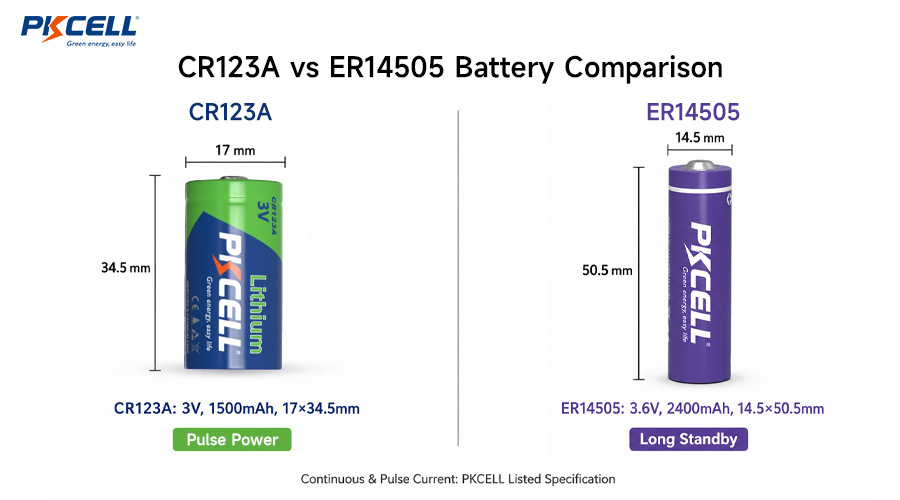
CR123A and ER14505 are both primary lithium batteries commonly considered for wireless sensors, alarms and remote monitoring devices. However, they use different chemistries, operate at different nominal voltages and deliver current in very different ways.
CR123A is a compact 3V lithium manganese dioxide battery known for strong pulse performance. ER14505 is an AA-size 3.6V lithium thionyl chloride battery designed for high energy density, low self-discharge and long low-current operation.
OEM buyers can review the
PKCELL CR123A battery
and PKCELL ER14505 battery
before requesting samples for circuit-level validation.
CR123A vs ER14505: Key Specifications
| Specification | CR123A | ER14505 | Why It Matters |
|---|---|---|---|
| Typical chemistry | Lithium manganese dioxide, Li/MnO2 | Lithium thionyl chloride, Li-SOCl2 | Chemistry affects voltage, capacity, current delivery and storage behavior. |
| Nominal voltage | 3.0V | 3.6V | The batteries cannot be exchanged without confirming the sensor’s voltage limits. |
| PKCELL listed capacity | 1500mAh | 2400mAh | ER14505 provides more nominal capacity, but available energy depends on load conditions. |
| Nominal energy estimate | Approximately 4.5Wh | Approximately 8.6Wh | Energy is calculated from nominal voltage multiplied by rated capacity and is not a runtime guarantee. |
| Dimensions | Approximately 17.0 x 34.5mm | Approximately 14.5 x 50.5mm | CR123A is shorter and wider; ER14505 uses an AA-size cylindrical format. |
| Reference weight | Approximately 16g | Approximately 19g | Weight may affect compact or wearable sensor designs. |
| PKCELL listed maximum continuous current | 1500mA | 100mA | CR123A is positioned for substantially stronger current delivery. |
| PKCELL listed maximum pulse current | 3000mA | 200mA | Pulse definitions and durations must be confirmed in the final datasheet. |
| PKCELL listed operating range | -40 to +85 degrees C | -55 to +85 degrees C | Available capacity and pulse output are not constant across the entire range. |
| Typical design priority | Compact size and pulse power | High energy and long low-drain life | The sensor’s duty cycle should determine the better chemistry. |
The current figures above are taken from PKCELL’s listed product specifications. Maximum-current ratings from different suppliers may use different pulse durations, rest periods, cutoff voltages and temperature conditions. Compare the final project datasheets before approving a battery.
How Battery Chemistry Affects Wireless Sensors
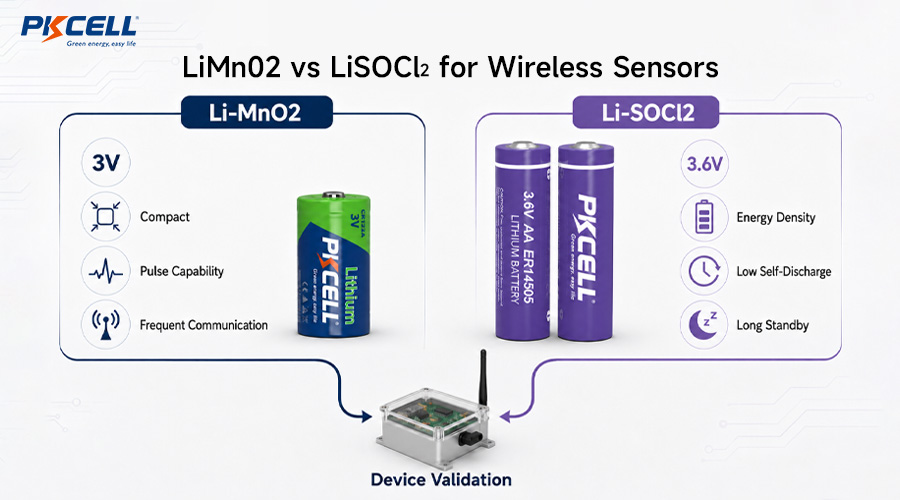
CR123A: Li-MnO2 for Compact Pulse Power
CR123A uses lithium manganese dioxide chemistry and provides a nominal 3V output. It is widely used in motion detectors, cameras, alarm accessories and other devices that spend time in standby but require strong current when sensing, processing or transmitting an event.
Its relatively short cylindrical format can also suit sensors that have enough diameter but limited length. The chemistry typically has less pronounced passivation behavior than a bobbin-type Li-SOCl2 cell.
PKCELL’s broader
LiMnO2 battery range
includes CR123A and other cylindrical 3V primary lithium formats.
ER14505: Li-SOCl2 for Long Standby Life
ER14505 uses lithium thionyl chloride chemistry and has a nominal voltage of 3.6V. Its high energy density and low self-discharge make it a strong candidate for remote sensors expected to operate for years at very low average current.
Typical applications include meter endpoints, remote monitoring nodes, environmental sensors and detectors that transmit infrequently. Standard bobbin-type ER14505 cells prioritize stored energy and low-rate operation rather than high unsupported pulses.
CR123A prioritizes pulse delivery in a compact 3V format. ER14505 prioritizes long-duration energy in a 3.6V AA-size format. Capacity alone does not determine which battery will keep a radio online.
Wireless Transmission and Pulse Current
A wireless sensor rarely draws one constant current. A typical cycle may include deep sleep, sensor sampling, processor startup, radio transmission, receive windows and retries. The battery must support both the total lifetime energy and the highest loaded-current event.
A simplified loaded-voltage estimate is:
Total resistance includes the cell, aging effects, tabs, welds, wires, connector, holder and PCB path. Cold temperature and a low state of charge can increase voltage drop.
When CR123A Has the Advantage
CR123A is usually the easier choice when the sensor has frequent RF events, higher processor demand, indicator LEDs, camera activation or alarm output. Its pulse capability can simplify the design because the cell may support the radio directly without a separate pulse-assistance component.
When ER14505 Needs Pulse Support
A standard ER14505 may support low-power radios with moderate pulses, but cellular, NB-IoT, LoRaWAN, GNSS and repeated weak-signal retries can demand more current than an energy-type bobbin cell should supply alone.
Possible engineering directions include:
- An ER Power or spiral-type Li-SOCl2 cell
- A correctly sized external pulse capacitor
- An ER14505 combined with a hybrid pulse capacitor
- A custom parallel or multi-cell battery assembly
- Radio firmware changes that reduce peak current or retries
For sensors combining multi-year standby with stronger communications, review PKCELL’s
primary lithium battery solution hub
and its ER14505 + HPC battery solution.
ER14505 Passivation and First-Transmission Reliability
Li-SOCl2 batteries naturally develop a passivation layer on the lithium anode. This layer limits unwanted internal reactions and contributes to low self-discharge and long storage life.
The same layer can temporarily restrict current after long storage or extended low-current standby. When a sudden load is applied, the battery may show an initial voltage drop before recovering. This behavior is commonly called voltage delay.
Passivation is especially important for sensors that remain inactive for months or years before sending a critical message. Examples include:
- Emergency buttons and panic alarms
- Flood, smoke or gas detectors
- Remote asset sensors with infrequent reports
- Backup monitoring nodes
- Seasonal agricultural or environmental equipment
Which Battery Is Better for Different Wireless Sensors?
| Wireless Sensor Type | Likely Starting Point | Selection Reason | Critical Test |
|---|---|---|---|
| PIR motion detector | CR123A | Compact format and repeated sensing or RF pulses | High-traffic operation at the lowest temperature |
| Door or window contact sensor | CR123A or ER14505 | Depends on voltage, reporting frequency and target life | Repeated open-close events and radio messages |
| Infrequent remote environmental sensor | ER14505 | Low average current and long unattended deployment | First transmission after extended standby |
| Wireless utility endpoint | ER14505 or ER + pulse support | High lifetime energy and low self-discharge | Scheduled reports, retries and end-of-life voltage |
| Compact camera or image sensor | CR123A or custom LiMnO2 pack | Image capture and transmission may require stronger current | Capture, processing and radio activity occurring together |
| LoRaWAN sensor | ER14505 with validation or pulse support | Long standby is attractive, but TX pulses must be supported | Maximum transmit power and repeated retries |
| NB-IoT or cellular sensor | ER Power or ER + HPC | Network connection and retries can create strong pulses | Weak-signal attach, transmission and retry sequence |
| Wireless alarm accessory | CR123A, ER14505 or custom pack | Depends on standby duration and alarm current | Full alarm event near projected battery end of life |
PKCELL’s
wireless alarm battery guide
covers additional detector, siren and alarm-current scenarios.
Choose CR123A When
- The circuit is designed for a 3V battery.
- The sensor enclosure favors a short cylindrical cell.
- Radio, camera or alarm pulses are frequent or relatively strong.
- You want to reduce dependence on an external pulse capacitor.
- The device already uses an approved CR123A power architecture.
Choose ER14505 When
- The circuit accepts a 3.6V Li-SOCl2 supply.
- Average current is low and the service-life target is long.
- An AA-size battery space is available.
- Reports are infrequent or pulse assistance is included.
- Passivation and first-transmission behavior can be validated.
Can CR123A Replace ER14505?
No. CR123A and ER14505 are not direct replacements. They differ in voltage, chemistry, dimensions, capacity and discharge behavior.
- CR123A provides a nominal 3V; ER14505 provides 3.6V.
- CR123A is approximately 17 x 34.5mm; ER14505 is approximately 14.5 x 50.5mm.
- CR123A prioritizes pulse capability; standard ER14505 prioritizes low-rate energy.
- The battery holders and enclosure geometry are different.
- Changing chemistry may affect certification, safety and low-battery detection.
OEM Selection Process for Wireless Sensor Batteries
- Define the accepted voltage range.
Include fresh-cell voltage, loaded voltage, regulator limits and low-battery threshold. - Measure the complete duty cycle.
Record sleep, sensing, processing, transmit, receive and retry currents. - Measure the worst pulse.
Test maximum radio power, simultaneous sensing and communication, and weak-signal retries. - Set the lifetime target.
Include warehouse storage, assembly, distribution and field operation. - Map the temperature profile.
Consider cold starts, solar heating, seasonal exposure and storage conditions. - Evaluate passivation.
For ER14505, test the first critical event after representative storage or standby. - Define the battery assembly.
Confirm tabs, leads, connectors, insulation, protection and pulse-support components. - Validate production samples.
Test the final cell, wiring, connector, enclosure, firmware and radio together.
For projects requiring custom wiring, connectors, series or parallel configurations, or capacitor-assisted output, review PKCELL’s
custom primary battery services.
Bulk Purchasing Checklist
- Exact chemistry, model and approved datasheet revision
- Nominal and maximum voltage requirements
- Capacity test current, cutoff voltage and temperature
- Pulse magnitude, duration, frequency and recovery time
- Passivation and storage-history requirements
- Tabs, wires, connector, polarity and insulation drawing
- Production date and remaining shelf life
- Sample, pilot-run and lot-traceability support
- Required safety and transport documentation
- MOQ, lead time and long-term supply plan
Safety and Handling
- CR123A and ER14505 are primary, non-rechargeable batteries.
- Do not charge, short-circuit, crush, puncture, heat or burn them.
- Do not solder directly to a standard bare cell.
- Use the correct voltage, polarity and approved battery assembly.
- Do not mix chemistries, models, production lots, or new and used cells.
- Store batteries in a dry, controlled environment away from conductive objects.
- Dispose of depleted batteries according to applicable local requirements.
Frequently Asked Questions
Which battery lasts longer, CR123A or ER14505?
ER14505 usually provides more nominal energy and may last longer in a low-current sensor. CR123A may perform better when frequent or strong pulses would otherwise reduce the usable energy of a standard ER14505.
Which battery is better for a PIR sensor?
CR123A is often a practical starting point because PIR detectors can require repeated processing and radio pulses. ER14505 may work in a 3.6V design when the pulse profile has been validated.
Can ER14505 support LoRaWAN transmissions?
It may support a suitably optimized LoRaWAN sensor, but maximum transmit power, pulse duration, cold temperature and retries must be tested. A capacitor, ER Power cell or ER + HPC solution may be required.
What is ER14505 voltage delay?
It is a temporary loaded-voltage drop associated with the passivation layer in Li-SOCl2 batteries, often observed after storage or prolonged low-current standby.
Can I replace CR123A with ER14505?
No. They have different voltages, dimensions, chemistries and current characteristics. Any change requires a redesigned and validated power system.
Can PKCELL supply custom sensor battery packs?
PKCELL supports selected wires, connectors, tabs, insulation, series or parallel assemblies and capacitor-assisted primary battery solutions for OEM projects.
Conclusion
CR123A is generally the stronger candidate for compact 3V wireless sensors that require reliable pulse power. ER14505 is typically better for 3.6V sensors with very low average current and a multi-year service-life target.
For wireless devices combining long standby with high-current communication, a standard ER14505 may need an external capacitor, an ER Power construction or an ER + HPC pack. The final decision should be based on measured current waveforms, minimum loaded voltage, temperature testing and first-transmission performance after storage.
Post time: Aug-31-2026


