

Best Batteries for Wireless Alarm Systems: OEM Guide
The best battery for a wireless alarm system must do two very different jobs. It must
support years of low-current standby while remaining ready to deliver an immediate pulse
for sensing, radio transmission, a siren, a cellular connection, or an actuator.
For alarm OEMs, security-system integrators, distributors, and contract manufacturers,
battery selection also affects certification, enclosure design, assembly time, shipping,
field-maintenance cost, and supply continuity.
Quick OEM answer:
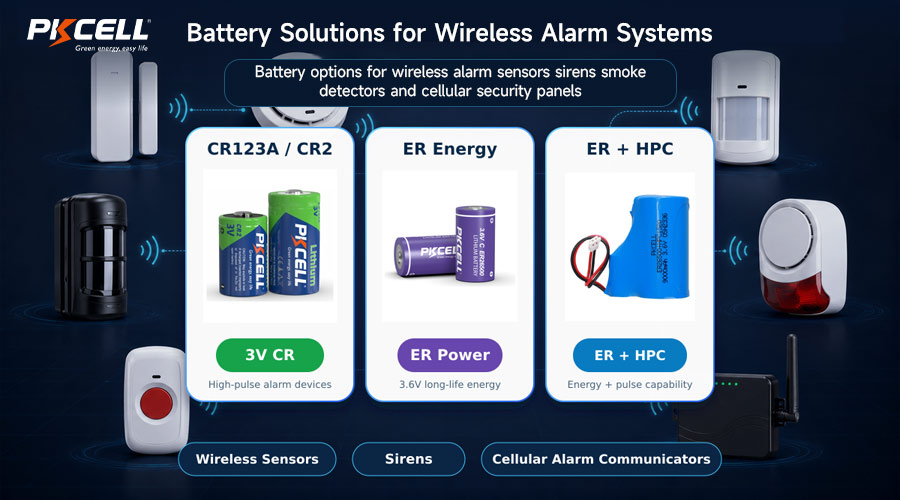
CR123A and CR2 LiMnO2 batteries are practical starting points for compact 3 V wireless
sensors with pulse loads. LiSOCl2 ER batteries are better suited to long-life 3.6 V
detectors with low average current. Use ER Power cells for heavier loads, or consider
an ER + HPC pack when the system combines multi-year standby with demanding radio,
cellular, siren, or actuator pulses.
There Is No Universal Best Alarm Battery
A magnetic door contact, PIR motion detector, smoke alarm, outdoor siren, panic button, and
cellular alarm panel do not share the same current profile. Selecting one battery chemistry
for every device in a security product family can lead to unnecessary cost, shorter life, or
voltage failure during an alarm event.
Battery selection should begin with four questions:
- What voltage range can the device safely accept?
- How much energy is required over the complete service life?
- What is the highest current pulse or continuous alarm load?
- What loaded voltage must be maintained at the worst temperature and end of life?
A battery can have enough remaining capacity and still fail an alarm event if its loaded
voltage falls below the radio, MCU, siren, or actuator threshold.
PKCELL’s
Primary Lithium Battery Solution Hub
provides a starting point for comparing LiMnO2, LiSOCl2, ER + HPC, and customized battery packs.
Wireless Alarm Load Profiles
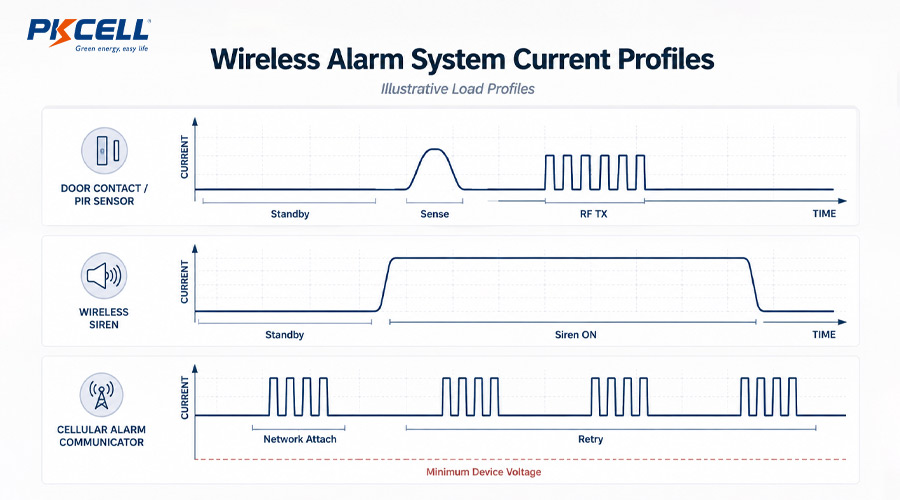
| Alarm Device | Typical Load Pattern | Battery Starting Point | Critical OEM Test |
|---|---|---|---|
| Door or window contact sensor | Very low standby with short RF transmissions | CR2, CR123A, ER14250, or ER14505 | Repeated open-close events and RF transmissions at minimum temperature |
| PIR motion detector | Continuous sensing with activity-dependent radio pulses | CR123A, CR2, or ER14505 | High-traffic operation with the shortest expected reporting interval |
| Glass-break or vibration sensor | Low standby with signal processing and alarm transmission | CR123A, ER14505, or ER Power | Sensor processing and radio pulse occurring at the same time |
| Smoke, heat, gas, or CO alarm | Long standby with alarm indicator, radio, buzzer, or sounder load | Application-approved CR or ER solution | Full alarm duration and low-battery warning behavior |
| Wireless siren | Low standby followed by sustained high alarm current | LiMnO2 pack, ER Power, or custom multi-cell pack | Required sounder duration at cold temperature and end-of-life voltage |
| Panic button or emergency pull station | Multi-year standby with brief critical transmission | CR123A, ER14505, ER17505, or high-capacity ER cell | First transmission after long storage or inactivity |
| Outdoor perimeter detector | Sensing, processing, communication, and environmental exposure | ER14505, ER34615, ER Power, or custom pack | Cold soak, repeated alarms, and enclosure-temperature testing |
| Cellular alarm communicator | Low standby with network attach, TX, RX, and retry pulses | ER Power or ER + HPC | Weak-signal connection attempts and repeated transmissions |
Best Battery Types for Wireless Alarms
LiMnO2 CR Batteries
CR123A and CR2 cells provide a nominal 3 V output, compact size, and good pulse
performance. They suit many PIR detectors, cameras, wireless transmitters, door sensors,
and professional alarm accessories.
LiSOCl2 ER Batteries
ER cells provide a nominal 3.6 V output, high energy density, and low self-discharge.
They are strong candidates for long-life detectors, panic buttons, remote alarm nodes,
and devices with low average current.
ER + HPC Packs
ER + HPC combines long-term LiSOCl2 energy with a rechargeable pulse-support component.
It suits devices that sleep for long periods but require high-current cellular,
LoRaWAN, siren, GNSS, or actuator events.
LiMnO2 for Compact 3 V Alarm Devices
PKCELL’s
LiMnO2 battery range
includes CR123A, CR2, CR14505, CR17450, and other cylindrical formats. These cells are useful
when the circuit is designed for a 3 V primary lithium source and requires a stronger pulse
response than a low-rate energy cell.
CR123A is frequently used in motion sensors, security cameras, alarm accessories, and
professional electronics. CR2 provides a more compact option for smaller sensors.
PKCELL’s
CR123A versus CR2 comparison
explains their dimensional and capacity differences.
LiSOCl2 for Long-Life Wireless Detectors
Bobbin
ER Energy Type batteries
prioritize high capacity, low self-discharge, and long low-current operation. Common starting
models include ER14250, ER14505, ER17505, ER26500, and ER34615.
PKCELL has documented applications using an
ER34615 security-alarm battery
for door sensors, motion detectors, glass-break sensors, outdoor alarm nodes, and emergency buttons.
ER Power for Higher Current
Spiral
ER Power Type batteries
provide a larger electrode interface and lower internal resistance than energy-oriented
bobbin cells. They may be better suited to alarm devices with higher continuous current,
frequent radio activity, or stronger unsupported pulses.
ER + HPC for Long Standby and High Pulses
In an
ER + HPC battery pack
,
the ER cell supplies lifetime energy while the HPC supports short high-current events. This
can reduce voltage sag during cellular transmission, siren startup, wireless retries, or
actuator operation.
without circuit validation. The voltage difference, dimensions, discharge curve, and
pulse behavior can affect the alarm electronics and certification.
Capacity and Pulse Current Must Be Checked Separately
Nominal amp-hour capacity estimates how much energy may be available under specified
datasheet conditions. It does not prove that the battery can support the highest alarm load.
Iavg = Σ(I × t) / Tcycle
Simplified loaded-voltage estimate:
Vload ≈ VOCV − Iload × Rsystem
Rsystem includes the cell, tabs, welds, wires, connector, protection devices,
and PCB paths. Temperature, storage, passivation, and aging can increase the effective
resistance.
OEM engineers should test both lifetime energy and minimum pulse voltage. A high-capacity
battery that resets the radio is unsuitable, while a high-power battery that cannot meet the
target service life is also unsuitable.
Passivation and First-Alarm Reliability
LiSOCl2 batteries naturally develop a protective passivation layer on the lithium anode.
This contributes to low self-discharge, but it can also cause initial voltage delay after
long storage or extended low-current standby.
This matters in panic buttons, emergency pull stations, remote detectors, and other devices
that may remain inactive for years before their first critical alarm.
Test the first alarm event after representative storage, at the minimum temperature, and
with the real radio or sounder load. PKCELL’s
LiSOCl2 passivation guide
provides a detailed loaded-voltage and recovery test approach.
Temperature and Outdoor Alarm Performance
Low temperature increases internal resistance and voltage sag. High-temperature storage can
accelerate self-discharge and aging. The broad operating range in a cell datasheet does not
mean identical capacity or pulse current is available at every temperature.
Outdoor alarm qualification should include:
- Cold soak of the complete device until the battery reaches thermal equilibrium
- First alarm event after storage
- Repeated wireless messages or cellular retries
- Full required siren or sounder duration
- Battery performance near the expected end of life
- Enclosure temperature under direct sunlight or high ambient heat
Example PKCELL Alarm and Detector Projects
Application history does not replace testing, but it can help procurement teams identify
suppliers with relevant engineering and production experience.
| Application Example | Battery Direction | Procurement Relevance |
|---|---|---|
| European burglar alarm system | Customized ER17505 LiSOCl2 pack | High capacity, custom integration, long service target, and export support |
| French wireless detector program | ER34615 LiSOCl2 battery | Sample validation, lifetime analysis, and production scaling |
| North American wireless security sensors | Customized ER341245 pack with wires and connectors | Ready-to-integrate assembly and reduced OEM installation work |
| Connected IoT device with pulse loads | ER battery with LIC or HPC support | Mechanical redesign, pulse support, and production-line integration |
Read the
burglar alarm battery case
and
wireless detector battery projects
for application-specific examples.
Need a Battery Recommendation for an Alarm Product?
Send PKCELL your alarm type, operating voltage, sleep current, alarm current, pulse
waveform, sounder duration, temperature range, target life, enclosure drawing, connector,
sample quantity, and annual forecast.
Request an Engineering Recommendation
Explore Security Battery Applications
Certifications: Battery vs. Alarm System
A battery document and an alarm-system certification serve different purposes. Battery
certification can support cell safety, transport, materials compliance, and supplier
quality. The finished alarm device must still meet the standards and regulatory requirements
applicable to its product category and destination market.
Battery and Supplier Documentation
| Document or Standard | Purpose | OEM Verification |
|---|---|---|
| ISO 9001 | Quality-management system | Check validity, manufacturing entity, accredited issuer, and scope. |
| ISO 14001 | Environmental-management system | Confirm the responsible site and certificate scope. |
| UN 38.3 | Lithium cell and battery transport testing | Confirm the exact cell or battery-pack model in the test summary. |
| IEC 60086-4 | Safety requirements for primary lithium batteries | Check the applicable edition, model coverage, and supporting report. |
| UL 1642 | Safety evaluation for applicable lithium cells | Verify the model designation and certificate status. |
| SDS or MSDS | Composition, handling, hazard, and transport information | Request a current document matching the quoted chemistry. |
| CE, RoHS, and REACH documentation | Applicable market conformity and substance requirements | Verify the declaration issuer, report date, and exact product scope. |
IEC describes IEC 60086-4 as covering safety tests and requirements for primary lithium
batteries under intended use and reasonably foreseeable misuse. The United Nations Manual
of Tests and Criteria contains subsection 38.3 for lithium cell and battery transport testing.
Finished Alarm Product Standards
Depending on the device and market, finished-product standards may include UL 217 for smoke
alarms, UL 268 for smoke detectors used in fire-alarm systems, UL 2034 for carbon-monoxide
alarms, EN 14604 for smoke-alarm devices, EN 54-series standards for fire-detection products,
or other regional intrusion and alarm-system requirements.
the finished wireless alarm. Likewise, a cell-level report may not cover a customized
multi-cell pack. Confirm the exact cell, pack, alarm-device, and destination-market scope
with the relevant laboratory or certification body.
Review PKCELL’s
certificate overview
and request current documents for the exact model and pack configuration being quoted.
Factory Capacity for OEM Alarm Programs
Alarm manufacturers need more than an acceptable laboratory sample. The supplier must be
able to reproduce the approved cell or pack across pilot production, mass production, and
repeat orders without uncontrolled changes.
According to PKCELL company information and the supplied corporate profile, its manufacturing
resources include:
Factory and Team
Approximately 28,000 square meters of factory space and a professional team of more than
400 people across development, production, testing, and delivery.
Production Scale
More than 20 automated production lines, with reported annual production capacity of
approximately one billion cells.
Quality Controls
More than 100 internal quality-control processes, with automated inspection coverage at
critical manufacturing stages.
PKCELL company materials also report service across more than 150 countries and regions,
more than 10,000 B2B customers, and a network of global logistics and distribution partners.
Available capacity and delivery dates should still be confirmed for the exact alarm-battery
model, connector, and forecast.
OEM Supply Questions to Ask
- Can the supplier support the pilot quantity and the three-year demand forecast?
- Which cell, connector, and pack components have the longest lead times?
- How are production lots and inspection results traced?
- Is a change-notification process available for materials, processes, or drawings?
- Can capacity be reserved through a forecast or blanket order?
- What contingency options exist for urgent replenishment or demand growth?
Custom Battery Packs for Alarm OEMs
A ready-to-install battery pack can reduce welding, wiring, inspection, and assembly work in
the alarm factory. PKCELL supports
customized primary lithium battery packs
with:
- Solder tabs, axial leads, wires, cables, and connectors
- Series and parallel cell configurations
- Custom voltage and capacity directions
- Shrink wrap, insulation, housings, and labels
- Specified wire gauge, length, polarity, and pinout
- Pulse-support components when required
- Device-specific mechanical and electrical testing
Approve a controlled drawing and golden sample before mass production. The specification
should identify the cell model, pack configuration, dimensions, polarity, connector, pinout,
wire, label, test criteria, packaging, and revision level.
How to Request Bulk Pricing
Bulk pricing depends on more than the number of cells. A quote for loose CR123A cells cannot
be compared directly with a quote for a customized, tested, labeled, and export-packed
LiSOCl2 battery assembly.
Wireless Alarm Battery RFQ Checklist
- Alarm device type and destination market
- Preferred battery model or acceptable chemistry
- Nominal voltage and minimum operating voltage
- Sleep current, active current, and alarm current
- Pulse waveform, duration, frequency, and alarm duration
- Operating and storage-temperature range
- Target service life and low-battery threshold
- Available battery compartment and pack drawing
- Tabs, wires, connector, housing, label, or barcode
- Required certifications and test documents
- Sample quantity, pilot quantity, and first production order
- Annual forecast and expected program duration
- Shipping destination, packaging, and preferred Incoterms
- Requested sample and mass-production dates
Request Three Commercial Tiers
| Quote Tier | Purpose | Items to Show Separately |
|---|---|---|
| Engineering samples | Electrical and mechanical validation | Sample price, engineering charge, tooling, test cost, and courier freight |
| Pilot order | Assembly, packaging, inspection, and production-process validation | Unit price, setup cost, packaging, inspection report, and freight |
| Mass production | Regular commercial supply | Quantity tiers, annual forecast pricing, lead time, payment, Incoterms, and warranty |
Other price drivers include chemistry, cell model, configuration, connector, wire, label,
packaging, inspection, traceability, certification support, delivery urgency, and
dangerous-goods transportation.
Request Alarm Battery Samples and Bulk Pricing
Submit your load profile, pack drawing, certification list, sample quantity, production
quantity, annual forecast, destination, and requested delivery date for a project-specific quote.
Get a Bulk Alarm Battery Quote
Discuss a Custom Alarm Battery Pack
FAQ: Wireless Alarm Battery Procurement
What is the best battery for a wireless alarm system?
It depends on the alarm voltage, standby current, pulse or siren current, temperature, and
target life. CR123A and CR2 suit many compact 3 V sensors. ER cells suit long-life 3.6 V
devices. ER Power or ER + HPC may be required for stronger radio, siren, or cellular loads.
Are CR123A batteries suitable for wireless alarm sensors?
CR123A batteries are widely used in motion detectors, wireless sensors, cameras, and alarm
accessories because of their compact size and pulse capability. The specific cell must
still be tested with the device’s load, temperature, and low-battery threshold.
When should an alarm OEM use LiSOCl2 batteries?
LiSOCl2 batteries are useful when a 3.6 V device requires high energy, low self-discharge,
and long unattended operation. Bobbin ER cells suit low average current, while ER Power
cells or ER + HPC packs address higher pulse requirements.
Can a 3 V CR battery be replaced by a 3.6 V ER battery?
Not without engineering validation. The 0.6 V nominal difference, open-circuit voltage,
dimensions, capacity, discharge behavior, and alarm certification can all be affected.
How should a wireless siren battery be selected?
Measure standby current, siren startup current, sustained alarm current, required alarm
duration, minimum voltage, and cold-temperature performance. A high-capacity low-rate cell
may not support the sounder current without a power-oriented or multi-cell solution.
What battery is suitable for a cellular alarm communicator?
Cellular modules can demand sharp pulses during network attachment, transmission, receive
windows, and weak-signal retries. Compare ER Power and ER + HPC solutions using the real
modem waveform rather than average current alone.
What is the minimum order quantity?
MOQ depends on the model, production status, connector, label, packaging, and degree of
customization. Request separate minimums for standard samples, customized samples, pilot
production, and mass production.
Can PKCELL provide samples before bulk production?
Yes. Samples should be tested in the actual alarm device. Include normal standby,
repeated triggers, full alarm duration, wireless retries, minimum temperature, storage
simulation, and end-of-life voltage.
Can PKCELL customize alarm battery packs?
Custom options include tabs, wires, connectors, series or parallel configurations,
shrink wrap, housings, labels, and pulse-support components. Provide a drawing or physical
sample to establish a controlled pack specification.
Which certifications should buyers request?
Relevant battery documentation may include ISO 9001, ISO 14001, UN 38.3, SDS, IEC 60086-4,
UL 1642, CE, RoHS, and REACH documents. Requirements vary by model, pack, product category,
destination, and shipping method.
Does a certified battery make the finished alarm certified?
No. The finished alarm must meet the standards applicable to its category and market.
Battery documentation supports the component and transport evaluation but does not replace
smoke-alarm, fire-detector, CO-alarm, or intrusion-system certification.
How long does custom sample and mass production take?
Timing depends on cell availability, connector sourcing, drawing approval, tooling,
testing, certification, quantity, and factory scheduling. PKCELL company materials describe
expedited solution and sample targets, but the binding dates should be confirmed in the quotation.
What affects bulk alarm battery pricing?
Price depends on chemistry, model, quantity, forecast, configuration, tabs, wires,
connectors, packaging, labeling, testing, certificates, inspection, lead time, freight,
Incoterms, payment terms, and warranty.
What warranty applies to an OEM battery order?
Warranty varies by product and project. Shelf life and calculated device life are not the
same as a commercial warranty. Confirm the period, storage conditions, permitted load,
temperature, claim procedure, and remedy in the written quotation.
Conclusion
The best batteries for wireless alarm systems are those that satisfy both long-term energy
and worst-case loaded-voltage requirements. CR123A and CR2 cells are strong starting points
for compact 3 V sensors. LiSOCl2 ER cells support long-life 3.6 V detectors, while ER Power
and ER + HPC solutions can handle more demanding radio, siren, cellular, and actuator loads.
OEM qualification should include storage, low-temperature startup, repeated alarms,
weak-signal communication, full sounder duration, and end-of-life behavior. Before bulk
purchasing, confirm the exact certification scope, approved drawing, golden sample,
inspection criteria, price tiers, production capacity, and delivery plan.
Build a Reliable Power System for Your Alarm Product
PKCELL can compare CR, ER Energy, ER Power, and ER + HPC options, then prepare customized
samples, connectors, labels, and volume pricing for your OEM alarm program.
Post time: Aug-11-2026


