

BR2032 vs CR2032: Which Is Better for Long-Term Use?
BR2032 and CR2032 batteries look almost identical. Both are non-rechargeable 3V lithium coin cells measuring approximately 20mm in diameter and 3.2mm high. Their chemistry and discharge behavior, however, make them suitable for different kinds of long-term operation.
The important question is not simply which battery lasts longer. Engineers must first define what “long-term” means for the device: extended storage, years of low-current memory backup, operation across a wide temperature range or repeated high-current pulses.
OEM buyers can compare the
PKCELL BR2032 battery
with the
PKCELL CR2032 lithium coin cell
before requesting samples for application validation.
BR2032 vs CR2032: Key Differences
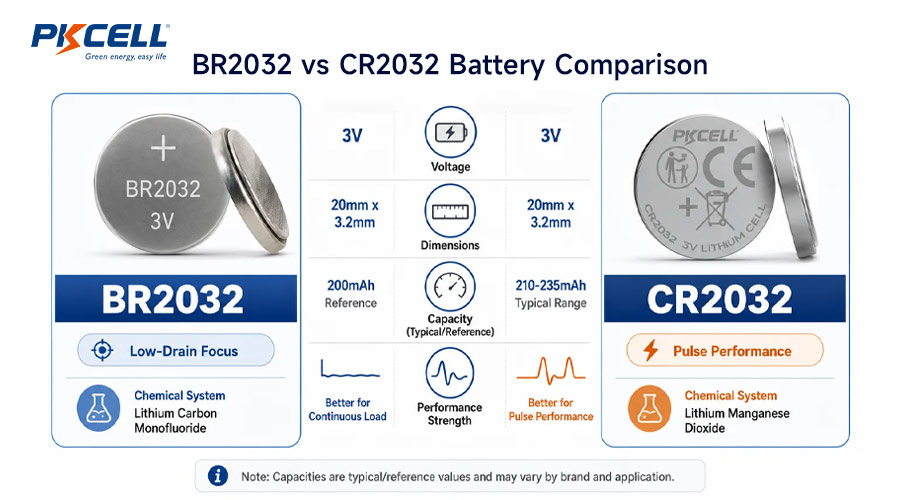
The two models share nominal voltage and external dimensions. Their main difference is the cathode chemistry, which influences capacity, current delivery, temperature behavior and suitability for prolonged low-drain service.
| Comparison Factor | BR2032 | CR2032 | Selection Impact |
|---|---|---|---|
| Typical chemistry | Lithium poly-carbon monofluoride | Lithium manganese dioxide | Chemistry influences discharge behavior, temperature performance and storage stability. |
| Nominal voltage | 3V | 3V | Nominal voltage is the same, but loaded-voltage behavior may differ. |
| Nominal dimensions | 20mm x 3.2mm | 20mm x 3.2mm | They may fit the same holder, but physical fit does not guarantee electrical compatibility. |
| Reference capacity | Often around 200mAh | Often around 210-235mAh | CR2032 commonly offers more rated capacity, although test conditions must be compared. |
| Continuous standard drain | Optimized for very low drain | Supports a higher standard drain | BR2032 suits long-term backup; CR2032 suits more active electronics. |
| Pulse performance | Generally intended for low, steady loads | Generally better for short current pulses | CR2032 is usually preferred for wireless transmission or remote-control signals. |
| Temperature range | Product-specific; wide-temperature versions are available | Product-specific; standard and special-temperature versions are available | Use the exact model datasheet rather than relying only on the BR or CR prefix. |
| Typical positioning | Long-term memory backup and low-drain industrial electronics | General electronics, key fobs, sensors and intermittent loads | The device duty cycle should drive the decision. |
For a consistent manufacturer-level comparison, current Panasonic reference sheets list BR2032 at 200mAh with a 0.03mA continuous standard drain, while CR2032 is listed at 225mAh with a 0.2mA continuous standard drain. These figures illustrate the different design priorities, but they should not be treated as universal specifications for every supplier.
How Chemistry Changes Long-Term Performance
BR2032: Lithium Poly-Carbon Monofluoride
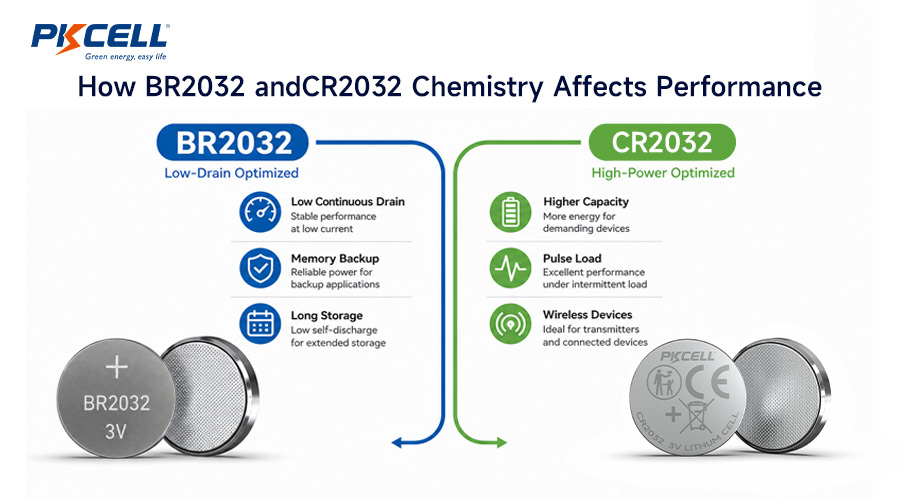
BR-series coin cells are designed around lithium poly-carbon monofluoride chemistry. Their strengths are most relevant when a device draws a very small, steady current and must preserve energy over a long operating or storage period.
This profile makes BR2032 a practical candidate for memory retention, real-time clock backup, meters and industrial electronics that remain inactive for most of their service life.
CR2032: Lithium Manganese Dioxide
CR2032 uses lithium manganese dioxide chemistry. It normally offers higher capacity in the same physical size and stronger pulse-discharge performance than a standard BR2032.
That combination is useful in devices that alternate between standby and active operation, such as car key fobs, wireless transmitters, electronic labels and compact sensors. For a broader explanation of this model, see the
complete CR2032 battery guide.
A battery with higher rated capacity does not automatically provide longer field life. The result depends on load profile, temperature, cutoff voltage, storage history and voltage drop during current pulses.
Which Battery Is Better for Long-Term Applications?
The answer changes according to the device’s definition of long-term performance.
Choose BR2032 When
- The device has an extremely low and mostly continuous current draw.
- Memory or real-time clock backup is the primary function.
- The battery may remain installed or stored for an extended period.
- Stable low-drain operation matters more than pulse capability.
- The selected BR2032 datasheet covers the required temperature exposure.
Choose CR2032 When
- The device produces intermittent current pulses.
- Wireless transmission, LEDs or user activation are part of the duty cycle.
- Higher usable capacity is important in the same 2032-size enclosure.
- The application requires a widely available replacement battery.
- The device manufacturer already specifies CR2032 chemistry.
Long Storage Is Not the Same as Long Service Life
Shelf life describes how well an unused battery retains capacity under defined storage conditions. Installed service life also includes circuit current, temperature exposure, contact resistance, pulse loads and the device’s minimum operating voltage.
A battery stored for years in a controlled warehouse has a different aging profile from one installed in an outdoor sensor. Procurement teams should therefore distinguish among:
- Required shelf life before installation
- Target service life after installation
- Total calendar life from production to replacement
Typical Applications for BR2032 and CR2032
Applications That May Favor BR2032
- Real-time clock and memory backup circuits
- Utility meter memory retention
- Servers and industrial controller backup
- Security equipment with very low standby current
- Measurement instruments and commercial equipment
- Electronics stored for extended periods before activation
Long-duration infrastructure projects may also require larger primary battery systems. PKCELL’s
utility meter battery solutions
provide additional context for equipment where service life and maintenance access are critical.
Applications That May Favor CR2032
- Automotive key fobs and remote entry systems
- Wireless sensors, beacons and electronic labels
- Portable medical and measuring devices
- Calculators, scales, timers and remote controls
- Consumer devices with displays or indicator LEDs
- Backup circuits that also require occasional pulse current
For alarm accessories and remote sensors, the battery must be evaluated against standby consumption and alarm or transmission pulses. PKCELL’s
security device battery solutions
outline additional environmental and maintenance considerations.
Are BR2032 and CR2032 Interchangeable?
BR2032 and CR2032 have the same nominal voltage and physical dimensions, so they may fit the same holder. That does not make them automatically interchangeable.
Before changing chemistry, confirm:
- The battery type approved by the device manufacturer
- Continuous, peak and pulse current requirements
- The circuit’s minimum operating or cutoff voltage
- Expected low- and high-temperature exposure
- Required operating and storage life
- Battery-holder contact pressure and resistance
- Applicable safety, compliance and warranty requirements
Both BR2032 and CR2032 are primary batteries. They must not be replaced by a rechargeable LIR2032 or another 2032-size chemistry unless the device has been specifically designed for its charging method and voltage profile.
How OEM Engineers Should Compare BR2032 and CR2032
- Record the complete current profile.
Measure sleep current, active current, pulse magnitude, pulse duration and event frequency. - Define the real temperature profile.
Include storage, transportation, seasonal extremes and time spent near the upper temperature limit. - Confirm the device cutoff voltage.
Evaluate loaded voltage throughout discharge rather than relying on open-circuit voltage. - Estimate total calendar life.
Include time in inventory, product assembly, distribution and field operation. - Review mechanical integration.
Choose a holder or factory-welded tabs, pins, leads or connectors. Do not solder directly to a loose coin cell. - Request representative samples.
Test cells from the proposed production model and termination configuration. - Run accelerated and real-duty-cycle tests.
Evaluate temperature, pulse loads, contact resistance, leakage risk and end-of-life behavior. - Approve the final documentation.
Confirm the specification, lot traceability, required certifications, transport documents and change-control process.
PCB-mounted products can use
lithium coin cells with factory-welded tabs or leads.
The tab direction, polarity, wire length, connector and insulation should be defined in the approved drawing.
Bulk Purchasing Checklist
For a long-term product, supply quality can be as important as chemistry. Before approving a bulk order, confirm:
- Exact battery model and approved datasheet revision
- Capacity test load, cutoff voltage and test temperature
- Operating and storage temperature limits
- Production date and remaining shelf life at shipment
- Terminal design, polarity and dimensional tolerances
- Packaging, labeling and lot traceability
- Sample and pilot-order availability
- Required safety and transport documentation
- MOQ, production lead time and long-term availability
Available company documentation can be reviewed on the
PKCELL certificates page.
Certification status should always be confirmed for the exact model supplied to the project.
Safety and Storage
- Do not recharge, short-circuit, crush, puncture or burn either battery.
- Do not solder directly to a loose BR2032 or CR2032 cell.
- Use the correct polarity and an approved holder or terminal assembly.
- Do not mix different chemistries, models, production lots, or new and used cells.
- Store batteries in a dry, controlled environment away from conductive materials.
- Dispose of depleted cells according to applicable local regulations.
Frequently Asked Questions
Which lasts longer, BR2032 or CR2032?
BR2032 may be better for very low continuous loads and long-duration backup, while CR2032 often provides greater capacity. Actual service life depends on current, pulses, temperature, cutoff voltage and storage history.
Can I replace a CR2032 with a BR2032?
Not automatically. Although the cells share nominal size and voltage, their discharge and pulse behavior differ. Use the model specified by the device manufacturer or validate the substitution through testing.
Which battery is better for memory backup?
BR2032 is often a strong candidate for very low-drain memory and real-time clock backup. The final choice depends on the circuit current, required voltage, temperature range and target service life.
Which battery is better for a key fob?
CR2032 is generally more suitable because a key fob requires short current pulses during transmission. Always use the battery model specified by the vehicle or device manufacturer.
Is BR2032 rechargeable?
No. BR2032 and CR2032 are both primary, non-rechargeable lithium coin cells.
Can PKCELL provide samples or custom terminals?
PKCELL can support model selection, samples and selected tab, lead-wire, connector and packaging requirements for OEM projects. Final availability depends on the project specification and order requirements.
Conclusion
BR2032 is not simply a longer-lasting version of CR2032, and CR2032 is not automatically better because it has higher rated capacity. BR2032 is oriented toward long-term, low-drain operation, while CR2032 is generally better suited to higher capacity and intermittent pulse loads.
For a memory backup circuit with extremely low current, BR2032 may provide the better performance profile. For a wireless sensor, remote control or key fob, CR2032 is usually the more appropriate starting point. In every OEM project, the final decision should be based on the exact datasheet, real duty cycle and device-level testing.
Post time: Aug-28-2026


