

Battery Selection for Subsea Sensors: Li-SOCl2, Runtime, Temperature & Pulse Loads
Battery selection for subsea sensors is not simply a search for the highest amp-hour rating. An underwater instrument may sleep at microamp-level current for most of a deployment, then demand a much larger burst for sampling, data storage, an acoustic modem, a sonar transducer, a valve, or communication after surfacing.
The selected battery must therefore pass two different tests: it must store enough energy for the complete mission, and it must maintain sufficient loaded voltage during the most demanding event. Temperature, storage history, passivation, wiring resistance, pressure-housing design and the device’s cut-off voltage all influence the result.
PKCELL supports batteries for sonar buoys, marine monitoring equipment and autonomous ocean systems through its oceanographic battery solutions.
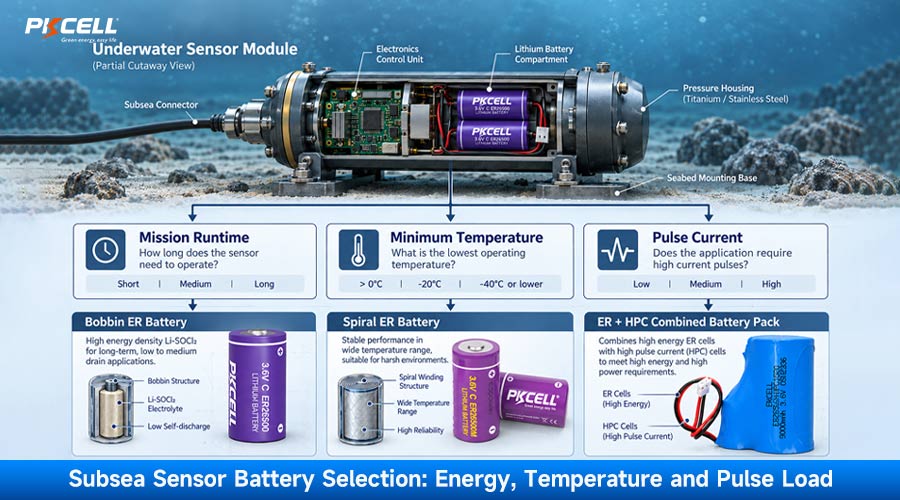
Why Subsea Sensor Battery Selection Is Different
Retrieving an underwater instrument can be expensive, weather-dependent or impossible until the end of a mission. A premature battery failure may mean more than replacing a cell: it can result in lost measurements, vessel time, missed maintenance windows and an incomplete research or inspection program.
Common subsea and oceanographic loads include:
- water-quality, pressure, temperature and chemical sensing;
- data logging and local signal processing;
- hydrophones, sonar and acoustic communication;
- valves, release mechanisms and actuators;
- GNSS acquisition and radio transmission after surfacing;
- status beacons, emergency location signals and recovery aids.
These functions rarely draw a constant current. A useful battery specification must describe the complete time-based load profile rather than one average-current number.
Is Li-SOCl2 a Good Choice for Subsea Sensors?
Lithium thionyl chloride, commonly written Li-SOCl2, is a primary lithium chemistry frequently considered for long-duration remote instruments. Its combination of high energy density, low background self-discharge and stable voltage under suitable low-rate loads makes it a strong starting point for equipment that must remain deployed without charging.
However, Li-SOCl2 batteries are not rechargeable, and not every Li-SOCl2 construction behaves the same way. Capacity, current capability, temperature response and passivation behavior depend on cell design, size, storage history and test conditions.
Bobbin, Spiral or ER + HPC?
Choosing the internal construction is one of the most important decisions in a subsea power system. PKCELL’s detailed bobbin versus spiral Li-SOCl2 guide explains the underlying energy-and-power tradeoff.
| Architecture | Primary Strength | Main Limitation | Likely Subsea Starting Point |
|---|---|---|---|
| Bobbin ER Energy Type | High capacity and low self-discharge for long, low-current service | Higher internal resistance and limited unsupported pulse capability | Long-term data loggers and sensors with infrequent, modest active events |
| Spiral ER Power Type | Lower resistance and stronger continuous or pulse-current delivery | Typically less nominal capacity than an energy cell of similar size | Frequent sampling, acoustic transmission, actuation or sustained active loads |
| Bobbin ER + HPC | Combines long-term energy storage with support for short high-current events | Additional components, recharge interval and integration requirements | Long sleep periods followed by sonar, modem, GNSS, beacon or release pulses |
| Custom Multi-Cell Pack | Voltage, capacity, mechanical format and connector can be adapted to the instrument | Requires pack-level protection, balancing assumptions and environmental validation | OEM instruments with mission-specific voltage, space or redundancy requirements |
When to Start With a Bobbin Cell
A bobbin cell is a logical candidate when sleep current dominates the mission and active events are short, infrequent and electrically modest. PKCELL’s ER Energy Type battery range includes several common cylindrical formats for long-life applications.
Do not select a bobbin cell from nominal capacity alone. Confirm that its loaded voltage remains above the sensor’s brownout threshold during startup, sampling and communication.
When a Spiral Cell May Be Better
A spiral construction provides a larger electrode interface and generally lower internal resistance. It can be a better starting point for a sensor with higher continuous current, repeated transmission events or a demanding actuator.
The tradeoff is energy. A spiral cell may pass the power test but provide less total mission life than a comparable bobbin cell. Review the available ER Power Type Li-SOCl2 models against both the pulse requirement and the lifetime energy budget.
When ER + HPC Solves the Mixed-Load Problem
Some subsea sensors spend almost all of their time asleep but occasionally require a current peak far above the normal load. In an ER + HPC architecture, the Li-SOCl2 cell acts as the long-term energy source while the Hybrid Pulse Capacitor supports short high-current events.
This approach may be suitable for acoustic transmissions, surfaced radio uploads, GNSS cold starts, release mechanisms and other intermittent loads. The HPC must have enough time to recover between events, so pulse magnitude, pulse duration and interval all matter. See PKCELL’s ER + HPC battery pack options for available configurations.
How to Calculate Subsea Sensor Battery Runtime
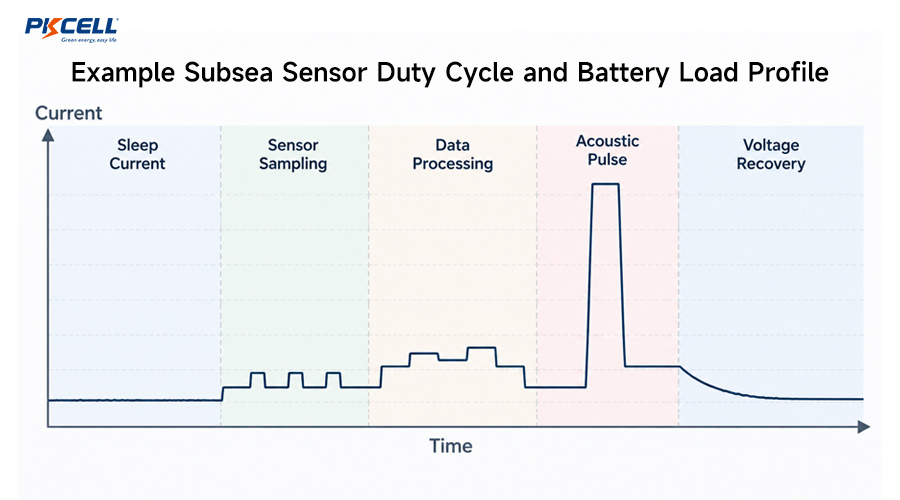
A runtime estimate should begin with a duty-cycle model. Separate the mission into sleep, measurement, processing, storage, communication and actuation states.
For example, a sensor cycle might contain a long sleep period, a measurement window, a short processing period and an acoustic upload. The charge used by each state can be calculated separately:
Add the charge for every state, multiply by the number of cycles in the mission and include non-routine events such as startup, calibration, communication retries, recovery signaling and actuator operation.
Do Not Treat Nominal Capacity as Usable Capacity
Nominal capacity is measured under defined laboratory conditions. The usable capacity in a subsea instrument may be lower because of:
- cold-temperature performance and higher internal resistance;
- the device’s minimum operating or cut-off voltage;
- passivation after storage or extended standby;
- pulse-induced voltage sag;
- cell aging and self-discharge during storage and deployment;
- converter efficiency and regulator quiescent current;
- connector, fuse, wire, weld and protection-component resistance;
- variation between production lots and mission profiles.
A battery can still contain energy and yet be unable to power the sensor if its loaded voltage falls below the electronics’ cut-off threshold.
Use an Engineering Margin
Apply a documented margin instead of assuming that every nominal milliamp-hour is available. The margin should reflect mission criticality, temperature uncertainty, retrieval cost, storage time, expected communication retries and the confidence level of the load data.
For series packs, voltage increases but amp-hour capacity does not. For parallel packs, nominal capacity increases, but current sharing, cell matching, isolation, fusing and failure behavior require engineering review. A simple spreadsheet multiplication is not a substitute for pack validation.
Engineers working with periodic wireless loads may also use PKCELL’s battery-life calculation guide as a reference for duty-cycle modeling.
How Temperature Changes Battery Performance
The battery should be selected for its internal operating temperature, not only for the temperature printed in a project overview. Consider transport, deck storage, deployment, stabilization at depth, operation, retrieval and post-retrieval handling.
Low Temperature
Lower temperature generally increases cell and system resistance. This can reduce loaded voltage and make startup or pulse events more difficult even when open-circuit voltage appears normal. The coldest pulse event may therefore determine the required cell size or architecture.
Cold validation should include:
- first startup after representative storage;
- the highest expected pulse current and duration;
- repeated pulses at the shortest expected interval;
- testing near the projected end-of-life state;
- the actual wire, connector, fuse and protection path;
- the real electronics cut-off and brownout thresholds.
High Temperature and Storage History
Elevated storage temperature can accelerate self-discharge and aging. If completed instruments may remain in a warehouse, shipping container or on deck before deployment, include that period in the energy and passivation assessment.
A useful qualification plan records the complete temperature history rather than checking only the final subsea operating point.
Pulse Loads: The Failure Mode Average Current Can Hide
A sensor may have an excellent calculated runtime and still reset on its first high-current event. Acoustic transmission, sonar activation, GNSS startup, RF communication after surfacing and electromechanical release systems can all create short but important peaks.
For each pulse, document:
- peak current;
- pulse duration;
- number of pulses per event;
- minimum interval between pulses;
- daily or mission-level frequency;
- minimum acceptable loaded voltage;
- temperature and projected state of charge;
- recovery time before the next event.
This equation is useful for understanding the problem, but resistance is not constant across temperature, state of charge, storage history and pulse duration. Measure the actual waveform instead of relying only on a room-temperature resistance value.
Passivation Must Be Included
Li-SOCl2 cells naturally form a passivation layer on the lithium anode. This layer helps limit self-discharge, but it can temporarily increase resistance and cause voltage delay when a load is first applied after storage or a long low-current period.
Subsea sensors are particularly sensitive because they may be stored before deployment and then remain asleep for extended intervals. Open-circuit voltage alone cannot confirm pulse readiness. Review the Li-SOCl2 passivation guide for OEM engineers and test first activation under representative conditions.
Subsea Packaging and Mechanical Design
Battery chemistry is only one part of subsea reliability. In many instruments the pressure housing protects the battery from direct seawater pressure, but the complete assembly must still survive the mechanical, moisture and temperature conditions of the mission.
Review these pack-level factors:
- available housing diameter, length and mass allocation;
- cell retention under shock, vibration and transport;
- connector and feedthrough resistance;
- wire gauge, weld quality and strain relief;
- insulation, polarity protection and short-circuit protection;
- condensation and moisture-control strategy;
- potting or encapsulation compatibility, where applicable;
- service and replacement procedures before deployment;
- transport documentation and pack traceability.
OEM projects that require special voltage, wires, connectors, housings or multi-cell configurations can review PKCELL’s custom primary lithium battery packs.
Subsea Battery Testing Checklist
| Test Area | What to Measure | Why It Matters |
|---|---|---|
| Energy budget | Sleep, sampling, processing, storage, communication and actuator charge | Confirms whether the pack has sufficient usable mission energy |
| Cold startup | Minimum loaded voltage and startup time at the lowest internal temperature | Reveals resistance and passivation-related brownout risk |
| Pulse profile | Peak current, duration, repetition, recovery voltage and retry behavior | Confirms the cell or HPC can support the real event |
| End-of-life operation | Loaded voltage using a representative depleted-battery condition | Prevents a design that works only with fresh cells |
| Storage simulation | First activation after expected storage time and temperature | Checks voltage delay before deployment |
| Environmental assembly | Temperature cycling, vibration, shock, moisture controls and housing integration | Validates the complete pack rather than the cell alone |
| Fault behavior | Short-circuit protection, reverse polarity, insulation and single-point failures | Supports safe pack and instrument design |
| Production consistency | Incoming inspection, lot traceability and sample pulse checks | Connects prototype performance with volume production |
Practical Selection Examples
Long-Term Water-Quality Logger
A logger that sleeps for long periods and wakes briefly to record measurements may begin with a bobbin ER Energy Type cell. The design still needs a startup test after storage and a check of the memory-write and sensor-heater load, if present.
Acoustic Sensor With Scheduled Uploads
If an acoustic modem creates a short but demanding current pulse, compare a spiral cell with an ER + HPC configuration. Test the actual transmit waveform, including retries and the minimum interval between messages.
Surfacing Instrument With GNSS and Radio
A surfaced communication sequence can combine GNSS acquisition, processor activity and radio transmission. Weak reception may extend acquisition time or create repeated transmissions, so the worst-case field sequence should be included in the energy budget.
Sonar or Underwater Scanning Equipment
Sonar systems may combine high total energy demand with periodic power peaks. Pack size, mission duration, pulse capability and supply logistics should be evaluated together. PKCELL’s underwater scanning battery case provides a related marine application reference.
Information to Send a Battery Supplier
A useful technical inquiry should include more than the required voltage and desired runtime. Send:
- device type and mission description;
- minimum, typical and maximum internal temperature;
- storage duration and storage temperature before deployment;
- sleep current and all active-state currents;
- peak current, pulse duration and pulse frequency;
- real communication or actuator waveform, when available;
- minimum operating and brownout voltage;
- target deployment life and engineering margin;
- available battery space and maximum mass;
- series or parallel voltage requirements;
- wire, connector, housing and mounting requirements;
- annual quantity, sample schedule and required documents.
Request a Subsea Sensor Battery Review
Share your load profile, mission duration, minimum temperature, pulse waveform, cut-off voltage and mechanical limits with PKCELL. The engineering team can review whether an ER Energy cell, ER Power cell, ER + HPC configuration or custom Li-SOCl2 pack is the most suitable starting point.
Frequently Asked Questions
What is the best battery chemistry for a subsea sensor?
There is no universal best chemistry. Li-SOCl2 is a strong candidate for long-duration primary-powered sensors with low average current, but chemistry and construction must be selected from the actual temperature, pulse load, voltage and mission requirements.
How do I calculate battery life for an underwater sensor?
Calculate the charge used by every operating state, multiply it by the number of mission cycles, include storage and non-routine events, and then apply justified allowances for temperature, cut-off voltage, aging, self-discharge and system losses. Confirm the calculation with device-level testing.
Should I choose a bobbin or spiral Li-SOCl2 battery?
Choose bobbin as a starting point when long life and low continuous current dominate. Consider spiral when the device requires higher continuous current or stronger pulse delivery. For long standby with occasional high-current events, compare both options with an ER + HPC architecture.
Why can a high-capacity battery still reset a subsea sensor?
Capacity describes stored charge, not guaranteed voltage during a current peak. Internal resistance, low temperature, passivation, wiring losses and state of charge can cause the loaded voltage to fall below the electronics’ brownout threshold.
Does low temperature only reduce runtime?
No. Low temperature can also increase resistance and deepen voltage sag during startup or pulse loads. A pack may have enough total energy but still fail the cold pulse-voltage requirement.
Can Li-SOCl2 batteries be recharged?
No. Standard Li-SOCl2 cells are primary, non-rechargeable batteries. Do not connect them to a charging source or attempt uncontrolled depassivation.
Does an HPC increase the battery’s nominal capacity?
An HPC is mainly used to support high-current pulses. It does not replace the mission energy stored in the primary cell. The ER cell must still provide enough total energy and enough recovery time to replenish the pulse component between events.
Conclusion
Reliable battery selection for subsea sensors requires both an energy calculation and a power-delivery test. Begin by mapping every operating state, then evaluate usable capacity, internal temperature, loaded-voltage limits, storage-related passivation and the complete pulse waveform.
Bobbin Li-SOCl2 cells favor long life at low current. Spiral cells favor stronger current delivery. ER + HPC systems can address applications that combine multi-year standby with occasional demanding events. The final choice should be verified inside the actual instrument, using representative storage, temperature and end-of-life conditions.
For an OEM recommendation, send PKCELL the device load profile, environmental range, mission duration and mechanical requirements through the technical inquiry and quotation page.
Post time: Oct-10-2026


