

LiSOCl2 Bobbin vs Spiral Battery: Which Fits Best?
Two LiSOCl2 batteries can have the same nominal voltage and external size yet behave very
differently under load. The reason is often their internal electrode structure.
A bobbin cell prioritizes capacity, low self-discharge, and long service life at a low
average current. A spiral cell sacrifices some energy capacity to provide a larger
electrode interface, lower internal resistance, and stronger continuous or pulse-current
performance.
Quick selection answer:
Choose a bobbin LiSOCl2 battery when years of low-current operation and
maximum energy in a limited space are the main priorities. Choose a
spiral LiSOCl2 battery when the device requires higher continuous current,
frequent pulses, or a stronger loaded-voltage response. For long standby combined with
occasional demanding pulses, a bobbin ER cell with HPC may provide a
better balance than either structure alone.
What Is a Bobbin LiSOCl2 Battery?
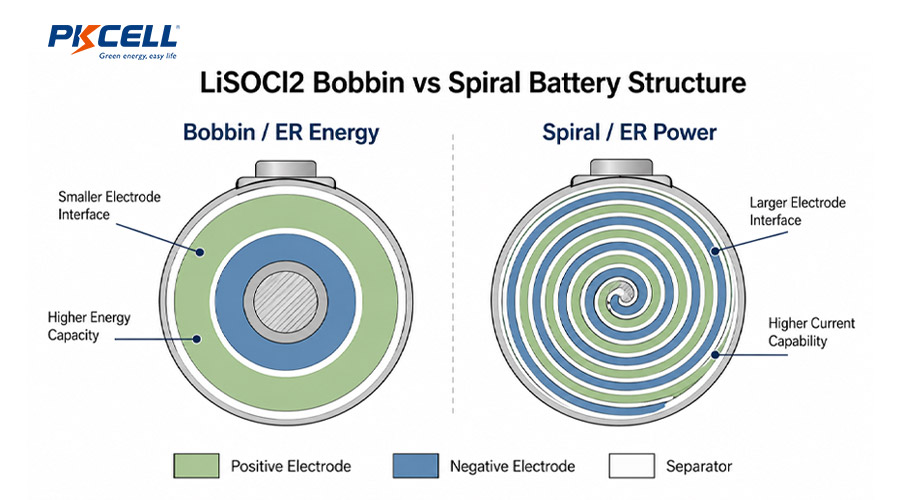
A bobbin cell uses a concentric internal arrangement with a relatively limited common
reaction area between its electrodes. This construction leaves more internal volume available
for active materials while limiting the rate at which energy can be delivered.
The result is an energy-oriented cell with high nominal capacity and very low background
self-discharge. PKCELL identifies these products as
ER Energy Type LiSOCl2 batteries.
Common models include ER14250, ER14505, ER18505, ER26500, and ER34615. They are typically used
in smart meters, memory backup, data loggers, remote sensors, security devices, and other
equipment that spends most of its life at a low current.
Main Bobbin Advantages
- Higher nominal capacity for a given cell size
- Very low self-discharge under suitable storage conditions
- Long shelf life and multi-year operating potential
- Stable voltage during low-rate discharge
- Strong fit for devices dominated by sleep or standby current
Main Bobbin Limitations
- Higher internal resistance than a comparable spiral cell
- Lower continuous-current capability
- Lower unsupported pulse-current capability
- Greater risk of voltage sag during demanding startup or radio events
- May require a capacitor or HPC for high-current communication pulses
What Is a Spiral LiSOCl2 Battery?
A spiral cell uses long, thin electrode layers separated and wound into a cylindrical
“jelly-roll” structure. This creates a much larger shared electrode surface area than the
bobbin construction.
The larger reaction area reduces internal resistance and allows the cell to deliver energy at
a higher rate. PKCELL groups these products under the ER Power Type LiSOCl2 range,
including models such as ER14505M, ER18505M, ER26500M, and ER34615M.
Main Spiral Advantages
- Lower internal resistance
- Higher continuous-current capability
- Stronger pulse-current performance
- Better voltage response under heavier loads
- Suitable for frequent wireless, alarm, motor, or actuator events
Main Spiral Limitations
- Typically lower nominal capacity than a bobbin cell of comparable size
- Higher background self-discharge relative to an energy-optimized bobbin design
- Potentially shorter service life when total energy is the limiting factor
- Greater need to evaluate protection and heat generation under fault conditions
- May be unnecessary and less energy-efficient for ultra-low-current devices
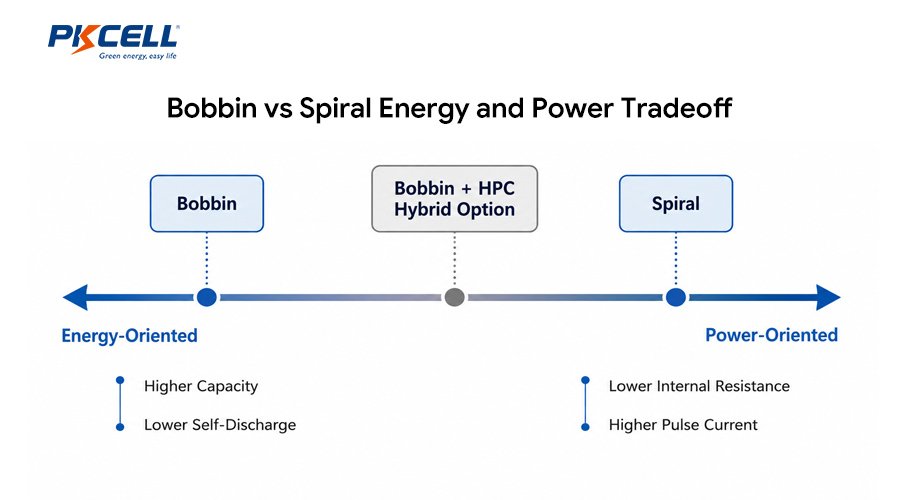
Bobbin and spiral are not quality grades. They are different engineering optimizations:
bobbin favors energy retention, while spiral favors power delivery.
LiSOCl2 Bobbin vs Spiral Battery Comparison
| Design Factor | Bobbin / ER Energy Type | Spiral / ER Power Type |
|---|---|---|
| Primary design goal | Maximum long-term energy | Higher current and power |
| Electrode interface | Smaller shared reaction area | Larger wound electrode area |
| Internal resistance | Generally higher | Generally lower |
| Nominal capacity | Typically higher for a comparable size | Typically lower because the power structure uses more internal space |
| Continuous current | Best for low continuous loads | Supports higher continuous loads |
| Pulse current | Moderate unless supported by a capacitor or HPC | Higher unsupported pulse capability |
| Self-discharge | Usually lower | Usually higher relative to bobbin cells |
| Service-life priority | Long standby and low-rate discharge | Higher-rate operation over a potentially shorter energy-limited life |
| Passivation concern | Voltage delay can be important after long storage or standby | Still possible, but the lower-resistance structure better supports higher loads |
| Typical applications | Smart meters, memory backup, remote sensors, data loggers | Wireless alarms, radio devices, actuators, industrial instruments |
This comparison describes typical structural behavior, not a guaranteed value for every
model. Current ratings, capacity, self-discharge, and temperature performance must be taken
from the exact product datasheet.
Why Electrode Surface Area Changes Performance
A larger electrode interface allows more electrochemical reaction to occur at the same time.
This is why a spiral cell can supply more current with less voltage drop. However, the larger
interface also creates more opportunity for background reactions and occupies space that could
otherwise hold energy-producing material.
A bobbin cell takes the opposite approach. By limiting the reaction area, it slows both useful
high-rate discharge and unwanted background reactions. This supports high energy retention but
increases resistance during demanding loads.
Capacity Is Not Enough to Select the Structure
Many battery-life calculations begin by dividing nominal capacity by average current. That is
useful for an initial energy estimate, but it does not prove that the battery can support the
device’s highest load.
Iavg = Σ(I × t) / Tcycle
Simplified loaded-voltage check:
Vload ≈ VOCV − Iload × Rsystem
The battery must satisfy both requirements: enough total energy for the intended service
life and enough loaded voltage during every continuous or pulse event.
A bobbin cell may produce the best theoretical lifetime but still reset the device during a
transmission pulse. A spiral cell may pass the pulse test but provide less lifetime than the
energy budget requires. Neither result is acceptable.
How Passivation Affects Bobbin and Spiral Cells
LiSOCl2 chemistry forms a lithium-chloride-based passivation layer on the lithium anode. This
protective layer limits self-discharge and supports long shelf life, but it can temporarily
increase resistance when a load is first applied.
Passivation is especially relevant to a bobbin cell that has remained at a very low current
for an extended period and must suddenly power a radio, valve, or other high-current load.
The open-circuit voltage may appear normal while the loaded voltage drops below the device’s
brownout threshold.
Spiral construction provides a larger reaction area and lower resistance, but it does not
make passivation irrelevant. Storage time, temperature, pulse profile, cut-off voltage, and
cell history still affect performance.
See PKCELL’s
LiSOCl2 battery passivation guide
for loaded-voltage, first-start, storage, and low-temperature testing recommendations.
recharged. Do not short-circuit a cell or use an uncontrolled high-current procedure to
remove passivation. Follow the cell manufacturer’s handling and conditioning instructions.
Temperature Can Change the Decision
Both structures can be available with broad operating-temperature specifications, but the
same current and capacity are not necessarily available throughout that range. Low
temperature increases internal resistance and can make pulse voltage more difficult to
maintain.
A spiral cell’s lower resistance may give it an advantage for cold pulse loads, but that does
not mean every spiral cell will meet the requirement. Battery state of discharge, pulse
duration, connector resistance, and device cut-off voltage must also be included.
High-temperature storage can accelerate self-discharge and aging. For a device expected to
remain in the field for many years, the complete storage and operating-temperature history
should be included in the energy budget.
Which Structure Fits Common Devices?
| Device or Load Profile | Likely Starting Point | Reason |
|---|---|---|
| Memory backup or real-time clock | Bobbin | Extremely low continuous current and long retention are the main priorities. |
| Simple remote sensor with infrequent reporting | Bobbin | Low average load allows the design to benefit from higher capacity. |
| Smart meter with a moderate communication pulse | Bobbin or bobbin + pulse support | The best choice depends on modem current, pulse duration, temperature, and cut-off voltage. |
| NB-IoT or cellular device | Spiral or bobbin + HPC | Network attachment, transmission, and retries can create demanding current peaks. |
| LoRaWAN tracker | Bobbin, spiral, or ER + HPC | Transmit power, spreading factor, reporting interval, and GNSS use change the requirement. |
| Wireless alarm or siren | Spiral | Alarm events may require a higher sustained current than an energy cell can provide. |
| Motorized valve or actuator | Spiral or ER + HPC | Startup current, movement duration, and repeated operation must be verified. |
| Weak-signal remote communications | Spiral or ER + HPC | Longer connection time and repeated transmissions increase pulse stress and energy use. |
The Third Option: Bobbin Battery With HPC
The choice is not always limited to a bobbin cell or a spiral cell. A device may need the
long-term energy and low self-discharge of a bobbin battery while also requiring occasional
high-current pulses.
In an ER + HPC pack, the bobbin LiSOCl2 cell supplies long-term energy and slowly replenishes
a Hybrid Pulse Capacitor. The HPC supports short communication, GNSS, alarm, or actuator
events, reducing the pulse stress placed directly on the primary battery.
This architecture is especially relevant when:
- The device spends more than 99% of its time in a low-power state.
- The pulse is much higher than the normal operating current.
- The project requires a long field life and stable pulse voltage.
- Low-temperature startup or passivation creates brownout risk.
- A spiral cell alone would reduce the available lifetime energy too much.
Explore PKCELL’s
Hybrid Pulse Capacitor battery solutions
for ER + HPC configurations used in smart metering, tracking, remote sensing, and industrial IoT.
Unsure Which ER Structure to Choose?
Send PKCELL your sleep current, continuous current, peak current, pulse duration, minimum
voltage, temperature range, storage period, available space, and target service life. The
engineering team can compare bobbin, spiral, and ER + HPC solutions for your device.
Request a Battery Recommendation
Explore Primary Battery Solutions
Selection Checklist for OEM Engineers
Before choosing a cell, define the complete application rather than requesting only a size
and amp-hour capacity.
- Sleep current: Include the MCU, sensors, regulator, protection, and leakage paths.
- Continuous active current: Measure the longest operating state, not only its average.
- Pulse waveform: Record current amplitude, duration, frequency, and repeated sub-pulses.
- Minimum voltage: Include modem reset, MCU brownout, regulator dropout, and sensor limits.
- Storage history: Define storage time and temperature before first activation.
- Field temperature: Specify minimum and maximum temperature at the battery.
- Service-life target: Include self-discharge, retries, aging, and reserve margin.
- Mechanical limits: Provide cell space, leads, connector, tabs, and enclosure details.
- Compliance needs: Identify transport, safety, certification, and market requirements.
- Sample test plan: Define room-temperature, cold, storage, pulse, and end-of-life tests.
Compare Products Using Consistent Conditions
Do not compare one cell’s nominal capacity with another cell’s maximum pulse current without
checking the test conditions. Datasheet values may use different temperatures, cut-off
voltages, base currents, pulse durations, rest intervals, and cell histories.
Use model-specific datasheets and test both candidates with the same device waveform. PKCELL
offers
custom primary lithium battery packs
with application-specific leads, connectors, tabs, configurations, and pulse-support options.
Common Selection Mistakes
- Choosing the cell with the highest nominal capacity without checking loaded voltage.
- Assuming the average current proves that a bobbin cell can support every pulse.
- Using a spiral cell when an energy cell would provide a longer and more economical service life.
- Assuming every model with an “M” suffix has the same current capability.
- Applying room-temperature pulse ratings at the minimum deployment temperature.
- Ignoring passivation after long storage or low-current standby.
- Testing only open-circuit voltage instead of the complete load waveform.
- Ignoring wire, tab, connector, weld, and PCB resistance.
- Adding a capacitor without checking ESR, recharge time, leakage, and voltage limits.
- Comparing specifications obtained under different test conditions.
Frequently Asked Questions
Is a spiral LiSOCl2 battery always better than a bobbin battery?
No. Spiral cells are better suited to higher-current loads, but bobbin cells generally
provide more energy and lower self-discharge for low-current devices. The better structure
is the one that satisfies both lifetime energy and loaded-voltage requirements.
Which structure has more capacity?
A bobbin cell typically has higher nominal capacity than a spiral cell of comparable
external size. Exact values depend on the model, materials, construction, and datasheet
test conditions.
Which structure provides more pulse current?
Spiral construction normally provides higher unsupported pulse current because its larger
electrode interface reduces internal resistance. Pulse performance still depends on
temperature, duration, frequency, storage history, state of discharge, and minimum voltage.
Does a spiral battery eliminate passivation?
No. Passivation is a characteristic of LiSOCl2 chemistry. A spiral cell can have a stronger
loaded-voltage response, but its first-start and pulse performance should still be tested
after representative storage and at the required temperature.
Can a bobbin battery power an NB-IoT device?
It may be possible when the pulse is supported by a properly designed capacitor, HPC, or
power circuit. A bobbin cell should not be selected for NB-IoT from average current alone;
the complete network-attachment and transmission waveform must be tested.
When should I use ER + HPC instead of a spiral cell?
Consider ER + HPC when the device needs the high energy and low self-discharge of a bobbin
cell but has occasional high-current pulses. Compare total energy, pulse duration, recharge
interval, temperature, available space, and system complexity before deciding.
Can PKCELL customize bobbin or spiral battery packs?
PKCELL supports custom pack structures, series and parallel configurations, wires,
connectors, tabs, housings, and ER + HPC solutions. Provide the complete electrical,
environmental, mechanical, compliance, and project requirements when requesting a review.
Conclusion
The LiSOCl2 bobbin vs spiral battery decision is a tradeoff between energy and power. Bobbin
construction is usually the better starting point for low-current equipment that must operate
for many years. Spiral construction is designed for devices requiring higher continuous
current, frequent pulses, or a stronger loaded-voltage response.
The final choice should not be made from cell structure or capacity alone. Measure the real
device waveform, define the minimum operating voltage, account for temperature and storage,
and test near the expected end of life. If neither structure independently meets the complete
requirement, a bobbin ER cell with HPC may deliver the needed combination of lifetime energy
and pulse power.
Get a LiSOCl2 Solution Matched to Your Device
PKCELL can help evaluate ER Energy, ER Power, and ER + HPC options, then customize the
pack, connector, leads, and sample configuration for device-level testing.
Post time: Aug-05-2026


