

1S2P vs 1S4P vs 1S6P Li-SOCl2 Battery Packs: Capacity, Current Sharing & Cell Matching
Choosing between a 1S2P, 1S4P and 1S6P Li-SOCl2 battery pack is not only a question of adding more capacity. All three configurations can maintain the nominal voltage of one lithium thionyl chloride cell, but they differ in total energy, physical size, current distribution, number of interconnects and cell-matching requirements.
In theory, adding parallel cells increases capacity and divides the load between more branches. In a real primary lithium battery pack, however, current does not always divide perfectly. Small differences in cell voltage, internal resistance, passivation, temperature and connection resistance can cause one cell to carry more load than another.
PKCELL provides custom Li-SOCl2 battery packs with series or parallel configurations, wires, connectors, insulation, labels and application-specific mechanical structures.
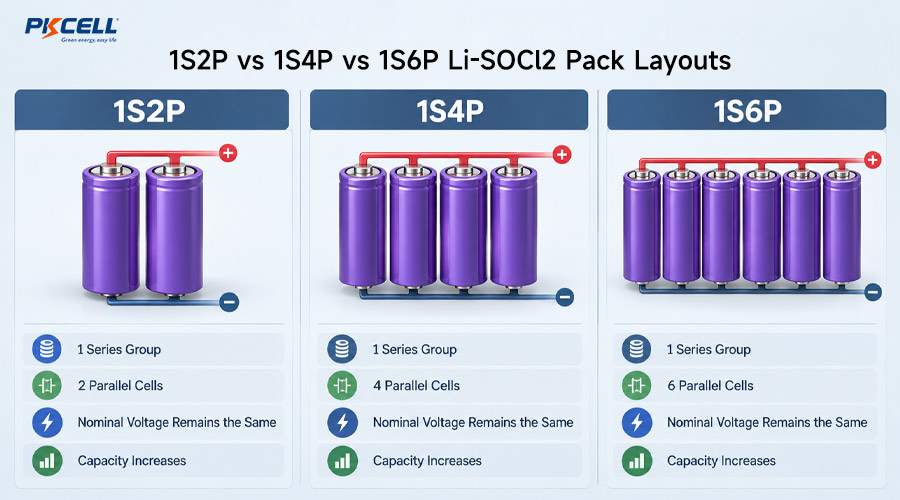
What Do 1S2P, 1S4P and 1S6P Mean?
Battery-pack notation describes how many cells are connected in series and in parallel:
- S means series. Series-connected cells increase pack voltage.
- P means parallel. Parallel-connected cells increase nominal capacity while keeping the nominal voltage equal to one cell.
Therefore:
- 1S2P: one series group containing two parallel cells;
- 1S4P: one series group containing four parallel cells;
- 1S6P: one series group containing six parallel cells.
When standard 3.6V Li-SOCl2 cells are used, each of these configurations remains a nominal 3.6V pack. Increasing the number of parallel cells does not change the nominal voltage.
1S2P vs 1S4P vs 1S6P: Main Differences
| Design Factor | 1S2P | 1S4P | 1S6P |
|---|---|---|---|
| Cell count | 2 cells | 4 cells | 6 cells |
| Nominal voltage | Same as one cell | Same as one cell | Same as one cell |
| Ideal nominal capacity | 2x single-cell capacity | 4x single-cell capacity | 6x single-cell capacity |
| Physical size and mass | Lowest of the three | Moderate | Highest of the three |
| Interconnect complexity | Relatively simple | More welds and current paths | Most matching and assembly complexity |
| Potential current sharing | Load shared by two branches | Load shared by four branches | Load shared by six branches |
| Cell-matching burden | Important | More demanding | Most demanding |
| Typical reason to choose | Compact runtime extension | Longer service life or greater load support | High mission energy at one-cell voltage |
More parallel cells can provide more nominal capacity, but the best configuration is the smallest validated pack that meets runtime, loaded-voltage, temperature, safety and mechanical requirements with an appropriate engineering margin.
How Parallel Cells Change Capacity
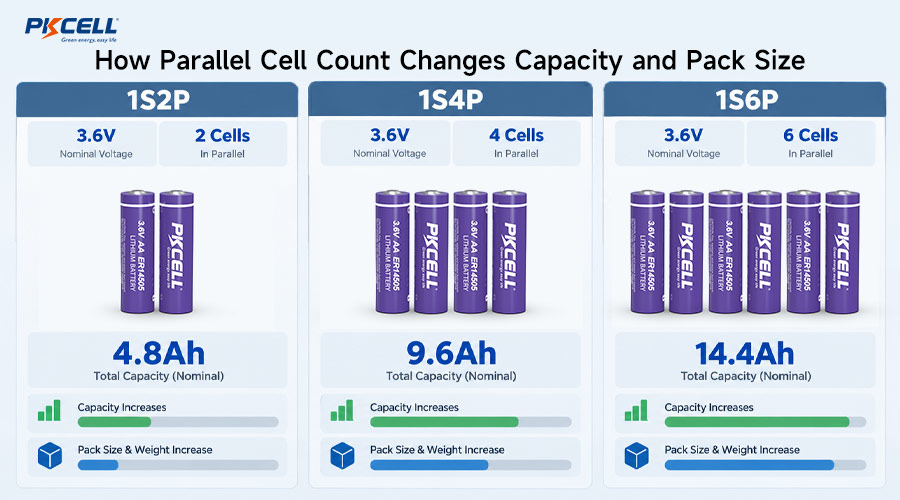
Assume that the same 3.6V, 2.4Ah Li-SOCl2 cell is used in all three configurations. The ideal nominal comparison would be:
| Configuration | Nominal Voltage | Ideal Nominal Capacity | Ideal Nominal Energy |
|---|---|---|---|
| 1S2P | 3.6V | 4.8Ah | 17.28Wh |
| 1S4P | 3.6V | 9.6Ah | 34.56Wh |
| 1S6P | 3.6V | 14.4Ah | 51.84Wh |
These figures illustrate the connection principle; they are not guaranteed usable capacities. Actual capacity depends on the exact cell model, discharge current, temperature, storage history, cut-off voltage and pulse profile.
Nominal Capacity Is Not the Same as Usable Capacity
A 1S6P pack may have three times the nominal capacity of a 1S2P pack made with the same cells, but this does not guarantee three times the field life. Usable energy can be reduced by:
- the device’s minimum operating voltage;
- cold-temperature voltage drop;
- passivation after storage or long standby;
- pulse-current demands;
- self-discharge during storage and service;
- connector, wire, fuse and weld resistance;
- converter efficiency and quiescent current;
- uneven current sharing between cells.
Battery life should be calculated from the complete duty cycle, then verified with the finished pack rather than extrapolated only from a catalog capacity.
How Current Sharing Works in a Parallel Battery Pack
In an ideal pack with identical cells and identical interconnect resistance, the device current would divide equally among the parallel branches.
For a 600mA pack load, the ideal current distribution would be:
- 1S2P: approximately 300mA per cell;
- 1S4P: approximately 150mA per cell;
- 1S6P: approximately 100mA per cell.
This is only an idealized calculation. Real cells and pack connections do not have perfectly identical voltage and resistance.
Why Current Does Not Divide Perfectly
The current carried by each parallel cell is influenced by:
- open-circuit and loaded-voltage differences;
- cell internal resistance;
- passivation level;
- temperature differences across the pack;
- cell state of discharge and storage history;
- weld, tab and busbar resistance;
- wire length and conductor size;
- connector and protection-component resistance.
A cell with a slightly higher voltage or lower total branch resistance may initially carry more current. That cell can discharge faster, heat differently or experience a deeper voltage drop later in the mission.
Symmetrical Interconnects Matter
The pack layout should avoid giving one cell a significantly shorter or lower-resistance path to the load. Connection geometry, conductor dimensions and weld consistency all influence current sharing.
Adding more parallel cells without reviewing the bus structure can create a pack in which the cells closest to the output connector carry a disproportionate part of the load.
Why Cell Matching Is Critical
Parallel cells are directly connected to the same pack voltage. If their electrical condition differs substantially, circulating or unequal currents may occur. For primary Li-SOCl2 cells, this can create reliability and safety concerns because the cells are not designed to be recharged.
Cell matching becomes more important as the parallel count increases. A 1S6P assembly has more cells, welds and branches than a 1S2P pack, creating more opportunities for variation.
What Should Be Matched?
For an OEM Li-SOCl2 pack, cell-selection controls should normally consider:
- the same manufacturer and cell model;
- the same chemistry and internal construction;
- the same production lot or controlled production window;
- similar manufacturing and storage age;
- similar open-circuit voltage after stabilization;
- similar loaded-voltage or pulse response;
- similar internal-resistance behavior under defined test conditions;
- consistent visual, leakage and dimensional inspection results.
Open-circuit voltage alone is not enough. Two cells can show similar unloaded voltage while behaving differently during a pulse because of internal resistance or passivation.
Do Not Mix New and Used Cells
New and partially discharged cells should not be combined in the same parallel pack. Cells from different models, manufacturers or storage histories should also not be mixed unless the battery manufacturer has designed and validated a specific architecture.
For more detail on voltage delay and loaded-voltage testing, review PKCELL’s Li-SOCl2 battery passivation guide.
Does Adding Parallel Cells Improve Pulse Current?
Parallel cells can reduce the current demanded from each individual cell, which may improve loaded-voltage performance. However, the result depends on cell construction and matching. A pack made from energy-optimized bobbin cells can still struggle with a demanding pulse, especially after storage or at low temperature.
Before increasing the parallel count solely to solve a pulse problem, compare three approaches:
- use more matched cells in parallel;
- select an ER Power Type spiral cell with stronger current capability;
- use an ER Energy cell with an appropriately designed HPC or pulse-support component.
PKCELL’s bobbin versus spiral Li-SOCl2 comparison explains why energy-optimized and power-optimized cells behave differently.
For devices that combine long standby with brief modem, GNSS, valve or alarm loads, an ER + HPC battery pack may provide more effective pulse support than adding cells only to increase parallel capacity.
When to Choose a 1S2P Pack
A 1S2P Li-SOCl2 battery pack is often a practical starting point when the device:
- requires the nominal voltage of one Li-SOCl2 cell;
- needs more runtime than a single cell can provide;
- has limited enclosure space;
- has a low or moderate continuous load;
- benefits from a simple two-cell mechanical arrangement.
With only two cells, 1S2P usually requires fewer welds and less pack volume than the larger configurations. It still requires matched cells and pack-level loaded-voltage testing.
PKCELL’s ER17335 1S2P fuel nozzle reader case shows how two cells were used to maintain 3.6V while increasing available capacity in a compact industrial device.
When to Choose a 1S4P Pack
A 1S4P pack can be considered when:
- the target runtime is beyond the practical capability of 1S2P;
- the load should be distributed across more matched cells;
- the enclosure can accommodate four cells and their interconnects;
- maintenance or battery replacement is expensive;
- the device still requires one-cell nominal voltage.
The four-cell layout offers more energy but adds matching, weld and packaging requirements. Engineers can review a representative ER17505 1S4P Li-SOCl2 battery pack while confirming the latest datasheet and project-specific specifications with PKCELL.
When to Choose a 1S6P Pack
A 1S6P configuration is generally considered when a 3.6V device requires a larger energy reserve or longer autonomous operation and can accept the additional pack size and mass.
It may be suitable for remote monitoring, metering, industrial logging or other applications where replacing the battery is difficult. However, six parallel cells also mean:
- more incoming cells to screen and match;
- more welds and possible connection variation;
- a larger thermal and mechanical footprint;
- more complex fault and protection analysis;
- greater shipping weight and material cost.
PKCELL lists a 3.6V ER14505 1S6P battery pack as one example of increasing nominal capacity while retaining a one-cell nominal voltage.
Why a Larger Single Cell May Be Better
More parallel cells are not always the best way to increase energy. In some devices, one or two larger-format cells may provide the required capacity with fewer welds, fewer parallel branches and a simpler pack structure.
Compare:
- total usable energy;
- continuous and pulse-current requirements;
- pack dimensions and orientation;
- weight and center of mass;
- number of interconnects;
- cell availability and long-term supply;
- assembly and validation cost.
The best result may be a larger ER cell, a spiral power cell, an ER + HPC system or a different pack geometry rather than simply moving from 1S2P to 1S6P.
Parallel Pack Design and Safety Considerations
Li-SOCl2 cells are primary, non-rechargeable batteries. Parallel battery packs should be designed and assembled by an experienced battery manufacturer using validated cells, controlled welding and appropriate insulation.
Pack-level engineering may need to address:
- branch isolation or protection strategy;
- fusing and fault-current behavior;
- reverse-current and forced-discharge risks;
- short-circuit protection;
- tab, busbar and weld-current capability;
- wire gauge and connector resistance;
- creepage, insulation and mechanical separation;
- shock, vibration and temperature cycling;
- cell retention and enclosure interaction;
- UN38.3 and applicable transport documentation.
Testing Checklist for 1S2P, 1S4P and 1S6P Packs
| Test | What to Check | Why It Matters |
|---|---|---|
| Incoming cell screening | Lot, age, voltage, visual condition and defined loaded response | Supports consistent cell matching |
| Branch resistance | Weld, tab, busbar, fuse and wire-path consistency | Reduces uneven current sharing |
| Continuous load | Loaded voltage and temperature over the required duration | Confirms sustained performance |
| Pulse load | Minimum voltage, recovery time and repeated pulse behavior | Checks brownout and reset risk |
| Low-temperature test | Startup, continuous load and pulse response at minimum temperature | Reveals increased resistance and voltage sag |
| Storage simulation | First activation after expected storage time and temperature | Evaluates passivation-related voltage delay |
| End-of-life test | Device operation at a representative depleted condition | Confirms the pack works beyond fresh-cell testing |
| Fault testing | Short, open branch, reversed connector and insulation failures | Supports safe pack and device design |
| Environmental test | Temperature cycling, shock, vibration and moisture exposure | Validates the complete assembly |
How to Select the Right Configuration
- Confirm voltage. Verify that the device is designed for a one-cell Li-SOCl2 voltage profile.
- Build the energy budget. Calculate sleep, active, pulse and storage energy over the complete mission.
- Define the load profile. Document continuous current, pulse magnitude, duration and frequency.
- Set the temperature range. Include storage, transport, startup and operating temperatures.
- Check the cut-off voltage. Capacity remaining below the device threshold may be unusable.
- Compare pack geometries. Evaluate two, four and six-cell layouts as well as larger single cells.
- Define matching criteria. Agree on lot control, screening and loaded-response requirements.
- Review protection and compliance. Include pack safety, transport and target-market documentation.
- Test samples in the device. Validate cold startup, pulse response, storage and end-of-life conditions.
PKCELL’s primary lithium battery solution hub provides additional application, chemistry and pack-selection paths for industrial OEM projects.
Request a Parallel Li-SOCl2 Pack Review
Send PKCELL your required voltage, average current, peak current, pulse duration, operating temperature, target runtime, available space, connector requirements and annual demand. The engineering team can compare 1S2P, 1S4P, 1S6P, larger-cell and ER + HPC options before sampling.
Frequently Asked Questions
Does a 1S4P battery pack have a higher voltage than 1S2P?
No. If the same cells are used, both are one-series configurations and retain the nominal voltage of one cell. The 1S4P pack has more parallel capacity.
Does a 1S6P pack have three times the capacity of 1S2P?
Its ideal nominal capacity is three times greater when all six cells are identical to the two cells used in the 1S2P pack. Usable capacity and field life still depend on temperature, load, cut-off voltage, storage and current sharing.
Does current divide equally between parallel cells?
Only in an ideal model. Real current distribution is affected by cell voltage, internal resistance, passivation, temperature and branch resistance. Symmetrical construction and matched cells help reduce imbalance.
Can I combine cells from different production lots?
It is generally preferable to use controlled, matched cells from the same production lot or manufacturing window. Any alternative must be reviewed and validated by the battery manufacturer.
Can I mix new and partially used Li-SOCl2 cells?
No. Differences in voltage and remaining capacity can create unequal loading and unsafe conditions. Do not combine new and used cells in a parallel primary lithium pack.
Is 1S6P always better for high pulse current?
No. Additional parallel cells may improve load distribution, but a spiral ER Power cell or ER + HPC configuration may provide a more effective solution. Compare energy, pulse performance, size, cost and complexity.
Does a parallel pack provide redundancy?
Not automatically. Directly paralleled cells are electrically connected and should not be treated as independent redundant power sources. Fault isolation and redundancy require a deliberately engineered architecture.
Can PKCELL customize the wire and connector?
Yes. PKCELL supports customized wires, connectors, tabs, insulation, labels, housings and series or parallel configurations. Final details depend on the device and project requirements.
Conclusion
The difference between 1S2P, 1S4P and 1S6P Li-SOCl2 battery packs extends beyond nominal capacity. All three can retain one-cell nominal voltage, but increasing the parallel count changes usable energy, physical size, current distribution, cell-matching requirements, assembly complexity and fault behavior.
Use 1S2P for a compact increase in runtime, 1S4P when more energy or load sharing is required, and 1S6P when the device needs a larger energy reserve and can accommodate the additional cells. The final choice must be based on the real duty cycle, loaded voltage, temperature, storage history and validated pack construction.
For a project-specific comparison, submit your electrical, mechanical and environmental requirements through the PKCELL battery engineering inquiry page.
Post time: Oct-10-2026


