

Li-SOCl2 engineering selection guide
ER14505 vs ER26500 vs ER34615: Selection by Device Power Profile
Choose the right 3.6V lithium thionyl chloride cell by matching energy, continuous load, pulse behavior, temperature, and mechanical limits to the device—not by comparing amp-hours alone.
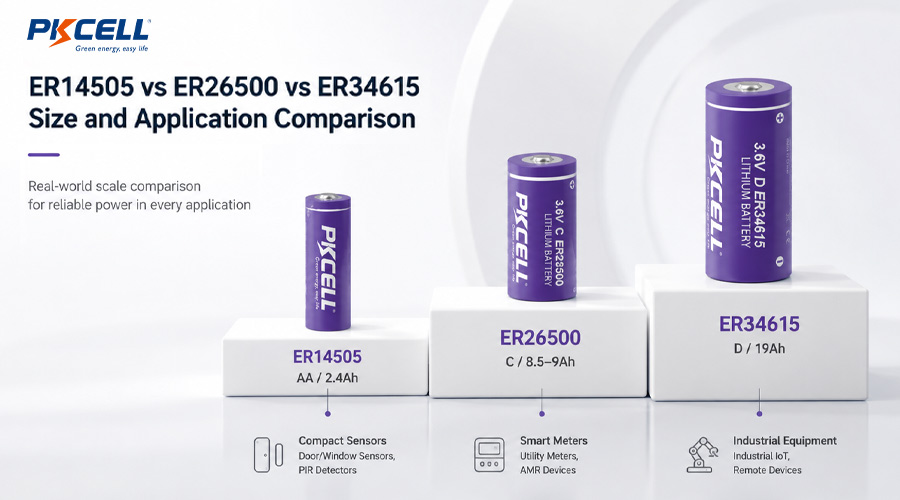
ER14505, ER26500, and ER34615 cells share the same nominal chemistry and voltage, but they are not interchangeable power solutions. The AA-size ER14505 prioritizes compactness, the C-size ER26500 offers a useful middle ground, and the D-size ER34615 provides the largest energy reserve and the strongest current ratings of these three PKCELL energy-type cells.
The key phrase is energy-type. These bobbin-structure Li-SOCl2 cells are designed for long service at low average current. A device that sleeps for hours and transmits for seconds presents a very different challenge from a device that draws a steady load, even when both have the same calculated daily consumption.
Quick selection answer: Start with ER14505 when enclosure space and low average current dominate. Move to ER26500 when the device needs materially more runtime or moderate current headroom. Use ER34615 for the longest maintenance interval and the greatest energy reserve. If the radio, valve, siren, or motor pulse approaches or exceeds the cell’s loaded-voltage capability—especially in cold conditions—evaluate an ER + HPC battery pack or an ER power-type spiral cell instead of simply choosing a larger bobbin cell.
ER14505 vs ER26500 vs ER34615 Specifications
The table below uses PKCELL’s published comparison values for standard energy-type cells. Capacity is a test-condition result, not a promise of identical usable energy in every device.
| Selection factor | ER14505 | ER26500 | ER34615 |
|---|---|---|---|
| IEC / common size | AA | C | D |
| Nominal voltage | 3.6V | 3.6V | 3.6V |
| Nominal capacity | 2,400mAh | 8,500mAh comparison value; 8,500/9,000mAh variants are listed | 19,000mAh |
| Dimensions | 14.5 × 50.5mm | 26.2 × 50.5mm | 34.2 × 61.5mm |
| Approximate weight | 19g | 55g | 107g |
| Standard current | 1mA | 2mA | 3mA |
| Maximum continuous current | 100mA | 130mA | 200mA |
| Maximum pulse current | 200mA | 300mA | 400mA |
| Published operating range | -55°C to +85°C | -55°C to +85°C | -55°C to +85°C |
| Best starting point | Compact, ultra-low-average-load devices | Balanced runtime, size, and moderate pulse demand | Maximum energy and long maintenance intervals |
Verify the exact ordered SKU and datasheet. Maximum current is not necessarily available at every temperature, state of charge, pulse duration, storage history, or cut-off voltage.
Start With the Device Power Profile
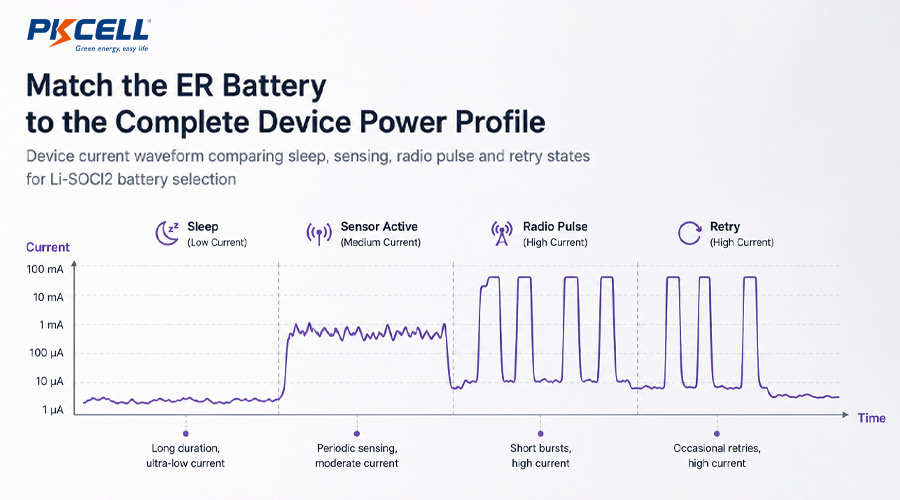
A useful battery requirement is a waveform, not a single current number. Capture at least four operating states: sleep, sensing or processing, communication or actuation, and fault or retry behavior.
1. Sleep current defines the long baseline
Include the MCU, real-time clock, regulator quiescent current, sensor bias, protection circuit, and leakage paths. A few microamps that were missed in the schematic budget can become significant over a ten-year deployment.
2. Active current defines sustained loading
Measure the longest continuous state, not only a short bench snapshot. Sensor warm-up, GNSS acquisition, memory writes, display operation, and network registration may last far longer than the final transmission.
3. Pulse amplitude and duration define voltage stability
Record amplitude, width, frequency, spacing between pulses, and the number of retries. A 250mA pulse lasting milliseconds is not the same requirement as 250mA sustained for several seconds. Wire, weld, connector, and PCB resistance also contribute to voltage drop.
4. Cut-off voltage defines how much energy is usable
The device may reset long before the cell is chemically empty. Include regulator dropout, modem brownout, MCU reset, and sensor minimum-voltage limits. Selection must pass the worst-case loaded-voltage test, not only an open-circuit voltage check.
Use average current for an initial energy budget, then separately prove that every continuous and pulse event stays above the device cut-off voltage. Reserve margin should cover self-discharge, high-temperature storage, low-temperature resistance, network retries, component variation, and aging.
When to Choose Each ER Battery
Choose ER14505 for compact, low-drain electronics
The PKCELL ER14505 3.6V AA battery is the natural starting point when board and enclosure volume are tightly constrained. Its 2,400mAh nominal capacity suits low-duty-cycle meters, beacons, memory backup, data loggers, security sensors, and compact trackers whose unsupported pulses remain within the validated device-level envelope.
Do not assume that an AA form factor makes it equivalent to a 1.5V alkaline AA cell. The voltage, chemistry, charging prohibition, transport requirements, and power behavior are different. For cellular products, PKCELL’s ER14505 + HPC1520 NB-IoT gateway case shows why pulse support may be more important than moving straight to a larger cell.
Choose ER26500 for the best size-to-runtime compromise
The ER26500 C-size Li-SOCl2 battery raises nominal energy substantially without requiring the D-size envelope. It is often the practical middle choice for smart meters, parking sensors, industrial monitoring, alarms, and asset trackers that need a longer service interval than ER14505 can provide.
Its published 130mA continuous and 300mA pulse ratings provide more headroom than ER14505, but they still do not make it a universal direct-drive source for demanding radios or actuators. Validate cold start, first pulse after storage, retry bursts, and near-end-of-life operation.
Choose ER34615 for maximum energy and maintenance avoidance
The ER34615 19Ah D-size battery is the strongest option of these three when replacement labor, site access, or downtime dominates total cost of ownership. Typical starting applications include long-life utility metering, remote industrial sensors, wireless detectors, marine instruments, and equipment deployed in difficult-to-service locations.
Its larger size and 107g approximate weight must be justified mechanically. More capacity extends the energy budget; it does not remove passivation, cold-temperature voltage sag, or a pulse requirement above the published rating. PKCELL’s wireless detector case study is a useful application reference for high-capacity ER34615 deployment.
Selection Matrix by Device Power Profile
| Device profile | Recommended starting point | Engineering reason | Critical validation |
|---|---|---|---|
| Microamp sleep, infrequent small packet | ER14505 | Compact package and adequate energy for low duty cycle | First pulse after storage and minimum loaded voltage |
| Low average current, longer target life | ER26500 | Large energy increase with a smaller envelope than D size | Capacity margin at field temperature |
| Remote installation with expensive service visits | ER34615 | 19Ah nominal energy supports long maintenance intervals | Weight, enclosure, and end-of-life pulse voltage |
| Smart meter with moderate radio pulse | ER26500 or ER34615; consider HPC | Runtime and pulse support can be optimized separately | Full modem waveform, retries, cold chamber |
| NB-IoT, LTE-M, GNSS, valve, or actuator peaks | ER + HPC or ER power type | Energy-type current rating may not support the peak directly | Peak duration, capacitor ESR, recharge time, leakage |
| Frequent or sustained high current | ER power-type spiral cell | Lower internal resistance is prioritized over maximum capacity | Thermal behavior, protection, total energy requirement |
For a deeper structure comparison, read LiSOCl2 Bobbin vs Spiral Battery. For deployments with severe winters or hot storage, also review how temperature affects Li-SOCl2 capacity and pulse current.
Send a Power Profile, Not Just a Part Number
Share sleep current, active current, peak current, pulse duration and frequency, minimum voltage, temperature range, available dimensions, target life, annual quantity, and required approvals. PKCELL can compare ER14505, ER26500, ER34615, spiral, and ER + HPC options for device-level sampling.
Validate Before Freezing the BOM
- Instrument the real device. Capture sleep, boot, sensing, acquisition, transmit, receive, actuation, retry, and fault states.
- Build an energy model. Add time-weighted loads, expected events, self-discharge allowance, environmental derating, and design reserve.
- Check loaded voltage. Test the complete pack, including tabs, leads, connector, protection, regulator, and enclosure temperature.
- Recreate storage and climate. Evaluate first pulse after representative storage, minimum temperature, elevated-temperature aging, and recovery between events.
- Test near end of life. A fresh room-temperature cell is the easiest condition. The final design must also work when resistance has risen and usable capacity is nearly exhausted.
Certifications, Factory Capacity, and Bulk Supply
Procurement qualification should cover the exact cell, pack configuration, production site, shipping route, and destination market. PKCELL’s current corporate pages list quality and compliance credentials including ISO 9001, ISO 14001, CE, UL, RoHS, KC, and BIS, while product and company materials also reference IEC, REACH, UN38.3, MSDS, and SGS documentation. Ask for current, model-specific copies and confirm their scope before approval; a corporate credential or certificate family should not be assumed to cover every custom pack automatically.
PKCELL states that its factory covers 28,000 square meters, employs about 400 people, uses automated production and testing equipment, and has annual production capacity of up to 980 million units. The company also advertises support for cells, tabs, leads, connectors, series/parallel packs, and pulse-support configurations.
A useful bulk quotation request includes the selected cell or candidate list, annual volume, order schedule, termination and connector drawing, pack voltage/capacity, wire length, packaging, labeling, certification destination, Incoterm, delivery country, sample quantity, and target production date. This lets the supplier price the actual configuration rather than a bare-cell assumption.
Purchasing FAQ: ER14505, ER26500, and ER34615
Send the full load profile, minimum operating voltage, temperature and storage range, service-life target, enclosure space, cell orientation, terminals, wire and connector details, protection requirements, annual quantity, delivery schedule, destination, and required compliance documents. A waveform file or oscilloscope capture is more useful than average current alone.
Yes. PKCELL’s product FAQ states that samples are available for evaluation. It lists a minimum formal-order value of USD 500, while the unit count depends on the selected battery and configuration. Confirm current sample cost, freight, and MOQ in the quotation.
Key factors include cell model, order and annual volume, tabs or pins, wire and connector, series/parallel configuration, protection components, HPC or capacitor support, housing, labeling, test requirements, packaging, certifications, Incoterm, and delivery route. Request tiered pricing at realistic forecast quantities.
Requirements vary by market and shipment. Common requests include the applicable quality-system certificate, product safety/compliance documents, UN38.3 test summary or report, and SDS/MSDS. Confirm the model name, manufacturer, production site, validity dates, pack configuration, and destination-market scope on every document.
PKCELL’s current homepage states a 28,000-square-meter factory, approximately 400 employees, automated manufacturing and test equipment, and annual capacity of up to 980 million units. Buyers should still confirm reserved capacity, line allocation, lot traceability, and lead time for the exact model and forecast.
PKCELL’s ER product FAQ lists standard sample arrival at roughly 7–12 days and formal orders at around 25 days, with some smaller orders potentially shipping in 15–18 days. Custom packs, peak season, certification work, and lithium shipping routes can change timing, so use the confirmed quotation and production schedule.
PKCELL advertises custom tabs, pins, leads, connectors, housings, series/parallel configurations, and ER + HPC solutions. Provide drawings, mating-connector information, polarity, wire specification, dimensional tolerances, and device-level test conditions before sample production.
Not necessarily. ER34615 has the highest current ratings of the three cells compared here, but cellular attach and transmit peaks may still cause excessive voltage sag, particularly after storage, at low temperature, or near end of life. Test the complete waveform and consider ER + HPC or a spiral power-type cell.
No. These are primary Li-SOCl2 batteries and must not be recharged. Do not short-circuit, crush, disassemble, incinerate, or operate them outside the specified conditions. Follow the manufacturer’s handling, protection, and transport instructions.
Conclusion: Select for Energy and Power
ER14505 vs ER26500 vs ER34615 is fundamentally a packaging and energy decision within the same 3.6V energy-type family. ER14505 is the compact choice, ER26500 is the balanced choice, and ER34615 is the maximum-energy choice. The correct design must also survive the highest pulse, the lowest field temperature, storage-induced passivation, wiring resistance, and the device’s minimum voltage.
Measure the actual waveform, shortlist the smallest cells that meet the energy target, and validate loaded voltage under realistic worst-case conditions. Then obtain model-specific documents and a configuration-based quote before releasing the BOM.
Get a Configuration-Based Bulk Quote
Send your device power profile and forecast to PKCELL for cell comparison, samples, custom pack design, certification document review, and volume pricing.
Post time: Aug-11-2026


