

LiMnO₂ vs LiSOCl₂ for Industrial Devices: How to Choose
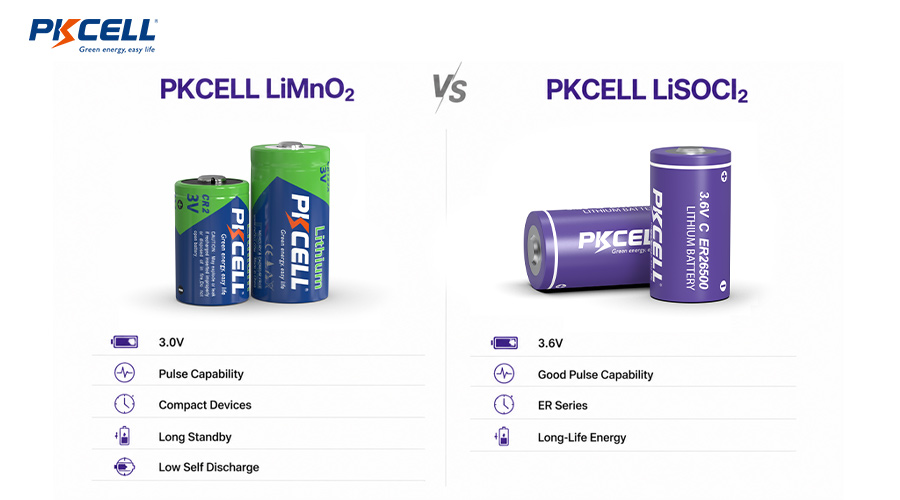
LiMnO₂ and LiSOCl₂ are both non-rechargeable lithium chemistries, but they solve different industrial power problems. LiMnO₂ is often a strong fit for compact 3 V devices with meaningful pulse loads, while LiSOCl₂ is commonly selected for 3.6 V systems requiring high energy, low self-discharge, long standby life, or operation across demanding environments.
The best choice is not determined by capacity alone. Engineers should compare the device voltage range, current profile, pulse duration, cutoff voltage, storage time, operating temperature, available space, and maintenance target.
For an application-based overview, visit the PKCELL Primary Lithium Battery Solution Hub. If you already have an electrical profile, you can also request a battery recommendation from PKCELL.
LiMnO₂ vs LiSOCl₂ at a Glance
| Selection factor | LiMnO₂ | LiSOCl₂ |
|---|---|---|
| Common designation | CR series | ER series |
| Typical nominal voltage | 3.0 V | 3.6 V |
| Primary advantage | Compact power with good pulse capability | High energy, low self-discharge, and long standby life |
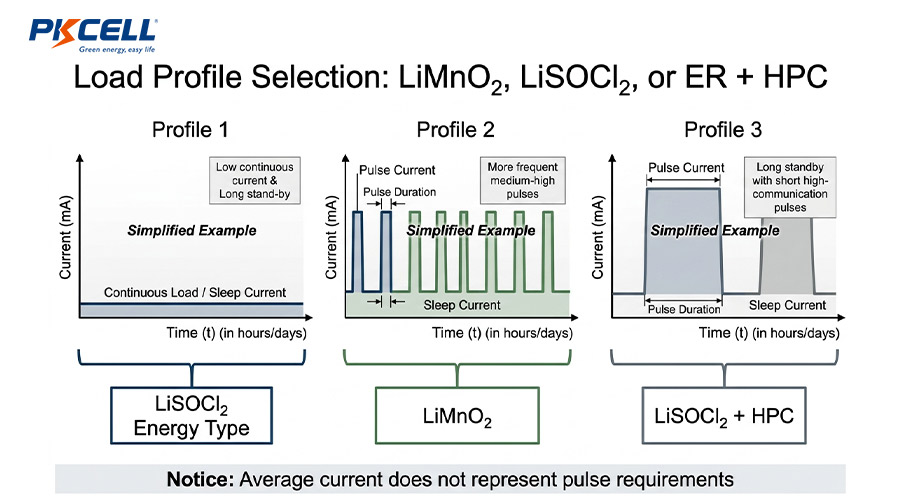
| Typical load profile | Moderate continuous load or intermittent pulses | Low continuous current and long standby; other variants support higher power |
| Pulse-load strategy | Often suitable for pulses when the model is correctly sized | Use the correct Energy Type, Power Type, or ER + HPC configuration |
| Passivation concern | Generally less prominent in system design | Must be evaluated after storage or long low-current standby |
| Common industrial uses | Security devices, alarms, cameras, medical electronics, portable instruments | Smart meters, industrial IoT, remote sensors, tracking, data loggers |
| Typical models | CR123A, CR2, CR14505, CR17450 | ER14250, ER14505, ER18505, ER26500, ER34615 |
| Rechargeable? | No | No |
These are chemistry-level tendencies, not guaranteed values for every cell. Current capability, temperature range, capacity, and discharge performance must be confirmed against the datasheet of the proposed model.
What Is a LiMnO₂ Battery?
A lithium manganese dioxide battery uses lithium as the anode and manganese dioxide as the cathode. Most cylindrical and coin-type LiMnO₂ cells are identified by a CR model number and provide a nominal voltage of approximately 3 V.
The chemistry is widely used where equipment needs a compact primary cell with stable voltage and useful pulse performance. Depending on cell format and design, applications may include:
- Wireless alarms and security sensors
- Electronic locks and access-control devices
- Cameras and portable instruments
- Medical electronics
- Emergency and backup equipment
- Compact industrial controllers
PKCELL’s LiMnO₂ battery range includes cylindrical CR cells used in security, medical, camera, and other compact equipment.
Where LiMnO₂ is especially useful
LiMnO₂ becomes a strong candidate when the electronics are designed for a 3 V source and the device periodically needs more current than a standard long-life bobbin-type LiSOCl₂ cell can provide directly.
For example, a security sensor may remain in standby and then activate a radio, light, buzzer, or camera. If the pulse duration, repetition rate, temperature, and required service life fit the selected CR cell, LiMnO₂ may provide a relatively straightforward solution without an additional pulse-support component.
What Is a LiSOCl₂ Battery?
A lithium thionyl chloride battery uses lithium and thionyl chloride chemistry and is normally identified as an ER cell. Its typical nominal voltage is 3.6 V.
LiSOCl₂ is commonly selected for industrial equipment that spends most of its time in standby or at a very low current. Its high energy density and low self-discharge make it useful when battery replacement is difficult or expensive.
Typical applications include:
- Smart water, gas, heat, and electricity meters
- Remote industrial sensors
- Environmental monitoring systems
- Data loggers and telemetry equipment
- Asset and GPS tracking devices
- Oil, gas, marine, and agricultural monitoring
- Long-life security and backup systems
Explore the available PKCELL 3.6 V LiSOCl₂ battery series for ER Energy Type and Power Type options.
Seven Differences That Matter in Industrial Design
1. Nominal voltage and device cutoff voltage
LiMnO₂ typically supplies 3.0 V, while LiSOCl₂ typically supplies 3.6 V. This difference affects far more than the label on the battery.
Confirm:
- The device’s acceptable input-voltage range
- The minimum voltage at which the device resets or shuts down
- Whether a regulator, diode, or other series component creates additional voltage loss
- How voltage changes during startup or radio transmission
- The voltage expected near the end of service life
A chemistry with more nominal energy is not useful if its voltage behavior is incompatible with the electronics. Conversely, a 3 V system should not automatically be connected to a 3.6 V cell without confirming the input rating and system design.
2. Energy density and maintenance interval
LiSOCl₂ is usually favored when maximizing stored energy and extending standby life are the main goals. This is one reason ER batteries are widely associated with utility meters and remote monitoring installations.
LiMnO₂ can also support long service periods, but it is often selected when pulse performance, compactness, and a 3 V platform carry more weight than achieving the longest possible low-drain runtime.
For industrial equipment, battery price alone rarely represents total cost. Replacement labor, travel, equipment access, service interruption, and device downtime may cost more than the battery.
3. Continuous and pulse-current capability
The current profile is often the deciding factor in the LiMnO₂ vs LiSOCl₂ comparison.
Provide at least:
- Sleep current
- Normal operating current
- Maximum continuous current
- Peak current
- Pulse duration
- Number of pulses per hour or day
- Startup current
- Device cutoff voltage during the pulse
LiMnO₂ cylindrical cells are frequently used for devices with intermittent pulse loads. Standard bobbin LiSOCl₂ cells, by contrast, are optimized primarily for long-term energy delivery at low current.
This does not mean LiSOCl₂ cannot support a transmitting industrial device. The solution may involve a larger ER cell, a spiral Power Type cell, a parallel capacitor, or an ER + HPC battery pack that stores energy between events and supplies short high-current pulses.
4. Temperature performance
Industrial equipment may face cold starts, high-temperature storage, or seasonal variation. LiSOCl₂ is notable for its wide-temperature industrial options, while LiMnO₂ operating limits vary by model and may be narrower.
Temperature should not be evaluated separately from load. A cell that works under a light room-temperature load may experience greater voltage drop when the same device starts a radio or actuator at the lowest operating temperature.
Ask the battery supplier for model-specific discharge data at:
- The application’s minimum temperature
- The normal operating temperature
- The maximum temperature
- The actual continuous and pulse loads
- The device’s real cutoff voltage
5. Passivation and voltage delay
Passivation is a natural characteristic of LiSOCl₂ chemistry. A protective layer forms on the lithium surface, helping reduce continuous self-discharge and supporting long storage life.
However, after storage or an extended period at very low current, this layer can temporarily increase impedance. When a substantial load is suddenly applied, the device may experience voltage delay or a deeper initial voltage drop.
The risk deserves particular attention when the application combines:
- Long storage before activation
- Months of low-current standby
- Cold operating temperatures
- High startup or transmission current
- A relatively high device cutoff voltage
- A small cell with a large pulse load
Read the detailed guide to LiSOCl₂ passivation for OEM devices for testing and design considerations.
6. Size, capacity, and pack configuration
Both chemistries are available in multiple cell formats, but equivalent physical sizes do not necessarily provide equivalent voltage, capacity, pulse performance, or lifetime.
A custom assembly may use cells in series to increase voltage or in parallel to increase capacity and current capability. The pack may also require:
- Wires and a specific connector
- Tabs or pins
- A fuse or diode
- Pulse-support components
- Shrink wrap or a molded housing
- Mounting hardware
- Custom labels and traceability information
PKCELL provides custom primary lithium battery pack solutions for projects requiring special voltage, capacity, shape, connectors, housing, or pack-level components.
7. Cost should be evaluated at system level
LiMnO₂ may be commercially attractive for compact or pulse-oriented devices. LiSOCl₂ may justify a different cell cost when it reduces replacement frequency in remote, sealed, underground, or widely distributed equipment.
Compare the total system impact:
- Number of cells required
- Additional capacitors or circuit components
- Pack assembly cost
- Battery replacement interval
- Field labor and travel
- Downtime or service penalties
- Shipping, documentation, and inventory requirements
Which Chemistry Fits Your Industrial Application?
Choose LiMnO₂ when:
- The device is designed for a 3 V battery
- Compact size is important
- The load includes meaningful intermittent pulses
- The required runtime is moderate rather than ultra-long
- The application is an alarm, security device, camera, portable instrument, or medical electronic device
- A suitable CR model meets the temperature and current requirements
Choose LiSOCl₂ when:
- The device is compatible with a 3.6 V source
- Long standby or service life is the main goal
- Replacement is difficult or expensive
- Low self-discharge is important
- The application faces a demanding temperature range
- The device is a meter, remote sensor, data logger, tracker, or industrial IoT node
Consider LiSOCl₂ Power Type or ER + HPC when:
- A long-life ER solution is required, but a standard Energy Type cell cannot support the pulse
- The device uses NB-IoT, LTE-M, LoRaWAN, GSM, GPS, or another pulsed communication module
- The load includes valve actuation, alarm output, GNSS startup, or motor activation
- Weak signal conditions can extend or repeat transmissions
- Cold-temperature pulse performance is critical
Not Sure Which Chemistry Fits Your Load Profile?
Send PKCELL your voltage range, standby current, pulse current, temperature, target life, size limit, and estimated quantity.
Application Examples
Smart utility meter
A meter may sleep at microamp-level current for most of its life and wake periodically to measure, store data, operate a valve, or communicate. Long standby life often points toward LiSOCl₂. If the communication or valve pulse is substantial, the design may require a Power Type cell or ER + HPC pack.
Wireless security detector
A compact detector with frequent alarm or radio pulses may favor LiMnO₂ if the service-life target and temperature range fit. A remote detector requiring much longer unattended operation may instead use LiSOCl₂ with appropriate pulse support.
PKCELL’s wireless detector battery case study shows how service life, environmental conditions, capacity, wires, and connectors influenced a customized LiSOCl₂ pack.
Industrial data logger
A low-current logger installed in a remote location may benefit from LiSOCl₂ energy density and low self-discharge. If it uploads a large data file periodically, the engineer must still evaluate the transmission pulse and voltage threshold.
Portable diagnostic device
A portable device used frequently for shorter sessions may place greater importance on immediate power delivery and a compact 3 V architecture. Depending on the exact current and lifetime requirements, LiMnO₂ may be the more direct choice.
How to Validate the Final Battery Choice
A comparison table can narrow the options, but it cannot replace device-level testing. Test the proposed cell or pack using production-representative hardware and firmware.
- Measure the real current profile. Record sleep, startup, processing, communication, retry, alarm, and actuator loads.
- Test at temperature limits. Include the highest load at the lowest expected operating temperature.
- Simulate storage and standby. For LiSOCl₂, evaluate first startup and pulse behavior after representative storage or low-current periods.
- Use the actual cutoff voltage. Do not base the decision only on nominal capacity or open-circuit voltage.
- Test aged or partially discharged samples. Beginning-of-life performance alone may hide end-of-life voltage limitations.
- Validate the complete pack. Wires, connectors, welding, diodes, fuses, and capacitors all contribute resistance and voltage drop.
- Confirm documentation. Review the model-specific datasheet and required transport, compliance, and quality documents.
The correct battery is the one that supports the real device load across the required temperature range and service life, not simply the cell with the largest capacity number.
Information to Send for Battery Selection
To receive a relevant recommendation or quote, provide:
- Application and installation environment
- Nominal and acceptable device voltage
- Device cutoff voltage
- Sleep and operating current
- Peak current, pulse duration, and pulse frequency
- Operating and storage temperature
- Target service life
- Maximum battery dimensions
- Wire, connector, and polarity requirements
- Sample quantity and estimated annual demand
- Delivery country and required documentation
Frequently Asked Questions
Is LiSOCl₂ always better than LiMnO₂ for industrial devices?
No. LiSOCl₂ is strong in long-life, low-current applications, but LiMnO₂ may be better for a 3 V device with higher pulse demand, compact dimensions, or a shorter service-life target.
Which chemistry is better for pulse current?
Many cylindrical LiMnO₂ cells provide good pulse performance. Standard bobbin-type LiSOCl₂ cells prioritize long-term energy at lower current, although spiral Power Type cells and ER + HPC packs can support more demanding pulses.
Which battery is better for smart meters?
LiSOCl₂ is widely used in smart meters because of its high energy, low self-discharge, and long standby performance. Wireless transmission or valve operation may require additional pulse support.
What is LiSOCl₂ passivation?
It is a protective layer that forms on the lithium surface. The layer supports low self-discharge but can temporarily increase impedance and cause voltage delay after storage or long low-current standby.
Can LiMnO₂ and LiSOCl₂ batteries be recharged?
No. The CR and ER batteries discussed here are primary, non-rechargeable batteries. They must not be charged.
Can I replace a 3 V LiMnO₂ battery with a 3.6 V LiSOCl₂ battery?
Not without engineering review. Confirm the device input rating, load profile, cutoff voltage, pulse demand, physical size, connector, and required service life before changing chemistry.
Can PKCELL customize either chemistry into a battery pack?
PKCELL supports custom primary lithium battery packs with series or parallel configurations, wires, connectors, tabs, housings, labels, and application-specific pulse solutions.
Conclusion
The practical choice between LiMnO₂ vs LiSOCl₂ for industrial devices begins with the load profile. LiMnO₂ is often well suited to compact 3 V devices requiring useful pulse performance. LiSOCl₂ is commonly preferred when high energy, low self-discharge, long unattended service, or challenging temperatures drive the design.
For pulsed IoT equipment, the decision may not be limited to CR versus standard ER cells. An ER Power Type cell or LiSOCl₂ plus HPC pack can combine long-term energy with stronger pulse support.
Get a Primary Lithium Battery Recommendation
Share your device voltage, current profile, pulse requirements, temperature range, target lifetime, dimensions, and project quantity with PKCELL.
Post time: Aug-18-2026


