

ER14505 + HPC vs ER18505 + HPC vs ER34615 + HPC: Which Battery Pack Fits Your IoT Device?
ER14505, ER18505 and ER34615 lithium thionyl chloride batteries can all be paired with a Hybrid Pulse Capacitor to support IoT devices that combine long standby periods with short, high-current communication events. The right combination depends on more than pulse current: total energy, enclosure size, transmission frequency, recovery time, temperature and maintenance cost all influence the decision.
The ER cell acts mainly as the long-term energy reservoir. The HPC supports brief loads such as cellular network attachment, NB-IoT or LoRaWAN transmission, GNSS startup, valve actuation and alarm signaling. A larger ER cell can extend service life, but it does not automatically mean that the pack has the correct pulse component for the device.
PKCELL provides multiple ER + HPC battery pack configurations for remote monitoring, smart metering, tracking, alarms, sonobuoys and connected industrial equipment.
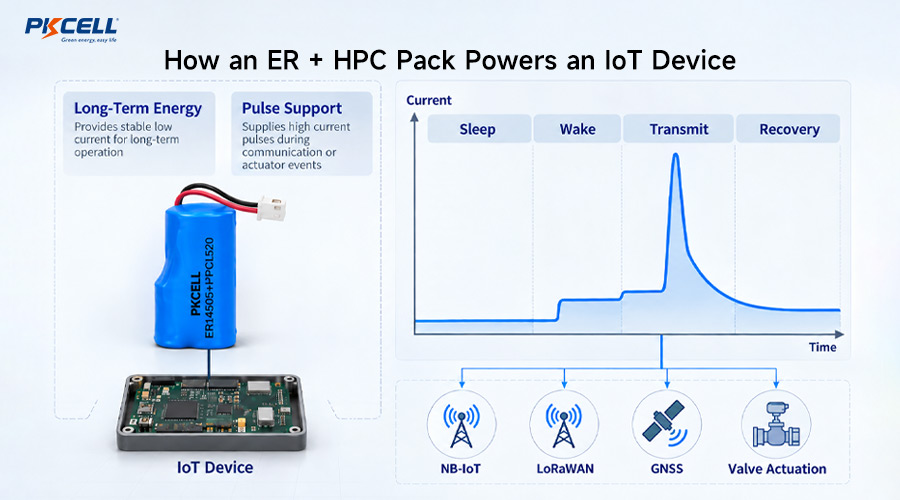
What Does an ER + HPC Battery Pack Do?
A typical connected device does not draw a constant current. It may remain asleep for minutes or hours, wake to read sensors, process data and then generate a short current peak while communicating.
Bobbin-type Li-SOCl2 cells are designed primarily for long-term energy storage and low-rate discharge. Their low self-discharge supports extended field operation, but a demanding pulse may cause voltage sag, particularly after storage, at low temperature or near end of life.
An ER + HPC architecture separates the two main jobs:
- ER battery: stores the energy needed for the complete service life;
- HPC: supports short high-current events and then recovers between pulses;
- Power circuit: manages the voltage path, protection and interaction between the two components;
- Device firmware: controls wake-up, communication retries and the timing between high-load events.
The ER cell determines most of the mission energy. The HPC helps deliver pulse power. Neither component can be selected correctly without the device’s complete load profile.
What the HPC Does Not Do
An HPC should not be treated as a substitute for the primary battery’s required amp-hour capacity. It can support pulse delivery, but the ER cell must still provide enough energy to operate the device and replenish the pulse component between events.
If a device transmits too frequently or has a high sustained load, the ER cell may not have enough recovery time. A larger HPC alone will not correct an insufficient energy budget or excessive continuous current.
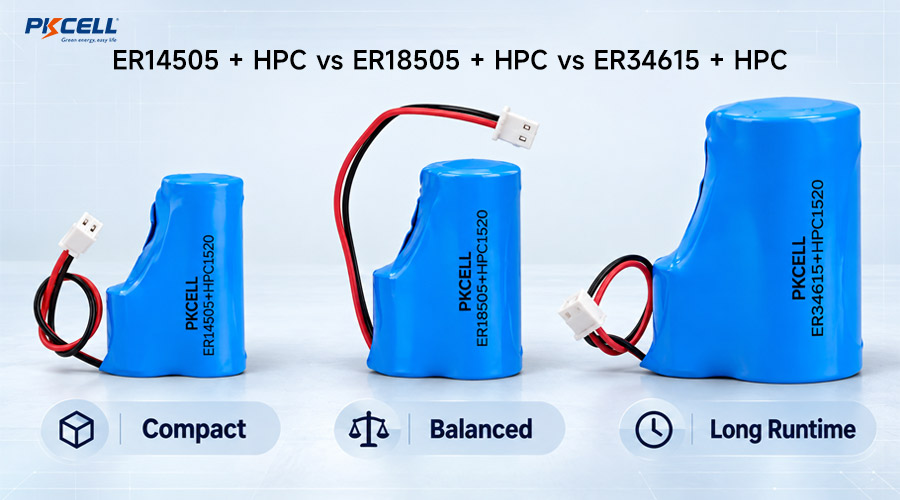
ER14505 + HPC vs ER18505 + HPC vs ER34615 + HPC
The following comparison uses representative PKCELL combinations. Exact pack performance depends on the selected HPC model, number of ER cells, wiring, protection, temperature and test conditions.
| Selection Factor | ER14505 + HPC | ER18505 + HPC | ER34615 + HPC |
|---|---|---|---|
| ER cell format | Compact AA-size class | Larger A-size class | High-capacity D-size class |
| Representative single-cell capacity | 2400mAh | 4000mAh | 19000mAh |
| Representative pulse component | HPC1520 | HPC1520 or another application-matched HPC | HPC1530, HPC1550 or another application-matched HPC |
| Relative pack size | Smallest | Medium | Largest |
| Runtime potential | Lowest of the three for the same duty cycle | Balanced runtime and size | Highest single-cell energy of the three |
| Typical design priority | Compact integration | More energy without D-size volume | Long deployment and lower maintenance frequency |
| Possible applications | Compact trackers, small NB-IoT nodes, portable gateways | Industrial sensors, security devices, remote monitoring | Smart meters, infrastructure monitoring, marine or remote assets |
When ER14505 + HPC Is the Best Fit
ER14505 + HPC is the most compact of the three starting points. It is useful when the PCB, antenna, enclosure and connector leave limited space for the power system.
Consider ER14505 + HPC when:
- the enclosure is designed around an AA-size battery format;
- the device has a low sleep current;
- reporting is relatively infrequent;
- the target operating life is moderate;
- weight is important for a tracker or portable device;
- communication creates short pulses that a standalone bobbin cell cannot reliably support.
A representative ER14505 + HPC1520 battery pack combines a 3.6V ER14505 energy source with pulse support for connected devices.
Example: NB-IoT Gateway
PKCELL developed an ER14505 and HPC1520 solution for an NB-IoT gateway. The ER section supplied long-term energy, while the HPC supported current peaks during cellular connection and data transmission.
This configuration demonstrates an important point: the required capacity may be achieved with more than one ER14505 cell, while the pulse component is selected separately. “ER14505 + HPC” identifies the design direction, not the complete pack specification.
Main Tradeoff
The compact format limits total stored energy compared with ER18505 or ER34615. If a device reports frequently, spends a long time attached to the network or operates in weak coverage, the smaller energy reserve may lead to a shorter replacement interval.
When ER18505 + HPC Is the Best Fit
ER18505 + HPC occupies the middle ground. It provides more nominal energy than a single ER14505 without requiring the volume of an ER34615.
Consider ER18505 + HPC when:
- the target life exceeds the practical range of a compact ER14505 solution;
- the enclosure cannot accept a D-size cell;
- the device has more frequent sensor sampling or reporting;
- maintenance reduction is important but size remains constrained;
- a cellular, GNSS, alarm or actuator pulse needs additional voltage support.
A representative ER18505 + HPC1520 battery pack uses a 4000mAh ER cell as its main energy source. The exact HPC should still be chosen from the actual pulse waveform.
Main Advantage
ER18505 + HPC often provides a practical balance between enclosure size, energy reserve and pulse support. It may be appropriate for industrial sensors and connected security devices that are too demanding for a compact AA-size solution but do not justify a D-size pack.
Main Tradeoff
It cannot match the total single-cell energy of ER34615. Long service targets, frequent transmissions or high background current may still require a larger cell or multiple-cell pack.
When ER34615 + HPC Is the Best Fit
ER34615 + HPC is intended for applications where energy reserve and maintenance interval are more important than minimum pack volume. A representative ER34615 provides substantially more nominal capacity than ER14505 or ER18505.
Consider ER34615 + HPC when:
- the device must operate for many years without battery replacement;
- site access or maintenance is expensive;
- reporting occurs frequently or includes repeated retries;
- the system includes multiple sensors, GNSS or an actuator;
- the enclosure can support a D-size cell and the selected HPC;
- the application is a smart meter, infrastructure sensor, marine instrument or remote industrial node.
PKCELL offers a representative ER34615 + HPC1530 battery pack built around a 3.6V, 19000mAh ER34615 energy source.
Higher-Capacity Pack Options
An ER34615-based design can also use multiple cells. In one metering project, PKCELL supplied a 3.6V 57Ah ER34615 + HPC1550 pack using a 1S3P configuration. This type of architecture should be engineered around the required runtime, current sharing, enclosure and safety requirements.
Main Tradeoff
ER34615 + HPC requires more enclosure volume and adds mass. It may be unnecessary for a compact device with a modest energy budget. Oversizing can also increase material cost and shipping weight without solving an incorrectly specified pulse load.
Capacity Comparison Does Not Determine Pulse Performance
It is tempting to assume that ER34615 + HPC always has the strongest pulse performance because it contains the largest ER cell. That conclusion is incomplete.
Pulse capability depends on:
- the selected HPC model;
- pulse current and duration;
- the number of pulses in one communication event;
- time available for recovery;
- ER cell recharge current into the HPC;
- temperature and state of charge;
- wire, connector and protection resistance;
- the device’s minimum operating voltage.
For example, PKCELL reference specifications list HPC1520 as a 2000mA pulse-capable component under its stated conditions and HPC1530 as a 3000mA pulse-capable component under its stated conditions. These component values must not be treated as automatic finished-pack ratings. The complete pack and device require validation.
Select the ER cell from energy and recovery requirements. Select the HPC from the complete pulse waveform. Then validate both components together.
How to Estimate IoT Battery Runtime
Begin by separating the device into operating states:
- deep sleep;
- sensor measurement;
- MCU processing;
- GNSS acquisition, if used;
- network attachment;
- data transmission and receive windows;
- communication retries;
- actuator, valve or alarm operation.
The second equation is only a starting point. The usable capacity must account for temperature, self-discharge, storage time, cut-off voltage, pulse-related voltage drop and an engineering margin.
For a detailed duty-cycle method, see PKCELL’s LoRaWAN and NB-IoT battery-life calculation guide.
Network Conditions Can Change the Result
A laboratory test with strong signal coverage may underestimate field consumption. Weak cellular coverage can extend connection time or cause repeated transmissions. GNSS cold starts can also last longer than warm starts.
Use field-representative waveforms and include a defined retry policy in the energy calculation. Otherwise, an ER14505 solution that appears adequate on paper may require ER18505 or ER34615 capacity in the real deployment.
Temperature, Storage and Passivation
Low temperature can increase internal resistance and deepen voltage sag during communication. High storage temperature can accelerate aging and self-discharge. Long storage or extended low-current operation can also influence passivation behavior.
The HPC can support pulse current and reduce stress on the ER cell, but it does not remove the need to test:
- first startup after representative storage;
- the coldest expected communication event;
- repeated pulses at the shortest expected interval;
- the device near its projected end-of-life condition;
- the actual connector, wire and protection path;
- voltage recovery after transmission.
PKCELL’s Li-SOCl2 passivation guide provides additional guidance on loaded-voltage and storage-related testing.
IoT Application Selection Matrix
| IoT Device | Likely Starting Point | Selection Reason |
|---|---|---|
| Compact asset tracker | ER14505 + HPC | Space and weight are important; reporting may be infrequent |
| NB-IoT sensor node | ER14505 + HPC or ER18505 + HPC | Depends on network activity, reporting interval and target life |
| Remote security sensor | ER18505 + HPC | Balanced energy reserve with alarm or radio pulse support |
| Smart water or gas meter | ER18505 + HPC or ER34615 + HPC | Long service life and periodic communication are key |
| Infrastructure monitor | ER34615 + HPC | Maintenance access is difficult and deployment life is long |
| Marine or remote environmental sensor | ER34615 + HPC | High energy reserve and reduced replacement frequency |
| Valve-control device | Application-specific ER + HPC | Actuator current and duration may dominate the selection |
This matrix is a starting point, not a substitute for electrical testing. Two devices using the same communication protocol can require different packs because their firmware, coverage, sensor load and service-life targets differ.
Common Battery Selection Mistakes
Choosing Only by Nominal Capacity
A high-capacity ER cell can still fail if the selected HPC, wiring or voltage path cannot support the communication pulse.
Choosing Only by Peak Current
A pack may pass one short pulse test but lack the total energy or recovery time needed for repeated field operation.
Ignoring Communication Retries
Retries can increase both pulse frequency and total energy use. Test weak-signal and failed-attachment conditions.
Using Room-Temperature Tests Only
Cold temperature changes voltage response and recovery behavior. Validate the worst expected internal temperature.
Comparing Model Names Instead of Complete Packs
“ER14505 + HPC” does not specify the number of ER cells, HPC model, protection circuit, connector or pack dimensions. Compare complete specifications.
Assuming a Larger Pack Is Automatically Safer
More capacity does not correct poor protection, incorrect wiring or an unsuitable pulse component. Safety requires pack-level engineering and validation.
Testing Checklist Before Mass Production
| Test | What to Record | Purpose |
|---|---|---|
| Sleep-current test | Actual current across all low-power modes | Establishes the long-term energy baseline |
| Communication waveform | Peak current, duration, receive windows and retries | Defines the HPC requirement |
| Recovery test | HPC voltage before and after repeated events | Confirms the reporting interval is sustainable |
| Cold startup | Minimum loaded voltage and boot stability | Checks resistance and passivation risk |
| Weak-signal test | Connection time, retries and energy per message | Represents difficult field coverage |
| End-of-life test | Loaded voltage at a representative depleted condition | Confirms operation beyond fresh-battery testing |
| Storage simulation | First activation after defined time and temperature | Evaluates voltage-delay behavior |
| Mechanical validation | Connector retention, vibration, insulation and fit | Confirms device-ready integration |
Information to Send a Battery Supplier
For a useful ER + HPC recommendation, provide:
- device type and communication technology;
- sleep, sensing and processing currents;
- peak current and complete pulse waveform;
- pulse frequency and minimum recovery interval;
- expected network retries and signal conditions;
- minimum acceptable device voltage;
- operating and storage temperature range;
- target service life;
- available battery dimensions and maximum weight;
- wire, connector, housing and mounting requirements;
- sample quantity, annual demand and required documents.
PKCELL’s primary lithium battery solution hub provides additional paths for comparing application, chemistry, pulse and custom pack requirements.
Request an ER + HPC Battery Recommendation
Send PKCELL your device load profile, pulse waveform, reporting interval, temperature range, target runtime and enclosure dimensions. The engineering team can compare ER14505 + HPC, ER18505 + HPC, ER34615 + HPC and customized multi-cell configurations before prototype sampling.
Frequently Asked Questions
Which ER + HPC battery pack lasts the longest?
For the same duty cycle and one-cell configuration, ER34615 generally offers the largest nominal energy reserve of the three. Actual service life still depends on temperature, cut-off voltage, transmission frequency, retries, storage and pack design.
Is ER14505 + HPC suitable for NB-IoT?
It can be suitable for a compact, low-average-current NB-IoT device when the selected HPC supports the real connection and transmission waveform. Network conditions, retry behavior and target life must be tested.
When should I move from ER14505 to ER18505?
Consider ER18505 when the ER14505 energy budget does not meet the target life, reporting is more frequent or additional energy margin is needed, but a D-size ER34615 is too large.
Does ER34615 automatically provide the highest pulse current?
No. The selected HPC, interconnects, temperature and complete load waveform determine pulse performance. The larger ER34615 primarily provides more long-term energy.
Can the same HPC be used with all three ER cells?
Not automatically. The HPC must be matched to pulse current, duration, frequency, recovery time, temperature and voltage requirements. A component suitable for one device may be too small or unnecessarily large for another.
Does an HPC eliminate Li-SOCl2 passivation?
No. It can reduce pulse stress on the ER cell and help support loaded voltage, but storage history, temperature, first startup and end-of-life behavior still require validation.
Can PKCELL customize the pack connector and dimensions?
PKCELL supports customized wires, connectors, tabs, labels, insulation, housings and multi-cell pack structures. Final dimensions depend on the selected ER cells, HPC and protection design.
Are ER + HPC battery packs rechargeable?
The Li-SOCl2 ER battery is a primary, non-rechargeable cell. Do not connect the complete pack to an external charging source unless the pack and system have been specifically engineered and documented for that function.
Conclusion
ER14505 + HPC is best suited to compact IoT devices with modest total energy needs. ER18505 + HPC offers a practical balance between size and runtime. ER34615 + HPC provides the largest single-cell energy reserve for long deployments and maintenance-sensitive installations.
The ER model should be chosen from the complete energy budget, while the HPC should be selected from pulse current, pulse duration, recovery time and temperature. The final decision must be verified with the real device under cold-start, weak-signal, repeated-transmission and end-of-life conditions.
For a project-specific comparison, submit your electrical, environmental and mechanical requirements through the PKCELL battery engineering inquiry page.
Post time: Oct-10-2026


