

The U.S. Battery Strategy 2030: What Global Industrial Battery Buyers Should Watch
The United States has set a new direction for its battery industry: build a more integrated domestic supply chain by 2030, strengthen technology and manufacturing leadership by 2035, and expand the deployment of reliable battery systems. For global industrial buyers, the strategy is not simply an announcement about U.S. factories. It is a signal to watch sourcing patterns, material availability, supplier qualification and the changing economics of battery procurement.
On October 28, 2026, the U.S. Department of Energy (DOE) released A National Strategy for American Leadership in Batteries. The document sets out priorities across mining, refining, materials, cell and pack manufacturing, research commercialisation and grid deployment.
For buyers outside the United States, the practical question is how these priorities may affect supplier choices, lead times, qualification requirements and long-term supply agreements.
What the U.S. Battery Strategy Actually Sets Out to Do
The DOE strategy establishes three broad objectives:
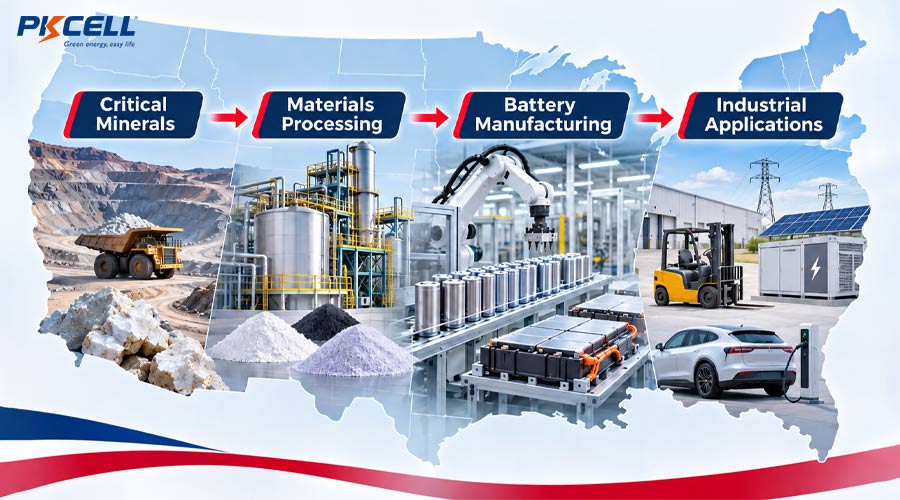
- Mine-to-market by 2030: develop a more continuous domestic value chain, covering extraction, refining, engineered materials, cells, packs and end products.
- Technology and manufacturing leadership by 2035: move promising battery discoveries into scalable, commercially viable production.
- Affordable and reliable deployment: support battery systems for grid reliability, transportation, data centres and other critical applications.
The DOE estimates that U.S. battery demand across transportation and energy-storage applications could rise from 179 GWh in 2025 to 707 GWh in 2035. The strategy also cites an estimate that data centres could account for 25% of U.S. battery-storage demand by 2030. These are forecasts for broad battery and storage markets, not demand estimates for primary lithium cells or any individual chemistry.
The strategy is important because it links industrial competitiveness with supply-chain resilience. It also recognises that expanding cell assembly alone will not create a complete domestic industry if key materials, components, processing capacity and production equipment remain concentrated elsewhere.
Six Developments Industrial Buyers Should Watch
1. More attention to upstream and midstream supply
Mining is only the first stage of a battery supply chain. Refining, precursor materials, cathodes, anodes, electrolytes, separators and manufacturing equipment can each become bottlenecks. The DOE strategy places greater emphasis on these upstream and midstream stages, where domestic capacity has been less developed.
For procurement teams, this means looking beyond the country where a battery cell is assembled. Ask suppliers where key materials and components originate, which processing stages rely on single regions, and whether alternative sources have been qualified. A final assembly location alone does not describe the full supply-chain exposure.
2. Grid and data-centre demand may reshape industrial priorities
Electricity demand from data centres and other large loads is increasing interest in grid-scale storage, fast-response services and longer-duration solutions. The DOE strategy identifies grid modernisation and resilience as priority deployment areas.
Industrial buyers should watch how utilities, data-centre operators and infrastructure contractors translate these priorities into tenders and supplier requirements. Demand growth may create opportunities across power conversion, monitoring, controls, backup systems and supporting electronics—not only large battery installations.
For remote metering and monitoring equipment, battery needs remain application-specific. PKCELL’s utility meter battery solutions provide a relevant example of a different industrial power segment from grid-scale rechargeable storage.
3. Manufacturing scale-up will depend on commercial execution
The strategy highlights the gap between laboratory research and commercial manufacturing. Pilot facilities, demonstration projects and validation are intended to help new technologies reach bankable production.
Buyers should distinguish announced capacity from qualified, repeatable output. When evaluating a new supplier, check whether the facility is operating, whether the specific product is in commercial production, how yields and quality are controlled, and whether the supplier can support the forecast volume over the contract period.
4. Process innovation and factory data will matter more
The DOE identifies continuous processing, advanced digital tools and digital twins as areas that could improve manufacturing efficiency and product consistency. For buyers, the commercial value is not the technology label itself. It is whether a supplier can demonstrate stable production, controlled process changes, traceable batches and consistent product performance.
Ask for evidence relevant to the product being purchased rather than relying on general statements about automation or smart factories.
5. Tax-credit eligibility and foreign-entity rules need careful interpretation
U.S. manufacturing incentives can influence where battery components are produced and how supply chains are structured. One important program to monitor is the Advanced Manufacturing Production Credit under Section 45X. The credit is tied to eligible components produced in the United States and sold by qualifying taxpayers, subject to statutory and regulatory conditions.
The IRS’s updated Instructions for Form 7207 explain changes under Public Law 119-21, including restrictions involving prohibited foreign entities and material assistance for tax years beginning after July 4, 2025. These rules may affect the eligibility of particular manufacturers or components for a credit.
However, buyers should not interpret 45X or the prohibited-foreign-entity rules as a general ban on imported batteries. Eligibility depends on the taxpayer, component, production location, ownership and control rules, supply-chain inputs and applicable guidance. Companies considering U.S. manufacturing or contract production should obtain tax and legal advice before making sourcing decisions.
6. International partnerships will remain part of the picture
Although the strategy prioritises domestic capability, it also refers to coordination with international partners and allied countries. The document recognises that countries have different strengths in natural resources, manufacturing expertise and research.
This matters to global buyers. A more resilient supply chain may combine U.S. production, allied-country materials, specialised overseas manufacturing and qualified alternative suppliers. The objective for procurement is not to assume that every component will become domestic, but to understand which supply-chain links are strategically sensitive and where credible alternatives exist.
What These Changes Mean for Global Industrial Battery Buyers
The impact will differ by battery category and end use. Buyers should avoid treating the U.S. battery strategy as one uniform market signal.
| Buyer segment | What to monitor | Procurement response |
|---|---|---|
| Grid-scale storage and data centres | Domestic project pipelines, system integration, long-duration storage and supplier bankability | Assess project-specific system requirements, warranties, service capability and long-term supplier capacity |
| Industrial equipment and backup systems | Availability of qualified cells, modules, power electronics and replacement components | Qualify alternatives and confirm lifecycle support for the complete equipment platform |
| Smart meters and remote infrastructure | Utility investment, connected-device deployment and long maintenance intervals | Match battery supply to device duty cycle, service life and field-replacement strategy |
| Importers and distributors | Country of origin, trade measures, customer documentation and supplier concentration | Maintain transparent product records and avoid dependence on a single source |
| OEMs using custom battery packs | Component provenance, contract manufacturing, design ownership and change control | Define specifications, approved production sites and notification requirements in supply agreements |
Do Not Confuse Advanced Battery Policy with Every Industrial Battery Market
A significant part of U.S. battery policy focuses on rechargeable batteries for electric vehicles and stationary energy storage. These markets use different product architectures, manufacturing processes and supply-chain inputs from many primary lithium applications.
For example, Li-SOCl2 cells used in long-life meters and remote sensors are non-rechargeable primary batteries. Their purchasing decisions are usually driven by service-life requirements, low self-discharge, operating environment, pulse demand, device compatibility and dependable supply—not by the same GWh-scale deployment economics used for EV or grid-storage batteries.
Likewise, LiMnO2 batteries used in selected security, tracking and industrial devices should be evaluated against their actual device requirements. They should not be presented as direct beneficiaries of policies aimed at domestic rechargeable-cell manufacturing.
Global buyers sourcing primary lithium products can review PKCELL’s Li-SOCl2 battery range, LiMnO2 battery range and customized primary lithium battery packs according to the intended application.
A Procurement Checklist for the 2030 Transition
Industrial buyers do not need to predict every policy outcome. They do need a sourcing process that can respond when customer requirements, trade conditions or supplier footprints change.
- Map the supply chain: identify manufacturing locations for cells, materials and critical components—not just the final shipping origin.
- Check policy exposure: determine whether the product or supplier participates in a U.S. incentive program or is subject to specific foreign-entity restrictions.
- Verify the supplier’s claims: request product-specific evidence for manufacturing location, ownership, origin and relevant certifications.
- Qualify alternative sources: assess second-source options before a supply disruption occurs, while preserving product equivalence and approval records.
- Review commercial terms: clarify price-adjustment mechanisms, lead times, allocation, minimum order quantities and change notifications.
- Separate forecasts from commitments: distinguish announced factories and planned capacity from commissioned facilities and proven output.
- Plan for lifecycle support: consider replacement availability, documentation retention and product continuity over the equipment’s service life.
- Revisit sourcing regularly: monitor official policy updates, customer requirements and supplier changes rather than relying on a one-time assessment.
How to Build a More Resilient Battery Sourcing Strategy
For many industrial buyers, resilience comes from combining supplier transparency with application-specific qualification. A second source is useful only when its product has been evaluated for the device, approved documentation is available and production changes are controlled.
For projects involving remote monitoring, metering, tracking or industrial electronics, battery sourcing should start with the equipment’s operating requirements and expected lifecycle. PKCELL’s IoT battery solutions and GPS tracking battery solutions illustrate application areas where long-term component availability and fit-for-purpose supply matter.
For customised requirements, buyers can also review the custom battery pack quotation checklist before preparing an RFQ.
Frequently Asked Questions
What is the main goal of the U.S. Battery Strategy 2030?
The DOE strategy aims to establish a more integrated domestic battery supply chain by 2030, strengthen U.S. technology and manufacturing leadership by 2035, and support affordable, safe and reliable battery deployment.
Does the U.S. strategy require all batteries sold in America to be made in the United States?
No. The DOE document is a national strategic roadmap, not a blanket domestic-content mandate for every battery sold in the United States. Specific incentives, procurement rules, trade measures or customer contracts may create separate requirements.
Will the strategy increase demand for all lithium battery chemistries?
Not equally. The published demand outlook focuses on transportation and energy-storage applications. Primary lithium cells for meters, sensors and tracking devices serve different markets and should be assessed using their own demand drivers.
What should overseas suppliers monitor under Section 45X?
Section 45X eligibility is tied to qualifying components produced in the United States and other statutory conditions. Suppliers and buyers should monitor the current IRS rules on eligible components, prohibited foreign entities and material assistance. It is not a general import ban.
How can industrial buyers reduce battery supply-chain risk?
Map material and manufacturing origins, qualify alternative suppliers, verify product-specific documentation, agree on change control and review sourcing assumptions regularly.
Conclusion: Watch the Supply Chain, Not Just the Factory Announcements
The U.S. Battery Strategy 2030 signals a long-term effort to strengthen domestic capability across materials, manufacturing, technology commercialisation and grid deployment. Its effects will emerge through investment decisions, supplier footprints, incentive eligibility and customer procurement requirements.
For global industrial battery buyers, the most useful response is practical: understand where products and components are made, verify policy claims, qualify suitable alternatives and maintain supply agreements that can adapt as the market changes. A resilient sourcing strategy is built on evidence and product fit—not assumptions about where the next factory will open.
Planning an Industrial Battery Project for the U.S. or Global Markets?
PKCELL supports OEM and industrial applications with Li-SOCl2, LiMnO2 and customized primary lithium battery pack solutions. Share your application, electrical requirements, target quantity and destination market to discuss a suitable supply option.
Policy note: The DOE strategy is a federal strategic document. Tax-credit eligibility, trade restrictions and procurement obligations depend on separate statutes, regulations, contracts and current agency guidance. This article is general market information, not legal, tax or investment advice. Confirm current requirements with qualified advisers before making sourcing or investment decisions.
Post time: Nov-10-2026


