

The CTE China Toy Expo 2026 is taking place in Shanghai from October 21 to 23, 2026. PKCELL welcomes toy brands, electronic toy developers, OEM manufacturers and sourcing teams to visit Booth E3A52 at the Shanghai New International Expo Centre.
For toy makers, choosing a primary battery starts with the function it must power. A battery-operated toy or remote controller designed for AA or AAA cells has different needs from a compact electronic module using a coin cell. Cell size, operating voltage, standby current, short power bursts, connection method and battery-compartment design all need to be considered together.
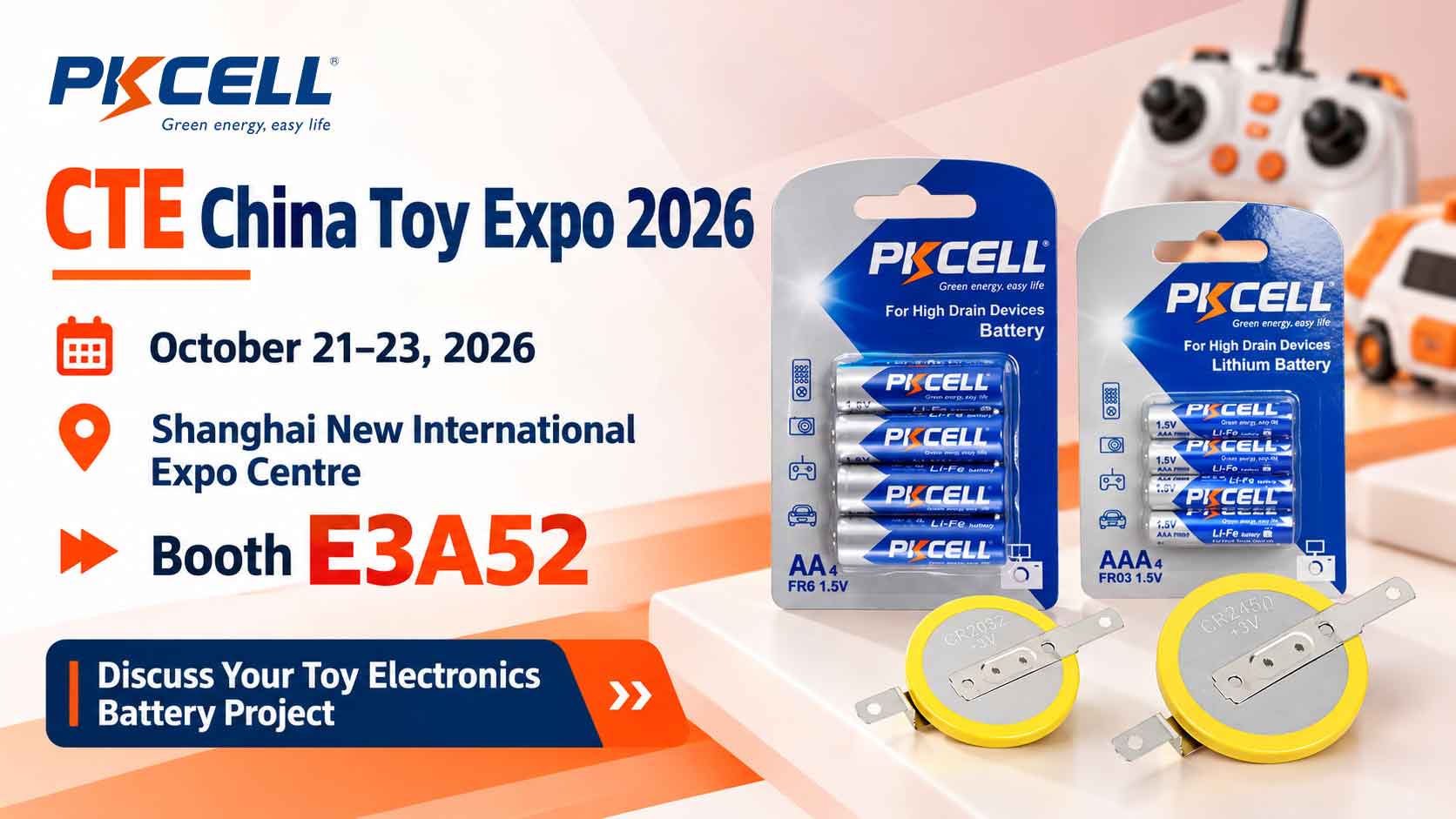
CTE China Toy Expo 2026: Visitor Information
CTE brings together companies across the toy, juvenile-products and related consumer-product sectors. At Booth E3A52, PKCELL’s discussion is focused on primary battery options for compatible toy electronics and on the engineering details that help a battery fit the finished product.
| Exhibition | CTE China Toy Expo 2026 |
|---|---|
| Dates | October 21-23, 2026 |
| Venue | Shanghai New International Expo Centre, Shanghai, China |
| PKCELL booth | E3A52 |
| Relevant visitors | Toy brands, electronic toy developers, OEM/ODM teams, component buyers and sourcing managers |
| Discussion topics | AA/AAA Li-FeS2 cells, CR coin cells, terminal options and battery integration for toy electronics |
For official visitor information, check the CTE China Toy Expo website. The booth number above follows the PKCELL exhibition poster.
Match the Battery Format to the Toy’s Power Architecture
There is no single primary battery that fits every toy. The most useful starting point is the product’s original battery format and electrical load. The following options are examples to evaluate against the actual device specification, not universal replacements.
AA and AAA Li-FeS2 Cells for Compatible Toys and Controllers
PKCELL’s FR6/FR14505 AA 1.5V Li-FeS2 cell and FR03/FR10445 AAA 1.5V Li-FeS2 cell are listed for toys and remote controls on their product pages. These cylindrical formats can be considered for devices designed around the corresponding AA or AAA size and 1.5V primary-cell system.
For an OEM project, confirm the number of cells, the required voltage, motor startup current if a motor is present, contact resistance and the device’s low-voltage cutoff. A similar physical size does not guarantee that a battery is electrically suitable. Review the FR6 AA battery, the FR03 AAA battery and the broader Li-FeS2 product range.
CR Coin Cells for Small, Low-Current Electronic Functions
For compact electronic functions such as memory retention, clocks, selected remote-control circuits or low-current light and sound modules, a CR coin cell may be suitable when the design specifically calls for that voltage and form factor. PKCELL lists electronic toys among the applications for its CR2032 and CR2450 button-cell products.
Check the device’s average and peak current, available cell thickness, holder contact design and expected service interval before selecting a model. For board-level assemblies, review CR2032 cells with lead or tab options and CR2450 cells with lead or tab options. You can also browse the full lithium button-cell range.
Other Cylindrical Li-MnO2 Cells for Designs with a Specific Requirement
PKCELL also offers cylindrical Li-MnO2 formats, including CR2 and CR123A models. These should only be considered for a toy-related electronic assembly when the original design specification calls for that exact format, voltage and load profile. They are not general substitutes for AA/AAA cells and should not be presented as universal power sources for toy motors. See the Li-MnO2 battery range for more information.
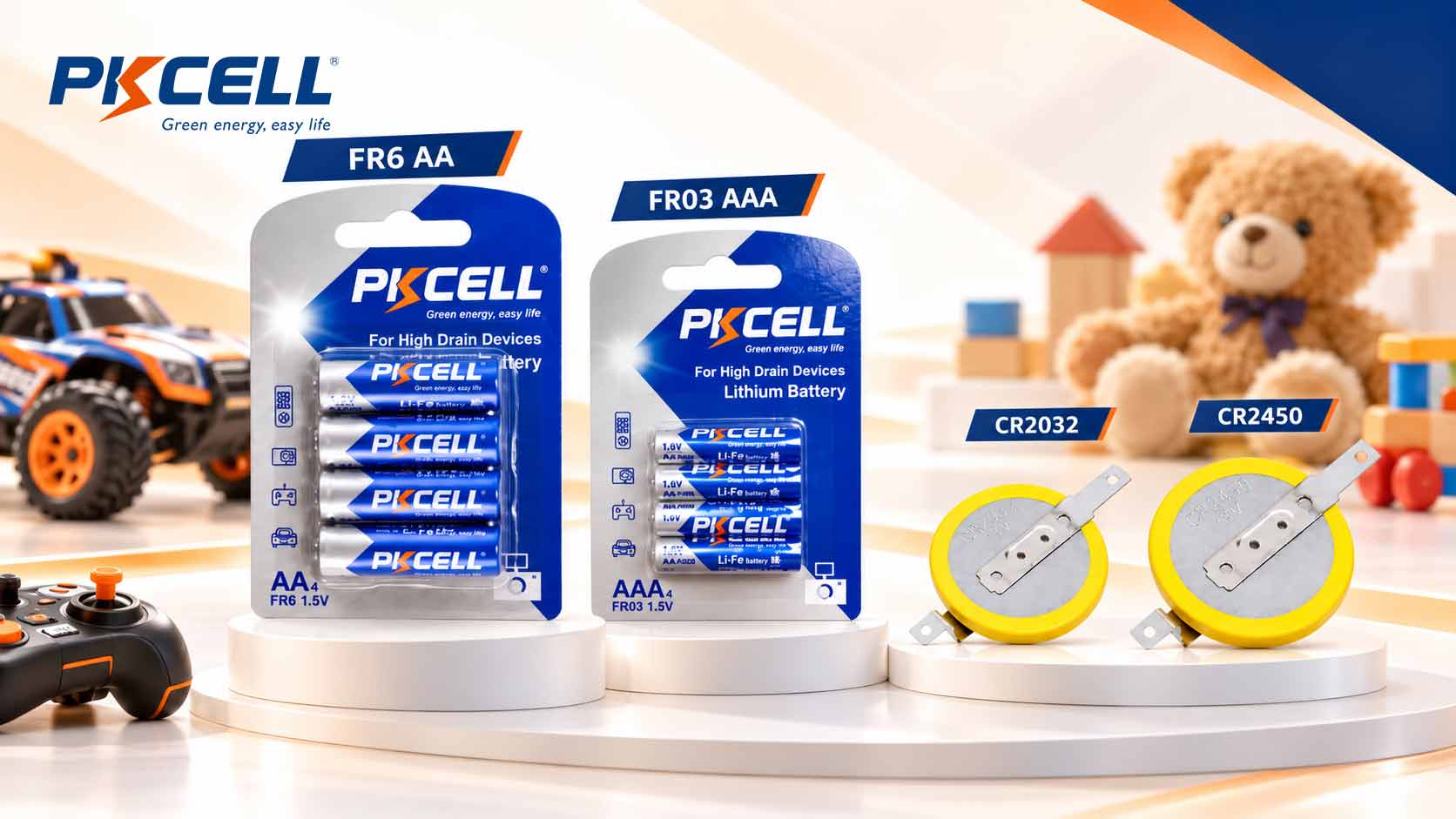
A Practical Battery Match for Different Toy Functions
Use the device function to narrow the candidate format before requesting a sample. This quick guide is a discussion aid; the final selection must be verified against the product’s electrical and mechanical specification.
| Toy or electronic function | Battery option to evaluate | Key design check |
|---|---|---|
| Battery-operated toy or controller designed for AA cells | FR6 / FR14505 AA Li-FeS2 | Cell count, 1.5V system compatibility, startup current and contacts |
| Compact toy or controller designed for AAA cells | FR03 / FR10445 AAA Li-FeS2 | Available space, current profile and required operating time |
| Small, low-current electronic function with a CR coin-cell holder | CR2032 or CR2450, if specified | Voltage, peak current, cell thickness, holder and secure enclosure |
| PCB-mounted electronic module | Compatible coin cell with factory tab or lead | Terminal direction, board layout, insulation and mechanical retention |
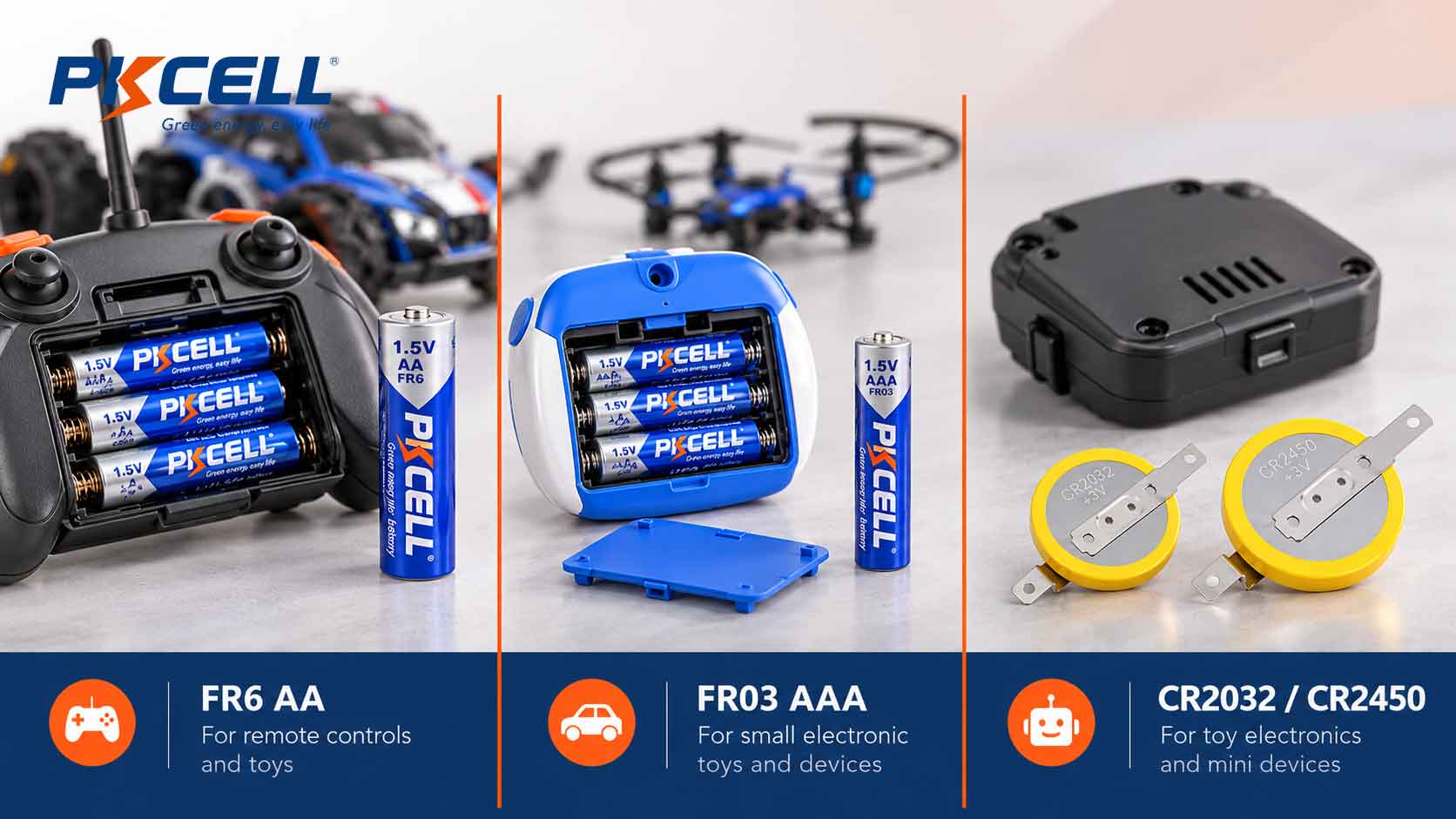
A cell that meets the electrical target still has to fit the production assembly. For a conventional cylindrical cell, confirm the holder, polarity and contact pressure. For a coin-cell design, check the holder geometry or specify the required factory-attached tab or lead. Tab orientation, lead exit direction, insulation and available enclosure space should be agreed before samples are approved.
PKCELL provides standard coin cells and selected coin-cell configurations with lead or tab options. For a quotation, share a drawing or sample reference whenever possible. If you are still at the concept stage, a dimensioned sketch and preliminary load profile are useful starting points.
- Electrical: nominal voltage, cell count, standby current, active current, pulse duration and low-voltage cutoff.
- Mechanical: battery compartment dimensions, holder type, terminal direction, lead length and insulation requirements.
- Use conditions: expected storage period, operating temperature, shipping route and the toy’s actual duty cycle.
- Project needs: target market, sample quantity, test plan, packaging and estimated annual volume.
Safety and Validation for Products Intended for Children
Battery selection is only one part of toy safety. Products intended for children require careful enclosure design, secure battery retention and validation against the applicable requirements in each target market. Coin cells can pose a serious ingestion hazard if they become accessible, so the finished product must keep them inaccessible during normal use and foreseeable handling.
For any proposed battery, check the datasheet, actual load profile, polarity protection, contact reliability, packaging and required documentation. A product page or nominal voltage alone does not prove that a finished toy complies with all applicable standards.
Prepare a Useful Brief Before Meeting PKCELL
To help the team understand your project at Booth E3A52, prepare as many of the following details as possible:
- The toy type and powered function: motor, controller, light, sound, memory or another electronic module.
- The original battery format, required voltage and cell count.
- Typical current, peak current, pulse duration and expected operating time.
- Battery compartment drawing, holder details, terminal type and available space.
- Target market, sample schedule, packaging requirements and estimated order quantity.
This information helps separate suitable candidates from formats that only look similar. If the project needs a tabbed coin cell, share the board layout and terminal direction; if it uses AA or AAA cells, share the device load and holder specification.
Meet PKCELL | CTE China Toy Expo 2026
Let’s Discuss Your Toy Electronics Battery Project
Visit Booth E3A52 at the Shanghai New International Expo Centre, October 21-23, 2026, or share your specifications with PKCELL online.
Request a Battery Consultation or Quote →
To help us prepare, mention “CTE China Toy Expo 2026″ and include your toy type, original battery format, voltage/current profile, terminal requirements and estimated quantity.
Post time: Oct-21-2026


