

LiSOCl2 Battery Storage Before Installation: How to Prevent First-Startup Failure
LiSOCl2 batteries are designed for long operating life, but long storage before installation can create a hidden first-startup risk. The battery may still show normal open-circuit voltage, yet fail during the first boot or first high-current pulse because of passivation-related voltage delay.
For smart meters, IoT sensors, tracking devices, industrial monitoring systems, and emergency equipment, this issue can turn into field returns, false low-battery alarms, or unreliable commissioning. The good news is that most first-startup problems can be reduced with better storage control, load testing, and installation procedures.
If you are selecting batteries for an OEM device, you can also review PKCELL’s 3.6V Li-SOCl2 battery range or contact PKCELL for a project quote.
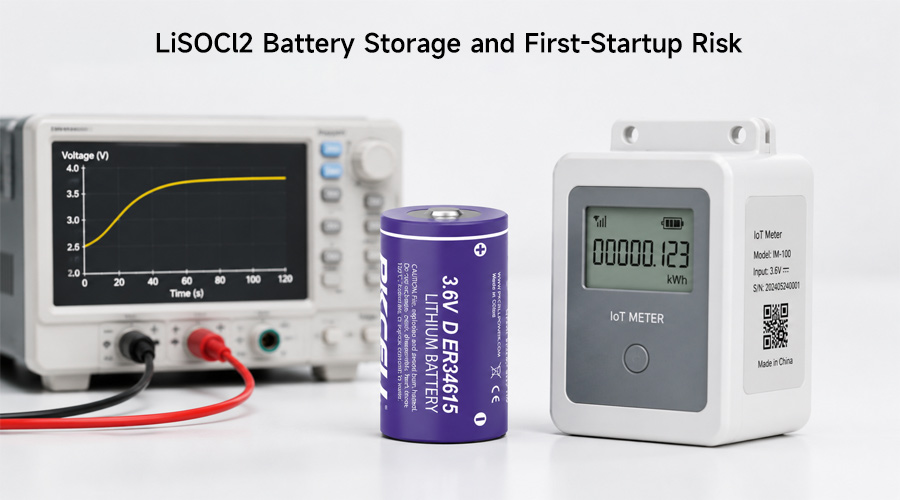
Why Stored LiSOCl2 Batteries Can Behave Differently at First Startup
Lithium thionyl chloride batteries, commonly known as LiSOCl2 batteries, are primary lithium batteries with high energy density, low self-discharge, and strong suitability for long-life industrial applications. PKCELL lists Li-SOCl2 batteries as suitable for remote systems and applications where long operating life is required.
One reason this chemistry stores so well is passivation. During storage or long idle periods, a thin lithium chloride layer forms on the lithium anode. This layer helps reduce unwanted internal reaction and supports long shelf life.
According to Jauch and Tadiran, passivation can increase with long storage time, high storage temperature, and long periods without load. When the device is switched on, the passivation layer may temporarily increase internal resistance, causing the working voltage to drop before it recovers.
The Main Risk: Voltage Delay After Long Storage
Voltage delay is the temporary voltage drop that appears when a passivated LiSOCl2 cell is first placed under load. This is why a battery can look acceptable when measured with a multimeter, but still fail when the device starts operating.
In real applications, voltage delay may cause:
- failed first boot after installation;
- microcontroller reset or brownout;
- failed NB-IoT, LTE-M, LoRaWAN, or wireless M-Bus transmission;
- false low-battery warnings;
- intermittent startup behavior during field commissioning;
- unnecessary battery replacement even when capacity remains.
What Makes First-Startup Risk Higher?
| Risk Factor | Why It Matters | What to Do Before Installation |
|---|---|---|
| Long storage time | The passivation layer may become more noticeable after long inactivity. | Track battery age and test older inventory under load. |
| High storage temperature | Higher temperature can increase passivation severity. | Store batteries in a cool, dry, ventilated area. |
| High first pulse current | Radio transmission, valve control, and capacitor charging can expose voltage delay. | Test the real startup profile, not only average current. |
| Low temperature startup | Cold conditions can make voltage response less forgiving. | Validate startup at expected field temperatures. |
| Strict voltage cut-off | A temporary voltage dip may trigger a false shutdown. | Review firmware thresholds and brownout timing. |
Why Open-Circuit Voltage Is Not Enough
Open-circuit voltage only shows the battery voltage with almost no load. It does not prove that the cell can support the device’s first pulse after long storage.
Qoitech reported a case study using unused Saft LS14500 cells stored for 4.5 years. Under a LoRaWAN-style load profile, the first pulse showed much higher internal resistance than later pulses, and voltage drops caused by passivation were observed. This demonstrates why practical load testing is more useful than a simple voltage check.
How to Reduce First-Startup Failure Before Installation
1. Test Batteries Under the Real Device Load
Use the actual startup sequence during validation. Include boot, sensor warm-up, radio join, first transmission, actuator movement, or capacitor charging. This helps reveal voltage delay before the device is deployed.
2. Use Approved Depassivation Procedures When Needed
Some applications may benefit from a controlled preload or commissioning step to reduce passivation before the full application load begins. The current, duration, and method should follow the battery manufacturer’s technical guidance for the specific cell model.
3. Add Pulse Support for High-Current Applications
If your device has high pulse current demand, consider whether a capacitor, hybrid pulse capacitor, or battery pack design is needed. Jauch notes that capacitor support can help with wake-up behavior, while Qoitech observed that capacitor-assisted testing reduced visible passivation impact during pulse loads.
For high-pulse or customized battery requirements, visit PKCELL’s Contact Us page and share your voltage, pulse current, operating temperature, quantity, and application details.
4. Review Firmware Low-Battery Logic
A temporary voltage dip should not always be treated as true end of life. Firmware should distinguish between a short startup voltage delay and sustained low-voltage behavior. This can reduce false alarms and unnecessary field service.
5. Improve Inventory and Storage Control
Use first-in, first-out inventory management. Record receipt date, production batch, storage location, and temperature exposure. Batteries stored for a long time should be tested more carefully before field installation.
Pre-Installation Checklist for Stored LiSOCl2 Batteries
Match the battery type to the device’s voltage, current, temperature, and lifetime requirements.
Identify batteries stored for months or years before installation.
Test with a realistic load profile instead of relying only on open-circuit voltage.
Look for voltage sag during boot, radio transmission, or actuator startup.
Apply only the procedure recommended for the specific cell or battery pack.
For OEM projects, ask the supplier to review pulse current, storage time, and installation conditions.
When to Ask PKCELL for Battery Selection Support
If your device will be stored before deployment, installed outdoors, or required to send a high-current wireless pulse at startup, battery selection should not be based on capacity alone. The cell construction, pulse capability, storage conditions, connector design, and pack configuration all matter.
PKCELL supplies LiSOCl2 batteries and related primary lithium battery solutions for industrial and OEM applications. You can also explore typical battery application scenarios to match chemistry and form factor with your project.
Need help choosing a LiSOCl2 battery for stored devices?
Send your device voltage, pulse current, standby current, storage time, temperature range, connector needs, and expected order quantity to PKCELL for a more accurate recommendation.
Provide voltage, capacity target, maximum pulse current, standby current, operating temperature, storage time before installation, device application, connector or wire requirements, certification needs, and estimated quantity.
Conclusion
LiSOCl2 battery storage before installation is not only a shelf-life question. The more important risk is whether the battery can support the device’s first startup after long storage. Passivation, voltage delay, first-pulse current, temperature, and firmware thresholds all influence field reliability.
Before deployment, test stored batteries under real load, control inventory age, use approved depassivation methods when needed, and design the device to handle short voltage delay. For OEM battery selection, pack configuration, or high-pulse applications, contact PKCELL with your project requirements.
Post time: Jul-27-2026


