

LiSOCl2 Battery End-of-Life Voltage: Why Nominal Capacity Is Not Fully Usable
A LiSOCl2 battery can look strong on a datasheet and still deliver less usable runtime in a real device. The reason is end-of-life voltage: your product stops working when the battery can no longer stay above the device cutoff voltage under load, even if some chemical capacity remains inside the cell.
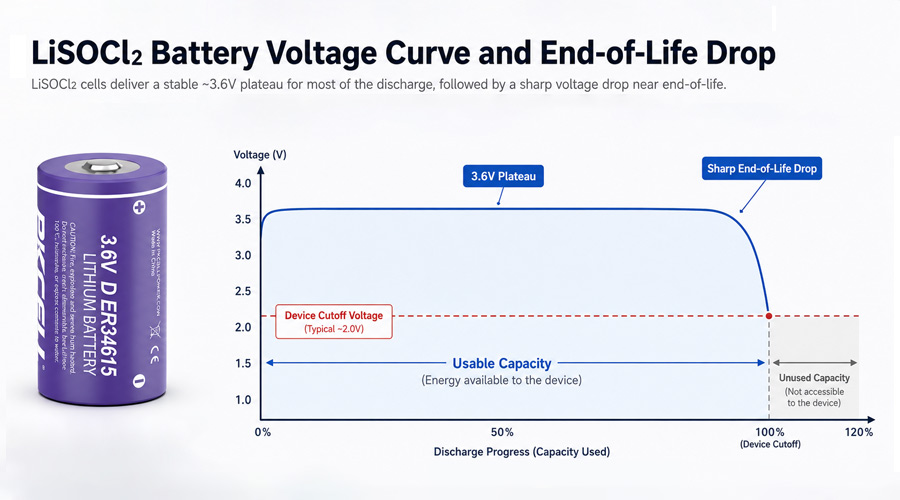
What End-of-Life Voltage Means for a LiSOCl2 Battery
Lithium thionyl chloride batteries, also called LiSOCl2 or ER batteries, are widely used in smart meters, IoT sensors, GPS trackers, security devices, and industrial monitoring systems. They are valued for a high nominal voltage of 3.6V, low self-discharge, and long service life.
However, battery life in the field is not decided by nominal capacity alone. It is decided by whether the cell or battery pack can keep the device above its minimum operating voltage during real use. This includes sleep current, startup current, wireless transmission, valve actuation, cold starts, and end-of-life conditions.
If your application needs a long-life 3.6V primary lithium solution, PKCELL offers LiSoCl2 batteries, customized LiSoCl2 battery packs, and ER + HPC battery pack solutions for pulse-load devices.
Share your cutoff voltage, pulse current, operating temperature, storage time, and target service life with PKCELL. The engineering team can recommend a suitable ER cell, ER Power Type cell, or ER + HPC battery pack.
Why Nominal Capacity Is Not Fully Usable
1. Datasheet capacity is tested under fixed conditions
Nominal capacity is usually measured at a defined current, temperature, and cutoff voltage. If a datasheet capacity is measured down to 2.0V or 3.0V, but your electronics stop working at a higher voltage, the remaining capacity below your cutoff point is not usable in your device.
2. LiSOCl2 batteries have a flat voltage curve
A LiSOCl2 cell can maintain a stable voltage for most of its life, then drop sharply near the end. This makes the chemistry excellent for stable long-term operation, but it also means voltage alone is a poor early warning signal.
The practical question is not “How many amp-hours are printed on the datasheet?” The better question is “How many amp-hours can my device actually use before loaded voltage falls below cutoff?”
3. Pulse loads reduce voltage margin
Many industrial and IoT devices spend most of their time in low-power sleep, then wake up for high-current events. NB-IoT transmission, LoRaWAN communication, GNSS positioning, alarm reporting, and valve control can all create pulse loads that pull voltage down.
For these applications, a standard ER Energy Type cell may not be enough. Engineers may need an ER + HPC battery pack or a power-type LiSOCl2 cell to support pulse current more reliably.
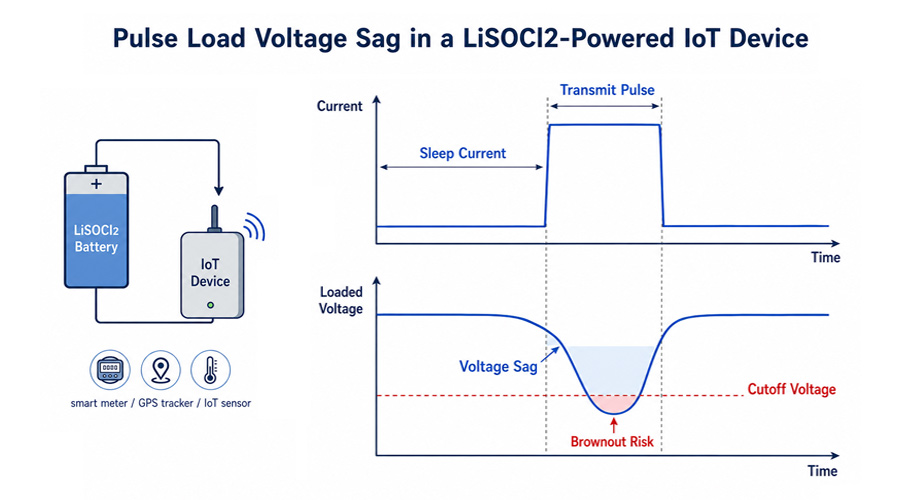
4. Low temperature increases voltage drop risk
Cold environments increase internal resistance and make voltage sag more severe. A battery that passes room-temperature testing may fail during winter startup or outdoor communication events. For smart meters, GPS trackers, and remote sensors, low-temperature loaded-voltage testing is essential.
5. Passivation can cause voltage delay
LiSOCl2 passivation helps reduce self-discharge and supports long storage life, but it can also increase initial impedance. After long storage or long standby, a sudden current demand may cause voltage delay. PKCELL explains this in more detail in its guide to LiSoCl2 battery passivation.
Nominal Capacity vs Usable Capacity
| Item | What It Means | Why It Affects Runtime |
|---|---|---|
| Nominal capacity | The rated Ah or mAh value under manufacturer test conditions. | Useful for comparison, but not a guarantee of field runtime. |
| Device cutoff voltage | The lowest voltage your device, radio, MCU, or regulator can accept. | A higher cutoff voltage leaves more battery capacity unused. |
| Loaded voltage | The voltage while the battery is supplying current. | This is more important than open-circuit voltage during real operation. |
| Pulse current | Short high-current events such as wireless transmission or valve control. | High pulses can trigger brownout before nominal capacity is consumed. |
| End-of-life voltage | The point where the battery can no longer support the device under load. | This determines the practical replacement point in the field. |
How OEM Engineers Can Improve Usable Runtime
- Define the real cutoff voltage. Include MCU brownout, radio minimum voltage, sensor requirements, regulator dropout, and safety margin.
- Measure voltage under load. Open-circuit voltage is not enough for LiSOCl2 battery health evaluation.
- Build a complete load profile. Include sleep current, active current, peak pulse current, pulse duration, pulse frequency, and retry behavior.
- Test at low temperature. Cold testing helps reveal voltage sag and passivation-related startup risk.
- Consider ER + HPC for pulse applications. A hybrid pulse capacitor can support high-current events while the ER cell provides long-term energy.
- Validate after storage. Test first startup and first transmission after realistic warehouse or field storage conditions.
For smart meters and utility applications, see PKCELL’s utility meter battery solutions. For connected devices, remote sensors, and tracking equipment, review PKCELL’s IoT battery solutions.
Send PKCELL your current profile, cutoff voltage, pulse current, temperature range, connector requirement, and expected annual volume.
Conclusion
LiSOCl2 batteries are excellent for long-life industrial and IoT devices, but nominal capacity should not be treated as fully usable capacity. Real runtime depends on end-of-life voltage under load, cutoff voltage, pulse current, temperature, storage condition, and passivation behavior.
The safest design approach is to select the battery from the device requirements backward. Define the cutoff voltage, test loaded voltage, validate pulse events, and choose the right ER cell or ER + HPC battery pack for the application.
Post time: Jul-27-2026


