

LiSOCl2 Battery Temperature: Capacity and Pulse Effects
Lithium thionyl chloride batteries are often specified for a very wide operating
temperature range. However, an operating range does not mean that a cell delivers the same
capacity, voltage, or pulse current at every temperature.
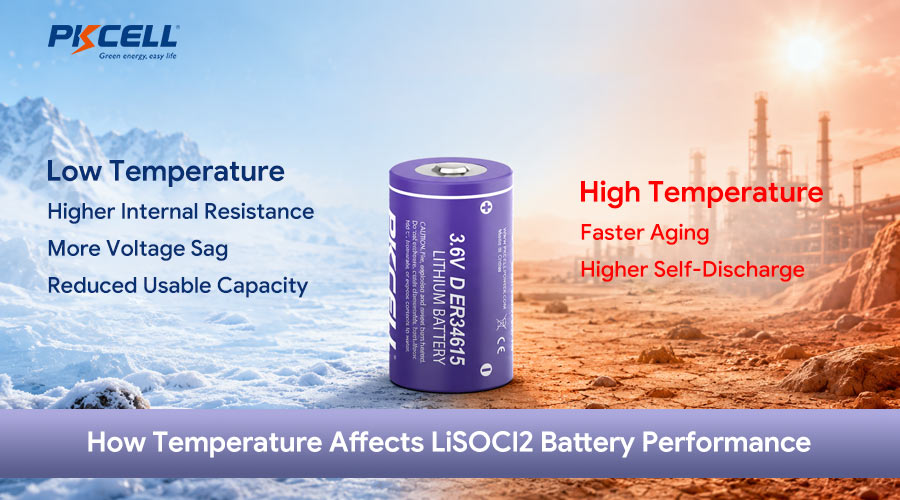
Cold conditions generally increase internal resistance and voltage drop. Extended exposure
to heat can accelerate self-discharge and aging. These effects become especially important
in smart meters, trackers, alarms, and remote IoT devices that remain asleep for long
periods and then demand a high-current communication or actuator pulse.
Key engineering answer:
Temperature affects both the amount of capacity a device can use before reaching its
cut-off voltage and the current a LiSOCl2 battery can deliver without excessive voltage
sag. Low temperature may temporarily make stored energy inaccessible under load, while
high-temperature storage can cause permanent loss through accelerated aging. Battery
selection must therefore be based on loaded voltage at the worst temperature, not nominal
amp-hour capacity alone.
Why Temperature Changes LiSOCl2 Battery Performance
A LiSOCl2 cell generates electricity through electrochemical reactions between its lithium
anode and thionyl chloride catholyte. Temperature influences reaction kinetics, ion transport,
electrolyte behavior, internal resistance, and the voltage response of the passivation layer.
As temperature falls, electrochemical reactions and ion movement become slower. Internal
resistance normally rises, so a given load produces a larger voltage drop. The battery may
still contain substantial chemical energy, but the device may be unable to access it above
its minimum operating voltage.
Moderate temperature can support a stronger immediate voltage response than extreme cold.
However, storing or operating a battery at elevated temperature for extended periods
accelerates unwanted side reactions, self-discharge, and aging. Higher temperature should
never be treated as permission to exceed a cell’s specified continuous or pulse-current limit.
Rated capacity describes performance under specified test conditions. It is not a guarantee
of identical usable capacity at every current, cut-off voltage, temperature, or stage of life.
Operating Range Is Not the Same as Full Performance
PKCELL LiSOCl2 products commonly specify a wide operating-temperature range, but model
datasheets also define nominal capacity using a particular discharge current, temperature,
and cut-off voltage. For example, capacity may be measured at room temperature under a
relatively low continuous current.
Moving away from those test conditions can change the result. Engineers should distinguish
among four related but different specifications:
- Nominal capacity: Capacity measured under the datasheet’s defined test conditions.
- Usable capacity: Capacity delivered before the actual device reaches its cut-off voltage.
- Continuous-current capability: The current the cell can sustain under defined conditions.
- Pulse capability: The current and duration the cell can support while maintaining acceptable loaded voltage.
Explore PKCELL’s
LiSOCl2 battery range
for available ER cell sizes and product-specific datasheets.
Cold Conditions
- Higher internal resistance
- Greater voltage sag under load
- Slower voltage recovery
- Less capacity accessible above cut-off
- More difficult first pulse after storage
Moderate Conditions
- Closer to datasheet test conditions
- Lower resistance than in extreme cold
- More stable pulse voltage
- Greater access to rated capacity
- Still dependent on current and cell history
Hot Conditions
- Potentially stronger short-term kinetics
- Faster self-discharge and aging
- Greater long-term storage loss
- Possible voltage and capacity degradation
- More stringent safety evaluation
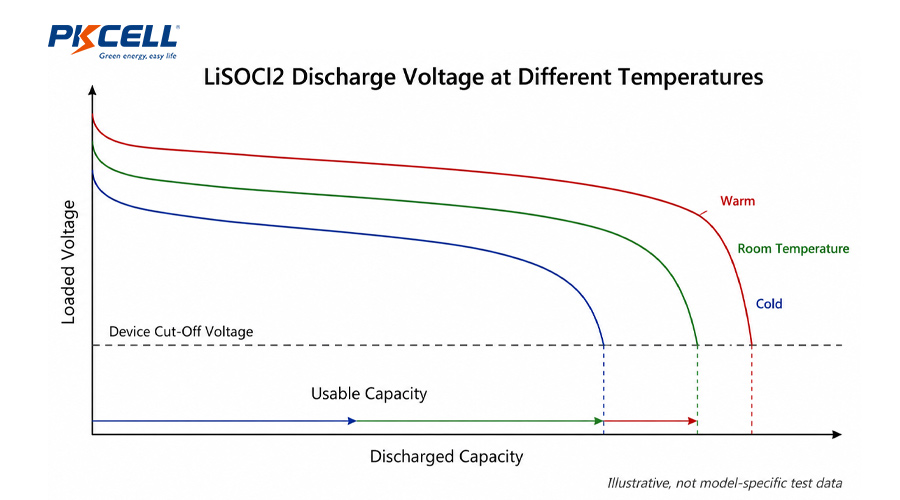
How Low Temperature Reduces Usable Capacity
Low temperature does not necessarily mean that the battery’s chemical reactants have
disappeared. Instead, increased resistance and slower electrochemical processes can prevent
the device from reaching that energy before its voltage falls below the system threshold.
Consider two devices using the same ER cell. A device with a 2.0 V cut-off may continue
operating through a larger voltage drop than a radio module that resets at 3.0 V. The
higher-cut-off device can therefore experience much less usable capacity in cold conditions,
even though the battery is unchanged.
Vload ≈ VOCV − I × Rinternal − Vpolarization
When temperature falls and internal resistance rises, the term
I × Rinternal becomes larger. The resulting loaded voltage can cross the
device’s cut-off threshold earlier.
This is why a room-temperature capacity test cannot establish cold-weather field life.
Usable capacity must be measured using the real load, realistic cut-off voltage, and required
minimum temperature.
How Temperature Affects Pulse Current
Pulse capability should not be defined by current alone. A meaningful pulse specification
includes current amplitude, pulse duration, pulse frequency, base current, temperature,
storage history, battery state of discharge, and the lowest acceptable voltage during the event.
At low temperature, increased impedance creates a larger instantaneous voltage drop when a
modem, GNSS receiver, valve, siren, or motor starts. Longer pulses remove more charge and can
cause additional polarization. Closely spaced pulses may also prevent the cell voltage from
fully recovering.
ΔVpulse ≈ Ipulse × Rsystem
Rsystem includes the cell, tabs, welds, leads, connector, PCB traces, and other
series elements. All of these should be considered during cold testing.
A datasheet pulse value measured at room temperature with a fresh cell cannot automatically
be applied at the minimum deployment temperature. Manufacturers often state that voltage
response varies with temperature, pulse characteristics, and the cell’s previous history.
Why Open-Circuit Voltage Can Be Misleading
A cold LiSOCl2 battery may show a normal open-circuit voltage when measured with a high-input-
impedance meter. That reading does not prove that the cell can sustain a transmission pulse.
The key measurement is the minimum loaded voltage during the actual event.
Engineers should record the complete waveform, including the initial drop, minimum voltage,
pulse duration, recovery time, and behavior across repeated events.
Temperature and LiSOCl2 Passivation
LiSOCl2 chemistry naturally forms a lithium-chloride-based passivation layer on the lithium
anode. This layer helps limit self-discharge and supports long storage life, but it can also
cause voltage delay when a load is first applied.
Low temperature increases cell impedance and can make passivation-related voltage delay more
noticeable during startup. Storage time and storage temperature also influence the battery’s
history before activation. The difficult case is often a cold device starting a high-current
load after months or years of standby.
PKCELL’s guide to
LiSOCl2 battery passivation
explains why open-circuit voltage alone is insufficient and how to conduct loaded-voltage,
recovery, storage, and low-temperature tests.
high-current load to remove passivation. Any conditioning procedure must follow the battery
supplier’s instructions and be validated against defined acceptance criteria.
High Temperature: Better Immediate Response, Faster Aging
Compared with extreme cold, warmer conditions may reduce internal resistance and improve
immediate voltage response. That short-term behavior can hide a separate long-term risk:
elevated temperature accelerates self-discharge and other aging mechanisms.
High-temperature storage is particularly important because the battery may spend far longer
in a warehouse, shipping container, outdoor enclosure, or parked asset than it spends
delivering a pulse. A battery that remains within its broad operating limit can still lose
useful life more quickly when continuously exposed to heat.
High temperature can also interact with enclosure design. Solar loading may make the
temperature inside a sealed outdoor housing significantly higher than local air temperature.
Battery qualification should therefore use the measured or calculated temperature at the
cell, not only a regional weather value.
Storage Temperature and Operating Temperature Are Different
Storage describes the condition while the battery is not powering the application.
Operation includes continuous loads, pulses, and internally generated heat. A cell may have
different recommendations for these conditions, so both should be documented in the
application specification.
| Temperature Scenario | Main Performance Risk | Recommended Validation |
|---|---|---|
| Cold startup after long storage | Passivation, high resistance, initial voltage delay | First-start pulse test after representative storage and cold soak |
| Continuous low-temperature operation | Lower loaded voltage and reduced accessible capacity | Full discharge or representative life test at the real cut-off voltage |
| Repeated radio pulses in cold conditions | Incomplete recovery and cumulative voltage sag | Use the real pulse train, network retries, and reporting interval |
| Extended high-temperature storage | Accelerated self-discharge and permanent aging | Supplier-approved storage-aging test followed by pulse verification |
| Hot outdoor enclosure | Cell temperature higher than ambient weather data | Measure internal enclosure temperature under solar and operating loads |
| Temperature cycling | Changing resistance, seals, connections, and system behavior | Cycle complete assemblies and inspect voltage, wiring, and connectors |
Cell Construction Changes the Temperature Tradeoff
LiSOCl2 cells are available in different internal constructions. A bobbin-type ER cell is
generally selected for high energy density, low self-discharge, and long-duration low-current
operation. A spiral-type power cell offers a larger electrode surface area and stronger
current capability, usually with a tradeoff in nominal capacity.
ER Energy Type for Low Average Current
PKCELL’s
ER Energy Type batteries
include models such as ER14250, ER14505, ER18505, ER26500, and ER34615. They are suitable when
long-term energy and low self-discharge are the main priorities, provided the load remains
within the model’s voltage and current capabilities at the required temperature.
ER Power Type for Higher Current
The
ER Power Type range
includes spiral models such as ER14505M, ER26500M, and ER34615M. These may be considered when
a standard bobbin cell cannot maintain sufficient voltage during the application’s active load.
Cell construction does not remove the need for temperature testing. The choice should be made
using the required current waveform, minimum voltage, lifetime energy, physical size, and
full temperature profile.
When ER + HPC Helps With Cold Pulse Loads
If the application combines multi-year low-current operation with high communication or
actuator pulses, a bobbin ER cell can be paired with a Hybrid Pulse Capacitor. The ER cell
supplies long-term energy while the HPC stores energy between events and supports the short
high-current load.
This architecture can reduce the pulse stress placed directly on the primary cell and help
maintain system voltage during NB-IoT transmission, LoRaWAN communication, GNSS startup,
alarm activation, or valve operation.
Review PKCELL’s
ER + HPC battery solutions
and the guide on
sizing a Hybrid Pulse Capacitor for NB-IoT
.
The HPC must also be evaluated at the minimum temperature. Its ESR, usable stored energy,
recharge time, voltage limits, and aging behavior affect the performance of the complete pack.
Need a Cold-Temperature Battery Recommendation?
Send PKCELL your minimum and maximum cell temperature, sleep current, peak current, pulse
duration, cut-off voltage, storage period, reporting interval, target lifetime, and
available battery space. The engineering team can compare ER Energy, ER Power, and ER + HPC
configurations for prototype testing.
Request a Battery Recommendation
Explore Primary Battery Solutions
How to Derate LiSOCl2 Capacity for Temperature
There is no accurate universal percentage that can be applied to every LiSOCl2 cell. The
temperature derating factor depends on cell size, construction, discharge current, pulse
profile, cut-off voltage, storage history, orientation, and required service life.
Qusable =
Qrated × Ktemperature × Kload ×
Kcutoff × Kaging
These factors must come from model-specific supplier data or testing. They should not be
guessed from the chemistry’s broad operating range.
For long-life IoT products, also subtract expected self-discharge and reserve energy for
network retries, component variation, aging, and unexpected environmental exposure.
PKCELL’s
battery-life calculation guide for LoRaWAN and NB-IoT
explains how to build a cycle-based energy budget.
Temperature Test Plan for OEM Devices
Testing should reproduce the battery’s real history and the device’s complete current
waveform. A useful qualification plan includes the following steps.
- Define cell temperature: Specify temperature at the battery, not only ambient air temperature.
- Measure the full load profile: Include sleep, sensing, MCU startup, TX, RX, GNSS, actuators, and retries.
- Set the real cut-off voltage: Include MCU brownout, modem reset, regulator dropout, and sensor limits.
- Cold-soak the complete device: Allow the battery and electronics to reach thermal equilibrium before testing.
- Test first activation: Repeat startup after representative storage to capture passivation effects.
- Record minimum pulse voltage: Use adequate oscilloscope sampling to capture the initial drop.
- Test repeated pulses: Reproduce weak-signal retries and the shortest expected recovery interval.
- Evaluate aged conditions: Include end-of-life energy and increased resistance margins.
- Run high-temperature storage tests: Follow supplier-approved time and temperature conditions.
- Verify complete packs: Include tabs, welds, leads, connectors, protection devices, and enclosure effects.
Cold Soak Requires Enough Time
Placing a device in a cold chamber does not mean the battery instantly reaches chamber
temperature. Cell size, enclosure insulation, airflow, mounting, and nearby electronics
affect thermal stabilization. Record the battery temperature directly or define a validated
soak time.
Test the Real Communication Network
A fixed resistor may be useful for screening, but it cannot reproduce every radio waveform.
Cellular and LPWAN devices can generate multiple peaks during attachment, transmission,
receive windows, and retries. Whenever possible, conduct environmental tests using the real
modem, firmware, antenna, and network conditions.
Common Temperature-Related Design Mistakes
- Assuming the full rated capacity is available across the entire operating range.
- Using open-circuit voltage as proof of cold pulse capability.
- Applying a room-temperature pulse-current value at the minimum field temperature.
- Ignoring the device’s real cut-off or brownout voltage.
- Testing only a fresh cell without representative storage or aging.
- Using ambient weather data instead of the temperature inside the enclosure.
- Ignoring connector, tab, weld, and wire resistance during cold tests.
- Assuming high temperature only improves performance and overlooking accelerated aging.
- Adding a capacitor without verifying its cold-temperature ESR and recharge time.
- Using one generic derating percentage for every LiSOCl2 cell model.
Frequently Asked Questions
Does cold temperature permanently reduce LiSOCl2 capacity?
Some cold-temperature loss may be caused by temporarily increased resistance and slower
electrochemical activity, meaning more energy may become accessible after the cell returns
to a moderate temperature. However, actual recovery depends on cell condition, discharge
history, cut-off voltage, and whether the battery has suffered other aging or damage.
Why does a LiSOCl2 battery show normal voltage but fail during transmission?
Open-circuit voltage is measured with almost no load. During transmission, the battery’s
internal resistance and passivation can cause a much larger voltage drop. Cold temperature
increases this risk by raising impedance. Measure the minimum voltage during the real pulse.
Can I use the datasheet maximum pulse current at -40°C?
Not unless the datasheet explicitly defines that value at -40°C under equivalent pulse and
battery-history conditions. Pulse performance is temperature-dependent and should be
confirmed with supplier data and device-level testing.
Does heating a LiSOCl2 battery improve its pulse current?
Moderate temperature may reduce internal resistance compared with extreme cold, but
uncontrolled heating is unsafe and can accelerate aging. Never exceed the manufacturer’s
temperature limits or apply a heating method without a reviewed thermal and safety design.
Should I choose ER Energy, ER Power, or ER + HPC?
ER Energy cells suit long-term low-current loads. ER Power cells provide stronger current
capability with a capacity tradeoff. ER + HPC packs suit applications combining low average
current with demanding pulses. Final selection depends on temperature, waveform, cut-off
voltage, lifetime, and size.
What information should I send to a LiSOCl2 battery supplier?
Provide the minimum and maximum battery temperature, storage conditions, sleep current,
continuous active current, pulse waveform, pulse frequency, minimum voltage, target field
life, enclosure size, connector, certification needs, and expected annual volume.
Conclusion
Temperature affects LiSOCl2 battery capacity and pulse current through changes in internal
resistance, electrochemical activity, passivation response, self-discharge, and long-term
aging. The broad operating range of an ER cell indicates where it may be used under defined
conditions; it does not promise constant capacity or power across that range.
Reliable selection starts with the worst-case loaded voltage. Test the actual device after
representative storage, at minimum temperature, during repeated pulses, and near the expected
end of life. When a bobbin ER cell cannot maintain the required pulse voltage, an ER Power
cell or properly sized ER + HPC pack may provide a more robust solution.
Get a Temperature-Matched LiSOCl2 Battery Solution
PKCELL can support model selection, ER + HPC matching, custom wires and connectors,
prototype samples, and application-specific pulse testing. Send your thermal profile and
device waveform to begin an engineering review.
Post time: Aug-05-2026


