

GPS Tracker Battery Guide: Types, Runtime and How to Choose
A GPS tracker battery must support long periods of sleep, repeated GNSS positioning and short wireless transmission events. The right battery depends on the complete power profile of the tracker, not only on its nominal capacity. This guide explains how to compare Li-SOCl2, Li-ion and LiPo batteries and how to select a power solution for asset tracking, NB-IoT, LTE-M and LoRaWAN devices.
Quick answer: Lithium thionyl chloride (Li-SOCl2) primary batteries are a strong choice for GPS trackers that must operate for long periods without charging. Rechargeable lithium-ion (Li-ion) and lithium polymer (LiPo) batteries are more suitable when the tracker can be charged regularly.
For cellular trackers, also check the short current pulse created during network connection and data transmission. A Li-SOCl2 cell may require a pulse-support component such as an HPC, depending on the modem and operating profile.
Li-SOCl2 primary cells store substantial energy in a compact format and have low self-discharge.
NB-IoT and LTE-M modems can create short, higher-current loads during connection and transmission.
Sleep current, update frequency, signal quality and temperature can matter as much as capacity.
What Does a GPS Tracker Battery Power?
A GPS tracker does more than receive a location signal. The battery supplies energy to the processor, GNSS receiver, memory, sensors and communication module. It may also support LEDs, alarms or other peripheral components.
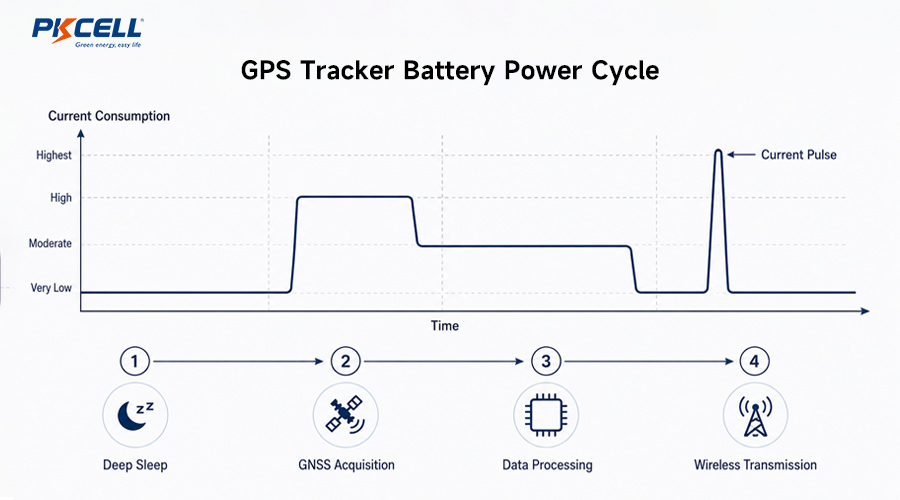
Many asset trackers remain in a low-power sleep state for most of the day. They wake at a scheduled time or after a sensor event. The device then obtains a position, processes the data and sends a report. This operating pattern combines very low background current with short periods of higher current.
How a GPS Tracker Uses Battery Power
- 1Deep sleepThe tracker waits between scheduled reports or motion events.
- 2GNSS acquisitionThe receiver searches for satellites and calculates the position.
- 3Data processingThe processor formats, stores or encrypts the tracking data.
- 4Wireless transmissionThe modem sends the report through NB-IoT, LTE-M, cellular or LoRaWAN.
The duration of each state changes the energy budget. A slow GNSS fix consumes more energy than a fast fix. Weak cellular coverage may extend connection time or cause retries. Frequent updates also increase daily consumption.
Battery capacity alone cannot predict tracker runtime. The design must also account for current pulses, voltage drop, temperature, network conditions and the device cutoff voltage.
GPS Tracker Battery Types Compared
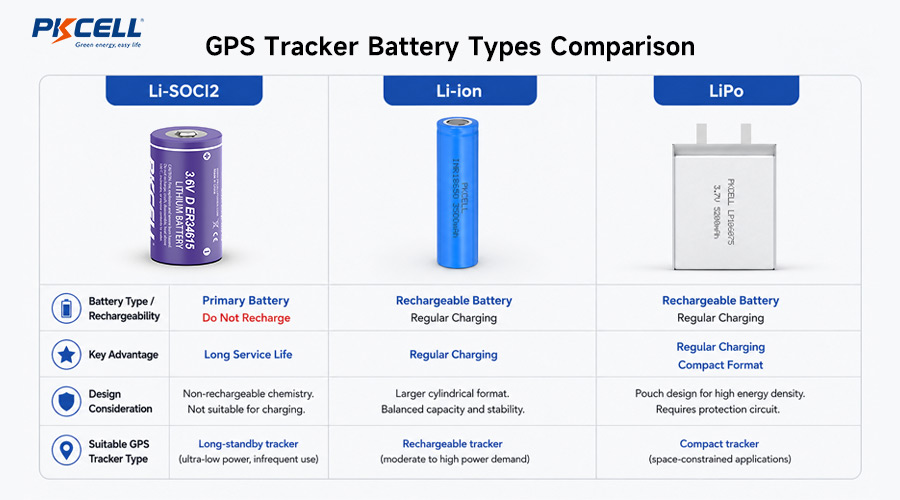
The first decision is whether the tracker must operate as a sealed, unattended device or can be charged regularly. This separates primary battery applications from rechargeable battery applications.
| Battery type | Rechargeable | Main advantage | Design consideration | Suitable tracker profile |
|---|---|---|---|---|
| Li-SOCl2 primary battery | No | Long storage and service life with high energy density | Pulse current and passivation must be evaluated | Remote asset trackers with long maintenance intervals |
| Li-ion rechargeable battery | Yes | Supports repeated charging and higher continuous loads | Requires charging, protection and thermal management | Vehicle, portable and frequently used trackers |
| LiPo rechargeable battery | Yes | Available in thin and flexible form factors | Requires electrical and mechanical protection | Compact personal, wearable or pet trackers |
Why Li-SOCl2 Batteries Are Used in Long-Life GPS Trackers
A Li-SOCl2 battery has a nominal voltage of 3.6 V and is designed for primary, non-rechargeable applications. The chemistry is widely considered for remote electronics that need high energy, low background current and a long replacement interval.
Li-SOCl2 can be useful for GPS asset trackers because it offers:
- High energy density for long-duration operation
- Low self-discharge for devices that spend most of their time asleep
- A 3.6 V nominal output that suits many industrial electronics designs
- Multiple cylindrical sizes for different enclosure and runtime requirements
- Options for wires, connectors and customized battery-pack integration
Li-SOCl2 is not automatically the correct choice for every tracker. A bobbin-type cell is optimized for long-term energy delivery, but a cellular modem may demand a short current pulse that is higher than the cell should supply alone. The complete current profile must be reviewed before the battery is selected.
ER14505, ER18505, ER26500 or ER34615?
These models are Li-SOCl2 cylindrical cells in different sizes. A larger cell generally provides more energy, but it also requires more enclosure space. Select a model by using measured device data rather than size alone.
| Model | Format | Selection direction | Possible tracker application | Check before approval |
|---|---|---|---|---|
| ER14505 | AA-size class | Compact designs with moderate energy requirements | Small asset tags and compact GPS trackers | Pulse load, reporting frequency and available space |
| ER18505 | A-size class | Balance between enclosure size and stored energy | Industrial and logistics tracking devices | Temperature, connection time and maintenance target |
| ER26500 | C-size class | Higher energy requirement and longer reporting program | Container, trailer and remote asset trackers | Mechanical fit, voltage drop and pulse-support need |
| ER34615 | D-size class | High-energy designs where enclosure space permits | Long-term industrial and infrastructure trackers | Weight, mounting, temperature and service-life target |
Product capacity and discharge performance vary by cell model and operating conditions. Confirm the current datasheet and test the battery with the final device firmware before approving a production design.
Pulse Support for NB-IoT and LTE-M GPS Trackers
A cellular tracker may draw a short, higher current when the modem registers with the network or sends data. The battery voltage can drop during this event. The risk increases with low temperature, cell aging, passivation, poor signal quality or repeated connection attempts.
An ER plus HPC battery pack combines a Li-SOCl2 cell with a hybrid pulse capacitor. The ER cell supplies long-term energy. The HPC supports short current pulses during communication events.
PKCELL has developed a customized ER14505 and HPC1520 pack for an NB-IoT gateway prototype. In that design, the ER14505 supplied long-term energy and the HPC1520 supported cellular connection and transmission pulses. Wires and a connector were added for device integration. This example shows the design principle, but it does not replace validation with the final GPS tracker load.
Review the modem datasheet and measure the real current waveform. Record the peak current, pulse duration, number of pulses, connection time and minimum acceptable voltage. These values help determine whether the cell can operate alone or needs pulse support.
How to Estimate GPS Tracker Battery Life
Start with the energy used by every operating state. Calculate sleep consumption separately from GNSS acquisition, processing and transmission.
For each active event, use:
Then estimate the ideal runtime:
The ideal result is not the final design life. Apply a suitable engineering margin for temperature, self-discharge, passivation, pulse-related voltage drop, battery variation, network retries, firmware changes and the device cutoff voltage.
Data Required for a Useful Runtime Estimate
- Sleep current and total sleep time per day
- GNSS acquisition current, duration and number of fixes
- Processor and sensor current during each event
- Transmission current, duration and reports per day
- Network retry frequency under weak signal conditions
- Operating temperature profile
- Device cutoff voltage
- Required operating life and design margin
GPS Tracker Battery Selection by Application
Long-Life Asset Tracking
Unpowered containers, tools and industrial assets may remain unattended for long periods. A Li-SOCl2 cell is a strong candidate when charging is unavailable and reports are infrequent.
Fleet and Trailer Tracking
A tracker connected to vehicle power may use a rechargeable backup battery. A standalone trailer tracker may require a primary battery with a long maintenance interval.
NB-IoT and LTE-M Tracking
Cellular trackers require evaluation of registration time, signal quality, transmit current and retries. A Li-SOCl2 plus HPC solution may be appropriate for pulse-heavy profiles.
LoRaWAN Asset Trackers
Runtime depends on report interval, transmission power, spreading factor and retry behavior. ER18505 or ER26500-class solutions may be considered when the enclosure and energy budget allow.
Cold-Chain and Environmental Tracking
Temperature changes affect battery voltage and usable capacity. Validate the complete power system across the expected storage and operating temperature profile.
Personal and Pet Trackers
These devices often send frequent updates and can usually be charged. A protected Li-ion or LiPo system may be more suitable than a primary cell.
GPS Asset Tracker Battery Case Example
Customized ER14505 Pack for an Asset Tracker
A South African GPS asset-tracking provider asked PKCELL for a long-life primary lithium power solution. PKCELL developed a customized ER14505 Li-SOCl2 battery pack and worked with the customer on the form factor, connection requirements and packaging.
The important lesson is the integration process. A tracker battery must match the electrical load, available enclosure space, connector, wire length, environmental conditions and production requirements.
GPS Tracker Battery Selection Checklist
Provide the following information to the battery supplier:
- Communication protocol: NB-IoT, LTE-M, cellular, LoRaWAN or another network
- Sleep current and wake-up schedule
- GNSS acquisition current and average fix time
- Transmission current waveform and minimum operating voltage
- Number of reports and expected retries per day
- Operating and storage temperature ranges
- Target service life
- Maximum battery dimensions and weight
- Wires, tabs, connector and battery-pack configuration
- Required certifications and shipping documents
Common Selection Mistakes
- Selecting a battery only by nominal capacity
- Ignoring modem pulses and the device cutoff voltage
- Using a room-temperature calculation for an outdoor tracker
- Assuming every location update consumes the same amount of energy
- Applying rechargeable-battery instructions to a primary Li-SOCl2 cell
- Skipping validation with final firmware and realistic network conditions
Safety, Storage and Integration
- Do not recharge, short-circuit, crush, puncture or incinerate a Li-SOCl2 battery.
- Use the correct polarity and prevent accidental reverse installation.
- Follow the cell datasheet for storage and operating limits.
- Use qualified protection and charging circuits for rechargeable Li-ion and LiPo packs.
- Confirm transport documentation and regulatory requirements for the final battery pack.
- Perform electrical, mechanical and environmental validation before mass production.
Frequently Asked Questions
What battery is best for a GPS tracker?
There is no single best battery for every tracker. Li-SOCl2 is suitable for many long-life devices that cannot be charged. Li-ion or LiPo is more suitable when regular charging is available. The final choice depends on the current profile, temperature, enclosure and required runtime.
How long does a GPS tracker battery last?
Runtime depends on sleep current, GNSS fix time, update frequency, wireless protocol, signal quality, temperature and battery size. Calculate each operating state and validate the result with the actual device. A universal lifespan range is not reliable.
Can a Li-SOCl2 GPS tracker battery be recharged?
No. Li-SOCl2 cells are primary batteries and must not be recharged. Use a protected rechargeable Li-ion or LiPo system when the product requires regular charging.
Why does cellular signal quality affect battery life?
Weak coverage can increase network registration time and transmission retries. The modem therefore remains active longer and uses more energy for each report.
Does an NB-IoT GPS tracker need an HPC?
Not every design needs one. Measure the modem current pulse and voltage drop first. An HPC may help when a Li-SOCl2 cell must support short communication pulses that exceed the preferred load profile of the cell.
Is ER26500 better than ER14505 for a GPS tracker?
ER26500 provides a larger format for designs with higher energy requirements. ER14505 is easier to integrate into a compact enclosure. The better choice depends on space, runtime, pulse load, temperature and weight limits.
How can I extend GPS tracker battery life?
Reduce unnecessary wake-ups, improve GNSS acquisition, optimize reporting frequency, limit network retries and use efficient firmware. Battery optimization must preserve the tracking and safety functions required by the application.
What information is needed for a custom GPS tracker battery pack?
Provide the voltage, current waveform, reporting schedule, temperature range, target runtime, available space, wire length, connector type and certification requirements. A device current log is especially useful.
Choose the Battery from the Tracker's Real Power Profile
A reliable GPS tracker battery design begins with measured device behavior. First define the sleep load, GNSS activity and wireless transmission profile. Then compare the required energy, pulse capability, temperature performance and mechanical fit.
Li-SOCl2 batteries offer an important advantage for remote, non-rechargeable GPS and IoT devices. For cellular trackers, an ER plus HPC solution can combine long-term energy with communication pulse support. Rechargeable Li-ion and LiPo remain appropriate when regular charging is part of the product design.
Request a GPS Tracker Battery Recommendation
Send PKCELL your device current profile, communication protocol, temperature range, enclosure dimensions and target runtime. Our team can review a Li-SOCl2 cell, an ER plus HPC solution or a customized primary battery pack for your tracker.
Sources
- PKCELL Li-SOCl2 Battery Range - chemistry overview and available ER battery models.
- PKCELL IoT Battery Pack Solutions - ER plus HPC power solutions for pulse-current IoT applications.
- PKCELL GPS Asset Tracker Case Study - customized ER14505 pack integration for an asset-tracking project.
- PKCELL ER14505 and HPC1520 NB-IoT Gateway Case - example of long-term energy and cellular pulse support.
- PKCELL LoRaWAN Tracker Battery Guide - battery considerations for LoRaWAN tracker designs.
Post time: Jun-27-2025


