

Gas meters are long-life utility devices that must keep working reliably for years after installation. A battery failure can cause meter downtime, lost consumption data, failed communication, delayed alarm reporting, or valve-control problems. For utility-scale projects, the battery is not just a component. It is part of the long-term operating cost and reliability strategy.
Key takeawayA reliable gas meter battery must provide long-term energy, stable voltage, and enough pulse capability for communication, alarm, and valve-control events. LiSoCl2 ER batteries are widely used for long-life gas meters, while ER + HPC battery packs are often considered for NB-IoT, valve-control, weak-signal, low-temperature, or high-pulse gas meter projects.
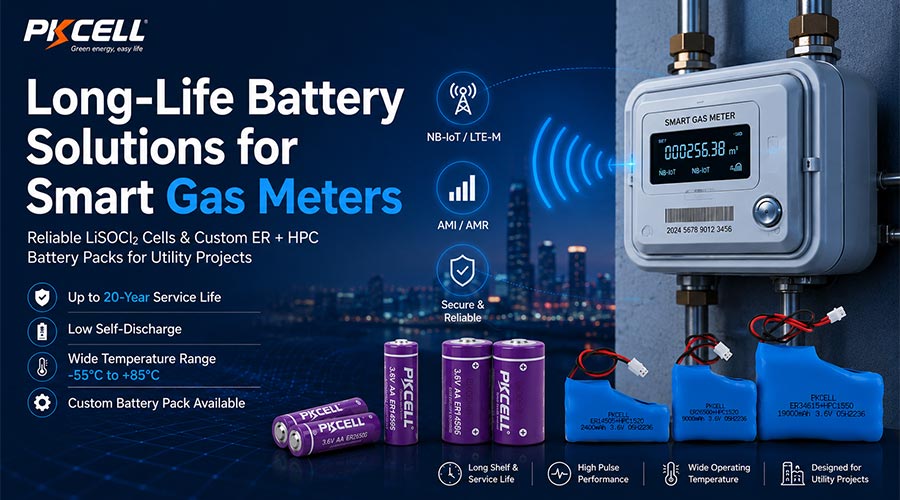
1. What Makes Gas Meter Battery Requirements Different?
Gas meters are usually deployed in large quantities and may be installed in basements, utility cabinets, outdoor boxes, semi-exposed areas, or locations with weak wireless coverage. Battery replacement can be expensive, especially when the project covers thousands or millions of meters. This makes long service life and predictable field performance critical.
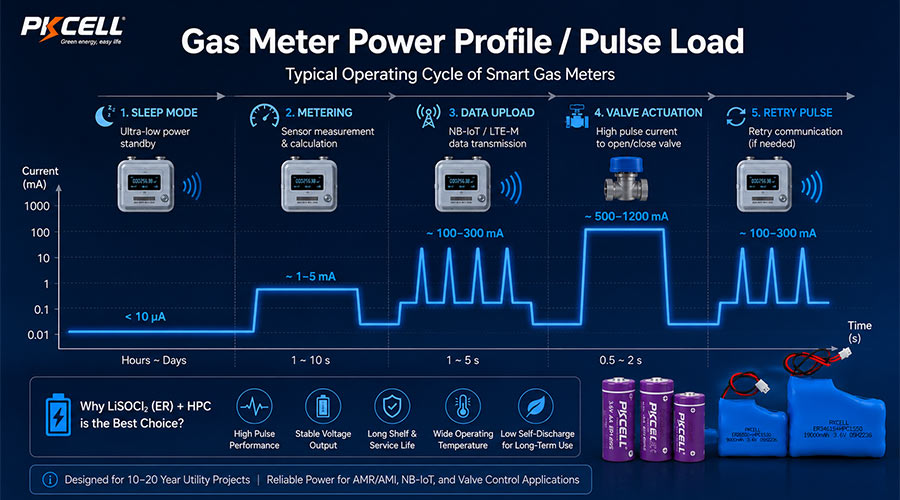
Typical Gas Meter Power Profile
Typical Gas Meter Operating Cycle
Main Power Risks in Gas Meter Projects
2. Why LiSoCl2 Batteries Are Commonly Used in Gas Meters
Lithium thionyl chloride batteries are often selected for gas meters because they combine high energy density, low self-discharge, long shelf life, stable 3.6V nominal voltage, and wide operating temperature capability. PKCELL’s LiSoCl2 battery series is positioned for long-life primary lithium applications such as remote meters and hard-to-maintain devices.
PKCELL’s Utility Meter Batteries for Water and Gas page also positions long-lasting battery solutions for utility metering projects, including smart water and gas meters.
Advantages of LiSoCl2 for Utility Metering
- High energy density for long service life.
- Low self-discharge for long storage and field deployment.
- Stable 3.6V nominal voltage platform.
- Wide operating temperature range for outdoor or harsh environments.
- Good fit for low-current, long-life metering devices.
- Available as single cells, parallel packs, or customized battery packs with wires, tabs, connectors, and housing.
ER Energy Type vs ER Power Type vs ER + HPC
Why Alkaline Batteries Are Usually Not Ideal for Long-Life Gas Meters
Alkaline batteries are easy to obtain and low in initial cost, but they are usually less suitable for long-life sealed utility meters because they have higher self-discharge, lower voltage per cell, weaker low-temperature performance, and higher replacement risk in long-term deployments.
3. Common Battery Options for Smart Gas Meters
ER14505 for Compact Gas Meter Modules
ER14505 is a compact AA-size 3.6V LiSoCl2 battery. It can be suitable for low-power gas meter modules with limited space, low reporting frequency, low sleep current, and no high-pulse valve motor.
- Best for compact low-power modules.
- Useful when mechanical space is limited.
- Not ideal for high-pulse NB-IoT or valve-control gas meters unless validated with suitable pulse support.
ER26500 for Standard Gas Meter Projects
ER26500 is a C-size 3.6V LiSoCl2 battery with 8500/9000mAh capacity. It is often a balanced option for standard smart gas meters, AMR/AMI devices, and utility projects that require a stronger capacity reserve than AA-size cells.
- Good balance between capacity and size.
- Suitable for mainstream AMR / AMI gas meter projects.
- Can be used as a single cell or in customized battery packs.
- May need HPC if NB-IoT, valve control, or weak-signal pulse loads are demanding.
ER34615 for Long-Life or High-Reserve Gas Meters
ER34615 is a D-size 3.6V LiSoCl2 cell with 19000mAh nominal capacity. PKCELL’s ER34615 Smart Meter Battery page positions it for long battery life, wide temperature range, low self-discharge, and smart water and gas meter applications.
- Best for 10-year or 15-year target life designs.
- Useful when the gas meter enclosure has enough space.
- Good for outdoor, cold-region, or utility-scale projects.
- Provides more reserve for aging, self-discharge, and communication retries.
ER26500M / ER34615M for Higher Pulse Requirements
M-type LiSoCl2 cells are designed for stronger pulse or medium-current requirements. PKCELL’s ER26500M page describes a C-size 3.6V LiSoCl2 cell with robust pulse capability for demanding industrial applications such as smart gas and water meters. PKCELL’s ER34615M page also describes a wound-structure D-size cell designed to deliver high pulse and continuous currents.
ER + HPC Battery Pack for NB-IoT and Valve-Control Gas Meters
If the gas meter uses NB-IoT, has valve shut-off, operates in a weak-signal location, or needs reliable pulse performance at low temperature, an ER + HPC battery pack should be considered. HPC helps support short current bursts while the ER cell provides long-term energy.
4. Gas Meter Battery Selection Matrix
The matrix below can be used as a first-stage selection guide. Final selection should be based on real load profile, field conditions, and validation testing.
CompactChoose ER14505 for compact, low-power gas meter modules.
BalancedChoose ER26500 for mainstream smart gas meters with balanced size and capacity.
Long-lifeChoose ER34615 or ER + HPC for long-life, pulse-heavy, or demanding utility deployments.
5. How Communication Technology Affects Gas Meter Battery Life
AMR / RF Gas Meters
AMR and RF gas meters may have lower communication energy than cellular devices, but the actual battery requirement depends on transmission power, communication distance, reporting interval, and retry behavior. ER14505 may be suitable for compact low-power modules, while ER26500 and ER34615 are more suitable for longer service life and stronger reserve capacity.
LoRaWAN Gas Meters
LoRaWAN gas meters can achieve low average current, but battery life depends on gateway coverage, spreading factor, confirmed messages, payload size, and uplink interval. For utility deployments, ER26500 or ER34615 is often more realistic than very small cells. For detailed calculation logic, see How to Calculate Battery Life for LoRaWAN and NB-IoT Devices.
NB-IoT Gas Meters
NB-IoT gas meters require careful battery design because network attach, data upload, paging, active timer, weak-signal retries, and PSM/eDRX behavior can strongly affect energy consumption. A standard ER cell may be enough only after real network testing. For many NB-IoT utility meters, ER26500 + HPC or ER34615 + HPC is a safer design direction.
6. Valve-Control Gas Meters: Why Pulse Current Matters
Gas meters with valve control require more careful battery design because valve events may be safety-related. Remote shut-off, emergency shut-off, abnormal consumption response, and valve open/close actions all require stable pulse output even when the battery is old, cold, or partially discharged.
Valve Pulse Current Parameters
- Valve open current.
- Valve close current.
- Peak motor current.
- Stall current.
- Pulse duration and number of pulses.
- Minimum operating voltage.
- Cold-start condition.
- End-of-life voltage condition.
Recommended Battery Direction for Valve-Control Gas Meters
7. ER + HPC Design for High-Pulse Gas Meter Applications
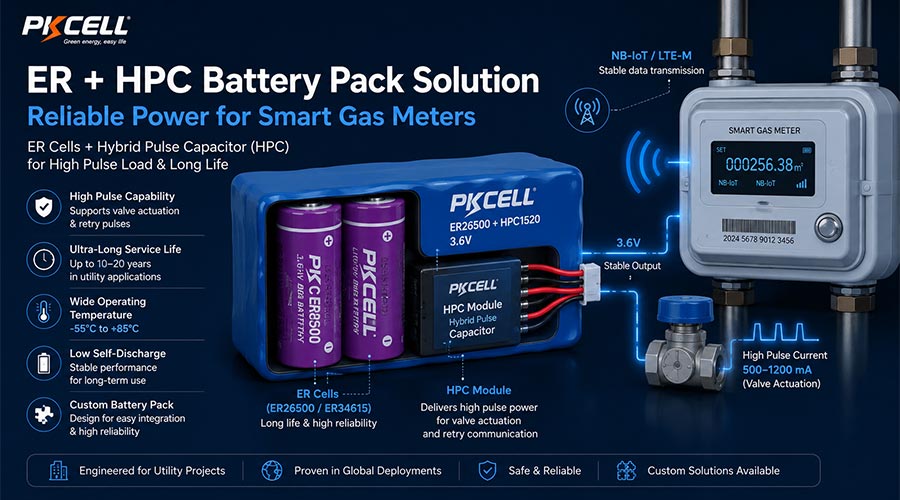
A standard bobbin-type ER battery is an excellent long-life energy cell, but some gas meters need additional pulse support. PKCELL’s IoT Battery Pack Solutions (ER + HPC) page describes a solution that combines a standard bobbin-type LiSoCl2 cell with HPC technology for high-current pulses and to reduce the adverse effects of LiSoCl2 battery passivation.
How ER + HPC Works
ER + HPC Working Logic
- ER cell provides long-term energy during standby life.
- HPC stores energy during low-load periods.
- HPC helps deliver pulse current during NB-IoT upload, valve actuation, alarm transmission, or retry events.
- After the pulse, the ER cell gradually recharges the HPC before the next event.
When to Use ER + HPC in Gas Meters
- NB-IoT gas meter.
- Valve-control gas meter.
- Poor signal or frequent retry locations.
- Low-temperature operation.
- High cut-off voltage electronics.
- Long storage before installation.
- 10-year or 15-year target life with high reliability requirements.
For more design details, see ER Battery + HPC Design Guide for High-Pulse IoT Applications and Hybrid Pulse Capacitor Series.
8. Battery Life Calculation for Gas Meters
Gas meter battery life should be calculated from the complete operating cycle. Standby current is important, but communication, valve action, alarm events, retries, low temperature, self-discharge, and cut-off voltage must also be included.
What to Include in a Gas Meter Battery Calculation
Device Consumption
- Sleep current
- Metering current
- MCU wake-up current
- Data logging current
- Wireless TX current
- RX or listening current
- Alarm event current
Field Derating
- Network retry margin
- Valve open and close current
- Self-discharge
- Temperature derating
- Passivation behavior
- Cut-off voltage
- Storage time before installation
Utility project marginGas meter projects should not be calculated with 100% nominal capacity. Long-life deployments require margin for low temperature, weak signal, valve actuation, storage, aging, production variation, and end-of-life voltage.
Simple Gas Meter Battery Life Estimator
9. Environmental Factors in Gas Meter Battery Selection
Low Temperature
Low temperature can reduce usable capacity, increase internal resistance, increase voltage drop, make valve motion harder, and increase communication failure risk. Gas meters installed in outdoor boxes, basements, or cold regions should be tested at the minimum operating temperature.
High Temperature and Long Storage
High temperature and long storage can affect self-discharge, aging, sealing reliability, passivation behavior, and first-start performance. Gas meter battery packs may be stored, shipped, and installed long after production, so initial activation after storage should be validated.
Outdoor and Underground Installation
Gas meters may be installed in outdoor meter boxes, basements, utility cabinets, damp environments, cold regions, or poor-signal locations. Battery pack design should consider waterproof structure, connector reliability, wire insulation, vibration, mechanical fixation, and condensation risk.
10. Testing Checklist Before Gas Meter Battery Approval
Electrical Tests
Communication, Environmental, and Pack-Level Tests
11. Recommended PKCELL Battery Solutions for Gas Meters
ER14505 for Compact Gas Meter ModulesRecommended for compact low-power gas meter modules, low reporting frequency designs, protected installation environments, and devices without valve motor or demanding pulse current.
ER26500 for Standard Smart Gas MetersRecommended for mainstream AMR/AMI gas meters that need balanced capacity, size, and service life. ER26500 is a practical option for many standard utility meter projects.
ER34615 for Long-Life Utility Gas MetersRecommended for long service life, outdoor deployment, larger enclosures, high reserve capacity, and utility-scale projects where low maintenance is a priority.
ER26500M / ER34615M for Higher Pulse Gas MetersRecommended for gas meter modules that require stronger pulse capability than standard energy-type cells, while still needing long-life primary lithium performance.
ER + HPC Battery Pack for NB-IoT and Valve-Control Gas MetersRecommended for NB-IoT gas meters, valve-control meters, weak-signal locations, low-temperature deployments, and high-reliability utility projects requiring stable pulse output.
View ER + HPC Battery Packs View ER26500 + HPC1520 View ER34615 + HPC1550
12. What Information Should You Provide to a Battery Supplier?
To recommend the correct gas meter battery or battery pack, the supplier needs a real load profile and deployment information. This helps avoid choosing a battery based only on model name or nominal capacity.
Need a gas meter battery recommendation?Share your gas meter load profile with PKCELL. Our engineers can help recommend an ER battery, ER Power Type cell, or custom ER + HPC battery pack based on your target lifetime, communication technology, valve requirement, and deployment environment.
Request Battery Recommendation View Utility Meter Battery Solutions Explore Primary Lithium Battery Solution Hub
13. FAQs About Gas Meter Batteries
Conclusion: Choose Gas Meter Batteries by Lifetime, Pulse Load, and Utility Reliability
Gas meter battery selection should not be based only on nominal capacity. Engineers must evaluate average current, pulse current, communication technology, valve-control load, temperature, passivation, cut-off voltage, and service-life target.
ER14505 is suitable for compact, low-power gas meter modules. ER26500 is a balanced option for standard smart gas meters. ER34615 is suitable for long-life, high-reserve utility projects. ER26500M and ER34615M can support higher pulse requirements, while ER + HPC battery packs are often the preferred direction for NB-IoT, valve-control, weak-signal, cold-environment, and high-reliability gas meter projects.
Related PKCELL Resources
- Utility Meter Batteries for Water and Gas
- LiSoCl2 Battery Series
- LiSoCl2 ER Energy Type Batteries
- IoT Battery Pack Solutions (ER + HPC)
- Hybrid Pulse Capacitor Series
- ER14505 3.6V AA LiSoCl2 Battery
- ER26500 3.6V C LiSoCl2 Battery
- ER26500M 3.6V C LiSoCl2 Battery
- ER34615 3.6V D LiSoCl2 Battery
- ER34615M 3.6V D LiSoCl2 Battery
- Why Lithium-Thionyl Chloride Batteries Are Ideal for Water and Gas Meters
- How to Calculate Battery Life for LoRaWAN and NB-IoT Devices
- ER Battery + HPC Design Guide
Post time: Jul-03-2026


