

ER34615 Battery for Water Quality Monitoring and Leak Detection
Water quality monitors and leak detectors are frequently installed in locations where mains power and regular maintenance are unavailable. A device may remain asleep for long periods, wake to energize a sensor, process a measurement and then transmit data through NB-IoT, LoRaWAN or another wireless network.
The ER34615 battery is a D-size, 3.6V lithium thionyl chloride primary cell with a reference nominal capacity of 19,000mAh. It can provide a large stored-energy reserve for remote water monitoring, pipeline leak detection, industrial sensing and environmental telemetry.
Capacity alone does not determine suitability. Sensor excitation, wireless pulses, cutoff voltage, temperature, moisture protection, connector design and required field life must all be evaluated before choosing a standard ER34615, ER34615M or ER34615 with HPC.
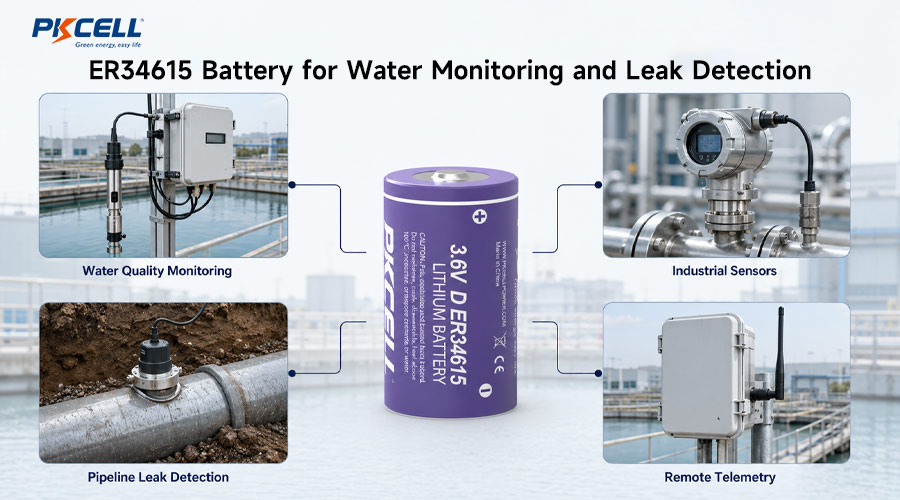
Quick Answer: Is ER34615 Suitable for Water and Leak Detection Devices?
ER34615 can be suitable when the device needs a large energy reserve, has low average consumption and must remain in the field without regular charging. Higher-current sensing or communication events require separate evaluation.
Standard ER34615: Long-term energy for low-current sensing and infrequent communication.
ER34615M: A power-type option for stronger direct current or more demanding active modes.
ER34615 + HPC: Long-term stored energy plus support for short NB-IoT, LoRaWAN or alarm pulses.
Custom battery pack: Use when the equipment requires higher voltage, more capacity, sealing, wiring or a specific connector.
PKCELL ER34615 Product Specifications
The following values describe the referenced PKCELL standard ER34615 model. Verify the current datasheet supplied with the exact production battery.
| Parameter | Reference Value | Industrial Design Note |
|---|---|---|
| Chemistry | Lithium thionyl chloride, LiSOCl2 | Primary and non-rechargeable |
| Format | D size | Confirm available equipment space |
| Rated voltage | 3.6V | Check sensor and radio operating voltage |
| Nominal capacity | 19,000mAh | Referenced at a low discharge rate to 2.0V |
| Standard current | 3mA | Useful as a product reference, not a universal device load |
| Maximum continuous discharge | 200mA | A maximum rating is not a recommended operating current |
| Maximum pulse discharge | 400mA | Pulse voltage must be validated under real conditions |
| Operating temperature | -55°C to +85°C | Available capacity and pulse voltage vary with temperature |
| Approximate dimensions | 34.2 × 61.5mm | Allow additional room for wires, HPC and insulation |
| Approximate weight | 107g | A complete battery pack will weigh more |
| Storage self-discharge | Less than 1% per year under referenced conditions | Storage time and temperature affect the result |
View the PKCELL ER34615 19,000mAh product
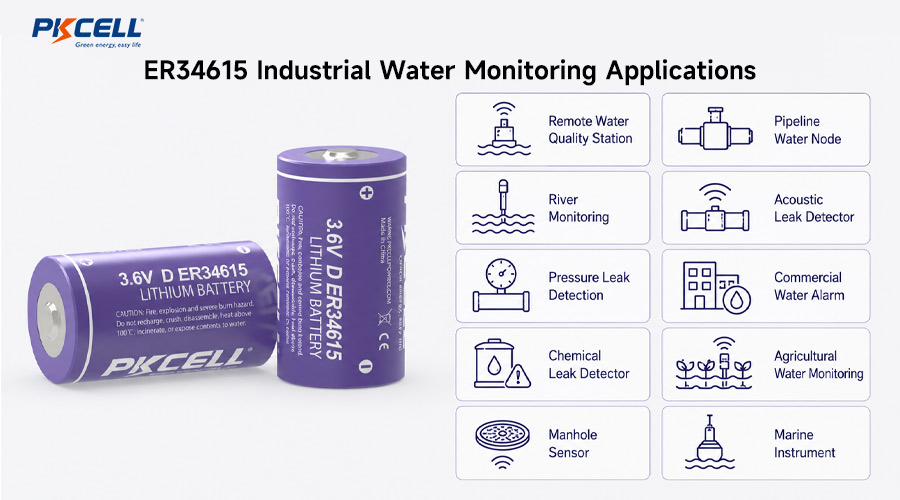
ER34615 Application Scenarios
Water quality monitoring
Remote Water Quality Stations
Remote stations may measure pH, conductivity, turbidity, temperature, dissolved oxygen or other parameters before storing and transmitting results.
Key load factors: Sensor warm-up, measurement duration, cleaning cycles, data logging and wireless reporting.
Municipal water
Pipeline Water Quality Nodes
Distributed monitoring nodes can be installed across water-treatment and distribution networks to detect changes in water conditions.
Key requirements: Long field deployment, sealed enclosure, stable sensing power and reliable telemetry.
Environmental monitoring
River, Reservoir and Groundwater Monitoring
Monitoring equipment may operate in isolated locations and report data through LoRaWAN, NB-IoT, satellite or proprietary radio.
Key requirements: Temperature assessment, long sleep periods, scheduled sensing and limited service access.
Water leak detection
Acoustic Pipeline Leak Detectors
Acoustic devices may wake on a schedule, power microphones or vibration sensors, process a signal and transmit an alert or diagnostic data.
Key load factors: Sampling frequency, processing time, event recording and communication pulses.
Industrial pipelines
Pressure and Flow-Based Leak Detection
Pipeline-monitoring nodes can compare pressure, flow or transient events to identify possible leakage in water, chemical or process systems.
Key load factors: Sensor excitation, measurement interval, alarm frequency and radio transmission.
Building monitoring
Commercial Water Leak Sensors
Leak sensors in plant rooms, data centers, warehouses and commercial buildings may remain in standby until moisture is detected.
Key requirements: Low standby current, reliable alarm activation and long storage before deployment.
Industrial safety
Chemical and Process Leak Detectors
Industrial detectors may monitor liquid or gas leakage near storage tanks, valves, pumps and process piping.
Key requirements: Sensor compatibility, enclosure material, alarm load and site-specific safety requirements.
Agricultural IoT
Agricultural Water Monitoring
Field devices may monitor water level, irrigation flow, soil conditions or reservoir status while operating far from mains power.
Key requirements: Outdoor temperature, long sleep periods, periodic wireless transmission and custom pack voltage.
Underground infrastructure
Manhole and Utility Chamber Sensors
Underground equipment can monitor water level, flooding, cover movement, humidity or pipeline status.
Key requirements: Moisture-resistant enclosure, difficult access, wireless pulse support and corrosion control.
Marine monitoring
Underwater and Marine Instruments
Marine instruments may require high stored energy for sonar, sensing, logging or telemetry in locations where battery replacement is complex.
Key requirements: Pressure-rated enclosure, corrosion resistance, mission duration and complete pack integration.
Battery Requirements for Industrial Monitoring Equipment
1. Electrical Load Profile
- Sleep and standby current
- Sensor warm-up current
- Measurement current and duration
- Processor and data-storage load
- Alarm or actuator current
2. Wireless Communication
- NB-IoT, LTE-M, LoRaWAN or RF protocol
- Connection and transmission current
- Pulse duration
- Reports per day
- Worst-case retries and weak signal
3. Environmental Conditions
- Operating and storage temperature
- Humidity and condensation
- Water immersion or splash exposure
- Chemical or salt exposure
- Shock, vibration and pressure
4. Mechanical Integration
- Available battery dimensions
- Wire length and gauge
- Connector type and polarity
- Mounting and strain relief
- Pack insulation and sealing
5. Service-Life Target
- Storage time before activation
- Expected field deployment
- Device cutoff voltage
- Engineering safety margin
- Cost and accessibility of replacement
6. Documentation
- Model-specific datasheet
- UN38.3 transport test summary
- Safety data sheet
- Applicable declarations or test reports
- Shipping and packaging documents
The equipment IP rating belongs to the complete enclosure. A hermetically sealed cell does not make an unfinished battery pack or connector waterproof.
Choosing the Right ER34615 Power Architecture
| Power Architecture | Potential Fit | Main Advantage | What to Verify |
|---|---|---|---|
| Standard ER34615 | Low-current sensing and infrequent reporting | Large nominal energy reserve | Pulse voltage, cutoff and temperature |
| ER34615M | Higher direct current or stronger active modes | Power-oriented discharge capability | Lower capacity and complete energy budget |
| ER34615 + HPC | Low average current with short wireless pulses | Stored energy plus pulse support | HPC size, ESR, pulse duration and recharge interval |
| Multi-cell pack | Higher voltage or larger total energy requirement | Custom voltage and capacity | Cell matching, pack protection and dimensions |
How ER34615 + HPC Supports Wireless Monitoring
- During sleep: The ER34615 supplies low baseline current.
- During measurement: The cell powers the sensor and controller within the verified load range.
- During transmission: The HPC supports a short higher-current wireless pulse.
- During recovery: The ER cell replenishes the HPC before the next event.
The system must be designed so that voltage remains above the device cutoff during sensing, startup and communication.
Verified ER34615 Monitoring Projects
Verified PKCELL evaluation
Agricultural Water Monitoring
PKCELL evaluated an ER34615M 2S3P battery pack for a remote agricultural water-monitoring device.
- Nominal pack configuration: 7.2V and 42Ah
- Long sleep periods
- Periodic wireless communication
- Wide-temperature field requirements
- Ten-year design-life target at 25°C
The evaluation emphasized load profile, low-temperature pulses, passivation, cutoff voltage, capacitor integration and complete-device testing.
Verified PKCELL project
Underwater Scanning Equipment
PKCELL supplied ER34615 batteries for underwater scanning systems used in mining-related projects.
- High-capacity battery requirement
- Marine and underwater operating context
- Long-term supply requirements
- Product documentation and sample testing
- Export compliance support
The project is not a water-quality tester case, but it demonstrates ER34615 use in water-related industrial equipment requiring substantial stored energy.
Verified PKCELL project
Wireless Detector Evaluation
A wireless detector manufacturer evaluated ER34615 for a high-capacity, low-self-discharge sensing platform.
- Load-profile and duty-cycle review
- Battery-life modeling
- Temperature-performance questions
- Sample testing and validation
- Long-term supply planning
This case supports the engineering method used for remote leak detectors, although the published customer application was a wireless security detector.
Engineering application scenario
Pipeline Leak Detection Node
A pipeline leak-detection node may combine pressure or acoustic sensing, local processing and wireless alarm reporting.
The battery design should be based on sensor excitation, sampling duration, data processing, alarm probability, radio pulses and the lowest expected field temperature.
This is an engineering scenario, not a claim of a completed customer deployment.
ER34615 Selection Guide for Industrial Equipment
- Define every operating state. Include sleep, measurement, processing, communication, alarm and actuator modes.
- Measure current and duration. Do not rely only on component typical values.
- Identify the worst pulse. Record minimum voltage during sensor startup and wireless transmission.
- Confirm device cutoff voltage. Capacity below the cutoff is unavailable to the equipment.
- Document communication behavior. Include normal messages, retries, weak signal and alarm reporting.
- Define environmental exposure. Include temperature, water, humidity, chemicals, vibration and pressure.
- Select the architecture. Compare standard ER34615, ER34615M, ER + HPC and a custom battery pack.
- Define pack mechanics. Specify dimensions, wiring, connector, sealing and mounting.
- Verify applicable documents. Request model-specific transport and compliance information.
- Test the complete equipment. Validate fresh, stored, cold and representative end-of-life conditions.
Information to Send PKCELL
- Equipment type and measured parameters
- Nominal and cutoff voltage
- Sleep and average current
- Sensor warm-up current and duration
- Wireless pulse current and duration
- Reports and retries per day
- Alarm or actuator load
- Operating and storage temperature
- Water, chemical and pressure exposure
- Target service life
- Maximum battery-pack dimensions
- Connector, wire and sealing requirements
Common Design Mistakes
- Promising a fixed 10- or 20-year life: Runtime depends on the complete equipment energy budget.
- Assuming the cell is waterproof: The enclosure and pack determine environmental protection.
- Choosing by capacity alone: Sensor and wireless pulses can cause voltage to fall below cutoff.
- Ignoring sensor warm-up: Water-quality probes can consume more energy during stabilization than during sleep.
- Ignoring network retries: Poor NB-IoT or LoRaWAN coverage can change consumption.
- Using maximum current as a recommended load: Reliable design requires margin and testing.
- Testing only fresh batteries: Validate storage, cold temperature and representative end-of-life conditions.
- Recharging ER34615: It is a primary battery and must not be charged.
PKCELL ER34615 Product and Pack Options
- Standard ER34615 3.6V 19,000mAh battery
- LiSOCl2 standard and power-type batteries
- ER battery packs with HPC pulse support
- Customized primary lithium battery packs
- Custom wires, connectors, solder tabs, housings, labels and pack configurations
Need an ER34615 for Water Monitoring or Leak Detection?
Send PKCELL your sensor load, wireless pulse, cutoff voltage, temperature range, target service life and environmental requirements. The engineering team can evaluate a standard ER34615, ER34615M, ER + HPC solution or custom battery pack.
Request an ER34615 Recommendation
View the ER34615 Product
View ER + HPC Solutions
Frequently Asked Questions
Is ER34615 suitable for a water quality monitoring station?
It can be suitable when the station needs a large stored-energy reserve and has low average consumption. Sensor warm-up, communication pulses, cutoff voltage and environmental protection must be validated.
Can ER34615 power a pipeline leak detector?
Yes, depending on the acoustic, pressure or flow sensor load and wireless communication profile. Higher-current events may require ER34615M or ER34615 with HPC.
Is the ER34615 waterproof?
The cell uses a sealed construction, but the equipment’s waterproof rating depends on the complete battery pack, connector, enclosure and sealing design.
Why use an HPC with ER34615?
An HPC can support short higher-current events during sensor startup, NB-IoT or LoRaWAN transmission and alarm reporting while the ER34615 supplies long-term energy.
How long does ER34615 last in a leak detector?
There is no universal lifespan. Runtime depends on sensor consumption, sampling frequency, wireless communication, retries, temperature, cutoff voltage and usable capacity.
Can ER34615 be recharged?
No. ER34615 is a primary lithium thionyl chloride battery and must not be recharged.
Conclusion
ER34615 offers a large energy reserve for remote water monitoring, leak detection and industrial sensing equipment that cannot rely on regular charging or maintenance.
Standard ER34615 is best suited to low-rate loads within its verified limits. ER34615M may suit stronger direct loads, while ER34615 with HPC can support equipment that combines long sleep periods with short sensor or wireless pulses.
Final selection should be based on measured electrical loads, environmental exposure, mechanical integration, model-specific documentation and complete-equipment testing.
Sources and Verification Notes
Product specifications can change. Use the datasheet supplied for the exact battery model and pack configuration as the final technical reference.
- PKCELL ER34615 Product Page — product parameters and application information.
- Agricultural Water Monitoring Case — verified ER34615M 2S3P evaluation.
- Underwater Scanning Case — verified ER34615 water-related industrial project.
- Wireless Detector Case — load-profile, lifetime and validation process.
- PKCELL ER + HPC Battery Packs — pulse-support architectures.
- PKCELL Primary Lithium Battery Packs — custom pack configurations.
Post time: Sep-15-2025


