

ER34615 Battery for Smart Water, Heat and Gas Meters
Smart water, heat and gas meters are often expected to operate for extended periods without mains power or regular maintenance. Their batteries must preserve energy during long standby periods while supporting sensing, data storage, wireless communication, alarms and, in some designs, valve actuation.
The ER34615 battery is a D-size, 3.6V lithium thionyl chloride primary cell with a reference nominal capacity of 19,000mAh. Its high stored energy makes it a practical starting point for utility meters with a large energy budget and sufficient installation space.
For NB-IoT, LoRaWAN and other communication systems with short higher-current events, the standard ER34615 may be combined with a hybrid pulse capacitor. The correct architecture depends on the complete meter load profile, not capacity alone.
Quick Answer: Is ER34615 Suitable for Smart Utility Meters?
ER34615 can be suitable when the meter needs a large energy reserve, has low average consumption and is difficult or expensive to service. Wireless communication and valve-control pulses must be evaluated separately.
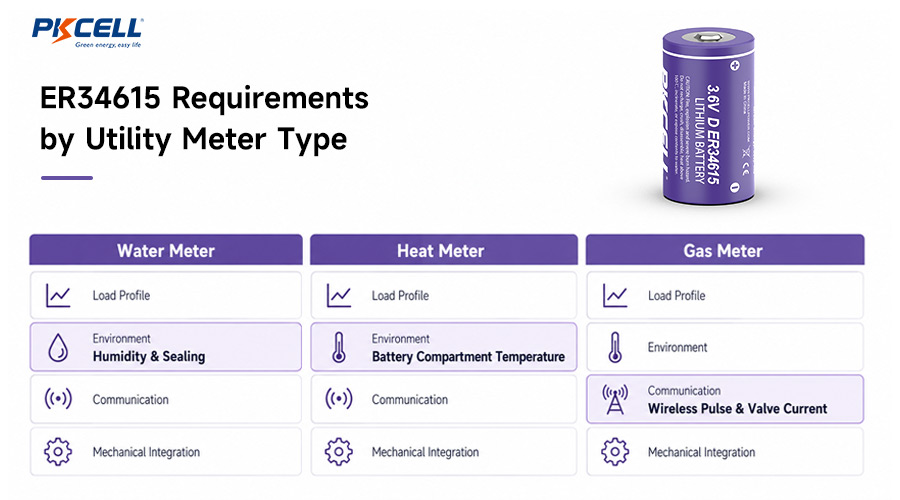
Water meters: Evaluate humidity, underground installation, communication pulses and pack sealing.
Heat meters: Evaluate ambient temperature, measurement schedule and wireless communication.
Gas meters: Evaluate long standby, communication pulses, alarm reporting and valve-actuation current.
ER34615 + HPC: Consider when the meter combines long sleep periods with short NB-IoT, LoRaWAN or actuator pulses.
PKCELL ER34615 Battery Specifications
The following values describe the referenced PKCELL ER34615 19,000mAh model. Capacity is measured under specific datasheet conditions and may not be fully available in every meter.
| Parameter | Reference Value | Utility Meter Design Note |
|---|---|---|
| Chemistry | Lithium thionyl chloride, LiSOCl2 | Primary and non-rechargeable |
| Format | D size | Confirm battery-compartment and pack dimensions |
| Rated voltage | 3.6V | Check meter operating and cutoff voltage |
| Nominal capacity | 19,000mAh | Measured at 2mA to 2.0V under the referenced conditions |
| Maximum continuous discharge | 200mA | A maximum rating is not a recommended design current |
| Maximum pulse discharge | 400mA | Verify pulse duration and minimum voltage |
| Operating temperature | -55°C to +85°C | Capacity and pulse performance vary with temperature |
| Approximate dimensions | 34.2 × 61.5mm | Tabs, wires, HPC and insulation increase pack size |
| Approximate weight | 107g | Confirm the complete assembly weight |
| Storage self-discharge | Less than 1% per year under referenced conditions | Storage temperature and duration affect the result |
| Reference storage life | More than 10 years | Storage life is not the same as meter operating life |
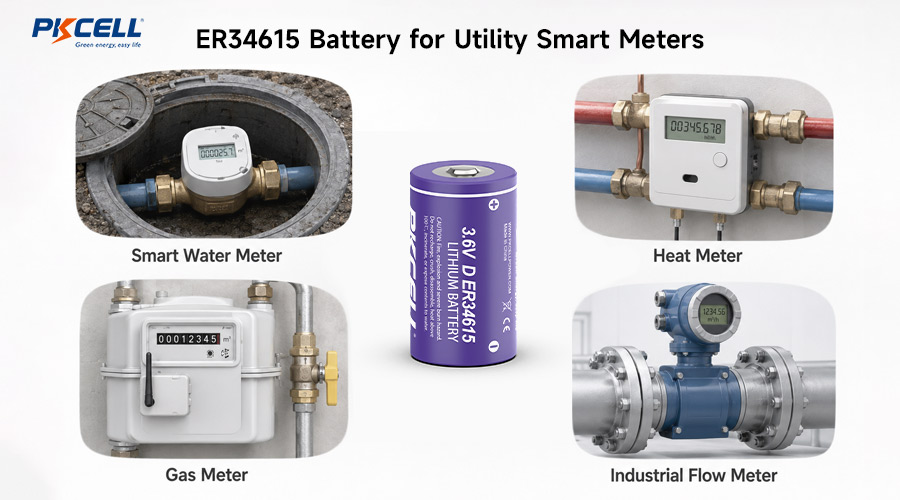
ER34615 Applications in Public Utilities
Water utility
Smart Water Meters
Water meters may be installed in outdoor boxes, basements or underground pits. Their power system may support sensing, memory, leak alarms and scheduled wireless transmissions.
Key battery requirements:
- Low self-discharge during long deployment
- Energy reserve for scheduled communication
- Stable voltage above the meter cutoff
- Connector and pack sealing suitable for the enclosure
- Pulse support for NB-IoT or LoRaWAN where required
District heating
Smart Heat Meters
Heat meters calculate energy usage using flow and temperature measurements. Installations may be near heating pipes, inside plant rooms or within building-service cabinets.
Key battery requirements:
- Verified performance at the actual battery-compartment temperature
- Energy for flow and temperature sensing
- Scheduled data logging and billing communication
- Long maintenance interval
- Mechanical separation from excessive heat sources
Gas utility
Smart Gas Meters
Smart gas meters may combine volume measurement, memory, tamper alarms, wireless reporting and an optional shutoff valve. The valve and communication system can create higher-current events.
Key battery requirements:
- Long standby energy
- Reliable alarm and communication events
- Valve-current assessment where fitted
- Model-specific safety and transport documentation
- Validation under expected field temperature
Industrial utility
Flow Meters
Industrial flow meters can operate in water-treatment, chemical, oil and gas or process-control systems. The load profile may include sensor excitation, displays, data logging and remote communication.
Key battery requirements:
- Sensor warm-up and measurement energy
- Communication or display consumption
- Temperature and vibration assessment
- Custom connector and pack integration
- Service-access and shutdown considerations
Standard ER34615 or ER34615 with HPC?
Standard ER34615
A standard bobbin-type ER34615 prioritizes nominal capacity and long-term low-rate discharge. It may be suitable when the meter has low continuous consumption and any load events remain within the cell’s verified capability.
ER34615 with HPC
Long-Term Energy Plus Pulse Support
In an ER34615 + HPC assembly, the ER cell supplies long-term energy. The hybrid pulse capacitor supports short higher-current events such as network connection, data transmission or valve actuation.
- ER34615: Supplies baseline and long-term energy.
- HPC: Supports short pulse loads.
- Recharge interval: The ER cell restores energy to the HPC between events.
- System objective: Keep voltage above the meter’s cutoff threshold.
| Meter Load Pattern | Potential Starting Point | What to Verify |
|---|---|---|
| Low continuous current and small, infrequent events | Standard ER34615 | Capacity, pulse voltage and cutoff voltage |
| Low average load with NB-IoT or LoRaWAN pulses | ER34615 + HPC | Pulse amplitude, duration, frequency and recharge interval |
| Meter with motorized shutoff valve | ER34615 + HPC or power-type architecture | Motor startup, movement duration and minimum voltage |
| High recurring current or frequent long events | Reassess complete power system | A different cell or larger battery pack may be necessary |
Selecting a larger ER cell does not automatically solve a wireless pulse problem. Capacity supplies energy; pulse capability determines whether the meter stays above its minimum operating voltage during the event.
Water, Heat and Gas Meter Application Cases
Verified PKCELL project
Smart Water Meter: ER34615 + HPC1520
A customer was developing a smart water meter for long-term outdoor deployment. The design needed pulse support, compact integration and improved protection for humid conditions.
PKCELL engineering work included:
- ER34615 and HPC1520 integration
- Top-mounted pulse-component layout
- Internal pack-structure optimization
- Waterproof glue sealing
- Prototype production for device validation
Verified metering project
Custom Metering Pack: ER34615 + HPC1550
A metering-device project required a high-capacity customized battery assembly. PKCELL supplied a 1S3P pack using ER34615 cells with HPC1550 pulse support, producing a nominal 3.6V and 57Ah configuration.
The project included:
- Three ER34615 cells in parallel
- HPC pulse-support integration
- Custom battery-pack engineering
- Prototype production
- Follow-up supply after initial validation
Engineering application scenario
Heat Meter Battery Design
A heat-meter project should begin by measuring flow-sensor consumption, temperature-sensor sampling, display activity and wireless transmissions.
Standard ER34615 may suit a low-duty-cycle design. ER34615 + HPC may be considered when NB-IoT, LoRaWAN or another radio creates a short current pulse.
Required validation: Battery-compartment temperature, transmission voltage, storage time and lifetime energy budget.
Engineering application scenario
Gas Meter with Wireless Reporting and Valve
A smart gas meter may remain in low-power standby, report data periodically and operate a shutoff valve only during exceptional events.
The ER34615 can supply the long-term energy reserve, while a properly selected HPC may support communication or valve pulses.
Required validation: Valve startup current, valve duration, wireless retries, cutoff voltage, temperature and market-specific compliance.
How to Estimate ER34615 Meter Battery Life
Do not promise a fixed 10- or 15-year life based only on the 19Ah capacity. Calculate each meter operating state separately.
| Energy Component | Information Required | Examples |
|---|---|---|
| Continuous load | Current × operating hours | Controller, clock, sensor and radio sleep current |
| Measurement events | Current × duration × events | Flow sampling, temperature sensing and calculation |
| Communication | Current × connection/transmission time × events | NB-IoT, LoRaWAN, RF or Zigbee messages |
| Network retries | Worst-case retries and signal conditions | Failed registration or repeated uplinks |
| Valve events | Startup current, running current and duration | Gas or water shutoff valve |
| Storage loss | Warehouse duration and temperature | Time between battery production and installation |
The calculated consumption should be adjusted for self-discharge, temperature, passivation, pulse losses, cutoff voltage, component variation and the required end-of-life margin.
ER34615 Utility Meter Selection Guide
- Identify the meter type. Document whether it is a water, heat, gas or industrial flow meter.
- Measure the continuous load. Include sensing, clock, memory and radio sleep current.
- Capture communication pulses. Measure current, duration, retries and minimum voltage.
- Measure valve current where applicable. Record startup, movement and holding loads.
- Confirm the device cutoff voltage. The meter cannot use capacity below its minimum operating voltage.
- Define the temperature profile. Measure the battery-compartment temperature rather than assuming the ambient range.
- Define mechanical requirements. Include pack dimensions, wires, connectors, HPC placement and sealing.
- Calculate the lifetime energy budget. Include normal, alarm and worst-case communication behavior.
- Test the complete meter. Validate fresh, stored, cold and representative end-of-life conditions.
Information to Send PKCELL
- Meter type and communication protocol
- Nominal and cutoff voltage
- Sleep and average current
- Maximum communication pulse
- Pulse duration and frequency
- Network retry assumptions
- Valve current and duration, if applicable
- Operating and storage temperatures
- Target service life
- Battery-compartment dimensions
- Wire, connector, tab and sealing requirements
- Annual order quantity and target market
Common Utility Meter Battery Mistakes
- Promising a fixed lifespan: Runtime depends on the complete meter energy budget.
- Ignoring network retries: Poor signal conditions can increase communication energy.
- Choosing from capacity alone: Wireless or valve pulses may cause voltage to fall below cutoff.
- Calling the ER34615 a C-size cell: ER34615 is generally classified as a D-size format.
- Claiming the battery makes readings accurate: The battery supplies power; measurement accuracy depends on the complete meter.
- Assuming the cell is waterproof: Environmental protection depends on the battery pack and meter enclosure.
- Testing only at room temperature: Temperature affects voltage, capacity and pulse behavior.
- Recharging the cell: ER34615 is a primary battery and must not be charged.
Need an ER34615 Battery for a Utility Meter?
Send PKCELL your water, heat, gas or flow-meter load profile, communication pulse, valve requirements, temperature range, target lifetime and pack dimensions. The engineering team can evaluate standard ER34615, ER34615 + HPC or a custom multi-cell pack.
Request a Utility Meter Battery Recommendation
View ER34615 Smart Meter Battery
View ER + HPC Battery Packs
Frequently Asked Questions
Is ER34615 suitable for a smart water meter?
It can be suitable when the meter requires a large energy reserve and has sufficient installation space. Wireless pulses, temperature, cutoff voltage and sealing requirements must be validated.
Can ER34615 power a heat meter?
Yes, subject to load and temperature validation. Measure the actual battery-compartment temperature, sensing load and communication profile before selection.
Can ER34615 power a smart gas meter valve?
The ER34615 can supply long-term energy, but valve startup may require pulse support or a different power architecture. Measure the valve current, duration and minimum operating voltage.
Why use an HPC with ER34615?
An HPC supports short higher-current events during NB-IoT, LoRaWAN, wireless reporting or valve operation while the ER34615 supplies long-term energy.
How long does an ER34615 last in a smart meter?
There is no universal lifespan. Runtime depends on usable capacity, sleep current, measurements, transmissions, retries, valve events, temperature, storage and cutoff voltage.
Is ER34615 rechargeable?
No. ER34615 is a primary lithium thionyl chloride battery and must not be recharged.
Conclusion
ER34615 provides a large energy reserve for utility meters that operate without mains power and are difficult to service. Its suitability still depends on the meter type and load profile.
Water meters require careful sealing and wireless-pulse evaluation. Heat meters require battery-compartment temperature assessment. Gas meters may add alarm, communication and valve-current requirements.
Use standard ER34615 for low-rate loads within the cell’s verified capability. Evaluate ER34615 with HPC when the meter combines long standby operation with short wireless or actuator pulses.
Sources and Verification Notes
Product specifications and pack configurations can change. Use the current technical specification supplied for the exact production battery as the final reference.
- PKCELL ER34615 Smart Meter Battery — dimensions, current limits and utility-meter applications.
- ER34615 + HPC1520 Datasheet — ER34615 and HPC1520 reference specifications.
- Smart Water Meter Power Solution — verified ER34615 + HPC1520 project.
- Metering Device Case Study — verified 1S3P ER34615 + HPC1550 pack project.
- PKCELL ER + HPC Battery Packs — pulse-support architectures.
- Primary Lithium Battery Solution Hub — utility metering and Industrial IoT selection information.
Post time: Aug-11-2025


