

Volumetric Constraints vs. Decade-Long Autonomy in Next-Gen Micro-Sensors
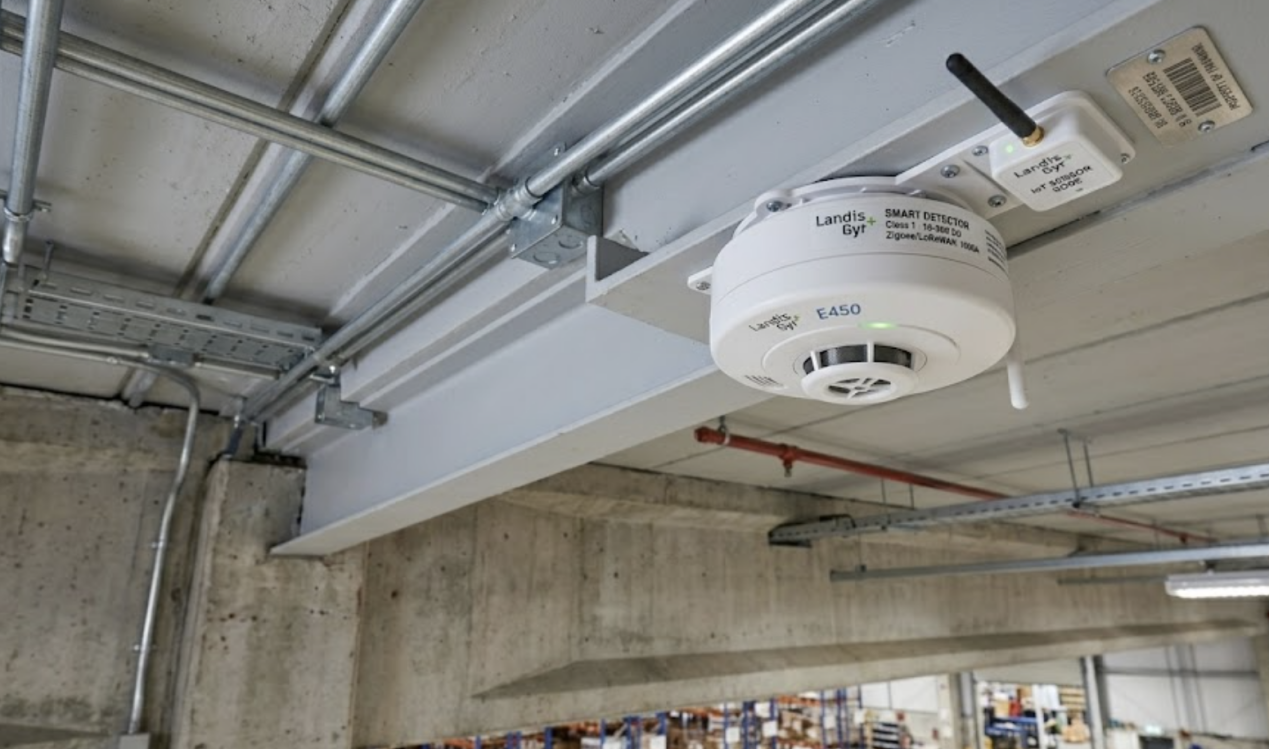
Distributed sensor networks have a power problem that doesn’t get talked about enough. Wireless smoke detectors, asset-tracking tags, smart door and window security nodes — these devices get installed in locations that nobody wants to revisit for maintenance. Rooftops, ceiling voids, shipping container stacks, remote infrastructure perimeters. Once they’re deployed, the expectation is that they simply work, for years, without intervention. That operational reality makes the battery selection decision disproportionately important relative to the cost of the component itself. Getting it wrong doesn’t just mean a dead sensor — it means a field technician spending labor hours locating a single failed node across a facility with thousands of them. This is why engineering teams building compact IoT hardware treat the choice of a High Quality ER14505 3.6V Primary Battery Supplier as a foundational design decision, not a procurement afterthought.
The zero-maintenance mandate is real and largely non-negotiable. A ten-year operational lifespan in diverse climate conditions — from cold storage warehouses to sun-exposed outdoor enclosures — requires primary cell chemistry that handles both extended idle periods and periodic transmission bursts without degrading prematurely. A single defective cell in a security perimeter network can create a blind spot that goes undetected until something goes wrong. At that point, the cost of the failure far exceeds whatever was saved on the original component. Procurement managers working on large sensor deployments have generally learned this lesson the hard way at least once.
Quantitative Parametric Breakdown: AA ER14505 vs. 1/2 AA ER14250 Cylindrical Cells
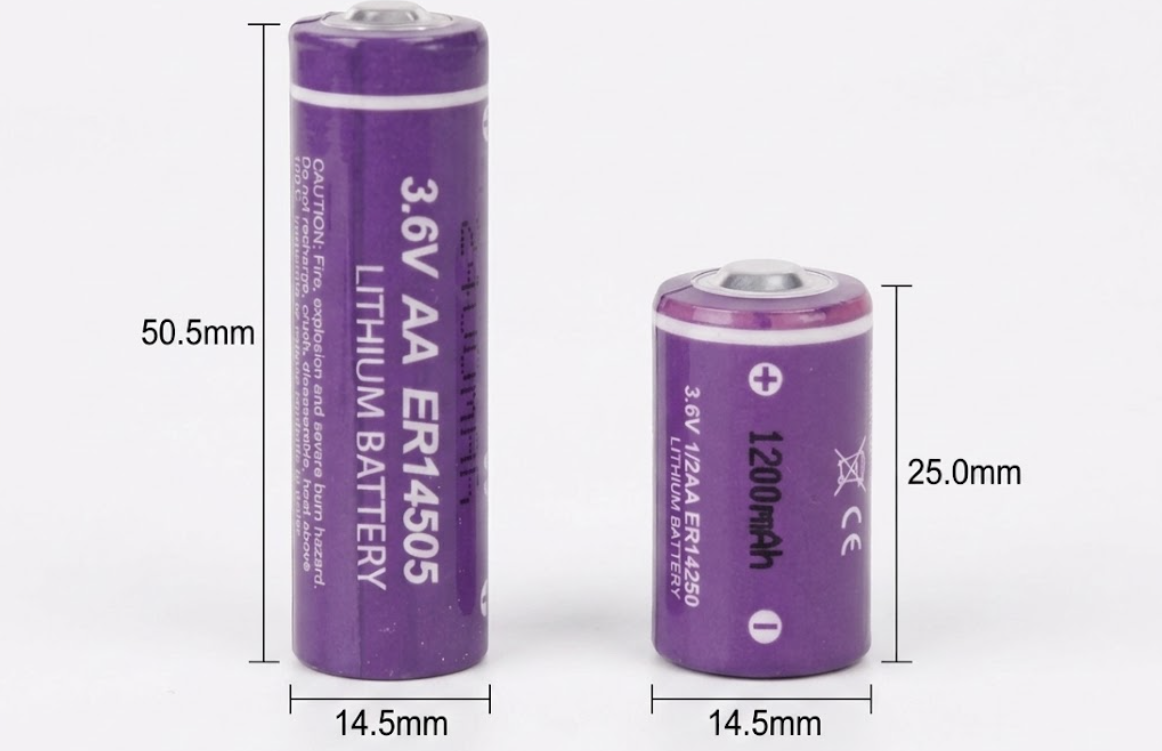
Both the ER14505 and the ER14250 use Lithium Thionyl Chloride chemistry and deliver a nominal 3.6V output — the common ground ends there. The physical geometry of each cell determines its capacity ceiling, and those ceilings are meaningfully different.
The AA-size ER14505 measures 14.5mm in diameter and 50.5mm in length, delivering approximately 2,400mAh. The 1/2 AA ER14250 keeps the same 14.5mm diameter but cuts the height to 25.2mm, which roughly halves the internal active material volume and brings capacity down to around 1,200mAh. For hardware designers, this is fundamentally a PCB clearance question: if the enclosure can accommodate the full AA height, the ER14505 provides double the runtime. If vertical space is the binding constraint, the ER14250 fits where the larger cell can’t.
When neither single-cell format provides enough capacity for the application’s duty cycle, multi-cell parallel configurations fill the gap. PKCell engineers custom parallel pack architectures for exactly this scenario — a 1S6P ER14505 pack, for instance, combines six AA cells to deliver 14,400mAh for high-drain applications, while a 1S5P ER14250 arrangement reaches 6,000mAh within a notably flat physical footprint. These configurations are particularly relevant for demanding deployments covered under a comprehensive IoT battery solution framework, where matching the energy architecture to the specific duty cycle of each device type is what separates a ten-year deployment from one that requires intervention at year six.
Eliminating Field Mortality: Strict Safety Certifications and Quality Homogeneity
Infant mortality — early field failure in deployed units — is the failure mode that damages IoT deployments most severely, because it tends to be unpredictable and clustered. A batch with subtle manufacturing inconsistencies doesn’t fail uniformly; it produces sporadic failures across a network that are difficult to diagnose and expensive to address. Prevention requires both the right certifications and the manufacturing discipline to back them up.
For sensors deployed in residential buildings or chemical storage environments, structural safety isn’t optional. UL certification and UN38.3 transport documentation confirm that the underlying chemistry survives extreme temperature variation, physical impact, and vibration during global distribution — conditions that primary lithium cells will encounter before they even reach the installation site. PKCell (Shenzhen Pkcell Battery Co., Ltd.) addresses electrolyte containment through hermetic glass-to-metal sealing across its production lines, combined with computerized electrolyte dosing systems that prevent the overfilling that causes internal pressure buildup and eventual leakage. In a compact sensor enclosure where the battery sits millimeters from sensitive microchips, a single leakage event is a total loss.
Batch-to-batch uniformity is enforced through automated testing of internal resistance and open-circuit voltage on every cell before assembly. The quality assurance process also includes voltage-delay screening — identifying and removing cells that show abnormal passivation behavior before they reach a customer’s production line. The practical outcome is that large shipments exhibit consistent discharge characteristics across the batch, which matters both for multi-cell pack balancing and for the predictability of network-wide performance over time.
Optimizing Total Cost of Ownership in Global IoT Infrastructure Rollouts
The procurement calculus for primary lithium cells in IoT deployments looks different from most component purchasing decisions because the cost exposure extends well beyond the initial bill of materials. An underspecified or inconsistent cell that triggers field maintenance three years into a ten-year deployment doesn’t just cost the price of a replacement battery — it costs the labor, logistics, and schedule disruption of a service event that wasn’t planned for. Experienced procurement managers working on large-scale rollouts have shifted their evaluation framework accordingly, weighting long-term field reliability heavily against upfront unit cost.
Certification readiness accelerates the commercial timeline on the front end. Shenzhen Pkcell Battery Co., Ltd. maintains full compliance with CE, RoHS, and IEC 60086-4 directives across its primary lithium portfolio, which means global clients can move through customs clearance and regulatory approval without the delays that non-certified components introduce. For product launches with hard market windows, that preparation has real commercial value.
The broader point is that primary cell selection shapes the long-term operational profile of the entire sensor network. A well-matched, consistently manufactured cell runs quietly in the background for a decade. A poorly specified one becomes visible in the worst possible way — as a field failure, a support ticket, or a gap in a monitoring network that was supposed to be invisible. The battery is never the most interesting part of an IoT deployment, but it’s often the part that determines whether the deployment succeeds on its original terms.
Corporate Website: https://www.pkcellpower.com/.
Post time: Jun-10-2026


