

CR927 vs CR1220: Best Coin Cell for Compact Devices
CR927 and CR1220 are small, non-rechargeable 3V lithium coin cells used in space-constrained electronics. They share similar chemistry and voltage, but their physical proportions are very different.
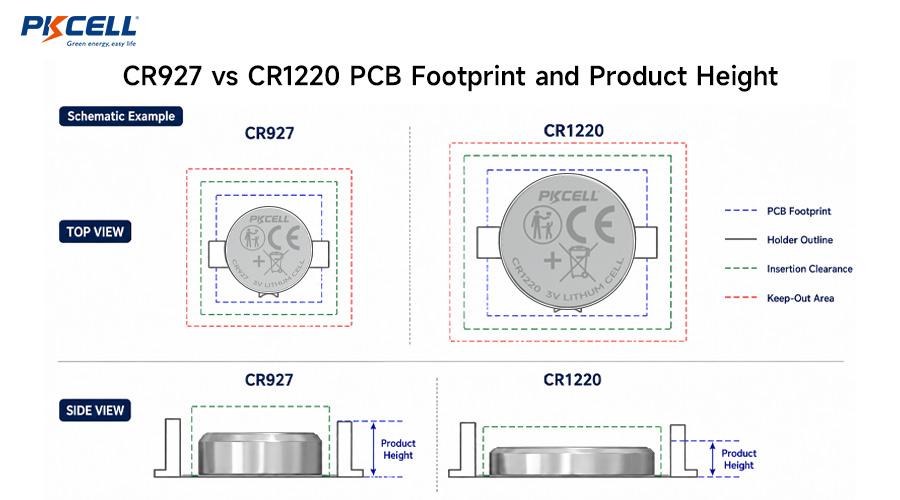
CR927 has the smaller PCB footprint but is thicker. CR1220 is wider, thinner and generally provides slightly more capacity. The best choice therefore depends on whether the product is constrained more by board area or enclosure height.
OEM teams can compare the
PKCELL CR927 battery
and PKCELL CR1220 battery
before requesting samples for mechanical and electrical validation.
CR927 vs CR1220: Key Specifications
| Specification | CR927 | CR1220 | Selection Impact |
|---|---|---|---|
| Battery type | Primary lithium coin cell | Primary lithium coin cell | Neither battery is rechargeable. |
| Typical chemistry | Li/MnO2 | Li/MnO2 | Both typically provide a stable nominal 3V output. |
| Nominal voltage | 3V | 3V | Matching voltage does not make the sizes interchangeable. |
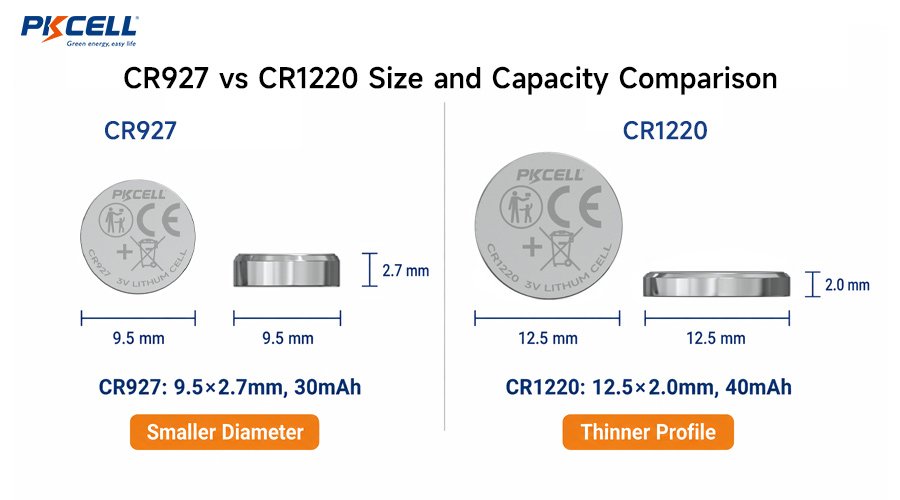
| PKCELL listed capacity | 30mAh | 40mAh | CR1220 offers approximately one-third more rated capacity under its specified test conditions. |
| Diameter | 9.5mm | 12.5mm | CR927 occupies less PCB area. |
| Height | 2.7mm | 2.0mm | CR1220 supports a thinner product profile. |
| Reference weight | Approximately 0.6g | Approximately 0.9g | CR927 is lighter for highly weight-sensitive designs. |
| PKCELL recommended constant current | 0.5mA | 1.0mA | Confirm the meaning and test conditions in the approved project datasheet. |
| PKCELL recommended pulse current | 5mA | 5mA | Pulse duration, frequency and loaded voltage still require testing. |
| Typical design priority | Small diameter and low weight | Thin profile and greater capacity | Mechanical geometry is usually the first decision. |
Capacity should only be compared when the test load, cutoff voltage and temperature are understood. For example, PKCELL’s CR927 technical specification rates 30mAh using a 68k-ohm continuous discharge to a 2.0V cutoff at approximately room temperature.
Diameter vs Height: The Most Important Difference
The model numbers encode the approximate battery dimensions:
- CR927: approximately 9.5mm in diameter and 2.7mm high
- CR1220: approximately 12.5mm in diameter and 2.0mm high
CR927 is not simply a smaller version of CR1220 in every direction. It saves about 3mm of diameter but requires about 0.7mm more height.
Choose CR927 When
- PCB area is extremely limited.
- The device can accept a 2.7mm battery height.
- Weight must be minimized.
- The energy requirement fits a 30mAh-class cell.
- The original product specifies CR927.
Choose CR1220 When
- The product must be thinner.
- A 12.5mm PCB footprint is available.
- Additional capacity is useful.
- A larger contact area suits the mechanical design.
- The product already uses a CR1220 holder or footprint.
Consider the Complete Mechanical Envelope
Do not compare bare-cell dimensions alone. A holder, welded tabs, insulation and insertion clearance can make the completed battery assembly considerably larger than the nominal cell.
For a removable battery, account for:
- Holder length and width
- Spring-contact height
- Battery insertion direction
- Finger or tool access
- Enclosure opening and battery door
- PCB keep-out areas
For a fixed tabbed battery, account for tab length, bend geometry, weld position, insulation and mechanical support.
Capacity, Current Demand and Runtime
CR1220 usually offers more rated capacity because its larger diameter allows more active material, despite being thinner. In the PKCELL model comparison, CR1220 is listed at 40mAh and CR927 at 30mAh.
A basic runtime estimate is:
This estimate should not be treated as a service-life guarantee. Usable capacity can be reduced by:
- Low or high operating temperatures
- Frequent current pulses
- Device cutoff voltage
- Battery aging and storage time
- Holder and terminal contact resistance
- Leakage current in the PCB
- LEDs, buzzers or wireless transmissions
In very small coin cells, eliminating a few microamps of PCB leakage can improve runtime more effectively than selecting a battery with a modest capacity advantage.
Do Not Design to Rated Capacity Alone
Both cells are intended primarily for low-current electronics. A 5mA pulse specification does not mean the battery can supply 5mA continuously for its full rated capacity.
For products with radio transmission, bright LEDs, vibration motors or buzzers, measure the loaded voltage during the complete event. The battery may still contain energy but fail to operate the device if voltage falls below the circuit’s cutoff threshold.
Reduce the Device Power Budget
When both batteries are too small for the calculated load, consider:
- Lowering sleep current
- Reducing sensor sampling frequency
- Shortening LED on-time
- Reducing wireless reports and retries
- Using a lower-power regulator or load switch
- Selecting a larger coin cell rather than overstressing a miniature one
PKCELL’s
lithium button cell selection hub
includes larger models when CR927 or CR1220 cannot meet the required service life.
Typical Applications for CR927 and CR1220
| Application | Likely Starting Point | Reason | What to Confirm |
|---|---|---|---|
| Miniature LED accessory | CR927 | Very small diameter and low weight | LED current, duty cycle and cutoff voltage |
| Thin card remote | CR1220 | Lower battery height | Available diameter and RF pulse demand |
| Compact electronic toy | CR927 or CR1220 | Depends on enclosure geometry | Motor, sounder or LED current |
| RTC or memory backup | Either | Both can support very low continuous loads | Leakage current, target life and holder footprint |
| Wearable accessory | CR927 | Smaller diameter and lower weight | Total assembly height and pulse demand |
| Slim medical accessory | CR1220 | Thinner profile and higher capacity | Approved cell, load profile and regulatory requirements |
| Security tag or electronic label | CR1220 | Thin construction and useful capacity | Radio or display update frequency |
| Miniature sensor node | Application-dependent | Footprint, height and transmission load all matter | Minimum loaded voltage at end of life |
For additional information about CR927 equivalents, specifications and replacement risks, read the
CR927 3V battery guide.
Can CR927 Replace CR1220?
No. CR927 and CR1220 are not physically interchangeable.
- CR927 is approximately 9.5mm in diameter; CR1220 is 12.5mm.
- CR927 is approximately 2.7mm high; CR1220 is 2.0mm.
- A CR1220 is too wide for a CR927 holder.
- A CR927 can be too narrow and too thick for a CR1220 holder.
- Contact pressure and terminal position will differ.
Cross-reference names such as DL927 or ECR927 may identify manufacturer-specific versions of the same nominal CR927 size. Similarly, DL1220 or ECR1220 may refer to CR1220-size cells. Always verify chemistry, voltage, dimensions and device approval.
Battery Holders, Solder Tabs and PCB Mounting
Replaceable Battery Holder
A holder is appropriate when the user or technician must replace the battery. Confirm the holder’s supported cell model, contact plating, retention, PCB footprint, temperature range and insertion clearance.
Factory-Welded Tabs or Pins
Tabbed cells are useful in sealed products, fixed-life devices and PCB assemblies where compact integration or vibration resistance matters. The tab direction, spacing, polarity and insulation must match the approved drawing.
PKCELL supplies selected
lithium coin cells with leads and solder tabs
for PCB and OEM integration.
Horizontal vs Vertical Installation
A horizontal cell minimizes product height but uses more PCB area. A vertical mounting arrangement can reduce board footprint but increases product height and may require additional mechanical support.
Because CR927 and CR1220 have different proportions, the most efficient orientation may also differ. Evaluate the full enclosure, not just the battery footprint.
How to Select the Right Small Coin Cell
- Define the maximum diameter.
Choose CR927 when a 12.5mm cell cannot fit on the PCB. - Define the maximum height.
Choose CR1220 when a 2.7mm battery is too thick for the enclosure. - Calculate the current budget.
Include sleep, sensing, processing, display and communication currents. - Set the target service life.
Include warehouse storage, assembly time and field operation. - Confirm the cutoff voltage.
Measure loaded voltage during the highest-current event. - Select the mounting structure.
Choose a holder for replacement or factory-welded tabs for fixed integration. - Test the environmental limits.
Evaluate low temperature, high temperature, humidity, shock and vibration as applicable. - Validate production samples.
Test the final cell, terminals, PCB, enclosure and firmware together.
Bulk Purchasing Checklist
- Exact battery model and approved datasheet revision
- Capacity test load, cutoff voltage and temperature
- Continuous and pulse-current requirements
- Maximum cell and assembly dimensions
- Holder, tab, pin or lead-wire drawing
- Production date and remaining shelf life
- Packaging and lot traceability
- Sample and pilot-order availability
- Required safety and transport documents
- MOQ, production lead time and supply continuity
Relevant company documentation can be reviewed through the
PKCELL certificates page.
Confirm document coverage for the exact purchased cell and destination market.
Safety and Storage
- Do not recharge CR927 or CR1220 batteries.
- Do not short-circuit, crush, puncture, open or burn the cells.
- Do not solder directly to the battery case.
- Install the correct model with the correct polarity.
- Do not mix new and used cells or different battery models.
- Store batteries in a dry, controlled environment away from conductive objects.
- Dispose of used batteries according to applicable local regulations.
Frequently Asked Questions
Which battery is smaller, CR927 or CR1220?
CR927 has the smaller diameter at approximately 9.5mm. However, it is thicker at 2.7mm compared with the 2.0mm CR1220.
Which battery has more capacity?
PKCELL lists CR1220 at 40mAh and CR927 at 30mAh. Actual usable capacity depends on load, temperature and cutoff voltage.
Can CR1220 replace CR927?
No. CR1220 is wider, and the two batteries require different holders or PCB footprints.
Which battery is better for a thin device?
CR1220 is generally better when product height is the main limitation because it is approximately 2.0mm high.
Which battery is better when PCB area is limited?
CR927 is generally the better starting point because its nominal diameter is approximately 3mm smaller.
Are CR927 and CR1220 rechargeable?
No. Standard CR927 and CR1220 batteries are primary, non-rechargeable lithium manganese dioxide coin cells.
Conclusion
CR927 and CR1220 solve different mechanical problems. CR927 minimizes diameter and weight, while CR1220 minimizes height and offers somewhat more capacity.
Choose CR927 when PCB footprint is the dominant constraint. Choose CR1220 when enclosure thickness and runtime are more important. For an OEM design, confirm the complete battery assembly dimensions, loaded-voltage performance and mounting method before production approval.
Post time: Sep-01-2026


