

CR2320 vs CR2325: Size, Fit & Replacement Guide
CR2320 and CR2325 coin cells look almost identical and share the same nominal voltage. However, a small difference in thickness can determine whether the battery fits securely, maintains reliable terminal contact, and allows the battery cover to close without excessive pressure.
This guide compares CR2320 vs CR2325 dimensions, capacity, fit, and replacement considerations. It also explains what OEM engineers and purchasing teams should validate before selecting either battery for a new device.
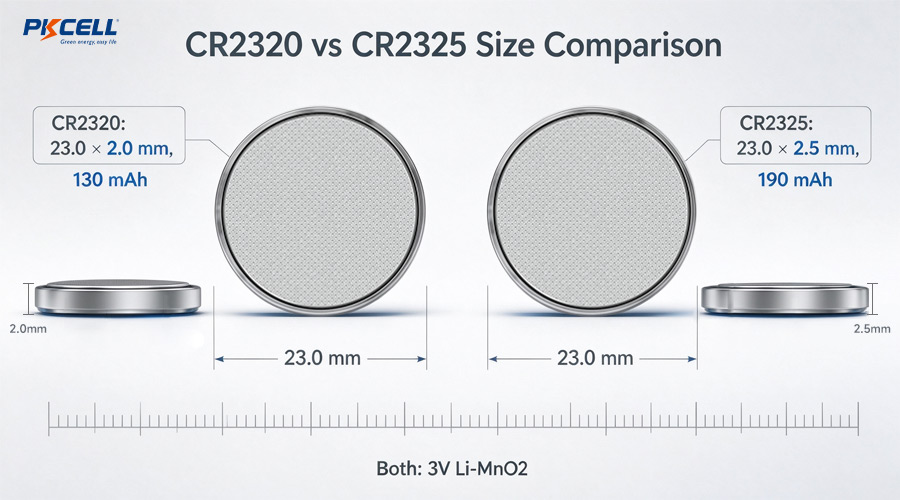
CR2320 vs CR2325 Specifications at a Glance
The model numbers provide a useful first indication of physical size. In common CR coin-cell naming, “23” indicates an approximate 23 mm diameter. The final digits indicate thickness in tenths of a millimeter: 20 means 2.0 mm, while 25 means 2.5 mm.
| Specification | CR2320 | CR2325 | Why It Matters |
|---|---|---|---|
| Chemistry | Li-MnO2 primary lithium | Li-MnO2 primary lithium | Both are non-rechargeable CR-series cells. |
| Nominal voltage | 3.0 V | 3.0 V | Voltage matches, but voltage alone does not establish compatibility. |
| Diameter | 23.0 mm | 23.0 mm | Both require a holder designed for a 23 mm coin cell. |
| Thickness | 2.0 mm | 2.5 mm | The 0.5 mm difference affects contact pressure and enclosure clearance. |
| PKCELL nominal capacity | 130 mAh | 190 mAh | CR2325 provides about 46% more nominal capacity under its specified test conditions. |
| Typical weight | 3.0 g | 3.5 g | The difference may matter in compact or weight-sensitive products. |
| PKCELL operating range | -20°C to 60°C | -20°C to 60°C | Validate the exact version for the intended environment. |
These values come from PKCELL’s standard CR2320 product specification and CR2325 product specification. Capacity is measured under defined test conditions and should not be interpreted as guaranteed runtime in every device.
The Main Difference: 0.5 mm of Thickness
The two cells occupy the same circular footprint, but the CR2325 is 25% thicker than the CR2320. That extra internal volume allows the CR2325 to contain more active material, which is why it carries a higher nominal capacity rating.
Mechanically, however, half a millimeter can be significant. Compact coin-cell holders use spring pressure, retaining clips, enclosure features, or a screw-down cover to keep the battery against its contacts. Changing the specified height can alter all of these relationships.
What can happen if a CR2320 is installed in a CR2325 holder?
- The thinner battery may not receive enough spring pressure.
- Movement or vibration may cause intermittent power.
- Oxidized or contaminated contacts may create a larger voltage drop.
- The device may reset even though the battery still has usable capacity.
What can happen if a CR2325 is installed in a CR2320 holder?
- The thicker battery may not enter the holder correctly.
- The cover may fail to close or may place stress on the housing.
- Contacts can be bent or permanently deformed.
- Excessive force may damage the battery, holder, or circuit board.
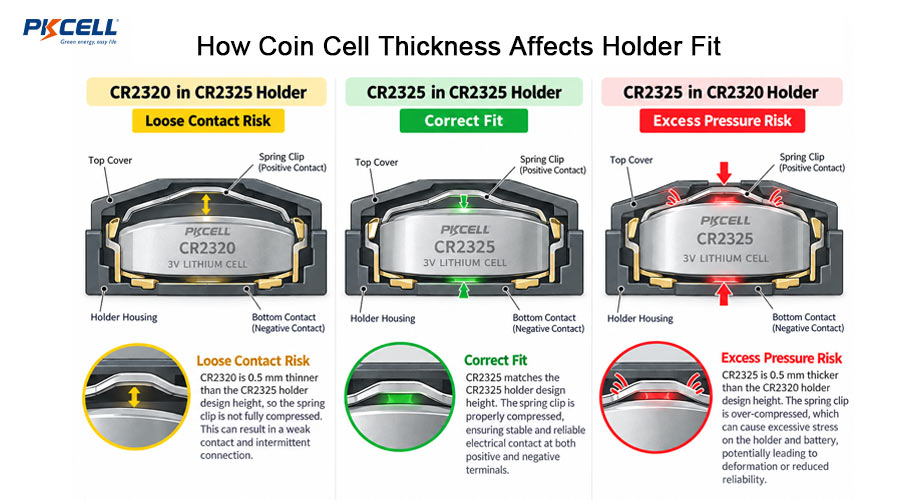
The same diameter and voltage do not make CR2320 and CR2325 automatically interchangeable. Battery height is part of the electrical and mechanical design.
CR2320 vs CR2325 Capacity and Battery Life
PKCELL lists the standard CR2320 at 130 mAh and the CR2325 at 190 mAh. On paper, the CR2325 therefore offers approximately 60 mAh, or 46%, more nominal capacity.
That difference can support a longer service interval in a device designed and validated for the CR2325. It does not mean every device will run exactly 46% longer. Usable battery life is also affected by:
- Continuous and standby current
- Peak current, pulse duration, and pulse frequency
- The device’s minimum operating voltage
- Temperature during storage and operation
- Contact resistance and holder pressure
- Battery age and storage history
- Differences in capacity test conditions
Wireless sensors, alarms, transmitters, and LED products can create brief loads that are much higher than their average current. For these applications, designers should measure loaded voltage during the complete operating event rather than selecting a cell from capacity alone.
For a wider dimensional comparison, see the PKCELL lithium coin cell size chart.
Can CR2325 Replace CR2320?
Not as a general replacement. Although both batteries provide a nominal 3 V output and share a 23 mm diameter, the CR2325 is 0.5 mm thicker. It should only replace a CR2320 when the device manufacturer explicitly allows both models or the complete holder and enclosure have been validated for both heights.
Never force the CR2325 into a compartment designed for a CR2320. Extra capacity does not justify damaging the holder, enclosure, or battery.
Can CR2320 Replace CR2325?
A CR2320 may physically enter some CR2325 compartments because it is thinner, but that does not make the substitution reliable. The reduced height can result in weak contact pressure, momentary disconnection, or unexpected resets.
The CR2320 also has less nominal capacity. Even if it appears to power the device initially, its service interval may be shorter. Follow the battery model printed in the compartment or specified in the device manual.
What Are the Correct CR2320 and CR2325 Equivalents?
Brand prefixes can differ, but a true cross-reference must preserve the same chemistry, voltage, diameter, and thickness. PKCELL lists the following model references:
CR2320 Cross-References
- DL2320
- ECR2320
- LM2320
- KCR2320
BR2320 has the same nominal dimensions but uses a different lithium chemistry. Confirm its electrical performance and device approval before treating it as a replacement.
CR2325 Cross-References
- DL2325
- ECR2325
- LM2325
- KCR2325
BR2325 may share the physical size while differing in chemistry and discharge behavior. Verify the exact datasheet and application requirements.
A similar-looking 20 mm or 24.5 mm coin cell is not a direct substitute. For example, CR2025 matches the 2.5 mm thickness of CR2325 but is only 20 mm in diameter. CR2330 shares the 23 mm diameter but is 3.0 mm thick. Always match the full model code.
For a broader replacement process, read how to choose the correct button cell battery.
How to Choose Between CR2320 and CR2325 for an OEM Design
For a new product, the decision should be based on more than maximum capacity. A thicker battery can improve the available energy budget, but only when the industrial design, holder, and operating profile support it.
1. Confirm the available battery envelope
Check the PCB footprint, vertical clearance, enclosure ribs, cover tolerance, and holder compression range. Include manufacturing tolerance and potential movement during shock or vibration.
2. Build a realistic energy budget
Document sleep current, active current, operating time per event, and event frequency. Include startup, alarms, radio transmissions, display operation, and end-of-life voltage behavior.
3. Measure pulse performance
Capacity in mAh describes stored charge under specified conditions; it does not fully describe how the cell behaves during short current peaks. Test the actual device at the expected temperature and near the end of the planned service interval.
4. Define the mounting method
A replaceable holder is appropriate when users or technicians will change the cell. PCB-mounted applications may require welded tabs, pins, wires, insulation, or a connector. Do not solder directly onto a standard loose coin cell.
PKCELL offers lithium button batteries with leads and tabs for OEM integration.
5. Validate samples before mass production
Test battery fit, contact reliability, minimum loaded voltage, temperature response, device cutoff, and target service life. Final approval should use production-representative cells, holders, PCBs, and enclosures.
Which Battery Should You Choose?
Choose CR2320 when:
- The device specifies CR2320.
- A 2.0 mm battery profile is required.
- The available energy budget fits the 130 mAh rating.
- The holder is designed for reliable CR2320 contact pressure.
Choose CR2325 when:
- The device specifies CR2325.
- The enclosure can accommodate 2.5 mm thickness.
- The application benefits from 190 mAh nominal capacity.
- The holder and cover are designed for the thicker cell.
OEM buyers can also compare other standard models through PKCELL’s lithium button cell battery selection hub.
Safe Handling and Replacement Practices
- Do not recharge CR2320 or CR2325 primary batteries.
- Do not short-circuit, crush, puncture, heat, or disassemble the cell.
- Install the battery with the polarity specified by the device.
- Do not mix different models, brands, or old and new cells in one device.
- Do not force a thicker cell into an incompatible holder.
- Keep coin cells and devices with accessible compartments away from children.
- Dispose of used cells according to applicable local battery regulations.
Frequently Asked Questions
Are CR2320 and CR2325 the same voltage?
Yes. Both are nominal 3 V lithium manganese dioxide coin cells. Their matching voltage does not eliminate the 0.5 mm thickness difference.
Which is thicker, CR2320 or CR2325?
CR2325 is thicker. It measures 2.5 mm compared with 2.0 mm for CR2320. Both have an approximate diameter of 23 mm.
Which battery has more capacity?
PKCELL rates its standard CR2325 at 190 mAh and its CR2320 at 130 mAh. The CR2325 therefore has about 46% more nominal capacity, although actual runtime depends on the device and operating conditions.
Can I use CR2325 instead of CR2320 for longer battery life?
Only if the device or holder manufacturer approves CR2325. The extra thickness can prevent proper installation or damage a CR2320 holder. Never force the battery into place.
Can I use CR2320 in a CR2325 compartment?
It is not recommended unless both models are specifically approved. The thinner CR2320 may have inadequate contact pressure and also provides less nominal capacity.
Are CR2320 and CR2325 rechargeable?
No. Standard CR2320 and CR2325 cells are primary, non-rechargeable batteries. Attempting to recharge them can create leakage, overheating, rupture, or fire hazards.
What should an OEM buyer include in an inquiry?
Provide the intended battery model, device type, available dimensions, continuous and peak current, pulse duration, temperature range, mounting method, target service life, sample quantity, annual demand, destination market, and required documentation.
Conclusion
The CR2320 and CR2325 share a 23 mm diameter, 3 V nominal output, and Li-MnO2 chemistry, but they are not identical batteries. The CR2325 is 0.5 mm thicker and offers a higher nominal capacity, while the CR2320 supports designs that require a slimmer 2.0 mm profile.
For replacement, use the exact model specified by the device manufacturer. For OEM development, evaluate the battery as part of the complete mechanical and electrical system rather than choosing by voltage or capacity alone.
Need CR2320 or CR2325 Samples?
Send PKCELL your device dimensions, load profile, operating temperature, mounting requirements, expected order volume, and destination market. The battery team can help review the model, tab or lead options, samples, and documentation for your project.
Post time: Oct-16-2026


