

CR2016 vs CR2025: Size, Capacity, Battery Life and Compatibility
CR2016 and CR2025 batteries look almost identical and both deliver a nominal 3 volts, but the 0.9 mm difference in thickness changes their capacity, runtime and physical fit. Choosing by diameter or voltage alone can lead to a loose connection, a battery cover that will not close or disappointing service life.
Quick answer: A CR2016 measures 20 mm × 1.6 mm and has a nominal capacity of 75 mAh in the PKCELL specification. A CR2025 measures 20 mm × 2.5 mm and is rated at 150 mAh. The CR2025 therefore offers about twice the rated capacity, but the two sizes should not be treated as automatic replacements. Use the exact battery model specified by the device manufacturer.
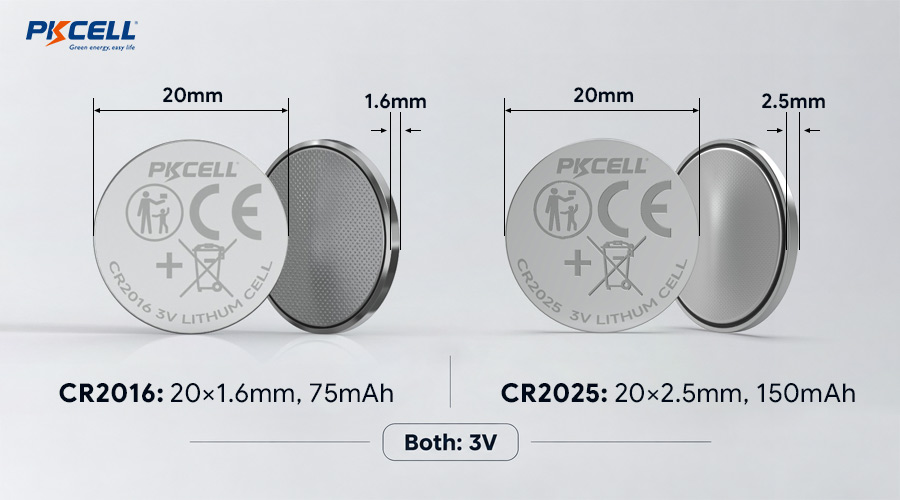
CR2016 vs CR2025: Side-by-Side Comparison
| Specification | CR2016 | CR2025 | Why It Matters |
|---|---|---|---|
| Chemistry | Lithium manganese dioxide (Li-MnO2) | Lithium manganese dioxide (Li-MnO2) | Both are primary, non-rechargeable lithium coin cells. |
| Nominal voltage | 3.0 V | 3.0 V | Voltage matches, but voltage alone does not establish compatibility. |
| Diameter | 20.0 mm | 20.0 mm | Both may sit within the same-diameter holder opening. |
| Thickness | 1.6 mm | 2.5 mm | The CR2025 is 0.9 mm thicker, which affects fit and contact pressure. |
| Nominal capacity | 75 mAh | 150 mAh | Under their specified test conditions, the CR2025 stores more charge. |
| Typical weight | 1.8 g | 2.4 g | The difference is small for replacement use but can matter in high-volume or weight-sensitive designs. |
| PKCELL operating range | -20°C to 60°C | -20°C to 60°C | Actual performance still changes with temperature and load. |
The values above come from the current PKCELL CR2016 datasheet and PKCELL CR2025 datasheet. Capacity comparisons across brands should always use the relevant manufacturer’s data because ratings can vary with test load, cutoff voltage and temperature.
What Do CR2016 and CR2025 Mean?
The names provide a useful first check. In both models, CR identifies a round lithium manganese dioxide primary battery. The first two digits indicate an approximate 20 mm diameter. The final two digits express thickness in tenths of a millimeter:
- CR2016: 20 mm diameter and 1.6 mm thickness
- CR2025: 20 mm diameter and 2.5 mm thickness
This naming logic is helpful when screening options, but it is not a substitute for checking the product drawing, holder design and device manual. Buyers comparing a wider range can browse PKCELL’s lithium button cell battery portfolio.
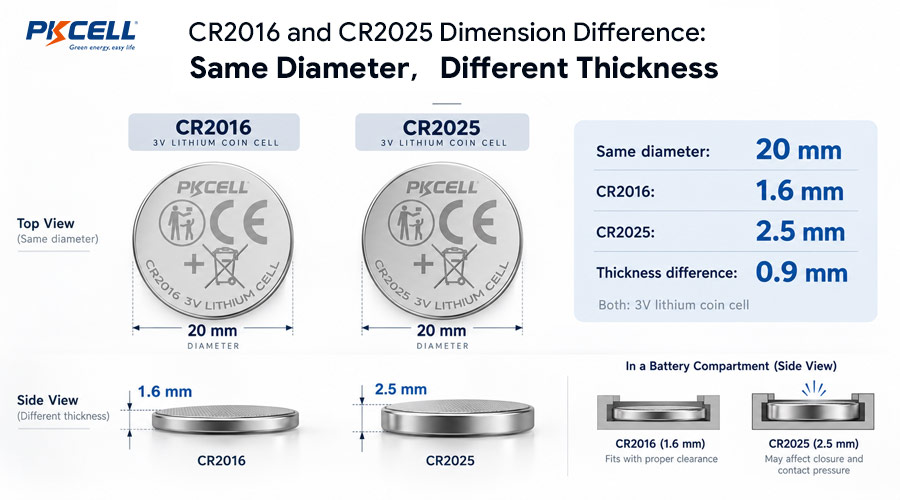
CR2016 vs CR2025 Capacity and Battery Life
For the PKCELL standard cells discussed here, the CR2025′s 150 mAh nominal capacity is twice the CR2016′s 75 mAh rating. In a suitably designed low-drain device under comparable conditions, that extra capacity can translate into a meaningfully longer replacement interval.
Capacity is an energy budget, not a guaranteed calendar-life promise. The device decides how quickly that budget is spent.
A simple runtime estimate
For early-stage planning, divide rated capacity by the device’s average current:
If a device averaged 0.01 mA continuously, the idealized calculation would be 7,500 hours for 75 mAh and 15,000 hours for 150 mAh. These are mathematical estimates, not guaranteed field results. Real runtime can be shorter because a device may stop operating before the cell reaches the datasheet cutoff voltage.
Why actual battery life varies
- Average and pulse current: A remote or wireless sensor may sleep most of the time but draw brief current pulses during transmission.
- Cutoff voltage: A device with a higher minimum operating voltage leaves more nominal capacity unused.
- Temperature: Cold or hot conditions can change electrochemical performance and voltage behavior.
- Contact resistance: Dirty, oxidized or weak holder contacts can create voltage drop and early shutdown.
- Usage pattern: Button presses, display activity, alarms and radio transmissions change the average load.
- Storage history: Time, temperature and storage conditions affect the energy available when the cell enters service.
There is another important testing detail: the two PKCELL capacity specifications do not use the same resistance. The CR2016 rating is specified at 30 kΩ, while the CR2025 rating is specified at 15 kΩ, both to a 2.0 V cutoff at 23°C ±3°C. For design validation, compare discharge curves and test samples in the actual device instead of assuming an exact 2:1 field-life ratio.
Are CR2016 and CR2025 Batteries Interchangeable?
Usually, no. They share chemistry, nominal voltage and diameter, but they do not share thickness. Mechanical fit is part of electrical compatibility.
Can CR2025 replace CR2016?
Do not assume it can. The CR2025 is 0.9 mm thicker. A compartment designed tightly around a CR2016 may not close, and forcing the cell can damage the cover, holder or contacts.
Can CR2016 replace CR2025?
It may enter the compartment, but it can sit loosely or fail to maintain reliable contact. Even if the device powers on, the lower capacity can shorten service life.
Never stack two CR2016 cells to imitate the thickness of another battery. Two 3 V cells connected in series can supply about 6 V, not 3 V, potentially damaging a device and creating a safety risk.
The practical rule is simple: read the model printed on the original battery, inspect the compartment marking and follow the device manufacturer’s instructions. Matching “20 mm” or “3 V” is not enough.
What about DL2016, ECR2016, DL2025 and ECR2025?
Brand-specific cross-reference codes can identify the same nominal size and voltage. PKCELL lists DL2016 and ECR2016 among CR2016 equivalents, and DL2025 and ECR2025 among CR2025 equivalents. Match the complete size code: a 2016 equivalent is not a 2025 equivalent. For product-specific details, see the 75 mAh CR2016 product page and the 150 mAh CR2025 coin cell.
Which Battery Is Better for Your Application?
Neither cell is universally better. The right choice depends on the mechanical envelope and the runtime target.
Choose CR2016 when…
- The device specifies CR2016.
- A 1.6 mm cell is required by a slim enclosure.
- Compact height matters more than maximum capacity.
- The expected load and service interval fit a 75 mAh nominal rating.
Choose CR2025 when…
- The device specifies CR2025.
- The holder is designed for a 2.5 mm cell.
- A 150 mAh nominal capacity supports a longer service target.
- The extra 0.9 mm thickness and weight are acceptable.
Both formats appear in compact electronics such as key fobs, watches, calculators, memory backup circuits, sensors, medical electronics and small remote controls. The exact battery varies by product design, so application category alone cannot determine the correct replacement.
OEM and Product-Design Selection Checklist
For replacement purchases, the printed model number is usually decisive. OEM selection needs a wider engineering review. Before approving a coin cell, document:
- Mechanical envelope: diameter, thickness, tolerances, insertion path and battery-cover clearance.
- Electrical load: sleep current, average current, peak current, pulse duration and pulse frequency.
- Voltage limits: device startup voltage and minimum operating voltage.
- Service target: required operating life, maintenance interval and storage time before use.
- Environment: minimum and maximum operating temperature plus humidity and vibration exposure.
- Connection method: replaceable holder, tabs, leads or pins. Do not solder directly to a standard loose coin cell.
- Compliance and logistics: required test reports, transport documents, packaging, labeling and lot traceability.
Prototype testing should reproduce the worst credible load and temperature conditions, not only a room-temperature bench test. PKCELL also offers special lithium button battery options for projects with requirements beyond a standard cell.
Need Help Choosing CR2016 or CR2025 for an OEM Project?
Share your device dimensions, operating temperature, average and peak current, annual volume, termination style and documentation needs. PKCELL’s team can review the application and prepare a tailored quotation.
Coin Cell Handling and Safety
- CR2016 and CR2025 are primary batteries. Do not recharge them.
- Install the cell with the polarity shown by the device.
- Do not short-circuit, puncture, crush, heat or disassemble the battery.
- Do not mix old and new cells or different models in a multi-cell device.
- Keep coin cells and devices with accessible battery compartments away from children.
- Dispose of used cells according to applicable local requirements.
Frequently Asked Questions
Which lasts longer, CR2016 or CR2025?
CR2025 normally lasts longer in a compatible device because the PKCELL model is rated at 150 mAh versus 75 mAh for CR2016. Actual runtime depends on load profile, cutoff voltage, temperature, contact quality and storage history.
Are CR2016 and CR2025 the same voltage?
Yes. Both have a nominal voltage of 3.0 V. They remain different battery sizes because CR2016 is 1.6 mm thick and CR2025 is 2.5 mm thick.
Will a CR2025 fit in a CR2016 holder?
Do not rely on it. The CR2025 is 0.9 mm thicker, so a holder or cover designed for CR2016 may not accommodate it. Never force the battery.
Can I use CR2016 instead of CR2025 temporarily?
It is not recommended unless the device manufacturer explicitly permits it. The thinner cell may have poor contact, and its lower capacity can reduce runtime.
Are CR2016 and CR2025 rechargeable?
No. Standard CR2016 and CR2025 cells are non-rechargeable. Replace depleted cells and never attempt to charge them.
What information should I send when requesting an OEM quote?
Provide the battery model or available dimensions, device load profile, peak current, temperature range, mounting method, required certifications, packaging, forecast volume and destination market. This helps suppliers evaluate both fit and performance.
Conclusion
The central difference in the CR2016 vs CR2025 comparison is thickness and the capacity that comes with it. Both are 20 mm, 3 V lithium manganese dioxide coin cells, but CR2016 is 1.6 mm thick with a 75 mAh nominal rating, while CR2025 is 2.5 mm thick with a 150 mAh nominal rating. CR2025 offers more energy; CR2016 fits thinner designs.
For an existing device, use the exact model specified. For a new product, validate the cell against the enclosure, load profile, voltage threshold, operating environment and required service life. You can also review PKCELL’s complete CR2016 battery guide and CR2025 technical overview before requesting samples.
Post time: Sep-09-2026


