

CR1620 vs CR1632: What’s the Difference and Are They Interchangeable?
CR1620 and CR1632 batteries share the same chemistry, 3V nominal voltage and 16 mm diameter. The important difference is thickness: CR1620 is 2.0 mm thick, while CR1632 is 3.2 mm thick. That 1.2 mm gap affects capacity, battery life and whether the cell can maintain safe, reliable contact inside a device.
Quick answer: The PKCELL CR1620 is rated at 70 mAh and measures 16.0 × 2.0 mm. The PKCELL CR1632 is rated at 120 mAh and measures 16.0 × 3.2 mm. Although both are 3V lithium coin cells, they are not generally interchangeable. A CR1632 may be too thick for a CR1620 compartment, while a CR1620 may be loose in a holder designed for CR1632.
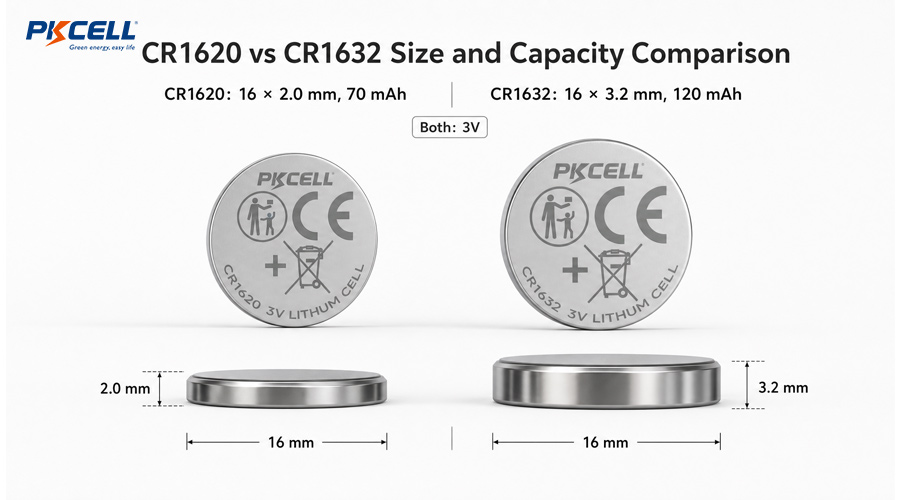
CR1620 vs CR1632 Specifications at a Glance
| Specification | CR1620 | CR1632 | Practical Impact |
|---|---|---|---|
| Chemistry | Lithium manganese dioxide (Li-MnO2) | Lithium manganese dioxide (Li-MnO2) | Both are primary, non-rechargeable lithium coin cells. |
| Nominal voltage | 3.0 V | 3.0 V | Matching voltage does not guarantee mechanical compatibility. |
| Diameter | 16.0 mm | 16.0 mm | Both have the same nominal footprint. |
| Thickness | 2.0 mm | 3.2 mm | CR1632 is 1.2 mm thicker and may not fit a CR1620 enclosure. |
| Nominal capacity | 70 mAh | 120 mAh | CR1632 has about 71% more rated capacity under the specified test conditions. |
| Normal weight | 1.6 g | 1.6 g | Use the current project datasheet when mass is design-critical. |
| PKCELL operating range | -20°C to 60°C | -20°C to 60°C | Actual performance and available capacity still vary with temperature. |
| Recommended pulse current | 10 mA | 15 mA | PKCELL’s product pages give CR1632 the higher pulse-current recommendation. |
The core technical values are based on the PKCELL CR1620 technical specification and CR1632 datasheet. For purchasing or product approval, always confirm the latest specification revision supplied with the quotation.
What Do the CR1620 and CR1632 Codes Mean?
The model codes describe chemistry, shape and nominal dimensions:
- CR: a round lithium manganese dioxide primary cell.
- 16: an approximately 16 mm diameter.
- 20: 2.0 mm thickness for CR1620.
- 32: 3.2 mm thickness for CR1632.
This makes the physical difference easy to remember: both cells are equally wide, but the CR1632 is 60% thicker. Designers comparing other sizes can review PKCELL’s broader Li-MnO2 button cell battery range.
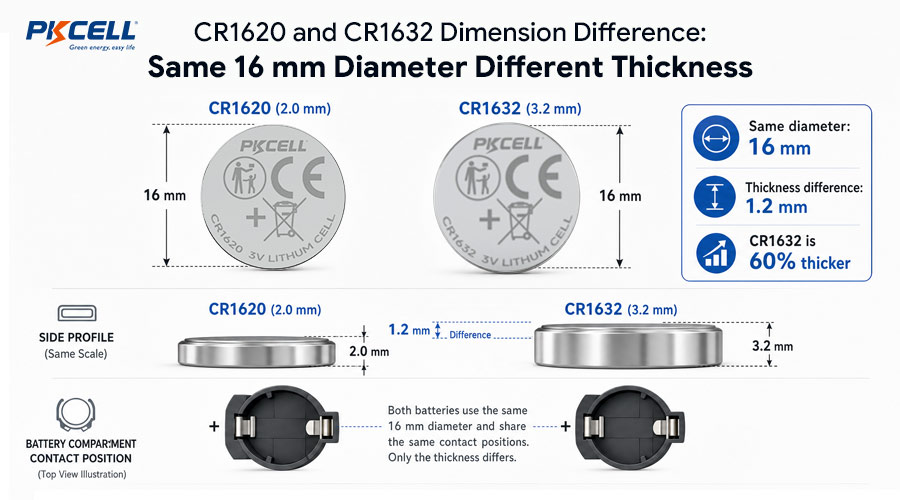
Capacity and Battery Life: How Much Longer Can CR1632 Last?
PKCELL rates CR1620 at 70 mAh and CR1632 at 120 mAh. The difference is 50 mAh, meaning CR1632 offers approximately 71% more nominal capacity. In a device engineered for CR1632, that extra active material can support a longer service interval than CR1620.
Higher capacity creates the potential for longer runtime, but it does not make a physically incompatible battery a suitable replacement.
The PKCELL datasheets provide a useful controlled comparison because both cells are specified with continuous discharge through 47 kΩ to a 2.0 V cutoff at 23°C ±3°C. Under those documented conditions, the normal discharge duration is 630 hours for CR1620 and 1,200 hours for CR1632. These laboratory figures should not be read as guaranteed runtime in a key fob, sensor or medical device.
Why real-world runtime differs
- Load profile: Constant low drain behaves differently from short radio, LED or actuator pulses.
- Device cutoff voltage: A product may shut down before the cell reaches the datasheet’s 2.0 V endpoint.
- Temperature: Cold and heat can affect available capacity, voltage response and service life.
- Contact resistance: Weak, dirty or oxidized contacts can cause voltage drop and intermittent operation.
- Usage frequency: Button presses, transmissions, alarms and displays change average energy demand.
- Storage conditions: Time and temperature before installation affect the remaining energy available in service.
For an OEM design, calculate an initial energy budget and then validate samples under the product’s peak current, minimum temperature and minimum acceptable voltage. Rated capacity alone cannot replace application testing.
Are CR1620 and CR1632 Interchangeable?
As a general replacement rule, no. Their equal voltage and diameter explain why they can look compatible, but the 1.2 mm thickness difference changes holder compression and enclosure clearance.
Can CR1632 replace CR1620?
Usually not. CR1632 is thicker, so the compartment cover may not close. Forcing it can deform contacts, damage the holder or stress the enclosure.
Can CR1620 replace CR1632?
It may enter a CR1632-size cavity, but the thinner cell can have insufficient contact pressure. It also carries less capacity, so runtime would be reduced even if the device initially powers on.
Do not bend contacts, add conductive spacers or force the battery cover. Improvised fit adjustments can create unreliable connections, short circuits or mechanical damage. Use the size printed on the original battery, battery compartment or device manual.
Are there equivalent battery codes?
Cross-reference labels from different brands may identify the same dimensional format. The PKCELL 70 mAh CR1620 product page lists codes such as DL1620 and ECR1620. A CR1632 should be replaced by another 16 × 3.2 mm model such as a correctly specified DL1632 or ECR1632 equivalent. A “1620” cross-reference is not interchangeable with a “1632” cross-reference.
Which Battery Should You Choose?
The correct battery is the one specified by the device or engineered into the product. Similar applications can use different cells depending on enclosure height, runtime goal and peak current.
Choose CR1620 when…
- The device marking specifies CR1620.
- The enclosure permits only a 2.0 mm thick cell.
- A slim profile is more important than maximum capacity.
- The load and maintenance interval suit a 70 mAh nominal rating.
Choose CR1632 when…
- The holder is designed for a 3.2 mm cell.
- The device calls for CR1632.
- A 120 mAh nominal rating better supports the service-life target.
- The application benefits from the higher recommended pulse current.
Both formats can appear in compact products such as car remotes, watches, calculators, sensors, memory backup circuits, electronic toys and medical electronics. Application type alone is not enough to choose between them. For more model-specific context, read PKCELL’s CR1620 battery guide or its CR1632 buying guide.
OEM Battery Selection Checklist
For a new device, select the coin cell as part of the complete electrical and mechanical system. Document these requirements before requesting samples:
- Mechanical fit: holder diameter, allowable thickness, tolerances, cover clearance and insertion method.
- Current profile: sleep current, average current, peak current, pulse duration and pulse frequency.
- Voltage window: startup requirement, normal operating voltage and shutdown threshold.
- Runtime target: expected service interval, duty cycle and storage period before installation.
- Environment: operating and storage temperature, humidity, shock and vibration.
- Connection format: replaceable holder, tabs, leads or pins. Standard loose coin cells should not be soldered directly.
- Supply requirements: documentation, packaging, private label, lot traceability, forecast volume and delivery destination.
Where the project needs PCB mounting or a nonstandard configuration, review PKCELL’s special lithium button battery options and confirm the termination design with the engineering team.
Need CR1620 or CR1632 Batteries for an OEM Project?
Send your device dimensions, average and peak current, temperature range, termination style, annual demand and required documentation. PKCELL can review the application and prepare a tailored quotation.
Handling and Safety Notes
- CR1620 and CR1632 are primary batteries and must not be recharged.
- Install the cell with the polarity shown by the device manufacturer.
- Do not short-circuit, heat, puncture, crush, disassemble or directly solder the battery.
- Do not mix different models or old and new cells in the same device.
- Keep loose coin cells and accessible battery compartments away from children.
- Dispose of used batteries according to applicable local requirements.
Frequently Asked Questions
What is the main difference between CR1620 and CR1632?
Thickness and capacity. Both are 16 mm, 3V lithium coin cells, but CR1620 is 2.0 mm thick and rated at 70 mAh, while CR1632 is 3.2 mm thick and rated at 120 mAh in the referenced PKCELL specifications.
Can I use a CR1632 instead of CR1620?
Not unless the device manufacturer explicitly approves it. CR1632 is 1.2 mm thicker and may prevent the cover from closing or damage the holder if forced.
Can CR1620 temporarily replace CR1632?
It is not recommended. The thinner battery may not maintain reliable electrical contact, and its lower capacity can shorten operating life.
Which battery lasts longer?
CR1632 generally lasts longer in a compatible device because it has a higher nominal capacity. Actual service life depends on current draw, pulses, temperature, cutoff voltage and contact quality.
Are CR1620 and CR1632 rechargeable?
No. Standard CR1620 and CR1632 batteries are non-rechargeable lithium primary cells. Attempting to charge them is unsafe.
What should an OEM buyer include in a quote request?
Provide the model or dimensional limits, load profile, peak current, temperature range, mounting method, certifications, packaging, annual volume and destination market.
Conclusion
CR1620 and CR1632 have the same 3V nominal voltage, Li-MnO2 chemistry and 16 mm diameter, but they serve different mechanical and energy requirements. CR1620 is the slimmer 2.0 mm option with a 70 mAh rating. CR1632 is 3.2 mm thick and offers 120 mAh, about 71% more nominal capacity.
For replacement use, follow the exact model number specified by the device. For product development, validate fit, contact force, voltage limits, pulse performance, temperature behavior and runtime in the complete device before approving the cell.
Post time: Sep-09-2026


