

CR123A vs CR17335: Size and Runtime Comparison
Comparing CR123A vs CR17335 is more complicated than comparing two completely different battery sizes. In many catalogs, CR123A is the familiar commercial name, while CR17335 is a dimensional or manufacturer-specific designation for a closely related 3 V lithium manganese dioxide cell.
However, the names are not applied identically by every manufacturer. Published cell heights, capacities, terminals, and discharge conditions can differ. Buyers should therefore compare exact datasheets rather than assume that every battery labeled CR123A or CR17335 is identical.
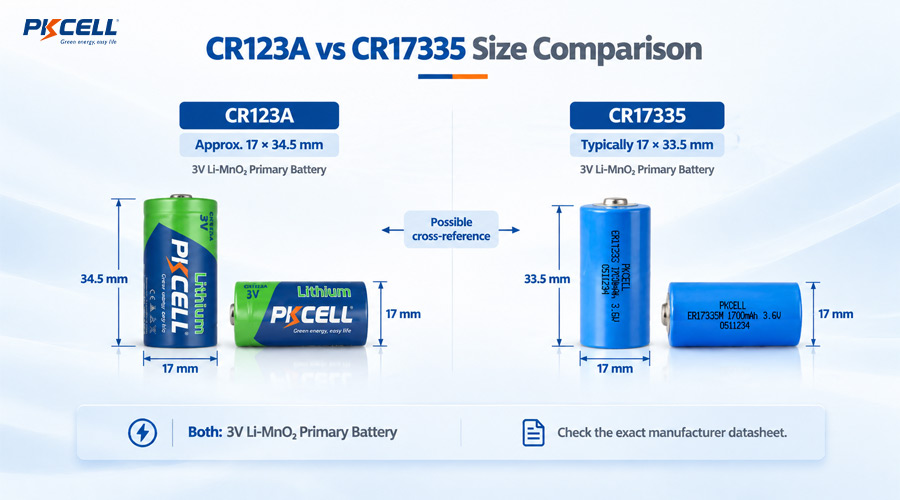
CR123A vs CR17335 Specifications
The table below compares the current PKCELL CR123A product specification with representative CR17335 specifications published by established cell manufacturers. CR17335 values vary by brand and construction, so they are shown as a reference range rather than as a universal standard.
| Specification | PKCELL CR123A | Representative CR17335 | Selection Impact |
|---|---|---|---|
| Battery system | Primary Li-MnO2 | Primary Li-MnO2 | Both are normally non-rechargeable 3 V lithium batteries. |
| Nominal voltage | 3.0 V | 3.0 V | Nominal voltage generally matches, but loaded voltage still requires testing. |
| Diameter | Approximately 17.0 mm | Typically 17.0 mm | Both use the same general cylindrical footprint. |
| Published height | Approximately 34.5 mm | Typically 33.5 mm | A 1 mm difference can affect holder pressure and enclosure clearance. |
| Model reference | CR123A / CR17345 | CR17335 / 2/3A | Model naming is not fully uniform across brands. |
| Published capacity | 1500 mAh | Commonly 1500–1650 mAh | Ratings cannot be compared fairly without checking test conditions. |
| Reference weight | Approximately 16 g | Approximately 16–17 g | Usually a minor difference, but relevant to portable equipment. |
| Terminal options | Standard cell or project-specific assembly | Standard, tabbed, pinned, or leaded versions may exist | Terminal structure must match the holder or PCB design. |
PKCELL lists its CR123A lithium manganese dioxide battery at 1500 mAh, 17 × 34.5 mm, and approximately 16 g. Its nominal capacity is specified using a 10 mA continuous discharge to a 2.0 V cutoff at 20°C ±3°C.
By comparison, published CR17335 products may use lower nominal discharge currents when establishing capacity. For example, one manufacturer may rate the cell at 5 mA while another uses a 2.5 mA standard drain. This matters because capacity obtained under a lighter test load may not predict performance under a heavier device load.
CR123A and CR17335 often describe the same battery class, but the model name alone does not guarantee identical dimensions, capacity, terminals, or high-current performance.
Why Are CR123A and CR17335 Names Different?
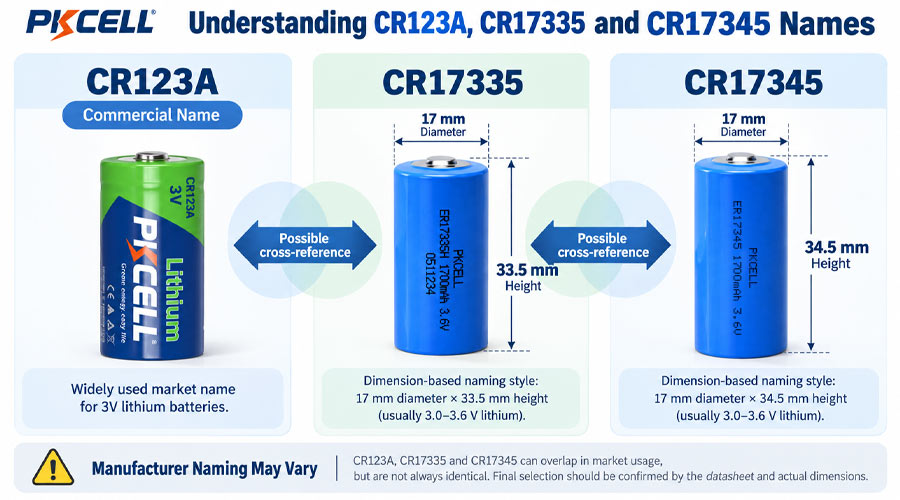
CR123A is a widely recognized commercial battery name used for cameras, security sensors, flashlights, medical electronics, and other compact 3 V products. CR17335 follows a dimensional naming convention more closely:
- CR generally identifies a cylindrical lithium manganese dioxide primary battery.
- 17 indicates an approximate 17 mm diameter.
- 335 indicates an approximate 33.5 mm height.
PKCELL also identifies its CR123A format as CR17345, reflecting its approximately 34.5 mm published height. Other brands and distributors may list CR123A and CR17335 together as equivalent references.
This variation is why purchasers should not approve a battery from the model name alone. The exact mechanical drawing and product specification take priority over a cross-reference table.
Are CR123A and CR17335 the Same Size?
They have the same general diameter and cylindrical form, but published heights can differ. A typical CR17335 specification is approximately 17.0 mm in diameter and 33.5 mm high. The current PKCELL CR123A product page lists approximately 17.0 mm in diameter and 34.5 mm high.
Some spring-loaded consumer holders may tolerate this difference, especially when the device manufacturer lists both names. That does not make every version universally interchangeable.
Check these mechanical details before replacement
- Maximum cell diameter and overall height
- Positive-terminal profile and contact area
- Flat-top or raised-top construction
- Wrapper and label thickness
- Spring compression and contact force
- Battery-cover clearance
- Tab, pin, lead, connector, and insulation dimensions
For an off-the-shelf device, follow the model specified in its manual. For an OEM product, test production-representative cells in the final holder and enclosure under vibration, shock, and temperature conditions appropriate to the application.
CR123A vs CR17335 Runtime Comparison
There is no single runtime winner based only on the two names. PKCELL rates its CR123A at 1500 mAh, while representative CR17335 specifications range from approximately 1500 to 1650 mAh. The apparent difference is relatively small and may partly reflect different discharge tests.
A higher printed capacity does not automatically mean longer runtime in the finished device. To make a valid comparison, both cells should be tested using the same:
- Continuous or average current
- Pulse magnitude, duration, and frequency
- Cutoff voltage
- Operating temperature
- Cell age and storage history
- Terminal and contact arrangement
Ideal runtime in hours = rated capacity in mAh ÷ average current in mA
| Example Average Load | Ideal Estimate From 1500 mAh | Important Limitation |
|---|---|---|
| 0.1 mA | 15,000 hours, or about 625 days | Self-discharge, pulse events, and environmental exposure become important over long periods. |
| 1 mA | 1,500 hours, or about 62.5 days | Actual capacity depends on cutoff voltage and discharge conditions. |
| 10 mA | 150 hours, or about 6.25 days | This corresponds to an ideal calculation, not guaranteed device runtime. |
| Intermittent high pulses | Cannot be predicted from average current alone | Measure minimum loaded voltage during every high-current event. |
These calculations assume the complete rated capacity is usable. Real devices usually stop sooner because the loaded voltage reaches the circuit’s cutoff, temperature reduces available energy, or pulse events cause temporary voltage drop.
Why security sensors require pulse testing
A wireless detector may spend most of its time at a very low standby current and then demand a much higher current when transmitting, sounding an alarm, or activating an indicator. Two cells with similar capacity can produce different results if their internal resistance and pulse capability differ.
For a broader analysis of this duty-cycle issue, see PKCELL’s comparison of CR123A and ER14505 for wireless sensors.
Can CR17335 Replace CR123A?
Sometimes, but only after verification. A CR17335 may replace a CR123A when the device documentation lists both designations or when the replacement matches the required dimensions, terminal structure, voltage, chemistry, discharge capability, and safety documentation.
Do not assume compatibility when:
- The battery is rigidly mounted rather than held by a spring.
- The device has very limited vertical clearance.
- The original cell uses welded tabs, pins, wires, or a connector.
- The device has high pulse-current demand.
- The product is medical, safety-related, or part of a certified system.
- The proposed replacement has not been validated at minimum temperature and end of life.
CR123A Is Not the Same as RCR123A or 16340
A standard CR123A or CR17335 is a primary, non-rechargeable 3 V Li-MnO2 battery. RCR123A and 16340 commonly identify rechargeable lithium-ion batteries that may have a nominal voltage of 3.6 or 3.7 V and a higher charging voltage.
Even when the physical size appears similar, the electrical difference can damage a device that was designed only for a primary 3 V cell. Never charge a CR123A or CR17335 primary battery, and never install a rechargeable alternative unless the device manufacturer explicitly permits it.
CR2 is another different 3 V primary battery. It is smaller and cannot directly replace CR123A. See the detailed CR123A vs CR2 comparison for dimensions and application differences.
How to Select a Battery for an OEM Project
Mechanical Validation
- Review the maximum cell dimensions.
- Confirm terminal geometry.
- Check holder compression.
- Inspect enclosure clearance.
- Approve tab or lead drawings.
Electrical Validation
- Measure sleep and active current.
- Record the complete pulse waveform.
- Define the circuit cutoff voltage.
- Test at temperature extremes.
- Verify end-of-life performance.
Information to include in a battery inquiry
- Device type and intended market
- Required model or available battery space
- Nominal and minimum operating voltage
- Standby and continuous current
- Peak current, pulse duration, and event frequency
- Operating and storage temperature
- Holder, tab, wire, or connector requirements
- Target service life
- Sample quantity and forecast annual demand
- Required certifications and transport documents
Engineers comparing other cylindrical 3 V battery formats can browse the PKCELL Li-MnO2 battery range or review the complete CR123A battery guide.
Safety and Handling
- Do not recharge a primary CR123A or CR17335 battery.
- Do not short-circuit, crush, puncture, heat, or disassemble the cell.
- Install the battery with the polarity specified by the device.
- Do not mix different models, brands, chemistries, or cell ages.
- Do not solder directly to the battery case; use an approved factory-welded termination.
- Store batteries in a cool, dry location away from conductive materials.
- Dispose of used or damaged cells according to applicable local requirements.
Frequently Asked Questions
Is CR17335 the same as CR123A?
CR17335 is often used as a dimensional or manufacturer reference for the CR123A battery family. However, exact height, capacity, terminals, and discharge specifications can differ. Confirm both the battery datasheet and device requirements.
What is the size difference between CR123A and CR17335?
A typical CR17335 is approximately 17.0 × 33.5 mm. PKCELL lists its CR123A, also referenced as CR17345, at approximately 17.0 × 34.5 mm. Manufacturing tolerances and terminal shapes must also be considered.
Which lasts longer, CR123A or CR17335?
The name alone does not determine runtime. PKCELL rates its CR123A at 1500 mAh, while published CR17335 ratings commonly range from 1500 to 1650 mAh. These figures may use different test loads, so compare discharge curves under equivalent conditions.
Can CR17335 replace CR123A in a security sensor?
Only when the sensor manufacturer permits it or the proposed cell has been validated for dimensions, voltage, pulse demand, temperature, and cutoff voltage. Wireless transmission performance should be tested in the complete sensor.
Are CR123A and CR17335 rechargeable?
No. The standard Li-MnO2 CR123A and CR17335 cells discussed here are primary batteries. Do not recharge them.
Is a 16340 battery a safe CR123A replacement?
Not automatically. A rechargeable 16340 commonly has a higher nominal and charging voltage. Use it only when the device manufacturer explicitly approves that chemistry and voltage range.
How can an OEM estimate CR123A runtime?
Start by dividing nominal capacity by average current, then refine the estimate using pulse demand, circuit cutoff voltage, temperature, contact resistance, storage time, and model-specific discharge curves. Confirm the result with device testing.
Conclusion
The most important point in the CR123A vs CR17335 comparison is that the names frequently overlap. They generally describe compact, non-rechargeable 3 V Li-MnO2 batteries in the 17 mm-diameter 2/3A family.
They should still be treated as exact manufacturer part numbers during design and procurement. A small difference in height, terminal structure, capacity test method, or pulse capability can affect fit and runtime. Review the final datasheet and validate samples in the actual device before approving a replacement or production order.
Need CR123A Samples or an OEM Battery Review?
Send PKCELL your available battery space, load profile, pulse requirements, temperature range, mounting method, target runtime, and estimated order quantity. The team can help evaluate the CR123A format, samples, terminations, packaging, and supporting documents.
Post time: Oct-16-2026


