

Canada’s 2026 Button and Coin Battery Safety Requirements: A Compliance Guide for Importers and Distributors
If you import or distribute button batteries or products containing them in Canada, checking the battery specification alone is not enough. The retail package, battery compartment, warnings and supporting evidence can all matter when assessing ingestion hazards.
This guide explains how to turn Health Canada’s published approach into a practical purchasing and product-review process. It covers batteries sold separately as well as consumer devices and toys that contain them.
Regulatory information reviewed: November 2026. This article is general information, not legal advice. Confirm the current Health Canada notice, applicable standards and product-specific obligations before placing goods on the Canadian market.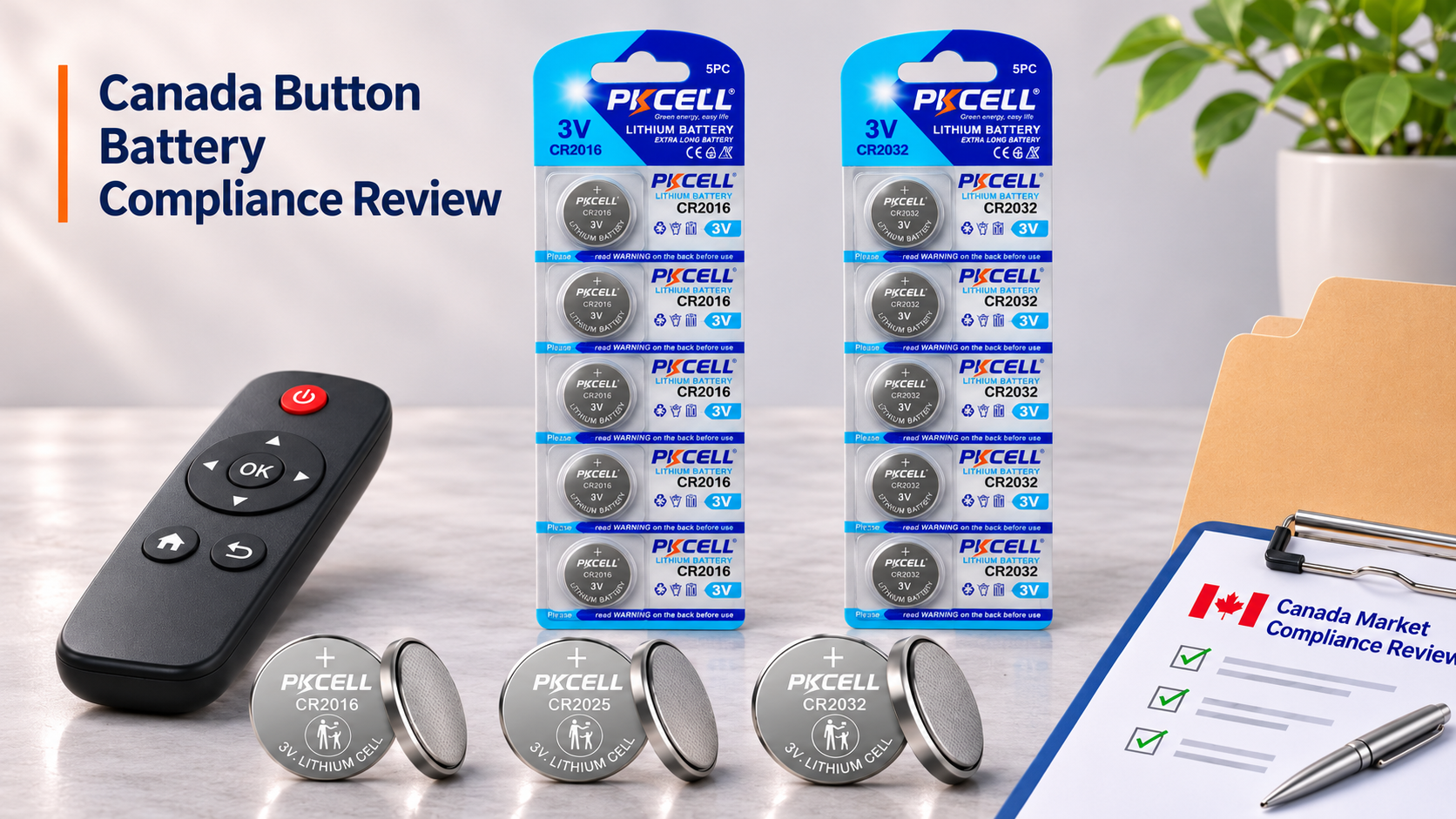 What Is Canada’s Button Battery Safety Approach in 2026?
Health Canada’s notice on button and coin batteries addresses ingestion hazards associated with consumer products containing these batteries and batteries sold alone.
The notice identifies applicable criteria in named standards, or equivalent criteria, for battery-containing products, battery packaging and labelling. Health Canada says these standards may sufficiently mitigate the ingestion hazard. It also cautions that meeting the identified criteria does not necessarily establish full compliance with the CCPSA or address every potential hazard.
Do not confuse a Health Canada safety notice with a new standalone “2026 button battery regulation.” The underlying legal prohibitions are in the CCPSA. The notice explains Health Canada’s assessment and identifies standards-based criteria relevant to the ingestion hazard. Check the notice for updates and obtain product-specific advice where needed.
The safety concern is significant: Health Canada explains that a swallowed button battery can cause severe injury, including a burn through the esophagus in as little as two hours. Even used batteries remain hazardous. See Health Canada’s button battery safety guidance.
Which Products and Standards Should You Review?
Start by mapping each SKU to the form in which it will be supplied. A battery sold in a retail pack and the same battery installed in a remote control present different review questions. Confirm scope, exclusions and the full applicable criteria in the current notice and the relevant standards.
| Product or component | Examples of criteria identified in the notice | Practical review point |
|---|---|---|
| Consumer products containing button or coin batteries, other than toys | Applicable criteria in ANSI/UL 4200A-2023, or equivalent | Assess the finished product, including access to the battery compartment and applicable performance and warning criteria. |
| Toys containing button or coin batteries | Applicable criteria in ASTM F963-23, or equivalent | Review the toy and its battery compartment against applicable criteria; check other Canadian toy requirements separately. |
| Reclosable packaging for batteries sold alone | CAN/CSA Z76.1-99 (R2003), ISO 8317:2015, or equivalent | Identify the final pack design and obtain evidence for the relevant child-resistant packaging criteria. |
| Non-reclosable packaging for batteries sold alone | CSA C22.2 No. 60086-4:19 (R2024), IEC 60086-5:2021, ISO 28862:2018, or equivalent | Select criteria relevant to the battery chemistry and packaging; verify the actual retail configuration. |
| Labelling for battery-containing consumer products or batteries sold alone | The notice lists several applicable standards, including UL 4200A, ASTM F963, CSA C22.2 No. 60086-4 and IEC 60086-5, or equivalent | Review the final battery, package, product and instruction artwork against the applicable criteria and other Canadian obligations. |
The standards listed in the labelling section of the notice are broader than the examples in this table. Do not assume that every standard applies to every SKU, or that one test report covers all requirements. Where an equivalent approach is used, retain a technical justification and evidence showing how it addresses the applicable criteria.
How to Review Child-Resistant Button Battery Packaging
For batteries sold alone, assess the packaging a Canadian consumer actually receives, not only the supplier’s bulk shipping carton. Identify whether the retail package is reclosable or non-reclosable, the battery chemistry and the relevant standard or equivalent criteria.
Check the final retail configuration
- Record the battery model, chemistry, number of cells and packaging version.
- Request test evidence that identifies the tested package and relevant criteria.
- Compare the tested sample with the proposed production pack, including materials, seals and opening method.
- Review multipacks carefully: removing one battery should not be assumed to leave the remaining batteries protected without checking the design and applicable criteria.
- Reassess the evidence when packaging materials, manufacturing processes or pack configuration change.
A supplier’s description such as “child-resistant blister” is a useful starting point, but it is not a substitute for reviewing evidence tied to the final design. The PKCELL lithium button cell range includes packaging options for B2B projects; discuss the intended Canadian retail configuration and documentation before ordering.
Battery Compartments, Warnings and Instructions
Assess the finished device
A battery supplier can provide information about the cell, but the finished-product manufacturer or importer must also evaluate the device. A compartment that looks secure may still need assessment against applicable construction and performance criteria, including after relevant testing.
For non-toy consumer products, the notice identifies applicable UL 4200A-2023 criteria or equivalent. For toys, it identifies applicable ASTM F963-23 criteria or equivalent. Obtain evidence for the actual device design and document any changes to the cover, fastener, enclosure or battery holder.
Review warnings as a complete artwork set
Check all relevant locations: the battery, retail package, product and instructions. The applicable standard determines which criteria to review for the product in question. Also assess applicable Canadian language, labelling and product-specific obligations; do not assume that U.S.-market artwork alone is sufficient.
Control artwork versions and keep approved copies with the corresponding SKU and package design. Before printing, have a qualified reviewer confirm the required wording, symbols, placement, legibility and language requirements for the product.
A Supplier Documentation Checklist for Canadian Importers
Ask for evidence early, ideally before approving a quotation or production artwork. The exact documents depend on the product and chosen compliance approach, but a useful review file may include:
- SKU identification: Battery model, chemistry, manufacturer, device model and intended Canadian sales configuration.
- Product specifications: Current datasheets and drawings for the cell, battery holder, compartment and retail packaging.
- Test evidence: Relevant reports identifying the tested design, standard and edition, test criteria, results and any limitations.
- Packaging evidence: The final pack configuration, opening method, material specifications and child-resistance test evidence where applicable.
- Label and instruction artwork: Approved versions for the Canadian market, including translations where applicable.
- Change controls: A process for notifying the importer when the cell, device, package, artwork or production site changes.
- Traceability and incident contacts: Batch or lot identification, distribution records and named contacts for investigating potential safety issues.
Match each report to the exact product and packaging being purchased. A transport test summary, datasheet or general quality certificate does not by itself demonstrate that retail packaging or a finished device meets the ingestion-hazard criteria.
Planning a Canadian coin cell project? Share your battery model, sales format, target packaging, expected quantity and documentation needs with PKCELL. Ask the team to confirm available specifications and evidence for your exact configuration.
What Importers and Distributors Should Do Before and After Launch
Before placing an order
- Classify each SKU as a battery sold alone, a battery-containing toy or another battery-containing consumer product.
- Map the applicable packaging, product and labelling criteria; check other laws relevant to the product category.
- Review representative production samples and evidence for the final Canadian configuration.
- Resolve gaps with the supplier and record who owns each corrective action.
- Approve the final artwork, specifications and version-controlled evidence before shipment.
After products enter the market
Maintain traceability, monitor complaints and safety alerts, and investigate changes or incidents promptly. Assess any applicable reporting and record-keeping duties under the CCPSA, including obligations triggered by an incident. Health Canada operates a post-market consumer product safety regime; its notice states that there is no pre-market review or approval of consumer products by Health Canada.
Health Canada may take enforcement action when it has reasonable grounds to believe a consumer product poses a danger. Possible actions include corrective measures or recall orders. An internal escalation plan helps a distributor identify affected lots and respond quickly if a problem arises.
Do Not Overlook Lithium Battery Transport
Ingestion-hazard controls and transport compliance address different risks. For lithium coin cells, confirm the applicable shipping requirements for the battery configuration, route and transport mode with your carrier or dangerous goods specialist. Transport Canada advises that lithium batteries, including those packed with or contained in equipment, must be declared to carriers and shipped in accordance with applicable Transportation of Dangerous Goods requirements.
Request relevant transport documentation for the exact cell or battery, but do not treat it as proof that the retail pack is child-resistant. Read Transport Canada’s lithium battery safety advisory and verify the current rules for your shipment.
Common Compliance Mistakes to Avoid
- Approving the cell but overlooking the device: The finished product and its compartment need their own review.
- Using a report for a different package: A change in seal, material or opening method may affect whether the evidence remains relevant.
- Assuming a U.S. label automatically covers Canada: Review Canadian requirements and the applicable standard for the actual SKU.
- Confusing transport and consumer safety evidence: Each addresses different hazards.
- Treating supplier claims as a complete compliance decision: Review the supporting documents and retain your own assessment.
For battery selection rather than regulatory review, see PKCELL’s CR2032 vs CR2450 vs CR123A selection guide. If your project needs tabs, leads or another structure, explore PKCELL’s custom battery services and confirm how the finished configuration will be assessed.
Frequently Asked Questions
Is UL 4200A automatically the only requirement for every button battery product in Canada?
No. Health Canada identifies applicable UL 4200A-2023 criteria or equivalent for battery-containing consumer products that are not toys. The notice identifies different criteria for toys, battery packaging and labelling. Other product-specific obligations may also apply.
Do CR2032 batteries sold separately need child-resistant packaging?
Health Canada’s notice identifies non-conforming packaging for button and coin batteries sold alone as posing a danger. Determine whether the final CR2032 retail pack is reclosable or non-reclosable, then assess it against applicable listed criteria or equivalent and retain supporting evidence.
Can an importer rely on the battery manufacturer’s test report for a finished device?
Not by itself. A cell report may support the battery assessment, but it does not necessarily cover the device’s compartment, performance after testing, product warnings or instructions. Obtain evidence relevant to the finished product.
Does Health Canada approve a button battery product before it is sold?
Health Canada states that its Consumer Product Safety Program operates as a post-market regime and does not conduct pre-market review or approval of consumer products. Businesses remain responsible for ensuring the products they supply comply with applicable requirements.
Conclusion: Build Compliance Into the Purchase
For Canada-bound button and coin battery products, the strongest starting point is a SKU-specific review: identify the sales configuration, select applicable criteria, verify the final package and device, and keep evidence current as designs change. This makes supplier discussions more productive and helps importers identify gaps before goods reach consumers.
Need a starting point for a lithium coin cell project? Browse the PKCELL CR2032 product page or contact PKCELL with your application, packaging and documentation requirements. Compliance of the final Canadian product must be assessed for its specific configuration.
Post time: Nov-17-2026


