

Many smart meter projects look reliable during laboratory testing. The device wakes up, measures data, sends a packet, receives a response, and returns to sleep mode quickly. Based on this controlled power profile, engineers may estimate a battery life of 8, 10, or even 15 years.
However, the same meter may behave very differently after field installation. Smart water meters, gas meters, heat meters, and other utility meters are often installed in basements, underground meter pits, pipe shafts, metal cabinets, concrete buildings, or outdoor boxes. These locations can weaken wireless signals and change how long the meter stays active during communication.
This is why signal quality is not only a communication issue. It is also a battery design issue. Poor signal can increase transmission duration, retry count, modem active time, receive window energy, and peak current stress. As a result, the real average current becomes higher than the laboratory estimate, and the battery life becomes shorter than expected.
For deep indoor smart meters, battery selection should not be based only on nominal capacity and reporting interval. Engineers must also consider signal quality, communication technology, enclosure design, antenna position, pulse current, voltage drop, low temperature, passivation, and service-life margin.
PKCELL provides LiSoCl2 ER batteries, ER Power Type cells, Hybrid Pulse Capacitor solutions, and custom ER + HPC battery packs for long-life smart meters installed in deep indoor, outdoor, weak-signal, and hard-to-maintain environments.
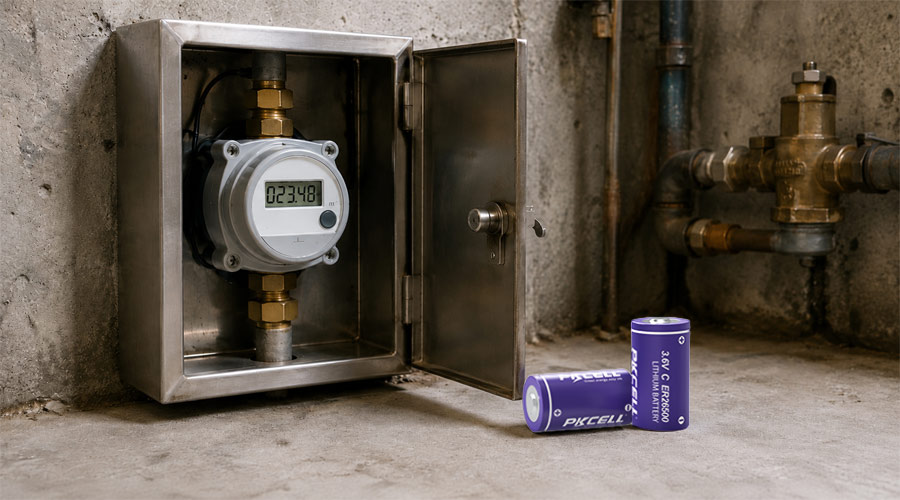
1. What Does “Deep Indoor” Mean for Smart Meters?
In smart metering, “deep indoor” usually refers to locations where wireless signals are weakened by walls, ground, metal enclosures, distance, or poor antenna placement. These installations are common in utility projects because meters are installed where pipelines, valves, and utility infrastructure are located, not where radio signals are strongest.
A meter installed in an open test room may communicate easily. A meter installed in a basement, underground chamber, or metal box may need more time and more energy to complete the same data upload.
| Deep Indoor Scenario | Why It Affects Signal Quality | Battery Design Impact |
|---|---|---|
| Basement utility room | Concrete walls and underground position weaken signal penetration | Longer communication time and more retry margin may be needed |
| Underground meter pit | Soil, water, cover materials, and depth reduce RF performance | Larger battery reserve or ER + HPC support may be required |
| Metal meter box | Metal shielding reduces antenna efficiency | Antenna design and pulse current validation become important |
| Pipe shaft or stairwell | Dense building structure and narrow installation space limit signal paths | Field testing should be done with the final enclosure |
| High-rise utility room | Distance from gateway or base station may vary by floor and building layout | Communication energy may differ across installation sites |
| Outdoor cabinet | Temperature, moisture, and enclosure materials affect both signal and battery behavior | Low-temperature and waterproof design must be considered |
| Industrial site | Equipment, metal structures, and electrical noise may interfere with communication | Higher reliability margin is needed for long-life projects |
Deep indoor environments also make it harder to rely on one battery-life estimate for all installations. A meter installed near a gateway may have a very different power profile from the same meter installed behind concrete, inside a metal box, or below ground.
2. How Signal Quality Affects Smart Meter Battery Life
Smart meter battery life is usually estimated from average current. In a simplified laboratory model, the meter stays in sleep mode for most of the time, wakes up at a fixed interval, measures data, transmits one packet, listens briefly, and then returns to sleep. Under strong signal conditions, this model can be stable and predictable.
However, deep indoor installations can change the entire communication behavior. A meter installed in a basement, underground pit, metal cabinet, or concrete utility room may need more time to complete the same data upload. The device may stay active longer, repeat transmissions, search for the network, or wait for a response before returning to sleep.
This means the reporting interval may remain the same, but the energy consumed during each reporting cycle becomes higher. In other words, weak signal does not only affect communication reliability. It directly increases battery consumption.
Core battery-life logic:
Poor Signal → Longer Communication → Higher Average Current → Shorter Battery Life
Battery Life = Usable Battery Capacity / Average Current
Average Current = Sleep Current + Metering Current + Communication Current + Retry Margin + Pulse Events
For deep indoor smart meters, the most important part of this formula is the communication current. In a strong-signal lab test, communication may take only a short time. In a weak-signal field installation, the same communication event may take much longer and may include multiple retry attempts.
| Signal-Related Factor | What Changes in the Field | Battery-Life Impact |
|---|---|---|
| Transmission duration | The meter may need more time to complete data upload when signal quality is poor. | Longer active time increases communication energy per reporting cycle. |
| Retry count | Failed or unstable communication can trigger repeated uplink attempts. | Each retry adds extra TX energy and can make real battery life shorter than the lab estimate. |
| Modem active time | NB-IoT or cellular modules may remain active longer during attach, upload, paging, or network search. | Longer modem active time increases average current and may create stronger pulse stress. |
| LoRaWAN airtime | Poor gateway coverage may require a higher spreading factor, which increases time-on-air. | Higher airtime increases energy per uplink and reduces expected battery life. |
| NB-IoT coverage behavior | Weak coverage may increase repetitions, attach time, or network search activity. | Communication energy becomes less predictable, and battery sizing needs more safety margin. |
| Voltage stress | Longer or repeated communication pulses increase the chance of voltage drop under load. | The meter may experience modem reset, MCU brownout, failed upload, or shorter practical service life. |
This is why laboratory battery-life results can be overly optimistic. A meter tested with strong signal, room temperature, ideal antenna position, and no retries may not represent a real installation in a basement, pipe shaft, underground chamber, or metal meter cabinet.
| Condition | Strong Signal Laboratory Test | Deep Indoor Field Deployment |
|---|---|---|
| Signal strength | Stable and strong | Weak, unstable, blocked, or installation-dependent |
| Transmission time | Short and predictable | Longer, variable, and affected by coverage quality |
| Retry behavior | Few retries or no retries | More retries may occur under poor coverage |
| Communication energy | Based on ideal or controlled upload behavior | Higher because of longer active time, repeated transmissions, or network search |
| Battery voltage stress | Lower pulse burden | Higher pulse duration and greater voltage drop risk |
| Estimated battery life | Often optimistic | Must include signal margin, retry margin, and field validation |
A common mistake is to calculate battery life using only the planned reporting interval. For example, a design may assume that the meter sends one packet every 6 hours or once per day. But if the real installation causes communication retries, longer uplink time, or more modem activity, the actual battery drain can be much higher than the original estimate.
For this reason, deep indoor smart meter projects should not rely on only one average-current value. Engineers should build at least three battery-life models: good signal, typical signal, and poor signal. This helps avoid unrealistic lifetime claims and provides a safer basis for selecting ER26500, ER34615, ER Power Type, or ER + HPC battery pack solutions.
3. NB-IoT Smart Meters: Why Coverage and Network Behavior Matter
NB-IoT is widely used in smart meter projects because it supports large-scale IoT deployment and improved coverage compared with many traditional cellular options. It is suitable for smart water meters, gas meters, heat meters, and other utility devices that need wide-area connectivity.
However, coverage improvement does not mean zero energy cost. In deep indoor or weak-signal locations, NB-IoT devices may need more repetitions, longer attach time, more network search activity, or extended active periods. These behaviors can significantly change the battery-life calculation.
For a battery-powered meter, the most important question is not simply whether the device can connect. The better question is: how much energy does it spend to connect, upload data, receive network response, and return to sleep?
| NB-IoT Factor | What Happens in Weak Signal | Battery Impact |
|---|---|---|
| Network attach | Device may stay active longer before registration completes | Higher energy per communication cycle |
| Data upload | Transmission may require more time or repetitions | Higher average current |
| Network search | Device may spend energy looking for service | High battery drain if repeated frequently |
| Active timer | Device may remain reachable for longer than expected | More receive/listening current |
| PSM / eDRX settings | Actual behavior may depend on network support and configuration | Lab assumptions may not match field behavior |
| Poor antenna placement | Enclosure or installation position reduces RF performance | Higher communication burden |
| Weak-signal retries | Upload failures trigger repeated communication attempts | Shorter practical battery life |
| Low temperature | Battery voltage drop becomes more visible during modem pulses | More risk of reset or failed upload |
For standard NB-IoT smart meters, ER26500 + HPC can be a practical direction when the current profile and target life fit the project. For long-life deep indoor or basement deployments, ER34615 + HPC or a custom ER + HPC battery pack may provide more reserve capacity and stronger pulse support.
The battery should be tested with the actual SIM card, antenna, enclosure, firmware, network operator, and installation environment. A strong-signal lab test is not enough for deep indoor NB-IoT smart meter approval.
4. LoRaWAN Smart Meters: Why Spreading Factor and Gateway Coverage Matter
LoRaWAN smart meters are often selected for low-power utility metering because they can operate with long sleep periods and short uplink events. But LoRaWAN battery life is strongly affected by airtime, spreading factor, payload size, confirmed messages, gateway coverage, and downlink requirements.
In good coverage, a LoRaWAN meter may transmit quickly and return to sleep mode with low energy consumption. In weak coverage, the device may use a higher spreading factor, which increases airtime. If confirmed messages are used, receive windows, acknowledgements, and retries may also increase energy consumption.
| LoRaWAN Design Factor | Battery Impact |
|---|---|
| Gateway coverage | Better coverage can reduce airtime and retransmission risk |
| Spreading factor | Higher spreading factor increases time-on-air and energy per uplink |
| Payload size | Larger payload increases transmission time |
| Confirmed uplink | Acknowledgement and retry behavior can increase RX and TX energy |
| Downlink requirement | More listening or response windows increase active time |
| Antenna placement | Poor placement may reduce link quality and increase retry risk |
| Reporting interval | More frequent reporting increases total communication energy |
| Field environment | Underground, metal, or concrete environments may require higher link margin |
LoRaWAN gateway planning is also battery planning. If the gateway layout is weak, the meter battery must compensate through longer communication events and higher retry margin. In large utility projects, gateway coverage, antenna design, and battery selection should be evaluated together.
For compact LoRaWAN meters with good signal and low reporting frequency, ER14505 or ER26500 may be considered. For utility-scale LoRaWAN smart meters with longer service-life targets, ER26500 or ER34615 is usually more realistic. If the device also includes valve control, GNSS, or high pulse loads, ER + HPC battery pack design should be evaluated.
5. Why Weak Signal Increases Pulse Current Risk
Average current determines long-term battery life, but peak current determines whether the device can complete critical events without voltage failure. Deep indoor smart meters may have both problems at the same time: higher average current from longer communication, and stronger pulse stress during modem activity, retries, or valve operation.
This is especially important for LiSoCl2 ER batteries. ER batteries are excellent for long-life, low-current applications, but pulse current, low temperature, long storage, and passivation can create voltage drop risk. If the meter electronics have a high cut-off voltage, even a temporary voltage delay may cause modem reset, MCU brownout, or failed upload.
| Weak-Signal Effect | Electrical Result | Possible Field Symptom |
|---|---|---|
| Longer modem active time | More energy per reporting cycle | Battery life shorter than calculated |
| More retries | Repeated pulse events | Unexpected battery drain |
| Higher communication stress | Deeper voltage drop | Modem reset or upload failure |
| Poor antenna position | Unstable link quality | Intermittent connection |
| Low temperature plus weak signal | Higher internal resistance and longer pulse stress | Startup failure or brownout |
| Long storage before installation | Passivation may be more visible at first pulse | First upload failure after installation |
| Valve plus communication event | Multiple pulse loads in one cycle | Valve failure or device reset |
This is where ER + HPC becomes important. In an ER + HPC battery pack, the ER LiSoCl2 cell provides long-term energy, while the Hybrid Pulse Capacitor helps support short high-current events. For NB-IoT meters, valve-control meters, weak-signal installations, or cold environments, this architecture can help reduce voltage drop risk during demanding communication or actuation events.
6. Smart Meter Battery Chemistry for Deep Indoor Applications
Deep indoor smart meter batteries must support long service life, low self-discharge, stable voltage, and reliable operation in hard-to-maintain locations. LiSoCl2 ER batteries are commonly used because they provide high energy density and long shelf life for low-current utility metering applications.
However, not all LiSoCl2 solutions are the same. Engineers should distinguish between energy-type ER cells, power-type ER cells, and ER + HPC battery packs.
| Battery Direction | Best Fit | Design Notes |
|---|---|---|
| ER14505 | Compact meter, low reporting frequency, good signal | Best when space is limited and current demand is low |
| ER26500 | Standard smart meter, balanced size and capacity | Suitable for many AMR, AMI, LoRaWAN, and utility meter projects |
| ER34615 | Long-life utility meter, weak signal, outdoor or deep indoor reserve | Better when larger capacity and longer service margin are needed |
| ER26500M / ER34615M | Higher pulse demand | Suitable when stronger pulse capability is needed than standard energy-type cells |
| ER + HPC battery pack | NB-IoT, valve control, weak signal, high-pulse communication | Helps support pulse current while maintaining long-life energy storage |
| Custom primary lithium pack | Special connector, wire, waterproof housing, multiple cells, or certification needs | Best for OEM projects with mechanical or electrical integration requirements |
For deep indoor smart meters, ER26500 and ER34615 are often the most relevant starting points. ER26500 provides a balanced capacity and size for standard meters, while ER34615 provides a larger energy reserve for long-life, weak-signal, or more demanding deployments. When the communication pulse is high or the installation is risky, ER + HPC may be more appropriate than simply increasing battery capacity.
7. Battery Life Calculation Must Include Signal Quality
A smart meter battery calculation should include the full reporting cycle. This means sleep current, metering current, MCU current, transmission current, receive/listening current, network attach energy, retry margin, valve actuation, temperature derating, self-discharge, cut-off voltage, and storage time.
For deep indoor smart meters, the communication part of the calculation should not be treated as a fixed number. The same meter may have different energy consumption depending on whether it is installed in a strong-signal, moderate-signal, or weak-signal environment.
| Signal Condition | Communication Behavior | Battery Design Recommendation |
|---|---|---|
| Good signal | Short upload time, low retry count, stable connection | Standard capacity estimate may be acceptable with normal derating |
| Moderate signal | Longer communication time, occasional retries | Add communication margin and validate in field-like conditions |
| Weak signal | Longer attach/upload, more retries, higher active time | Use larger capacity, stronger pulse support, and real network testing |
| Deep indoor / basement | Signal may vary by building, cabinet, or meter position | Consider ER34615, ER Power Type, or ER + HPC depending on load profile |
| Underground / metal cabinet | Severe attenuation and antenna constraints | Test with final enclosure and installation structure before approval |
A single average-current value is not enough for large deployments. Utility projects should define at least three battery-life models: good signal, typical signal, and poor signal. This helps prevent overly optimistic lifetime claims and gives engineers a more realistic basis for battery selection.
8. Design Strategies to Reduce Battery Drain in Weak Signal Areas
Battery life can be improved not only by selecting a larger battery, but also by reducing communication energy. A well-designed deep indoor smart meter should optimize the antenna, enclosure, reporting strategy, communication parameters, and battery pack together.
Antenna placement is one of the first areas to check. A poor antenna position inside a metal or wet enclosure can turn a good battery design into a poor field performer. The antenna should be tested with the final housing, final battery position, final PCB layout, and final installation orientation.
Reporting interval also matters. Sending data too frequently can shorten battery life, especially when signal quality is poor. For utility meters, unnecessary frequent reporting should be avoided unless it is required by the application. Data batching and event-based reporting may help reduce total communication events, but they must be designed carefully to avoid excessive retry behavior.
For NB-IoT meters, PSM and eDRX settings should be validated with the actual operator network. Requested timers may not always behave exactly as expected, and long active time can add hidden energy consumption. For LoRaWAN meters, gateway coverage, spreading factor, confirmed uplink strategy, payload size, and ADR settings should be reviewed together.
| Optimization Area | Practical Action | Expected Battery Benefit |
|---|---|---|
| Antenna design | Test antenna position with final enclosure and installation structure | Reduces retry risk and improves communication efficiency |
| Enclosure design | Avoid unnecessary metal shielding around antenna where possible | Improves link quality and reduces active communication time |
| Reporting interval | Reduce unnecessary transmissions and batch data where suitable | Lowers total communication energy |
| NB-IoT settings | Validate PSM, eDRX, active timer, and attach behavior in real network | Reduces standby and active-mode energy waste |
| LoRaWAN planning | Improve gateway coverage and avoid unnecessary confirmed uplinks | Reduces airtime, downlink listening, and retries |
| Battery pack design | Use suitable ER cell, ER Power Type, or ER + HPC depending on pulse risk | Improves voltage stability during communication |
| Low-temperature validation | Test communication and pulse events at minimum operating temperature | Reduces field failure risk |
| Storage control | Consider long storage before activation and first-start behavior | Reduces unexpected initial voltage delay problems |
In many projects, the best solution is not one single change. It is a combined design approach: better RF planning, realistic power profiling, sufficient battery reserve, pulse support, and field validation.
9. Testing Checklist for Deep Indoor Smart Meter Battery Design
Deep indoor battery validation must go beyond capacity testing. A battery that performs well in a room-temperature laboratory may still fail in a basement, metal cabinet, or underground meter chamber. The test plan should include electrical behavior, communication behavior, environmental conditions, and pack-level integration.
| Test Category | What to Test | Why It Matters |
|---|---|---|
| Signal test | RSSI, RSRP, RSRQ, SNR, gateway distance, antenna orientation | Confirms whether the communication environment matches the battery-life model |
| Communication test | Real NB-IoT attach, upload duration, LoRaWAN uplink, downlink, retry count | Measures actual energy per reporting cycle |
| Electrical test | Sleep current, active current, TX pulse current, RX/listening current | Defines the real current profile |
| Voltage test | Minimum voltage during communication, voltage recovery, brownout threshold | Identifies reset or failed upload risk |
| Environmental test | Low temperature, high temperature, humidity, temperature cycling | Verifies battery and device behavior under field conditions |
| Enclosure test | Metal box, waterproof housing, underground installation, final antenna placement | Shows how the final product structure affects signal and battery drain |
| Storage test | Long storage first-start test and passivation-sensitive pulse behavior | Reduces risk of first activation failure |
| End-of-life test | Communication and valve operation at simulated low battery voltage | Confirms the meter still works near the end of service life |
| Pack-level test | Connector, wire resistance, tab welding, insulation, vibration | Ensures the battery pack does not add avoidable voltage drop |
The most important principle is to test with the real system. This means real firmware, real meter enclosure, real antenna, real SIM or network configuration, real valve or sensor load, and realistic field conditions. Spreadsheet calculations are useful, but they cannot replace real current and voltage measurements.
10. Battery Selection Matrix for Deep Indoor Smart Meters
The following matrix can be used as an early selection guide. Final battery approval should always be based on the actual current profile, installation environment, communication behavior, and target service life.
| Project Condition | Recommended Battery Direction | Reason |
|---|---|---|
| Good signal, compact meter | ER14505 | Compact size and suitable for low-power designs |
| Standard signal, standard smart meter | ER26500 | Balanced capacity, size, and cost |
| Long-life utility meter | ER34615 | Higher capacity and stronger energy reserve |
| Weak signal with NB-IoT | ER26500 + HPC or ER34615 + HPC | Supports communication pulse and retry margin |
| Deep indoor or basement deployment | ER34615 or custom ER + HPC | Provides reserve capacity and stronger field margin |
| Valve-control meter | ER + HPC battery pack | Helps support motor pulse current and communication pulse |
| Low-temperature weak-signal meter | ER34615 + HPC with validation | Reduces voltage drop risk under cold pulse load |
| High retry or high TX current | ER Power Type or ER + HPC | Improves pulse capability |
| Custom connector or waterproof housing | Custom primary lithium battery pack | Supports OEM mechanical and electrical integration |
This table should not be used as a replacement for testing. It is a decision framework for early design discussion. The final recommendation should be made after checking signal quality data, power profile, cut-off voltage, battery compartment size, and target lifetime.
11. Recommended PKCELL Battery Solutions
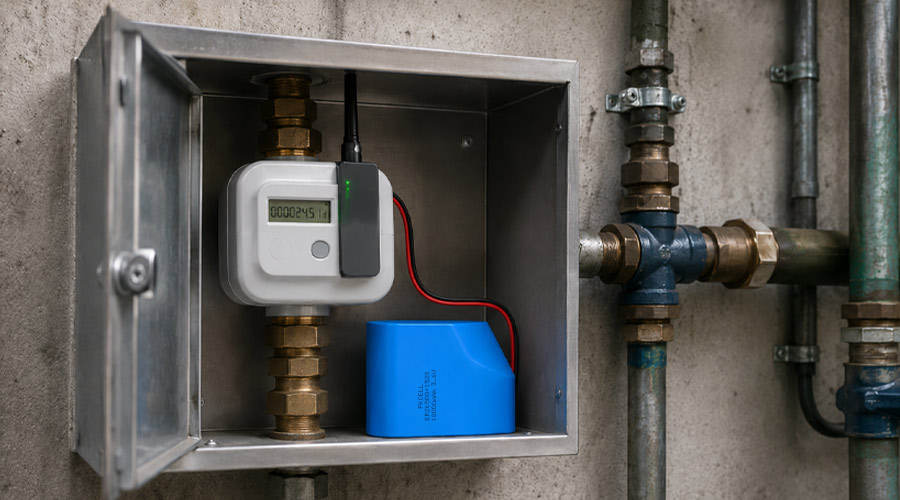
PKCELL offers several battery directions for smart meter projects installed in weak-signal or deep indoor locations. The right choice depends on whether the main design challenge is capacity, pulse current, mechanical space, low temperature, communication technology, or custom integration.
ER26500 for Standard Smart Meter Projects
ER26500 LiSoCl2 battery is suitable for standard smart water meters, gas meters, AMR/AMI devices, and utility meters that need a practical balance between capacity and size. It is often a good starting point when the installation environment is not extremely severe and the communication profile is moderate.
ER34615 for Long-Life and Weak-Signal Deployments
ER34615 LiSoCl2 battery is suitable for long-life utility meter projects that require larger reserve capacity. It is especially relevant for outdoor meters, deep indoor meters, basement gas meters, and deployments where field replacement is expensive. The ER34615 Smart Meter Battery page can be used as a related solution reference.
ER26500M / ER34615M for Higher Pulse Demand
For smart meters with stronger communication pulse demand, ER26500M and ER Power Type cells may be considered. These are more suitable when the application requires stronger pulse capability than standard energy-type ER cells.
ER + HPC Battery Packs for NB-IoT and Deep Indoor Meters
For NB-IoT meters, valve-control meters, weak-signal installations, or low-temperature deployments, ER + HPC IoT battery packs and Hybrid Pulse Capacitor solutions can help support short high-current events. This is especially useful when the meter must complete data transmission or valve actuation reliably even under poor coverage or low-temperature conditions.
| PKCELL Solution | Best Application | Related Page |
|---|---|---|
| LiSoCl2 ER Energy Type | Long-life low-current meters | LiSoCl2 ER Energy Type |
| ER Power Type | Higher pulse smart meter designs | LiSoCl2 ER Power Type |
| ER26500 | Standard smart meters | ER26500 Battery |
| ER34615 | Long-life utility meters | ER34615 Battery |
| ER + HPC Pack | NB-IoT, valve control, weak signal | IoT Battery Pack ER + HPC |
| Custom Primary Lithium Pack | Wires, connectors, housing, multi-cell design | Primary Lithium Battery Packs |
12. What Information Should You Provide to a Battery Supplier?
A battery supplier cannot make an accurate recommendation from voltage and capacity alone. For deep indoor smart meter projects, signal quality and communication behavior are just as important as battery capacity.
| Required Information | Why It Matters |
|---|---|
| Meter type | Water meter, gas meter, heat meter, or other utility device affects load profile |
| Installation environment | Basement, underground pit, metal cabinet, outdoor box, or indoor room affects signal and temperature |
| Communication technology | NB-IoT, LoRaWAN, AMR, RF, LTE-M, or other technology determines communication load |
| Reporting interval | Determines how often the meter consumes communication energy |
| Signal quality data | RSSI, RSRP, RSRQ, SNR, gateway distance, or field test data helps estimate retry margin |
| Sleep current | Determines baseline long-term consumption |
| TX and RX current | Determines communication energy per cycle |
| Network attach duration | Especially important for NB-IoT and cellular devices |
| Retry count | Shows how much extra energy is consumed in weak signal |
| Valve current | Required for valve-control meters |
| Minimum operating voltage | Determines usable battery capacity and voltage drop tolerance |
| Operating temperature | Low temperature affects pulse capability and usable capacity |
| Storage time before installation | Long storage can affect first-start behavior and passivation risk |
| Target service life | Determines required capacity and derating margin |
| Battery compartment size | Limits whether ER14505, ER26500, ER34615, or a custom pack can fit |
| Connector and wire requirement | Affects pack design and resistance |
| Certification requirement | Helps define project documentation and compliance needs |
| Annual volume and sample plan | Supports production planning and validation schedule |
Once this information is available, PKCELL can help evaluate whether the project is better suited for an ER14505, ER26500, ER34615, ER Power Type cell, or a custom ER + HPC battery pack.
13. FAQs About Deep Indoor Smart Meter Batteries
Conclusion: Signal Quality Should Be Part of Battery Design
Smart meter battery design should not be based only on nominal capacity and reporting interval. In deep indoor or weak-signal environments, communication behavior can become one of the main factors that determines real battery life.
A smart meter installed in a strong-signal laboratory may complete communication quickly and return to sleep with low energy consumption. The same meter installed in a basement, underground pit, metal cabinet, or pipe shaft may need longer transmission time, more retries, and stronger pulse support. This increases average current and can shorten service life.
For deep indoor utility deployments, engineers should include signal margin in the battery calculation, validate real communication behavior, and test with the final enclosure and antenna design. ER26500 and ER34615 are common LiSoCl2 options for smart meters, while ER Power Type cells or ER + HPC battery packs should be considered for high-pulse, weak-signal, valve-control, or low-temperature applications.
PKCELL provides LiSoCl2 ER batteries, ER Power Type cells, Hybrid Pulse Capacitor solutions, and custom ER + HPC battery packs for smart meters installed in deep indoor, outdoor, weak-signal, and hard-to-maintain environments.
Post time: Jul-22-2026


