

ER26500 vs ER26500M: Specifications, Differences and Selection Guide
ER26500 and ER26500M are both C-size, 3.6V lithium thionyl chloride primary batteries. They have similar external dimensions, but they are designed for different electrical loads.
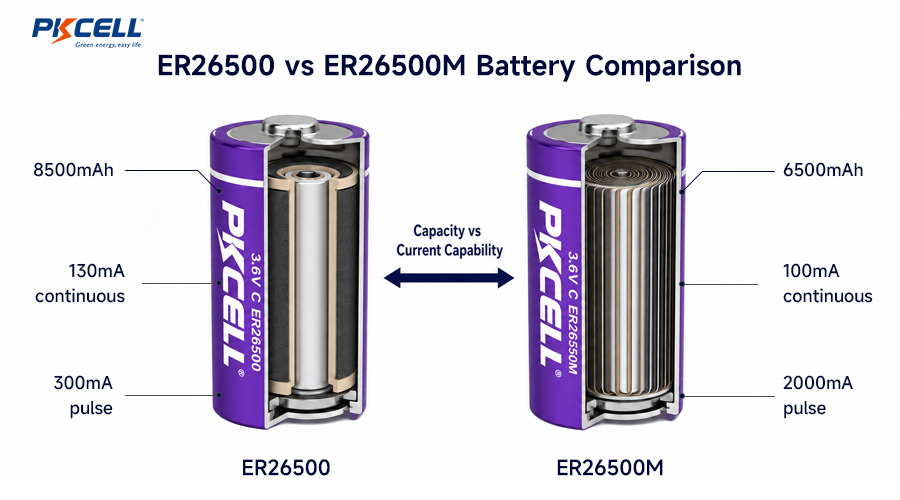
The standard ER26500 battery prioritizes nominal capacity and long-term energy for low-rate discharge. The ER26500M battery uses a power-type construction that sacrifices some capacity to provide substantially stronger continuous and pulse-current capability.
Selecting between them requires more than checking whether the cell fits the battery compartment. Engineers should compare average current, peak current, pulse duration, cutoff voltage, operating temperature and required service life.
Quick Answer: What Is the Difference Between ER26500 and ER26500M?
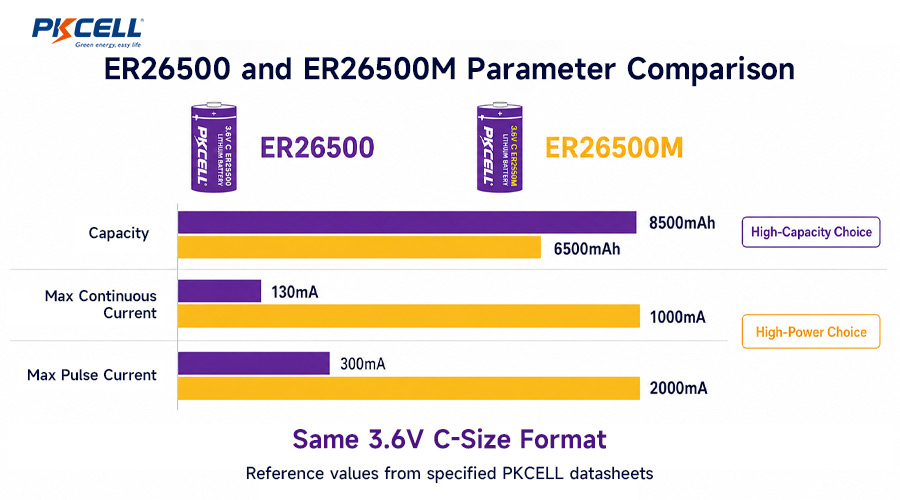
ER26500: 8500mAh reference capacity, 130mA maximum continuous current and 300mA maximum pulse current.
ER26500M: 6500mAh reference capacity, 1000mA maximum continuous current and 2000mA maximum pulse current.
Choose ER26500: When long-term energy matters more than direct high-current performance.
Choose ER26500M: When the device needs stronger current and accepts a lower nominal capacity.
ER26500 vs ER26500M Comparison Table
| Parameter | ER26500 | ER26500M | What the Difference Means |
|---|---|---|---|
| Chemistry | LiSOCl2 primary lithium | LiSOCl2 primary lithium | Both are non-rechargeable 3.6V cells |
| Construction focus | High-capacity bobbin type | High-power spiral type | Internal construction produces different discharge behavior |
| Rated voltage | 3.6V | 3.6V | Voltage alone cannot determine interchangeability |
| Reference capacity | 8500mAh | 6500mAh | ER26500 provides a larger nominal energy reserve |
| Capacity test condition | 3mA to 2.0V at 23 ± 2°C | 10mA to 2.0V at 23 ± 2°C | Ratings use different discharge conditions |
| Maximum continuous discharge | 130mA | 1000mA | ER26500M supports a much stronger continuous load |
| Maximum pulse discharge | 300mA | 2000mA | ER26500M is more suitable for direct high-power pulses |
| Operating temperature | -55°C to +85°C | -55°C to +85°C | Actual capacity and voltage still vary with temperature |
| Approximate dimensions | 26.2 × 50.5mm | 26.2 × 50.5mm | Similar dimensions do not mean identical performance |
| Approximate weight | About 55g | About 55g | Confirm pack weight after adding wires or connectors |
| Reference storage life | 10 years at room temperature | 10 years at room temperature | Storage life is not the same as operating life |
| Typical load pattern | Low continuous current over a long duration | Higher continuous current or stronger pulses | Select according to the complete load profile |
ER26500 and ER26500M Product Parameters
ER26500 High-Capacity Battery
Bobbin type
8500mAh
Low-rate discharge
The standard ER26500 is optimized to store more energy in a C-size format. It is most relevant when the device remains in a low-power state for most of its operating life.
- Rated voltage: 3.6V
- Reference capacity: 8500mAh
- Capacity condition: 3mA discharge to 2.0V at 23 ± 2°C
- Maximum continuous current: 130mA
- Maximum pulse current: 300mA
- Temperature range: -55°C to +85°C
- Available terminations: Standard, solder tabs and axial pins
Potential fit: Utility meters, low-power sensors, data loggers, memory backup, remote monitoring and standby systems.
ER26500M High-Power Battery
Power type
6500mAh
Higher current
ER26500M uses a power-oriented construction. It provides less nominal capacity than the standard version but offers substantially stronger direct continuous and pulse-current capability.
- Rated voltage: 3.6V
- Reference capacity: 6500mAh
- Capacity condition: 10mA discharge to 2.0V at 23 ± 2°C
- Maximum continuous current: 1000mA
- Maximum pulse current: 2000mA
- Temperature range: -55°C to +85°C
- Available terminations: Standard, solder tabs and axial pins
Potential fit: Tracking devices, alarms, actuators, wireless transmitters and industrial electronics with stronger current events.
Five Key Differences Between ER26500 and ER26500M
1. Energy Capacity
The referenced standard ER26500 provides 8500mAh, compared with 6500mAh for ER26500M. Under an appropriate low-rate load, the standard version offers more nominal energy for long-duration operation.
2. Continuous Current Capability
ER26500M has a much higher maximum continuous-current rating. This can make it more appropriate when the electronics draw more than a low-power bobbin cell should supply directly.
3. Pulse-Current Capability
ER26500M is better suited to stronger short-duration loads. However, the actual minimum voltage during a pulse depends on temperature, storage history, state of discharge, wiring resistance and pulse duration.
4. Internal Construction
Standard ER26500 uses a bobbin construction focused on high capacity and low-rate discharge. ER26500M uses a power-oriented spiral construction with more electrode surface area for stronger current delivery.
5. Expected Application Fit
ER26500 is generally more appropriate for low-power meters and sensors. ER26500M is more relevant when the device has a stronger radio, alarm, actuator or other current-demanding function.
ER26500M is not an upgraded version that is automatically better. It exchanges part of the nominal capacity for stronger current capability.
Application Comparison
Smart Water and Gas Meters
A low-power meter with infrequent transmissions may use standard ER26500. A meter with stronger communication pulses may require ER26500M or an ER26500 with HPC.
NB-IoT and LTE-M Devices
Cellular modules can create short higher-current events during connection and transmission. Evaluate ER26500M or an ER + HPC architecture using measured pulse data.
LoRaWAN Sensors
Standard ER26500 may suit a low-duty-cycle LoRaWAN sensor. GNSS use, transmission power and message retries may increase the need for pulse support.
GPS Asset Trackers
GNSS acquisition and cellular reporting can create stronger loads. ER26500M may suit direct power, while ER26500 plus HPC can combine stored energy with pulse support.
Wireless Alarms
Standard ER26500 can support long standby periods, but alarm transmission, sirens or actuators may require a power-type cell or auxiliary pulse component.
Smart Valves
Valve startup and movement current should be measured separately. ER26500M may be more appropriate when the motor load must be supplied directly.
Industrial Data Loggers
Standard ER26500 is a strong starting point when the device collects data at low power and transmits infrequently.
Remote Monitoring
Choose according to sensor warm-up, radio activity, alarm behavior, temperature and the cost of field battery replacement.
ER26500 or ER26500M Selection Guide
Choose Standard ER26500 When:
- The device prioritizes the largest possible energy reserve.
- Average and continuous current are relatively low.
- Pulses remain within the verified capability of the cell.
- The device spends most of its time in sleep or standby.
- Long service intervals are more important than direct high-current output.
Choose ER26500M When:
- The device has a stronger continuous load.
- The radio, alarm or actuator creates higher-current events.
- Direct pulse delivery is more important than maximum nominal capacity.
- The device must maintain a higher minimum voltage during load events.
- The lower 6500mAh reference capacity still meets the energy budget.
Step-by-Step Engineering Process
- Confirm voltage compatibility. Review nominal voltage, maximum voltage and device cutoff voltage.
- Measure continuous current. Include all electronics active during sleep and normal operation.
- Capture the largest pulse. Measure current, duration and minimum voltage at the battery terminals.
- Calculate total energy demand. Include continuous consumption, transmissions, retries, alarms and actuators.
- Review temperature conditions. Test pulse voltage and usable capacity at expected temperature extremes.
- Evaluate storage history. Long or warm storage can affect passivation and initial voltage response.
- Select the preliminary architecture. Compare ER26500, ER26500M and ER26500 with HPC.
- Test the complete device. Validate communication, startup, recovery and representative end-of-life conditions.
When ER26500 with HPC May Be Better Than ER26500M
ER26500M is not the only way to address a higher pulse current. When a device has very low average consumption but produces short, strong pulses, a standard ER26500 combined with a hybrid pulse capacitor may provide a better balance between stored energy and pulse support.
| Load Pattern | Potential Starting Point | Reason |
|---|---|---|
| Low continuous current and small pulses | Standard ER26500 | Prioritizes nominal capacity |
| Higher continuous current | ER26500M | Stronger direct discharge capability |
| Low average current with short wireless pulses | ER26500 + HPC | Combines stored energy with pulse support |
| Higher current plus frequent long events | Reassess the full power architecture | A different cell, larger pack or rechargeable system may be required |
ER + HPC designs are particularly relevant to NB-IoT, LTE-M, LoRaWAN, GNSS and smart-meter devices that remain asleep for long periods and wake briefly to transmit data.
Passivation and Voltage Delay
LiSOCl2 batteries naturally develop a passivation layer during storage. This layer contributes to low self-discharge, but it can also cause a temporary voltage delay when a load is first applied.
Passivation behavior depends on storage duration, storage temperature, cell construction, load current and operating temperature. It should not be evaluated from open-circuit voltage alone.
Prototype testing should record:
- Minimum voltage during startup or transmission
- Time required for voltage recovery
- Repeated-pulse behavior
- Performance after representative storage
- Low-temperature voltage response
- Behavior near the expected end of service
Termination and Battery Pack Options
Both models can be supplied with standard terminals, solder tabs or axial pins. OEM battery packs may also include:
- Lead wires and custom cable lengths
- Application-specific connectors
- Series or parallel cell configurations
- Insulation, sleeves and labels
- Mechanical housings and mounting components
- HPC pulse-support components
- Environmental sealing for the complete assembly
Common Selection Mistakes
- Choosing ER26500M because the model name looks newer: The M version serves a different current profile.
- Using ER26500 capacity with ER26500M current ratings: The values belong to different cell constructions.
- Treating maximum current as recommended current: Reliable design requires margin and pulse-voltage testing.
- Ignoring capacity test conditions: Rated capacity changes with load, temperature and cutoff voltage.
- Selecting from open-circuit voltage: Open-circuit voltage does not prove that the cell can support the device load.
- Ignoring passivation: Storage history can affect initial voltage response.
- Recharging either model: ER26500 and ER26500M are primary cells and must not be charged.
Need Help Choosing ER26500 or ER26500M?
Send PKCELL your continuous current, pulse current, pulse duration, cutoff voltage, operating temperature, target service life and mechanical requirements. The engineering team can evaluate standard ER26500, ER26500M or ER26500 with HPC.
Frequently Asked Questions
What does the M mean in ER26500M?
The M identifies a power-type version designed for stronger continuous and pulse-current delivery. It is not simply a higher-capacity version of ER26500.
Which has more capacity, ER26500 or ER26500M?
In the referenced PKCELL specifications, ER26500 is rated at 8500mAh, while ER26500M is rated at 6500mAh. The exact capacity must be confirmed from the applicable datasheet.
Which battery has higher pulse current?
The referenced ER26500M has a much higher maximum pulse-current rating than the standard ER26500. Actual pulse suitability still depends on duration, temperature, battery age and device cutoff voltage.
Can I replace ER26500 with ER26500M?
The similar voltage and dimensions may allow mechanical compatibility, but electrical performance and runtime will change. Recalculate the energy budget and validate the device before substitution.
When should I use ER26500 with an HPC?
Consider ER26500 with HPC when the device has low average consumption but produces short higher-current pulses during NB-IoT, LTE-M, LoRaWAN, GNSS or other wireless events.
Are ER26500 and ER26500M rechargeable?
No. Both are primary lithium thionyl chloride batteries and must not be recharged.
Conclusion
ER26500 and ER26500M share the same chemistry, nominal voltage and C-size format, but their performance priorities are different.
Choose standard ER26500 when the device needs more stored energy and has a relatively low load. Choose ER26500M when stronger continuous or pulse current is more important than maximum capacity. For devices with low average consumption and brief wireless pulses, evaluate an ER26500 with HPC.
Final selection should be based on the exact datasheet, measured load profile, temperature, cutoff voltage, storage conditions and complete-device testing.
Sources and Verification Notes
PKCELL has published different ER26500 and ER26500M versions over time. Use the technical specification supplied with the exact production model as the final reference.
- PKCELL ER26500 8500mAh Datasheet — reference capacity, current and temperature limits.
- PKCELL ER26500M 6500mAh Datasheet — reference capacity, continuous current and pulse current.
- PKCELL ER26500M Product Page — current product and application information.
- PKCELL ER + HPC Battery Packs — pulse-support power architectures.
- ER26500 Industrial IoT Guide — ER26500 applications and selection context.
Post time: Apr-27-2023


