

CR2032 Pulse Current: Can a Coin Cell Power Wireless Devices?
A CR2032 can power some wireless devices, including carefully optimized Bluetooth Low Energy beacons, remote controls, and low-duty-cycle sensors. However, success depends on more than the battery’s 210 mAh capacity. The radio’s peak current, pulse duration, transmission frequency, minimum operating voltage, temperature, and battery condition can determine whether the device transmits successfully or resets.
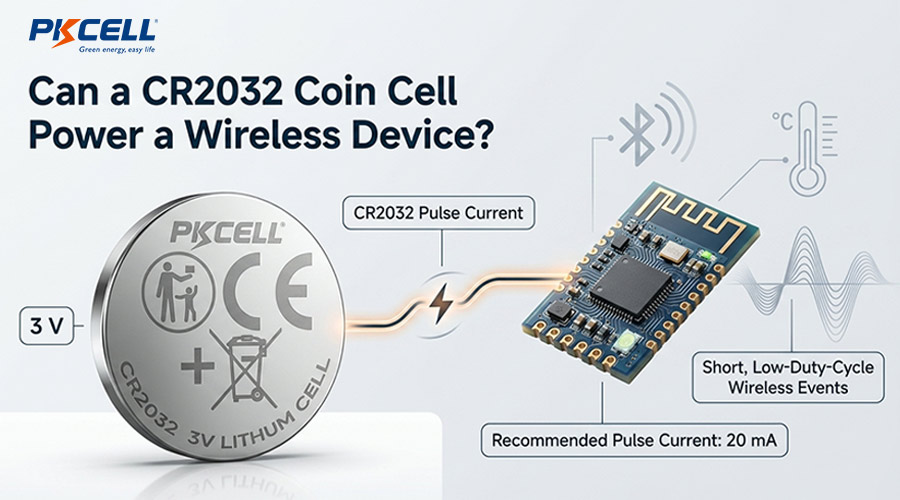
PKCELL lists a recommended constant current of 3 mA and a recommended pulse current of 20 mA for its standard 3 V 210 mAh CR2032 battery. These figures are useful starting points, but they do not mean every 20 mA wireless load will work under all conditions.
Key PKCELL CR2032 Specifications
| Parameter | PKCELL CR2032 value | What it means for a wireless design |
|---|---|---|
| Nominal voltage | 3.0 V | The radio, MCU, sensors, and other circuits must operate across the actual battery voltage range. |
| Nominal capacity | 210 mAh | Measured under specified low-drain conditions; it is not a direct pulse-current rating. |
| Dimensions | 20 × 3.2 mm | Compact enough for thin sensors, beacons, remotes, and medical electronics. |
| Recommended constant current | 3 mA | A reference for sustained loading, not the device’s recommended average current for long life. |
| Recommended pulse current | 20 mA | A useful design boundary that still requires confirmation of pulse duration, duty cycle, temperature, and cutoff voltage. |
| Standard operating temperature | -20°C to 60°C | Cold conditions can increase impedance and deepen the voltage drop during radio transmission. |
The PKCELL datasheet rates the CR2032 at 210 mAh when discharged through a 15 kΩ load to 2.0 V at 23°C ±3°C. At approximately 3 V, a 15 kΩ load initially draws only about 0.2 mA.
You can compare CR2032 with other sizes in PKCELL’s LiMnO₂ button cell battery range.
Why Wireless Devices Are Difficult for Coin Cells
Most wireless devices do not draw a constant current. They alternate between several operating states:
- Deep sleep or standby
- Sensor measurement
- MCU processing
- Radio startup
- Signal transmission
- Receive or acknowledgment windows
- Retries when signal conditions are poor
The average current may appear extremely low because the device sleeps most of the time. The battery still has to maintain sufficient voltage during every high-current event.
A simplified beacon might sleep at a few microamps and briefly draw several milliamps when advertising. Another product described as “low power” might activate multiple sensors, illuminate an LED, transmit at high RF power, and wait for a response. These products should not be treated as equivalent merely because they use the same wireless protocol.
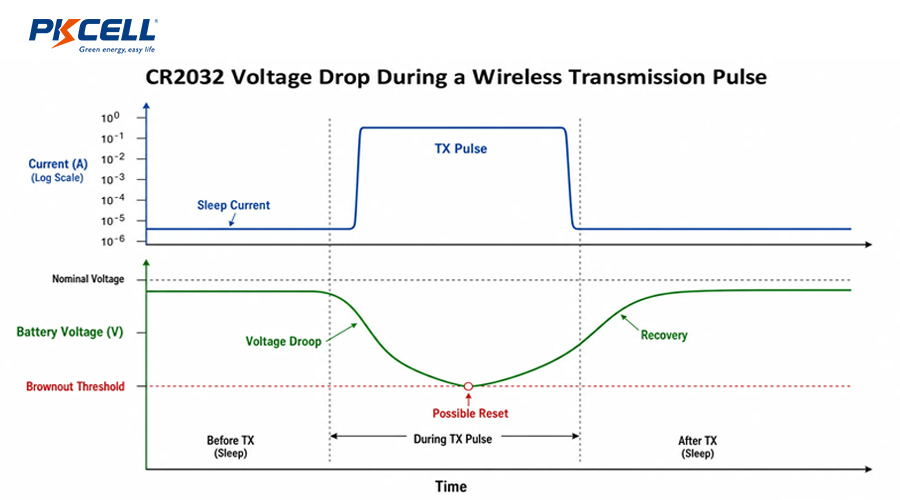
A wireless device can have an excellent average-current budget and still fail because one short pulse pulls its supply voltage below the MCU’s brownout threshold.
Pulse Current Is Not a Single Universal Limit
A statement such as “CR2032 supports 20 mA pulses” is incomplete without the conditions surrounding the pulse.
The practical result depends on:
- Pulse duration
- Time between pulses
- Number of pulses in one radio event
- Battery temperature
- Remaining capacity and battery age
- Cell-to-cell variation
- Battery holder and contact resistance
- PCB trace resistance
- Bulk capacitance
- Device minimum operating voltage
A 20 mA pulse lasting a few milliseconds with a long recovery interval is very different from a 20 mA load lasting several seconds or repeating continuously.
How Internal Resistance Causes Voltage Drop
A real CR2032 behaves like a voltage source with internal resistance. When the radio demands current, the voltage available to the device drops.
Vload ≈ Voc − (Ipulse × Rtotal)In this relationship:
Vloadis the voltage seen by the device during the pulse.Vocis the battery’s open-circuit voltage.Ipulseis the pulse current.Rtotalincludes the cell, holder, contacts, tabs, traces, and other series resistance.
As current or resistance increases, the loaded voltage falls. If that voltage crosses the MCU, radio, sensor, or regulator cutoff level, the device may reset, lose a packet, corrupt a measurement, or enter a retry cycle.
The resistance of a coin cell generally becomes more important at low temperature and as the battery is depleted. A design that works with a fresh cell on a laboratory bench may therefore fail near end of life or in a cold installation.
Which Wireless Devices Can a CR2032 Power?
The wireless protocol name alone cannot confirm compatibility. The table below is a starting point; final selection requires measurements from the actual hardware and firmware.
| Wireless application | CR2032 suitability | Main design condition |
|---|---|---|
| Bluetooth Low Energy beacon | Often suitable | Short advertising events, long sleep intervals, controlled TX power, and low standby current |
| BLE temperature or humidity sensor | Often suitable | Low-power sensor, infrequent reporting, and an optimized radio schedule |
| Wireless remote control | Often suitable | Very short, user-initiated transmissions with long recovery time |
| Low-duty-cycle Sub-GHz sensor | Possibly suitable | Measured peak current and pulse duration must fit the cell and capacitor design |
| Zigbee or Thread end device | Application dependent | Sleep behavior, receive windows, network activity, and retries must be evaluated |
| GPS/GNSS tracker | Usually challenging | Position acquisition and communication can create longer or higher load events |
| Wi-Fi device | Generally unsuitable for direct power | Connection and transmission currents are usually far beyond a bare CR2032′s intended load profile |
| Cellular, NB-IoT, or LTE-M device | Not suitable as a direct standalone source | Network attachment and RF transmission normally require a different battery architecture |
Texas Instruments has demonstrated a low-power PIR motion detector with Bluetooth powered by a CR2032. The important lesson is not that every BLE device will achieve the same result. It is that a carefully selected radio, extremely low standby current, controlled duty cycle, and properly designed power network can make coin-cell wireless operation practical.
Can a Capacitor Help With CR2032 Pulse Current?
Yes. A capacitor placed close to the wireless circuit can store energy between transmissions and deliver part of the current during a short pulse. This can reduce the immediate load on the battery and limit voltage droop.
A first-order capacitance estimate is:
C ≥ ((Iload − Ibattery) × tpulse) ÷ ΔVWhere:
Cis the required capacitance.Iloadis the device current during the event.Ibatteryis the portion supplied directly by the battery.tpulseis the pulse duration.ΔVis the allowable voltage drop.
This equation is only the starting point. The final design must also consider capacitor ESR, capacitance tolerance, DC-bias derating, leakage current, temperature, PCB resistance, battery recovery time, and the minimum device voltage.
Eight Ways to Improve Wireless Performance
1. Reduce the radio peak current
Select a wireless SoC and RF configuration with a peak current compatible with the battery. Avoid automatically using maximum transmit power when the application does not need it.
2. Shorten the active period
Complete measurement, processing, and transmission quickly. Waking the entire system for longer than necessary increases both average current and pulse duration.
3. Increase the transmission interval
Sending one packet every few minutes consumes far less energy than maintaining frequent communication. Choose an interval based on the actual user need.
4. Plan for weak-signal retries
Laboratory testing often occurs close to a gateway. Field devices may retry transmissions or remain active longer when signal strength is poor. Test the worst credible communication condition.
5. Add correctly sized bulk capacitance
Place the pulse buffer close to the radio supply path. Follow the wireless chipset manufacturer’s decoupling and power-layout guidance.
6. Lower connection resistance
A low-quality holder, contaminated contact, thin PCB trace, or unsuitable termination adds resistance. Use a reliable holder or a factory-produced tabbed cell where the design requires a permanent PCB connection.
Do not solder directly to a standard coin cell. PKCELL supplies lithium coin cells with leads or solder tabs for OEM assembly.
7. Avoid unnecessary loads
An indicator LED, buzzer, sensor heater, or long MCU processing cycle may consume more energy than the radio. Profile the whole device rather than the wireless module alone.
8. Select a larger battery when needed
If the device cannot meet its voltage or runtime target, consider a larger coin cell, a cylindrical LiMnO₂ cell, or another primary lithium solution. A larger battery can be more reliable than adding increasingly complex workarounds to an undersized CR2032.
PKCELL’s primary lithium battery selection hub compares button cells, cylindrical LiMnO₂ cells, LiSOCl₂ batteries, and pulse-assisted packs for different applications.
Do Not Estimate Runtime From 210 mAh Alone
A basic energy calculation divides battery capacity by average current:
Runtime (hours) = Battery capacity (mAh) ÷ Average current (mA)This formula is useful for an early estimate, but it assumes all rated capacity is usable. A practical wireless design must apply margins for:
- Pulse-related voltage drop
- Battery cutoff voltage
- Low-temperature performance
- Self-discharge during the required life
- Cell and component tolerance
- Capacitor leakage
- Regulator losses
- Sensor and peripheral consumption
- Failed transmissions and retries
- End-of-life internal resistance
Average current should be calculated from every operating state:
Iavg = Σ (Current in each state × Time in that state) ÷ Total cycle timeKeep the pulse-current check separate from the average-current calculation. Average current estimates lifetime; minimum loaded voltage determines whether the device can complete each event.
How to Test a CR2032 Wireless Device
- Capture the real load waveform. Use suitable measurement equipment to record sleep, startup, sensing, processing, TX, RX, and retry currents.
- Measure at the battery terminals and at the radio. This reveals losses through the holder, protection components, and PCB.
- Record minimum pulse voltage. Compare it with every relevant brownout and regulator threshold.
- Test fresh and partially discharged cells. Fresh-cell success does not prove end-of-life operation.
- Test at the minimum temperature. Allow the complete device and battery to reach the target temperature before testing.
- Include weak-signal operation. Measure connection time, retransmissions, and receive-window behavior.
- Test the longest pulse sequence. Include startup, pairing, firmware tasks, alarms, and other unusual events.
- Repeat across multiple samples. Do not qualify a production design with one cell and one PCB.
Qualification should answer two different questions: Does the battery contain enough energy for the target life, and can it keep the device above its minimum voltage during every wireless event?
When to Move Beyond a CR2032
Consider another battery when:
- The device repeatedly requires more than the recommended CR2032 pulse capability
- The pulse lasts too long for practical capacitor buffering
- The capacitor cannot recharge between events
- The device operates in cold conditions with little voltage margin
- Wi-Fi, cellular, GNSS, a motor, or a high-power sensor dominates the load
- The required life cannot be achieved within the available capacity
- The product needs a connector, special housing, or multi-cell arrangement
Options may include a larger LiMnO₂ battery, a higher-capacity coin cell, or a custom primary battery assembly. PKCELL’s custom battery service supports button cells, tabs, leads, wires, connectors, and application-specific configurations.
Need Help Evaluating a Wireless Load?
Send PKCELL your wireless protocol, peak current, pulse duration, transmission interval, cutoff voltage, operating temperature, dimensions, and estimated order quantity.
Information to Provide for a CR2032 Inquiry
- Device type and wireless protocol
- Nominal and minimum operating voltage
- Sleep current
- Peak current
- Pulse duration and number of pulses per event
- Advertising, reporting, or connection interval
- Expected retries under weak signal conditions
- Operating and storage temperature
- Target battery life
- Holder, tab, lead, or connector requirement
- Sample quantity and annual demand
- Delivery country and documentation requirements
Frequently Asked Questions
What is the recommended CR2032 pulse current?
PKCELL lists a recommended pulse current of 20 mA for its standard 210 mAh CR2032. Actual suitability depends on pulse duration, repetition rate, temperature, battery age, circuit resistance, and device cutoff voltage.
Can a CR2032 power Bluetooth Low Energy?
Yes, many carefully optimized BLE beacons, sensors, and remotes can operate from a CR2032. The radio must use short events, low standby current, an appropriate transmission interval, and sufficient voltage margin.
Can a CR2032 power Wi-Fi?
A bare CR2032 is generally not suitable for directly powering typical Wi-Fi connection and transmission peaks. A different battery or power architecture is normally required.
Does adding a capacitor increase battery capacity?
No. A capacitor does not add meaningful battery capacity. It temporarily supplies current during a pulse and can help the circuit use more of the battery’s available energy without crossing its minimum voltage.
Why does a wireless device reset even when the CR2032 measures 3 V?
A multimeter usually measures voltage with almost no load. During transmission, battery and circuit resistance can cause a temporary voltage drop below the device’s brownout threshold.
Can two CR2032 cells in series provide more pulse current?
Series connection increases voltage, not cell current capability. It may also exceed the device’s voltage rating. Any multi-cell design should be reviewed as a complete electrical and mechanical system.
Can I solder wires directly to a CR2032?
No. The PKCELL CR2032 specification warns against direct soldering. Use a suitable holder or a factory-produced cell with welded tabs or leads.
Conclusion
A CR2032 can power a wireless device, but only when the complete system is designed around the coin cell’s limitations. The PKCELL CR2032′s recommended 20 mA pulse current is a useful reference, not a universal guarantee.
Measure the actual radio waveform, calculate average current, verify minimum loaded voltage, test at low temperature and near end of life, and add appropriately sized capacitance when necessary. If the pulse is too high, too long, or too frequent, move to a larger cell or another primary lithium solution.
Get a Battery Recommendation for Your Wireless Device
Share your current waveform, duty cycle, temperature range, target life, available space, and termination requirements with PKCELL.
Post time: Aug-18-2026


