

Industrial Data Logger Battery Guide: ER14505 vs ER26500 vs ER34615
The right industrial data logger battery is not simply the cell with the highest capacity. It is the smallest battery that can support the logger’s sleep current, sampling schedule, memory writes, sensor warm-up, radio transmissions, temperature range, and required service interval with adequate design margin.
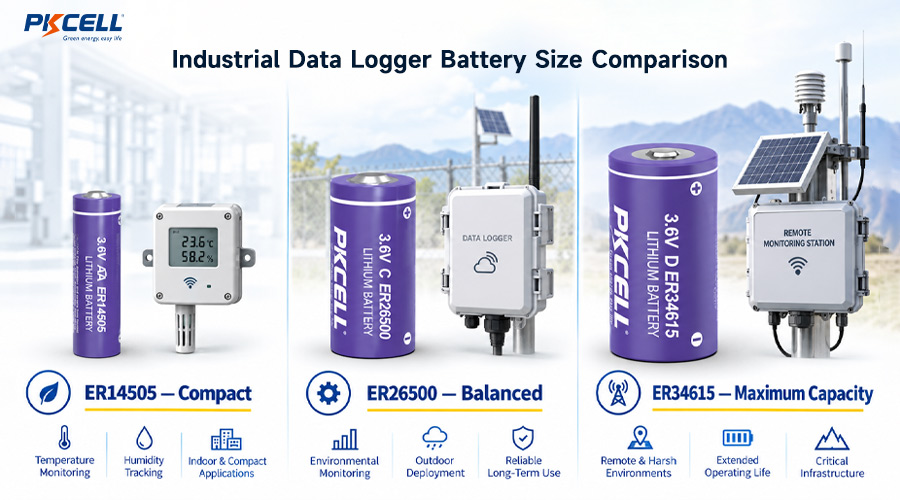
For many low-power data loggers, 3.6V lithium thionyl chloride (Li-SOCl2) cells are a practical starting point because they combine high energy density, low annual self-discharge, and a wide operating temperature range. Within the PKCELL range, the AA-size ER14505, C-size ER26500, and D-size ER34615 cover three distinct enclosure and runtime classes.
Need a Battery Recommendation for Your Logger?
Send PKCELL your sleep current, active current, pulse profile, reporting interval, temperature range, target life, and enclosure limits. An engineer can help shortlist the cell, termination, connector, and pulse-support configuration.
Request a Battery Recommendation
Explore Industrial Battery Solutions
Why Data Loggers Need a Different Battery Selection Method
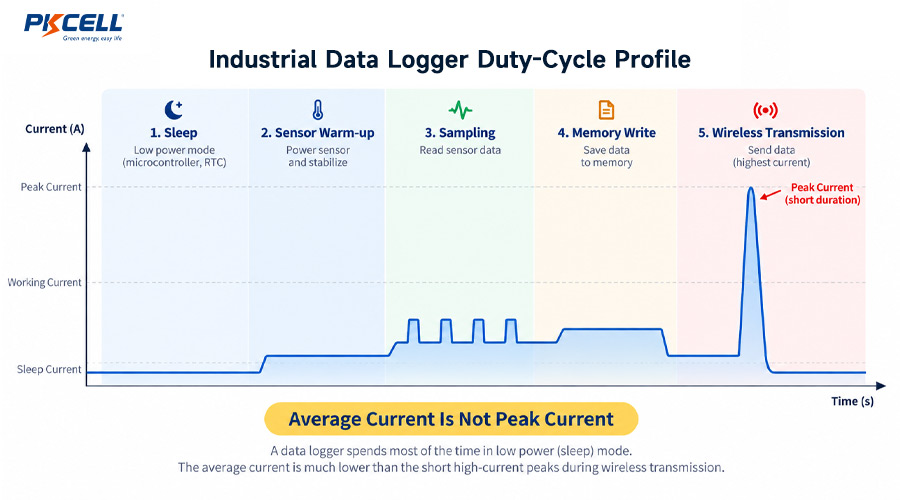
An industrial data logger rarely draws a constant current. It may sleep for minutes or hours, wake to power a sensor, write to memory, calculate a result, and then transmit a packet. The average current can look very small even when short events create a much higher peak.
This mixed load profile creates five selection questions:
- Energy: Is there enough usable capacity for the complete field interval?
- Pulse response: Can the cell hold voltage during radio, GPS, flash-memory, valve, or sensor-startup pulses?
- Temperature: Will cold conditions increase voltage drop or reduce usable capacity?
- Mechanical fit: Does the enclosure allow the cell diameter, length, holder, wiring, and service clearance?
- Integration: Does the assembly require tabs, leads, a connector, insulation, or a custom battery pack?
Capacity answers how much energy is stored. It does not, by itself, answer whether the data logger will survive its highest-current event at the lowest operating temperature.
ER14505 vs ER26500 vs ER34615: Specification Comparison
All three models use 3.6V Li-SOCl2 chemistry and are non-rechargeable. The values below are based on PKCELL’s current product pages and should be used for preliminary selection. Confirm the datasheet for the exact SKU, termination, and pack configuration before design release.
| Selection Point | ER14505 | ER26500 | ER34615 |
|---|---|---|---|
| Format | AA size | C size | D size |
| Nominal voltage | 3.6V | 3.6V | 3.6V |
| Listed nominal capacity | 2,400mAh | 8,500/9,000mAh | 19,000mAh |
| Listed dimensions | 14.5 × 50.5mm | 26.5 × 50.5mm on product page | 34.0 × 61.5mm |
| Listed weight | 19g | 55g | 107g |
| Max. continuous current | 100mA | 130mA | 200mA |
| Max. pulse current | 200mA | 300mA | 400mA |
| Listed operating range | -55°C to +85°C | -55°C to +85°C | -55°C to +85°C |
| Best preliminary fit | Compact, low-duty-cycle loggers | Balanced runtime and enclosure size | Long missions and difficult service access |
| Product details | View ER14505 | Review ER26500 | See ER34615 |
Capacity is measured under specified test conditions. Higher drain, low temperature, pulse loading, cutoff voltage, storage time, and passivation can reduce the energy available to the final device.
When ER14505 Is the Best Data Logger Battery
The ER14505 is the compact option. Its AA-size body and 19g listed weight make it attractive for small environmental loggers, portable recorders, asset-monitoring nodes, and designs that must fit an established AA-format enclosure.
Choose ER14505 when:
- The electronics have very low sleep current and short, infrequent active periods.
- Data is downloaded locally or transmitted only occasionally.
- Enclosure diameter and total device weight are tightly constrained.
- The maintenance interval can be achieved with approximately 2,400mAh of nominal capacity plus a realistic design margin.
Do not choose it only because the holder accepts an AA-size cell. A conventional alkaline AA and a 3.6V ER14505 are not electrically interchangeable. Verify the logger’s input-voltage limit, reverse-polarity protection, and brownout threshold. For more model context, see the ER14505 long-life application guide.
When ER26500 Offers the Best Balance
The ER26500 moves into C-size territory and raises listed nominal capacity to 8,500/9,000mAh. For many outdoor industrial data loggers, this is the practical middle ground: considerably more energy than ER14505 without the full volume and weight of a D-size cell.
Choose ER26500 when:
- The logger samples frequently or powers several sensors during each wake cycle.
- Remote transmissions occur regularly but enclosure space remains limited.
- Field replacement is possible, yet truck rolls and technician time are expensive.
- The design needs additional energy margin for cold seasons, longer reporting campaigns, or future firmware changes.
ER26500 is often the first model worth evaluating for weather stations, pipeline monitors, water-quality loggers, industrial condition-monitoring nodes, and utility-adjacent equipment. PKCELL’s ER26500 industrial automation guide provides additional application context for unattended field systems.
When ER34615 Is Worth the Extra Space
The ER34615 is the high-capacity choice in this comparison. PKCELL lists 19,000mAh nominal capacity in a D-size format, making it suitable for long campaigns, higher sampling demand, larger sensor suites, and installations where battery replacement is difficult or costly.
Choose ER34615 when:
- The device must operate for an extended period between scheduled service visits.
- The logger is installed at a remote, elevated, sealed, hazardous, offshore, or otherwise difficult-to-access site.
- Sensor warm-up time or data processing consumes meaningful energy.
- The project needs a larger reserve for temperature derating, self-discharge, communication retries, and aging.
A larger cell does not automatically solve every peak-current problem. If the logger contains a cellular modem, GPS acquisition stage, satellite transmitter, high-power sensor, or actuator, validate the full pulse profile. PKCELL’s ER + HPC battery pack solutions are designed for applications that combine long-term energy storage with high-current pulses.
How to Estimate Data Logger Battery Life
Begin with a duty-cycle energy budget rather than dividing nominal capacity by sleep current. Calculate the charge used by every operating state, then add allowances for storage, self-discharge, temperature, cutoff voltage, aging, and load uncertainty.
For example, a logger cycle may include deep sleep, sensor stabilization, measurement, a flash-memory write, local display activity, and a radio upload. Model scheduled transmissions and exceptional events such as retries, alarms, configuration sessions, and weak-signal network searches.
Apply engineering margins before choosing a model
- Do not use 100% of nominal capacity. The device will stop when voltage reaches its cutoff, not when the cell has delivered every rated milliamp-hour.
- Model the coldest condition. Internal resistance and voltage drop can become more restrictive at low temperature.
- Include self-discharge and pre-installation storage. Long projects may spend months in inventory before field deployment.
- Allow for communication retries. Poor network coverage can consume more energy than a clean laboratory connection.
- Reserve capacity for product evolution. Firmware updates may increase sampling frequency, processing time, or radio activity.
When a Hybrid Pulse Capacitor Should Be Evaluated
Bobbin-type Li-SOCl2 cells are optimized for long-duration, low-current service. A wireless data logger can create a different requirement: short current bursts that are far above the long-term average. Under these conditions, voltage can dip during transmission even when meaningful capacity remains in the cell.
Evaluate a hybrid pulse capacitor (HPC) or an alternative high-rate architecture when the design includes:
- Cellular, NB-IoT, LTE-M, LoRa, satellite, or frequent long-range radio transmissions.
- GPS acquisition, especially in weak-signal environments.
- High-current sensor warm-up, pumps, valves, relays, buzzers, or actuators.
- Low-temperature pulse operation or a sensitive system brownout threshold.
- Long storage or low background current followed by an immediate high-current event.
The correct HPC choice depends on pulse amplitude, pulse duration, recovery time, minimum voltage, temperature, and repetition rate. It should be validated on the final electronics rather than treated as a generic add-on.
Seven Inputs to Send a Battery Supplier
- Electrical limits: operating voltage, minimum input voltage, cutoff voltage, and regulator type.
- Load profile: sleep, sensing, processing, memory, display, and communication currents with durations.
- Pulse details: peak current, pulse width, repetition interval, and acceptable voltage drop.
- Mission profile: target field life, reporting frequency, expected retries, and service strategy.
- Environment: minimum and maximum temperature, humidity, vibration, shock, altitude, and ingress protection.
- Mechanical limits: available space, mounting direction, cell holder or fixed pack, and weight target.
- Assembly requirements: tabs, wires, connector, fuse, insulation, labeling, and compliance documents.
Providing these inputs allows a supplier to compare more than catalog capacity. PKCELL offers individual cells and battery-pack configurations with wires or connectors across its LiSOCl2 battery range.
Common Data Logger Battery Selection Mistakes
Choosing by nominal capacity alone
A high-capacity cell can still fall below the logger’s minimum voltage during a pulse. Review both energy and power behavior.
Using a room-temperature bench test as the final proof
Test at temperature extremes, at end-of-life conditions, and with realistic network behavior. A successful transmission on a warm bench does not prove winter field performance.
Ignoring passivation after storage
Li-SOCl2 cells can develop a passivation layer during storage. This characteristic supports low self-discharge, but it may also contribute to initial voltage delay. Validate startup behavior after representative storage and deployment conditions.
Treating nominally similar sizes as direct substitutes
Check voltage, dimensions, polarity, terminal geometry, capacity test conditions, maximum current, safety documentation, and device qualification before approving a replacement.
Forgetting transport and assembly requirements
Primary lithium batteries are regulated for transport. Bring packaging, certifications, connector design, traceability, and supply planning into the project before pilot production.
Industrial Data Logger Battery Selection Summary
| If Your Priority Is… | Start With | Then Verify… |
|---|---|---|
| Minimum size and weight | ER14505 | Energy margin and radio pulse response |
| Balanced size and multi-year energy reserve | ER26500 | Enclosure diameter, cold behavior, and reporting duty cycle |
| Maximum standalone capacity | ER34615 | Weight, pack mounting, and peak-current demand |
| High radio or actuator pulses | ER + HPC evaluation | Pulse width, minimum voltage, recovery time, and temperature |
Frequently Asked Questions
Which battery is best for a compact industrial data logger?
ER14505 is the logical starting point when enclosure size and weight are the main constraints. Confirm that its usable capacity and pulse behavior meet the full duty cycle and lowest operating temperature.
Is ER26500 a good battery for wireless data loggers?
It can be a strong fit because it offers more nominal capacity than ER14505 without the volume of ER34615. However, wireless pulse current must still be tested. A logger with demanding cellular or GPS bursts may need HPC support or a different cell construction.
Does ER34615 always last longer than ER26500?
ER34615 has higher listed nominal capacity, but actual field life depends on load, temperature, cutoff voltage, storage, pulse performance, and design margin. Use a complete energy model and device testing before committing to a service-life claim.
Can ER14505, ER26500, or ER34615 be recharged?
No. These Li-SOCl2 models are primary, non-rechargeable batteries. Do not recharge them. Follow the product datasheet and applicable safety and transport instructions.
What information is needed for a custom data logger battery pack?
Provide voltage limits, current profile, peak pulse, reporting interval, target life, temperature range, available space, wire and connector requirements, annual quantity, and required certifications.
Conclusion: Select for the Mission, Not Just the Model Number
ER14505, ER26500, and ER34615 are not simply small, medium, and large versions of the same decision. ER14505 prioritizes compact integration, ER26500 offers a versatile balance, and ER34615 provides the largest energy reserve of the three. The best industrial data logger battery is the model that satisfies energy, pulse current, temperature, mechanical, maintenance, and compliance requirements together.
Before freezing the enclosure or ordering production quantities, validate the exact cell or pack in the final logger across its full temperature and communication profile.
Turn Your Load Profile Into a Battery Shortlist
Share your logger specifications with PKCELL for model selection support, samples, datasheets, and a custom pack quotation.
Get a Data Logger Battery Quote
Compare More ER Battery Models
Post time: Sep-20-2026


