

Bulk Battery Buying Guide for Wireless Security Devices
Buying batteries for wireless security equipment is different from purchasing retail
replacement cells. An OEM, security-system integrator, distributor, or contract
manufacturer must evaluate device voltage, sleep current, alarm pulses, temperature,
service life, certification coverage, batch consistency, pack assembly, and international
shipping before approving a bulk order.
This guide explains how to source primary lithium batteries for wireless alarms, motion
detectors, smoke and heat detectors, door sensors, smart locks, surveillance accessories,
panic buttons, and cellular security nodes.
Quick procurement answer:
Do not select a security battery from capacity or unit price alone. First confirm the
device voltage and complete load waveform. Then compare LiMnO2, LiSOCl2, LiFeS2, or an
ER + HPC pack. Before mass production, verify model-specific certifications, test samples
in the actual device, approve the connector and label drawing, and request volume-tier
pricing with clearly defined delivery and quality terms.
Why Security Device Battery Procurement Is Different
A wireless security device may remain in standby for months and then require an immediate
current pulse for sensing, wireless communication, a siren, camera activation, or lock
movement. A battery that performs well under a small continuous load can still suffer
excessive voltage drop during the critical event.
Field failures also carry a higher cost than the battery itself. A failed sensor may require
an installer visit, interrupt alarm coverage, generate a low-battery service call, or damage
confidence in the security brand.
For security OEMs, the lowest-priced cell is not necessarily the lowest-cost power solution.
Total cost includes qualification, assembly, field replacement, false alarms, logistics, and
supplier continuity.
PKCELL’s
Primary Lithium Battery Solution Hub
provides starting recommendations for security devices, industrial IoT equipment, and custom
primary battery packs.
Match the Battery to the Security Device
| Security Device | Typical Power Profile | Battery Starting Points | Key Qualification Question |
|---|---|---|---|
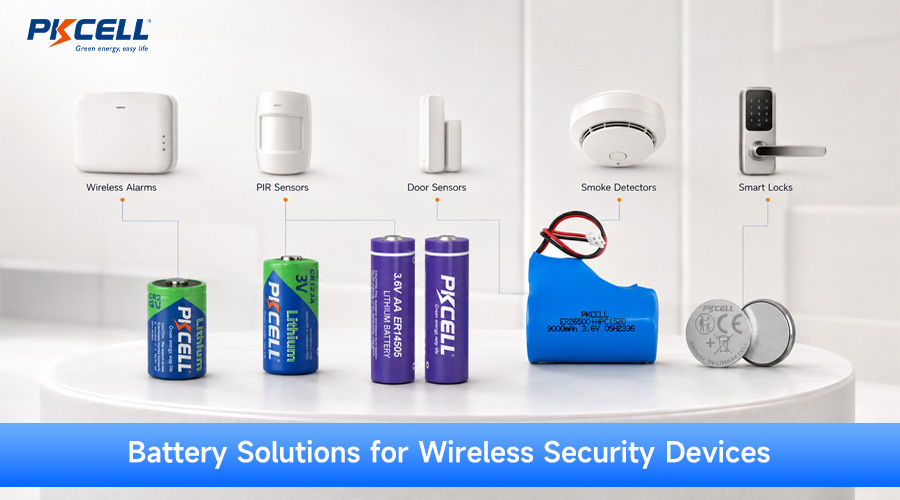
| Wireless door or window sensor | Very low standby with short sensing and RF pulses | CR2, CR123A, ER14250, ER14505 | Can the loaded voltage remain above the radio and MCU cut-off? |
| PIR motion detector | Continuous low-power sensing with intermittent wireless transmission | CR123A, CR2, ER14505 | How often does the sensor transmit in a high-traffic installation? |
| Smoke, heat, or gas detector | Long standby with alarm, radio, buzzer, or indicator loads | Application-specific CR or ER battery and custom pack | Does the complete detector meet its applicable product and market requirements? |
| Wireless siren or panic alarm | Low standby followed by a relatively high or sustained alarm load | LiMnO2, ER Power, or custom multi-cell pack | How long must the siren operate at minimum temperature and end of life? |
| Smart lock or access-control device | Standby electronics plus motor, solenoid, wireless, and user-interface loads | LiFeS2 AA, LiMnO2, or custom pack | What is the motor startup current and minimum operating voltage? |
| Cellular alarm communicator | Low standby with high network-attach and transmission pulses | ER Power or ER + HPC | What happens during weak-signal retries and extended network searches? |
| Outdoor surveillance sensor | Sensing, illumination, imaging, processing, and radio transmission | CR123A, CR2, ER Power, or custom pack | Has the battery been tested after cold soak and outdoor storage? |
| Remote control or key fob | Very low standby with brief user-triggered transmission | CR2032, CR2025, or another approved button cell | Are tabs, contacts, or child-resistant packaging required? |
replacements for each other. Confirm the circuit’s maximum input voltage, minimum operating
voltage, discharge curve, and battery compartment before changing chemistry.
Compare the Main Battery Chemistries
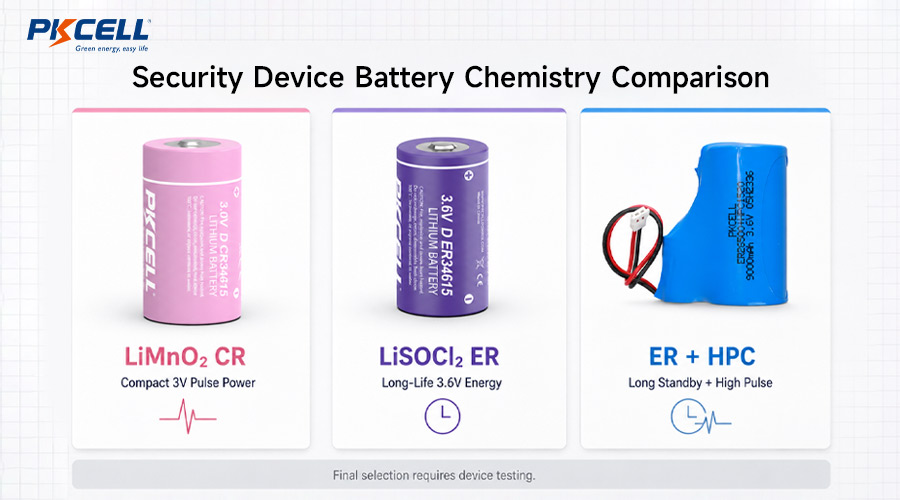
LiMnO2 CR Batteries
Cylindrical LiMnO2 batteries such as CR123A and CR2 provide a nominal 3 V output and good
pulse performance in compact security equipment. They are common starting points for
cameras, PIR detectors, wireless alarms, and professional sensors.
LiSOCl2 ER Batteries
LiSOCl2 batteries provide a nominal 3.6 V output, high energy density, and low
self-discharge. Bobbin ER Energy cells suit long-life low-current devices, while spiral
ER Power cells support stronger continuous and pulse loads.
ER + HPC Packs
An ER + HPC pack combines a long-life bobbin LiSOCl2 cell with a Hybrid Pulse Capacitor.
The ER cell provides long-term energy while the HPC supports communication, alarm, GNSS,
or actuator pulses.
When to Consider LiMnO2
Consider the
PKCELL LiMnO2 battery range
when the device is designed for a 3 V cylindrical primary lithium battery and requires
compact size with good pulse delivery. Common security-oriented models include CR123A, CR2,
CR14505, and CR17450.
When to Consider LiSOCl2
Use
ER Energy Type cells
when long standby life and low average current are the main priorities. Consider
ER Power Type cells
when the load exceeds the continuous or pulse capability of an energy-oriented bobbin cell.
When to Add HPC Pulse Support
For NB-IoT, LTE-M, cellular, LoRaWAN, GNSS, siren, or valve loads, compare an ER Power cell
with an
ER + HPC battery solution
.
Selection should account for pulse amplitude, duration, recovery interval, temperature,
storage history, and device cut-off voltage.
Build a Complete Electrical Requirement
A useful battery request contains more than voltage and capacity. Give the supplier a
measured current waveform whenever possible.
- Sleep current: Include the MCU, sensors, regulator, radio, and leakage paths.
- Active current: Define sensing, processing, listening, illumination, and motor states.
- Peak current: Record amplitude, duration, frequency, and repeated sub-pulses.
- Minimum voltage: Include MCU brownout, radio reset, regulator dropout, and motor limits.
- Duty cycle: Specify normal operation and high-activity worst cases.
- Temperature: Provide minimum and maximum temperature at the battery.
- Storage: State the possible warehouse and pre-installation storage period.
- Target life: Include reserve margin and end-of-life behavior.
Security devices should also be tested in abnormal but plausible operating conditions. These
include repeated alarms, high-traffic motion detection, weak wireless coverage, cellular
reconnection, cold startup, and tamper events.
Cell, Tab, Connector, or Finished Battery Pack?
A standard cell may offer the lowest component price, but it can shift welding, wiring,
insulation, testing, and traceability work to the security-device factory. A finished pack
can reduce assembly steps and help maintain consistent mechanical integration.
PKCELL supports
customized primary lithium battery packs
with options such as:
- Solder tabs, axial leads, wires, cables, and connectors
- Series and parallel configurations
- Shrink wrapping, insulation, housings, and labels
- Custom wire length and connector orientation
- Pulse-support components and pack-level protection when required
- Device-specific mechanical and electrical testing
Before tooling or mass production, approve a controlled drawing that identifies the cell,
configuration, polarity, dimensions, lead length, connector, pinout, label, and packaging.
Need a Battery Recommendation for a Security Device?
Send PKCELL your device type, voltage, load waveform, temperature range, target life,
battery-space drawing, connector requirements, trial quantity, and annual forecast.
Request an Engineering Recommendation
Explore Security Battery Applications
Certifications and Documents for Global Procurement
Certification requirements depend on the chemistry, model, battery pack, destination market,
device category, and shipping method. Procurement teams should request documents for the exact
SKU and configuration being quoted.
| Document or Standard | What It Supports | What the Buyer Should Verify |
|---|---|---|
| ISO 9001 | Quality-management system | Certificate validity, accredited issuer, scope, and manufacturing entity |
| ISO 14001 | Environmental-management system | Valid scope and responsible production location |
| UN 38.3 | Lithium battery transport testing | Exact cell or pack model, test summary, and configuration coverage |
| MSDS or SDS | Composition, hazards, handling, and transport information | Current revision and match to the supplied chemistry |
| UL 1642 | Safety evaluation for applicable lithium cells | Certificate number, model designation, and status |
| IEC 60086-4 | Safety requirements for lithium primary batteries | Test report scope and relationship to the purchased model |
| CE, RoHS, and REACH documents | Applicable market conformity and restricted-substance requirements | Product scope, declaration issuer, report date, and destination requirements |
| KC, UKCA, CB, or other market documents | Additional country or product requirements where applicable | Whether the specific security device and battery require the document |
assumed to cover a customized multi-cell battery pack. Changing the cell, wiring,
configuration, protection, housing, or label may change the documentation required. Ask for
written confirmation of the exact model and pack scope.
Buyers can review PKCELL’s
certificate overview
and request the current documents that correspond to their selected product.
Factory Capacity and Supply Continuity
For a large security deployment, production capacity matters because approved batteries may
need to remain available across several device-production cycles. Factory scale should be
evaluated together with quality control, change management, traceability, and delivery planning.
According to PKCELL company information and the supplied corporate profile, the manufacturing
operation includes:
Manufacturing Scale
A factory area of approximately 28,000 square meters, a team of more than 400 people, and
more than 20 automated production lines.
Production Capacity
Annual output capacity is reported at approximately one billion cells, supporting both
standard products and high-volume OEM programs.
Quality Infrastructure
Company materials report more than 100 internal quality-control processes and automated
inspection coverage at critical manufacturing stages.
PKCELL also reports supplying more than 10,000 B2B customers and serving markets across more
than 150 countries and regions. Procurement teams should still confirm available capacity,
reserved production slots, lead time, and forecast requirements for their particular model.
Questions to Ask About Supply Continuity
- Is the quoted product manufactured on a regular production schedule?
- What forecast or blanket-order commitment is required to reserve capacity?
- How are raw materials and long-lead connectors managed?
- Will the supplier notify the buyer before changing materials, processes, or drawings?
- Can every shipment be traced to production and inspection records?
- What is the contingency plan for demand increases or logistics disruption?
How to Request an Accurate Bulk Battery Quote
A request that says only “Please quote 100,000 batteries” is not enough to produce a reliable
commercial and technical proposal. The supplier must know whether the buyer needs loose cells,
retail packs, industrial trays, tabs, wires, connectors, custom labels, or a tested battery assembly.
Include These Details in Your RFQ
- Device and application name
- Preferred battery model or required chemistry
- Nominal voltage and minimum operating voltage
- Capacity target and service-life target
- Continuous current and pulse waveform
- Operating and storage-temperature range
- Cell, tab, wire, connector, pack, or housing requirement
- Drawing, photo, sample, or connector part number
- Required certificates and destination market
- Sample quantity and pilot-order quantity
- First mass-production order and annual forecast
- Packaging, label, barcode, and traceability requirements
- Shipping destination and preferred trade terms
- Required sample and production delivery dates
What Determines the Bulk Price?
- Battery chemistry, model, capacity, and production status
- Order quantity and committed annual volume
- Tabs, wires, connectors, housings, labels, and packaging
- Engineering, tooling, testing, and certification work
- Inspection, traceability, and reporting requirements
- Lead-time expectations and reserved production capacity
- Shipping method, dangerous-goods handling, and destination
- Payment terms, warranty terms, and Incoterms
Request separate quotation lines for samples, engineering or tooling charges, unit price,
packaging, testing, freight, and any certificate-related cost. This makes competing proposals
easier to compare.
Ask for Volume Tiers
A useful quotation can show prices at several quantities, such as the pilot order, expected
production order, and annual framework volume. Volume tiers allow the buyer to evaluate
production ramp-up without assuming that prototype pricing will remain unchanged.
Request Bulk Pricing, Samples, and Lead Time
Submit your battery model, customization drawing, quantity tiers, annual forecast,
destination, certification requirements, and requested delivery date for a project-specific quote.
From Samples to Mass Production
- Application review: Confirm chemistry, voltage, load profile, temperature,
mechanical space, service life, and compliance requirements. - Initial quotation: Define the proposed model, sample cost, customization,
quantity tiers, commercial terms, and estimated schedule. - Sample production: Build standard or customized samples using a controlled drawing.
- Device validation: Test normal operation, alarms, radio transmission,
motors, low temperature, storage, and end-of-life voltage. - Pilot order: Confirm assembly compatibility, incoming inspection,
packaging, barcode, traceability, and production documentation. - Golden sample approval: Freeze the approved model, drawing, connector,
label, and performance criteria. - Mass production: Release the production order against the approved
specification and quality agreement. - Incoming inspection: Check shipment identity, quantity, lot information,
dimensions, OCV, loaded voltage, appearance, and documentation.
The uploaded PKCELL corporate profile lists service targets that can include rapid solution
preparation, sample development, and mass-production ramp-up. Actual timing should be
confirmed in the written quotation because connector sourcing, tooling, testing,
certification, quantity, and production scheduling can change lead time.
FAQ: Bulk Battery Procurement for Security Devices
What information is required for a bulk battery quotation?
Provide the device type, voltage, current waveform, temperature, target life, battery-space
drawing, preferred model, customization, certificates, sample quantity, order quantity,
annual forecast, destination, and required delivery date. Complete information improves
both price and technical accuracy.
What is the minimum order quantity for PKCELL batteries?
MOQ depends on the battery model, whether it is regularly produced, packaging, connector,
label, and customization. Standard cells and custom packs can have different minimums.
Request separate MOQs for samples, pilot production, and mass production.
Can buyers order samples before placing a bulk order?
Yes. Sample testing is recommended before mass production. Test the battery in the actual
security device under normal operation, alarm conditions, maximum pulse load, minimum
temperature, and representative end-of-life voltage.
How long does a custom battery sample take?
Timing depends on cell availability, connector lead time, drawing approval, tooling,
electronics, and testing. PKCELL company materials describe expedited sample-development
targets for suitable projects, but the binding schedule should be stated in the quotation.
Which battery is best for a wireless alarm sensor?
There is no universal model. CR123A and CR2 are common 3 V choices for compact pulse loads.
ER cells suit long-life 3.6 V designs, while ER Power or ER + HPC may suit higher pulses.
Select from the measured waveform and the device’s voltage limits.
Can a CR123A battery be replaced with an ER14505?
Not automatically. CR123A is typically a 3 V LiMnO2 battery, while ER14505 is a 3.6 V
LiSOCl2 battery with different dimensions and discharge behavior. Changing chemistry
requires electrical, mechanical, safety, and lifetime validation.
Can PKCELL add wires, tabs, or custom connectors?
PKCELL supports solder tabs, leads, wires, connectors, series or parallel assemblies,
insulation, labels, and custom pack structures. Provide a drawing, mating-connector part
number, pinout, wire gauge, length, polarity, and orientation for review.
Which certifications should a security battery have?
Requirements vary by chemistry, model, pack, device, market, and transport method.
Relevant documents may include ISO 9001, UN 38.3, SDS, UL 1642, IEC 60086-4, CE, RoHS,
REACH, or market-specific approvals. Verify coverage for the exact purchased SKU.
Does a cell-level UN 38.3 report cover a custom battery pack?
Do not assume that it does. A multi-cell pack or modified configuration may require
separate transport testing or documentation. Ask the supplier to confirm the exact
configuration covered by the report and test summary.
How should two bulk quotations be compared?
Compare the exact model, test conditions, certification scope, customization, packaging,
inspection, warranty, lead time, payment terms, Incoterms, freight, and annual-volume
commitment. A lower cell price may exclude necessary assembly or compliance costs.
What warranty applies to a bulk battery order?
Warranty varies by product and project. Do not confuse shelf-life or design-life claims
with a commercial warranty. The quotation should state the warranty period, storage
requirements, accepted operating conditions, claim procedure, and available remedy.
How are lithium batteries shipped internationally?
International shipment depends on chemistry, lithium content, configuration, quantity,
packaging, carrier, and destination. Provide the shipment details early so the supplier
can prepare the applicable UN 38.3 documentation, SDS, labels, packaging, and
dangerous-goods arrangements.
What incoming inspections should an OEM perform?
Verify the model, lot, quantity, appearance, dimensions, polarity, connector, label,
packaging, open-circuit voltage, loaded voltage, and required documents. Keep retained
samples and lot traceability based on the agreed inspection plan.
Conclusion
Successful bulk purchasing for wireless security devices requires a balance of electrical
performance, service life, certification, manufacturability, factory capacity, commercial
terms, and supply continuity. Start with the real device load rather than a generic capacity
target, and verify both normal standby operation and the highest alarm or communication pulse.
LiMnO2 CR batteries are strong candidates for compact 3 V security products. LiSOCl2 ER
batteries support long-life 3.6 V designs, while ER Power and ER + HPC solutions address
stronger continuous or pulse loads. A customized pack can simplify assembly when the project
requires specific tabs, wires, connectors, housings, or labels.
Source Batteries for Your Next Security Device Project
Send PKCELL your electrical specification, mechanical drawing, certification list, sample
quantity, production quantity, and annual forecast. The team can recommend a battery
direction and prepare a project-specific bulk quotation.
Post time: Aug-11-2026


