

Battery Design for Smart Gas Meters with Remote Shut-Off Valves
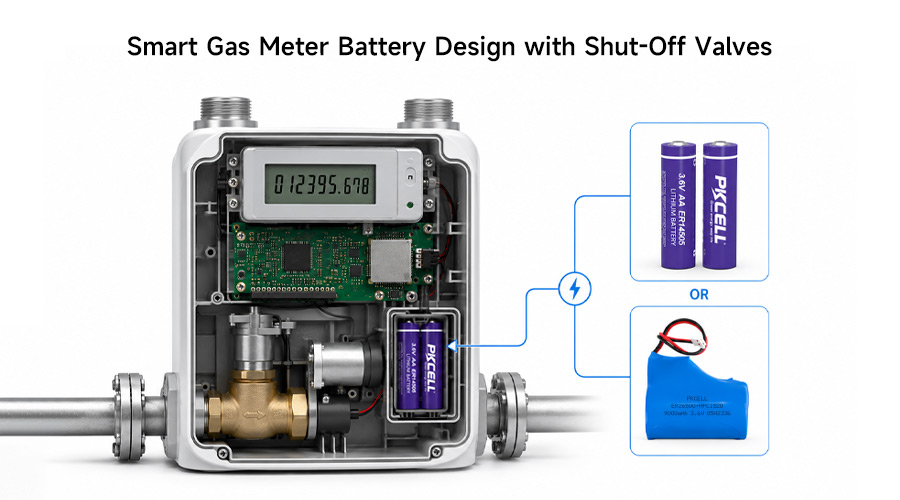
A smart gas meter battery does more than power a display. In meters with remote shut-off valves, the battery must support years of low-power metering, wireless communication, alarms, and short high-current valve-control events.
For utity projects, the design target is clear: long field life, reliable pulse power, stable voltage, safe valve operation, and fewer maintenance visits. The best battery design for smart gas meters starts with the real load profile instead of nominal battery capacity alone.
Why Remote Shut-Off Valves Change the Battery Requirement
Traditional gas meters mainly measure flow. Smart gas meters add electronics, communication modules, tamper detection, and sometimes a motorized shut-off valve. This valve is valuable for prepaid metering, remote utility operation, abnormal-flow protection, and emergency shutoff, but it also creates one of the most demanding power events in the meter.
According to Texas Instruments, remote shut-off has become increasingly important in flow meters, including gas meters, because it improves utility efficiency and enables additional consumer benefits. From a battery perspective, however, the valve should be treated as a high-pulse load that must still operate after years of battery aging and temperature exposure.
The Real Power Profile of a Valve-Controlled Gas Meter
A reliable design separates the meter load into three layers:
- Continuous background current: metrology circuit, real-time clock, memory, sensors, and standby electronics.
- Scheduled pulse loads: wireless transmission, network registration, data upload, and periodic status reporting.
- Event-driven pulse loads: valve close, valve open authorization, tamper alarm, abnormal-flow alarm, firmware activity, or weak-signal retransmission.
A Tadiran utility-meter battery application note gives an example profile for an electronic gas meter with radio module and shutoff valve, including a minimum voltage requirement, microamp-level continuous current, and repeated radio pulses. Real projects may be more demanding, especially when NB-IoT or cellular communication is used.
Common Battery Choices for Smart Gas Meters
Li-SOCl2 ER Batteries
Lithium thionyl chloride, commonly written as Li-SOCl2 or ER, is widely used in gas and water meters because it offers high energy density, low self-discharge, stable voltage, and long service life. PKCELL’s ER34615 Smart Meter Battery is positioned for long battery life, wide temperature operation, and smart water and gas meter applications.
Li-MnO2 CR Batteries
Lithium manganese dioxide, or CR, batteries can provide strong short-pulse capability. They may be considered for devices where pulse current is a major design factor, but engineers must compare voltage, lifetime, temperature behavior, and total system requirements.
ER + HPC Battery Packs
For gas meters with remote shut-off valves, many designs combine an ER cell with a pulse-support component such as an HPC. PKCELL’s ER + HPC IoT battery pack solution combines a bobbin-type Li-SOCl2 cell with Hybrid Pulse Capacitor technology to support high-current pulses and reduce the impact of Li-SOCl2 passivation.
Battery Selection Matrix for Gas Meter Projects
| Meter Scenario | Recommended Battery Direction | Key Design Check |
|---|---|---|
| Low-power gas meter without valve | Single ER cell or ER battery pack | Average current, shelf life, operating temperature |
| Gas meter with small shut-off valve | High-pulse ER cell or ER + HPC pack | Valve start current, running current, and end-of-life voltage drop |
| NB-IoT gas meter with valve | ER + HPC/HLC pulse-support battery pack | Network attach current, retransmission behavior, and valve pulse margin |
| Cold outdoor deployment | Larger ER pack plus validated pulse support | Low-temperature impedance and valve torque requirement |
| High-reliability utility rollout | Custom battery pack matched to the meter load profile | Lifetime model, accelerated testing, and safety validation |
Remote Valve Operation Requires More Than Peak Current
The shut-off valve load is not only about current amplitude. Engineers should validate the complete valve event:
- Start current: the initial motor or actuator demand.
- Running current: the current required while the valve moves.
- Stall current: the worst case if the valve is blocked, aged, frozen, or mechanically stressed.
- Pulse duration: the time required to complete a close or open action.
- Voltage recovery: how quickly battery voltage returns after the pulse.
- End-of-life margin: whether the valve still operates when the battery is near minimum voltage.
How Communication Technology Affects Battery Life
Wireless communication can become the second largest battery stress after the valve. Short-range RF, LoRaWAN, GPRS, LTE-M, and NB-IoT have different pulse shapes and network behaviors. A meter in a weak-signal basement may consume far more energy than the same meter in a strong-signal cabinet.
Texas Instruments notes that high-powered RF modules such as NB-IoT modems can require high current pulses during transmission intervals. That means a battery design based only on average laboratory current may fail when field signal conditions are poor.
Battery Life Calculation: What to Include
A practical smart gas meter battery calculation should include both energy consumption and power delivery. At minimum, include:
- Continuous current consumption of the metrology and control circuit.
- Communication interval, current, duration, and retry assumptions.
- Valve close and open current profiles, including worst-case stall current.
- Alarm and tamper events expected during the product lifetime.
- Battery self-discharge over the target service life.
- Temperature derating for both capacity and pulse performance.
- Passivation behavior in Li-SOCl2 cells after long storage or low-current operation.
- End-of-life minimum voltage required by the MCU, radio, valve driver, and memory.
Need a Battery Pack for a Smart Gas Meter Project?
Share your voltage range, pulse current, valve current curve, communication interval, operating temperature, target lifetime, size limit, connector requirement, and test plan. PKCELL can help evaluate a suitable Li-SOCl2 or ER + HPC battery solution.
Common Battery Design Mistakes
Choosing by Capacity Alone
A high-capacity cell can still be the wrong choice if it cannot deliver the valve pulse without voltage sag.
Ignoring Low-Temperature Pulse Performance
Cold temperatures increase internal resistance and can reduce available pulse power. Outdoor or unheated meter locations need temperature-specific testing.
Testing a New Valve Only
Valve torque can change with wear, dust, pressure, seal aging, and long idle periods. Battery tests should include aged or worst-case mechanical samples.
Underestimating Network Retries
NB-IoT and cellular modules can draw much more energy in poor coverage. Field signal conditions should be part of the battery model.
FAQ About Smart Gas Meter Battery Design
For many long-life gas meters, Li-SOCl2 ER batteries are a strong starting point. If the meter includes NB-IoT, weak-signal operation, cold deployment, or a motorized valve, an ER + HPC battery pack is often more suitable because it supports both long service life and pulse current.
The shut-off valve uses a motor or actuator that draws a short burst of current when it moves. The battery must keep voltage high enough during that pulse so the valve closes reliably, especially at low temperature or near end of battery life.
Alkaline batteries are usually not preferred for sealed long-life utility gas meters because they have higher self-discharge and weaker long-term performance than industrial lithium options. They may also increase replacement risk in multi-year deployments.
Many utility projects target 10 years or more, but actual lifetime depends on communication frequency, valve operation, standby current, temperature, signal quality, and battery pack design.
Provide voltage range, average current, peak pulse current, valve current curve, communication interval, operating temperature, target lifetime, battery size limit, connector or wire requirement, and test conditions.
Conclusion
Battery design for smart gas meters with remote shut-off valves is a system-level engineering task. The right choice depends on average current, pulse current, communication technology, valve torque, temperature, safety logic, and service-life target.
For low-power meters, a carefully selected ER cell may be enough. For valve-controlled, NB-IoT, cold-region, or high-reliability utility deployments, an ER + HPC battery pack is often the safer design direction. Before choosing a battery, define the load profile, measure real valve and radio pulses, and validate the design at end-of-life conditions.
Planning a smart gas meter rollout? Contact PKCELL to discuss a custom battery solution for your meter design.
Post time: Jul-24-2026


