

Quick selection answer: choose ER14250 when the approved battery assembly requires a compact 1/2 AA cell and its capacity meets the required backup interval. Choose ER14505 when an AA-size enclosure is available and the system needs more capacity or maintenance reserve. Neither cell is automatically a drop-in replacement for an existing PLC or CNC battery pack, even though both have a nominal voltage of 3.6V.
- 1Identify controller
- 2Verify OEM battery
- 3Compare cell format
- 4Match connector
- 5Validate replacement
A PLC battery or CNC battery may preserve volatile memory, real-time clock data, machine parameters, offsets, programs or other retained information when the main power supply is unavailable. Some controllers use batteries for memory retention, while others use nonvolatile memory, capacitors or separate batteries for different functions.
The first question should therefore be “What does this battery support in this exact controller?” rather than “Which 3.6V battery fits?”
PKCELL supplies standard Li-SOCl2 batteries and application-specific assemblies with tabs, wires and connectors. Any replacement must still be verified against the controller manufacturer’s approved part number, manual and electrical requirements.
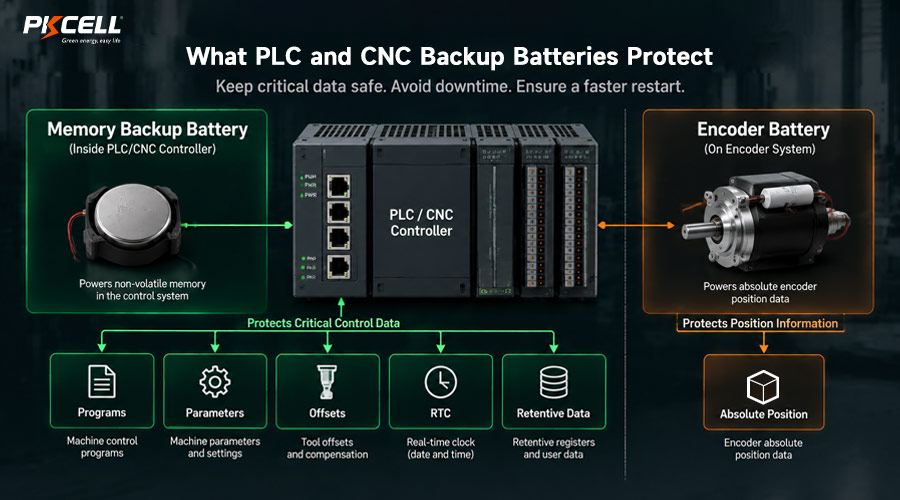
What Does a PLC or CNC Backup Battery Protect?
Depending on the controller generation and architecture, a memory backup battery may support:
- PLC programs held in battery-backed RAM
- Machine parameters and configuration data
- CNC work offsets and tool offsets
- Retentive variables, counters and recipe data
- Real-time clock and calendar information
- Alarm histories or maintenance records
- Absolute encoder or pulse-coder position data
These functions should not be assumed to share one battery. A CNC control can use one battery for memory and another for an absolute-position system. Installing the correct memory battery will not resolve an alarm originating from a separate encoder battery pack.
Newer PLC platforms may store programs in nonvolatile memory and use a battery only for selected retained data or the clock. Some controllers do not require a backup battery at all. Check the precise CPU, control unit, drive or encoder model before purchasing replacements.
Match the battery to the exact controller function and manufacturer part number—not merely to the voltage printed on the old pack.
ER14250 vs ER14505: Key Specifications
The following values are based on the referenced PKCELL standard energy-type product pages. Confirm the final ordered SKU, datasheet, terminals and test conditions before design approval.
| Selection factor | ER14250 | ER14505 | Why it matters |
|---|---|---|---|
| Typical format | 1/2 AA | AA | Determines enclosure fit and mounting options |
| Nominal voltage | 3.6V | 3.6V | Voltage matches, but this alone does not establish interchangeability |
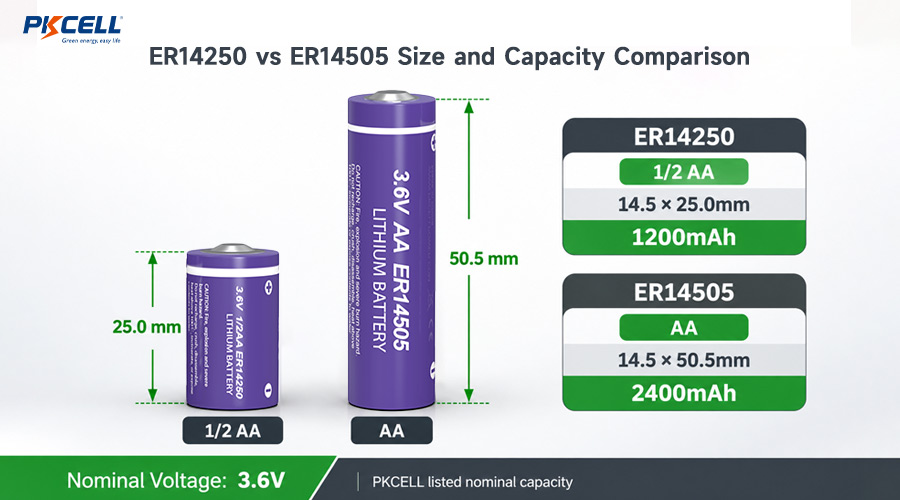
| PKCELL listed capacity | 1200mAh | 2400mAh | ER14505 provides approximately twice the nominal capacity under its specified test conditions |
| Dimensions | Approximately 14.5 × 25.0mm | Approximately 14.5 × 50.5mm | Both have a similar diameter, but ER14505 is about twice as long |
| Reference weight | Approximately 10g | Approximately 19g | Relevant to mounting, vibration and shipping calculations |
| Standard current | 0.5mA | 1mA | Both are positioned for long-duration, relatively low-current applications |
| Maximum continuous current | 20mA | 100mA | Relevant if the battery supports more than static memory retention |
| Maximum pulse current | 45mA | 200mA | Pulse ratings depend on temperature, duration, history and cut-off voltage |
| Listed operating range | -55°C to +85°C | -55°C to +85°C | Available capacity and voltage are not constant across the entire range |
| Typical selection priority | Compact size and low backup current | Greater capacity and longer maintenance reserve | The final choice depends on the controller, not capacity alone |
Review the detailed PKCELL ER14250 battery and PKCELL ER14505 battery product pages before requesting samples.
Capacity note: rated capacity is measured under defined discharge conditions. It is not a guaranteed controller backup period. Cut-off voltage, temperature, self-discharge, battery age, standby current and the controller’s low-battery threshold affect usable service life.
When ER14250 Is the Better Starting Point
ER14250 is a compact 1/2 AA 3.6V Li-SOCl2 cell. It is a practical starting point when the approved controller battery has limited space and a low, predictable memory-retention load.
Consider ER14250 when:
- The existing approved assembly uses a 1/2 AA-size Li-SOCl2 cell.
- The enclosure cannot accept the additional length of ER14505.
- The required backup interval fits within the validated 1200mAh capacity.
- The connector, lead length and polarity can be matched exactly.
- The maintenance plan allows replacement at the specified interval.
- The controller’s current remains within the validated cell profile.
The smaller cell can reduce pack volume and material cost, but it leaves less capacity reserve for unexpected shutdown duration, elevated-temperature exposure or delayed maintenance.
When ER14505 Is the Better Starting Point
ER14505 is an AA-size 3.6V Li-SOCl2 cell with a listed nominal capacity of 2400mAh. PKCELL specifically lists memory backup among its applications.
Consider ER14505 when:
- The controller or approved replacement assembly uses an AA-size cell.
- The enclosure provides enough length and secure mounting space.
- A longer backup interval or greater maintenance reserve is required.
- Shutdown periods may be extended or unpredictable.
- The design requires greater continuous or pulse-current headroom.
- The replacement schedule makes a larger energy reserve valuable.
More capacity does not make ER14505 universally better. It cannot replace ER14250 when the holder, enclosure, connector or controller approval is incompatible.
Why Matching 3.6V Is Not Enough
An industrial backup battery is often a complete assembly rather than a bare cell. Two packs using ER14250 cells can have different connectors, polarity, lead lengths, insulation or protective components.
Before treating any product as an equivalent PLC or CNC battery, compare all of the following:
| Compatibility item | What to verify | Failure risk if incorrect |
|---|---|---|
| Controller identification | Manufacturer, full model, CPU or control-unit revision and original battery part number | Wrong battery type or wrong replacement procedure |
| Nominal and maximum voltage | Required chemistry and accepted voltage range | Memory failure or circuit damage |
| Connector | Manufacturer, series, number of positions, pitch and locking feature | Poor retention or inability to connect |
| Polarity and pinout | Positive and negative positions viewed from the correct connector orientation | Reverse polarity and possible equipment damage |
| Wire | Gauge, insulation, color, length and routing | Installation difficulty, pinching or excessive resistance |
| Pack components | Fuse, diode, resistor, thermistor, insulation and sleeving | Loss of an OEM-required electrical or safety function |
| Physical size | Cell dimensions, pack dimensions and mounting method | Loose mounting, vibration damage or cabinet interference |
| Temperature | Temperature at the battery during operation and cabinet shutdown | Reduced voltage, capacity or service life |
PKCELL can supply custom primary lithium battery packs with wires, connectors, tabs, insulation and application-specific configurations. A drawing or physical reference sample should be used when the connector identity or pin orientation is uncertain.
Five-Step Selection Process for Maintenance Buyers
Record the Complete Controller Information
Photograph the controller nameplate, CPU model, old battery label, connector and wire orientation. Record the machine model and serial number because control hardware may change during a machine’s production history.
Find the Official Battery Part Number
Use the controller’s maintenance manual and spare-parts documentation. Do not identify the battery from cell color, approximate size or an online photo alone.
Confirm What the Battery Supports
Determine whether it protects PLC memory, CNC memory, a real-time clock, an absolute encoder or another module. One machine may contain several different backup batteries.
Compare the Complete Battery Assembly
Verify voltage, chemistry, capacity, dimensions, connector, polarity, leads, pack components, production date and required documentation. Match the controller-approved specification rather than selecting the highest-capacity cell that fits.
Test and Approve Before Volume Purchase
Use samples to verify mechanical fit, connector retention, polarity, standby voltage, alarm behavior and expected backup operation. Record the approved battery drawing and revision in the maintenance system.
How to Estimate Memory Backup Battery Life
A first-pass energy calculation can compare two candidate cells:
This calculation is not a replacement interval. A practical estimate must apply margin for:
- Self-discharge during storage and operation
- Battery age before installation
- Elevated cabinet temperature
- Controller low-battery alarm threshold
- Minimum usable voltage and cut-off behavior
- Cell and load variation
- Passivation after extended standby
- Time between alarm detection and maintenance
Use the controller manufacturer’s stated replacement interval when one is provided. Do not extend that interval solely because a replacement cell has a larger nominal capacity.
For projects requiring a more complete energy model, PKCELL’s battery-life calculation guide explains how to combine operating states, self-discharge and design reserve.
Safe PLC and CNC Battery Replacement Planning
There is no universal replacement procedure for industrial controllers. Some manufacturers instruct technicians to replace a battery with controller power present. Others require power to be removed after an internal capacitor has been charged. Some specify a limited replacement window.
Critical safety warning: follow the official procedure for the exact controller model. Never assume that a generic “replace with power on” or “replace with power off” instruction is correct. Work inside energized industrial equipment may expose personnel to hazardous voltage, moving machinery and stored energy. Only properly trained and authorized personnel should perform the work under the applicable site safety procedure.
Before replacement, the responsible technician should normally verify the following against the controller manual and site procedure:
- A current backup of programs, parameters and machine data is available.
- The backup can be restored and is associated with the correct machine.
- The correct battery part and connector have been approved.
- The machine is in the required safe state.
- The manufacturer’s power-state instructions are understood.
- The permitted replacement time is known.
- The old battery’s polarity and lead routing are documented.
- Post-replacement alarms, clock and retained data will be checked.
After replacement, record the battery model, lot code, installation date, technician and next planned inspection or replacement date in the computerized maintenance management system.
OEM Design Considerations for New Controllers
OEM engineers developing a new controller or memory module have more flexibility than maintenance buyers replacing an existing pack. Start with the actual retention requirement:
- Memory or RTC voltage range
- Typical and maximum backup current
- Required unpowered retention period
- Expected cabinet temperature
- Product storage before commissioning
- Maintenance and replacement interval
- Low-battery detection threshold
- Connector, holder or solder-tab strategy
- Vibration, shock and insulation requirements
Choose ER14250 when compactness and low backup current dominate. Choose ER14505 when the enclosure accepts AA length and additional capacity creates useful maintenance margin. If the backup system includes significant startup or communication pulses, select by the complete load profile rather than by memory-retention current alone.
Long storage can also affect first-load voltage through passivation. Review PKCELL’s Li-SOCl2 passivation guide when the controller must start reliably after extended warehouse or standby periods.
PLC and CNC Battery Bulk-Order Checklist
- Controller manufacturer and model
- CPU or control-unit revision
- Original battery part number
- Battery function
- Required chemistry
- Nominal voltage
- Minimum required capacity
- Cell size and pack dimensions
- Connector manufacturer and model
- Pinout and polarity
- Wire gauge, color and length
- Fuse, diode or other pack components
- Sleeving and insulation requirements
- Production date requirement
- Packaging and lot traceability
- Sample quantity
- Annual purchase forecast
- Destination and required documents
Request an ER14250 or ER14505 Battery Quote
Send PKCELL the original battery part number, controller model, battery photos, connector dimensions, polarity, wire length, annual quantity and destination. The team can review standard ER14250 and ER14505 cells or an application-specific 3.6V memory backup battery assembly.
Frequently Asked Questions
What battery is commonly used for PLC memory backup?
Some industrial controllers use 3.6V Li-SOCl2 batteries such as ER14250 or ER14505, but many other cell types and pack configurations exist. Always check the controller’s official battery part number and manual.
Can ER14505 replace an ER14250 battery?
Not automatically. Both are nominally 3.6V, but ER14505 is approximately twice as long. The enclosure, connector, polarity, wiring, controller approval and replacement procedure must all be compatible.
What is the main difference between ER14250 and ER14505?
ER14250 is a 1/2 AA cell with a PKCELL listed capacity of 1200mAh. ER14505 is an AA-size cell with a listed capacity of 2400mAh. ER14505 provides more nominal capacity but requires approximately twice the cell length.
Should a PLC battery be replaced with the controller powered on?
There is no universal answer. Manufacturer procedures differ. Some controllers require power during replacement, while others specify a powered-down procedure and a limited backup-capacitor window. Follow the exact manual and site safety procedure.
Can the PLC program be lost when changing the battery?
Yes, on controllers that depend on battery-backed volatile memory. Data loss may occur if the battery is removed under the wrong conditions or the replacement takes too long. Create and verify a recoverable backup before beginning.
Can a standard AA battery replace ER14505?
No. Similar physical size does not mean electrical compatibility. ER14505 is a 3.6V Li-SOCl2 primary battery with different voltage and discharge characteristics from common 1.5V AA batteries.
Are ER14250 and ER14505 rechargeable?
No. Both are primary lithium thionyl chloride batteries and must not be recharged, short-circuited, punctured, crushed, heated or incinerated.
Conclusion
ER14250 and ER14505 are strong candidates for long-life 3.6V memory backup applications, but selecting a PLC or CNC battery requires more than comparing voltage and capacity. The controller model, battery function, physical size, connector, polarity, wiring and manufacturer-approved replacement procedure must all match.
Use ER14250 where compact 1/2 AA construction and low current are the priorities. Use ER14505 where AA-size space is available and additional capacity provides meaningful backup or maintenance margin.
For samples, connector customization or volume pricing, send PKCELL the original battery details and request an engineering review.


