

Electronic locks and access control devices need a dependable power source to keep their electronic functions available and respond when access is requested. From wireless door sensors and keypad locks to battery-powered access control hardware, the power system must support both long periods of inactivity and brief periods of active operation.
Lithium batteries are used in many of these applications because selected lithium chemistries offer high energy density, low self-discharge, and useful discharge characteristics for compact electronic equipment. However, not every lithium battery is suitable for every lock. The right choice depends on the device architecture, standby current, motor or solenoid load, operating voltage, and expected maintenance interval.
This article explains why lithium batteries are used in electronic locks and access control devices, which operating requirements influence battery selection, and when primary lithium batteries may be appropriate for an industrial or OEM design.
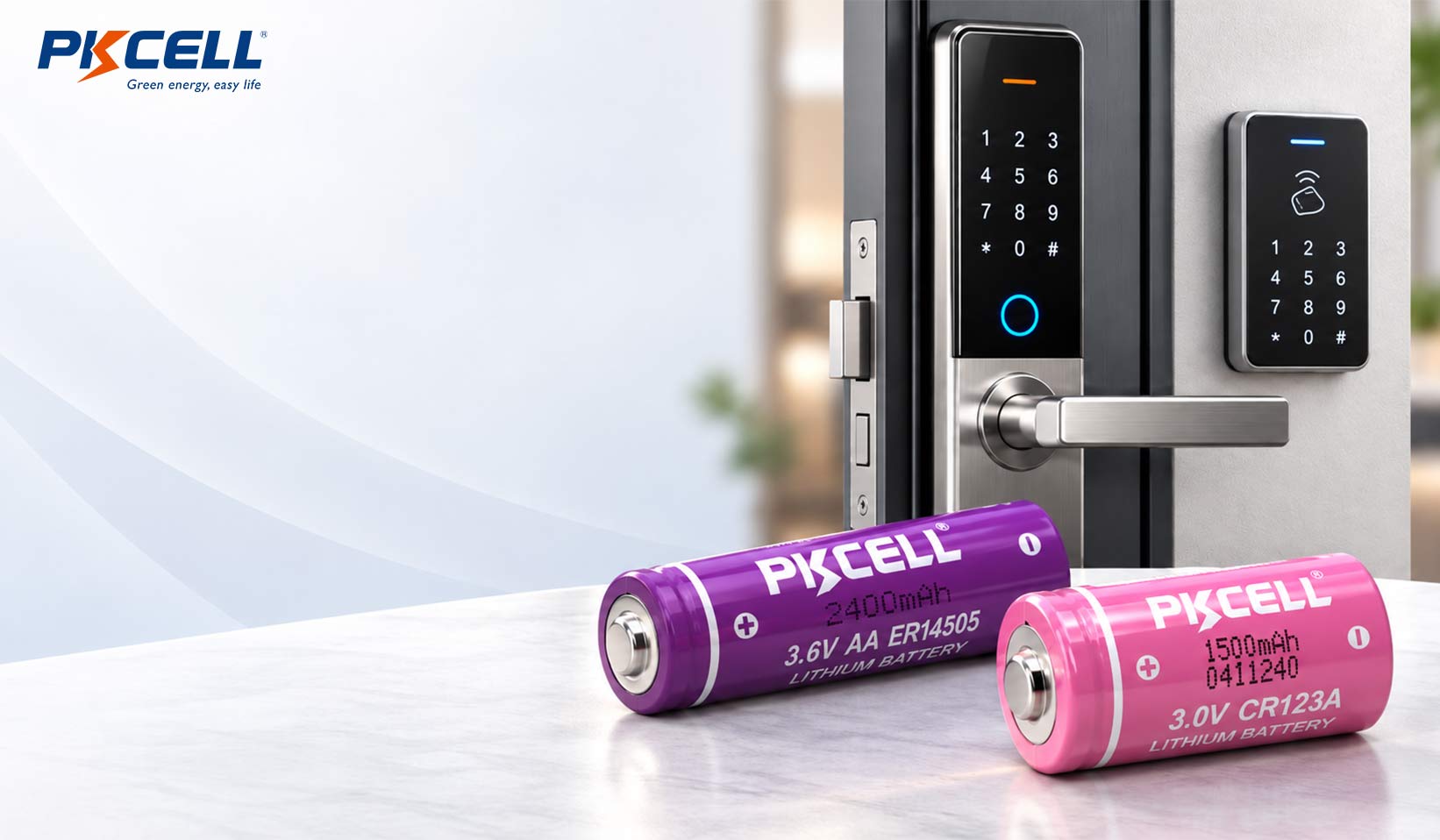
1. Electronic Locks Have Distinctive Power Requirements
Unlike equipment that operates continuously, many electronic locks spend most of their time waiting for an access request. Their electronics may monitor a keypad, read a credential, listen for a wireless command, or detect activity before activating the locking mechanism.
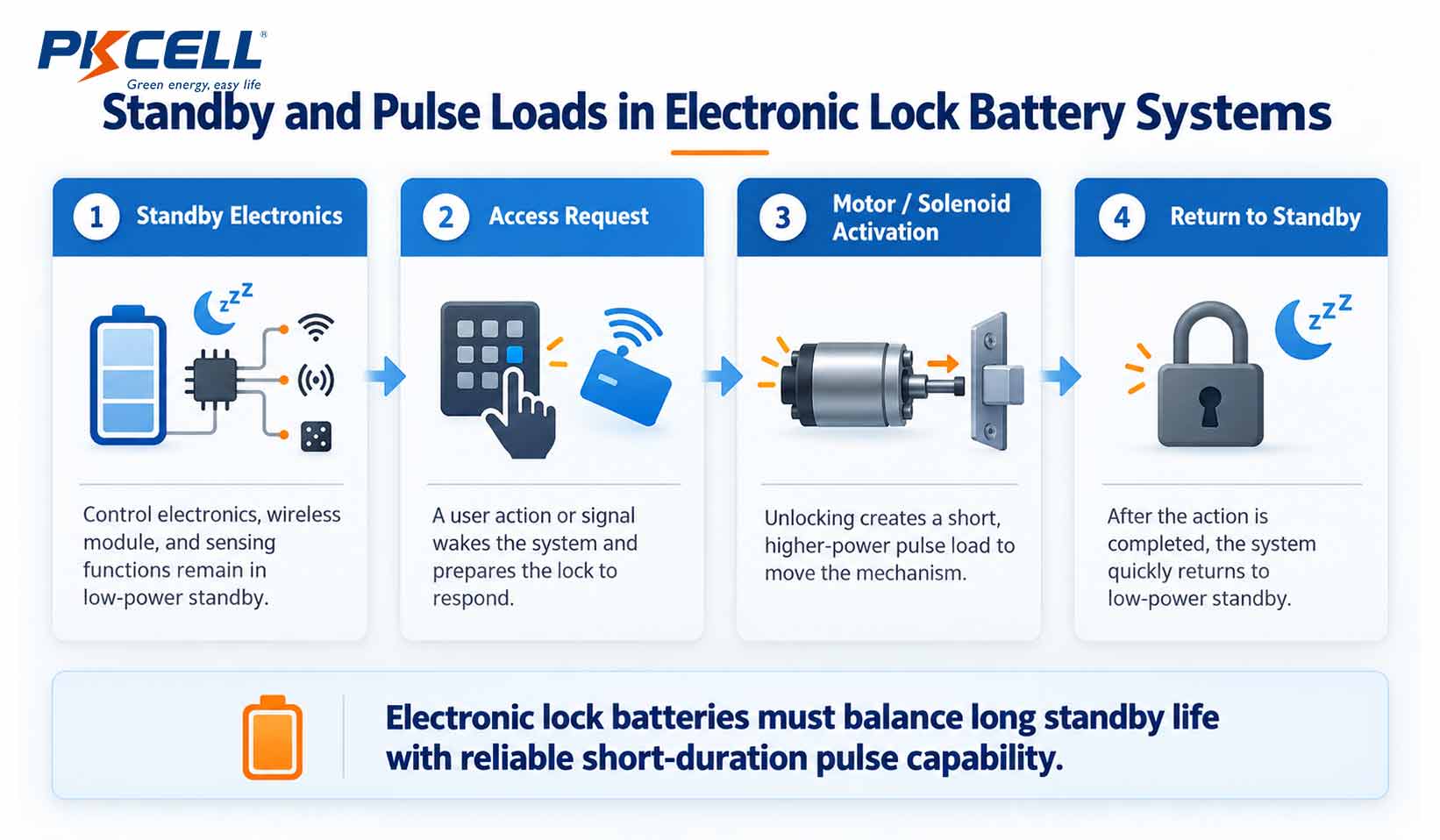
This operating pattern creates two different power requirements: low energy consumption during standby and sufficient power when the device performs an action.
Standby Operation
During standby, a lock may power its controller, sensing circuits, and wireless communication functions. Although the current may be relatively low, the device can remain in this state for long periods. The accumulated energy consumption over months or years can therefore become an important design consideration.
Battery selection should account for the complete standby current, including the controller, radio, voltage regulator, sensors, and other circuits that remain active. Battery self-discharge is only one part of the overall energy budget.
Access Events and Mechanical Activation
When a user enters a code, presents a credential, or sends an unlock command, the lock may activate a motor, solenoid, indicator, or communication module. These functions can increase current demand for a short period.
A battery that supports a low standby current may not automatically support the peak load. Engineers need to check both the average energy requirement and the voltage response during the most demanding operating event.
2. Why Lithium Batteries Are Used in Access Control Devices
High Energy Density in Compact Equipment
Electronic locks often have limited space for the power source. Battery compartments must fit around the mechanical lock assembly, circuit board, motor, wiring, and enclosure.
Selected lithium battery chemistries offer high energy density, allowing designers to evaluate compact cells that provide useful energy for the intended operating profile. The actual benefit depends on the chemistry, cell format, load, temperature, and device voltage requirements.
For an OEM project, the battery should be evaluated together with the complete enclosure and electrical design rather than selected on energy density alone.
Low Self-Discharge for Long Standby Periods
Some access control devices may remain in storage before installation or operate for extended periods between battery replacements. Low self-discharge can help preserve stored energy while the device is not actively consuming power.
Li-SOCl2 primary lithium batteries are often considered for long-life, low-current industrial electronics because of their low self-discharge characteristics. They may be suitable for compatible access control peripherals or monitoring devices when the current profile matches the specific cell design.
Low self-discharge does not guarantee a particular service life. The electronics’ standby current, activation frequency, operating temperature, battery condition, and voltage cutoff all influence actual operating time.
Useful Energy for Intermittent Operation
Access control devices can have an uneven load profile: low current during standby followed by a short sensing, communication, or actuation event. Some primary lithium batteries can support this type of duty cycle when their discharge characteristics are matched to the application.
For example, Li-MnO2 primary lithium batteries are used in compatible electronic devices requiring a nominal 3V source. A CR-series cell may be a candidate for an access control design only when the device specifies the corresponding voltage, format, and discharge capability.
For more information about this product family, see the PKCELL Li-MnO2 battery range.
Reduced Battery Replacement Requirements
Battery replacement can involve more than the cost of a new cell. In commercial buildings, distributed access control installations, or remote facilities, maintenance may require a technician to visit the device, verify operation, and restore service.
A battery system that matches the device’s actual energy requirements may help reduce unnecessary replacement frequency. However, replacement intervals must be established through product-specific calculations and validation, not inferred from chemistry alone.
3. Why Battery Chemistry Matters More Than the Word “Lithium”
Lithium is used in several different battery chemistries. Their nominal voltage, discharge characteristics, charging requirements, and suitability for a particular load can differ significantly.
Li-SOCl2: Long-Life Primary Power
Li-SOCl2 batteries are commonly evaluated for industrial equipment that requires long standby periods and low self-discharge. They can be appropriate for compatible sensors, metering devices, and access control peripherals with low average current.
However, some bobbin-type Li-SOCl2 cells are not designed to directly supply the high pulse current demanded by a lock motor. Passivation, voltage drop, temperature, and pulse duration must be considered when assessing a specific model.
Explore the PKCELL Li-SOCl2 battery portfolio for product specifications and possible industrial applications.
Li-MnO2: Primary Power for Compatible Compact Devices
Li-MnO2 primary lithium batteries provide a nominal 3V output in common CR-series formats. Depending on the device design, they may be considered for compact security electronics, wireless sensors, and other compatible equipment.
For example, the PKCELL CR123A 3V Li-MnO2 battery is a product option to review when the equipment manufacturer specifies a compatible CR123A battery. It is a primary, non-rechargeable cell.
Rechargeable Lithium-Ion Battery Packs
Some smart locks use rechargeable lithium-ion battery packs, particularly when their motors, cameras, displays, or other functions require a different voltage and current capability. Such designs need a compatible charging system and appropriate pack-level protection.
A rechargeable lithium-ion pack is not interchangeable with a primary lithium cell simply because both contain lithium. Nominal voltage, voltage range, dimensions, current capability, and charging architecture must all match the device.
For a more detailed explanation of the distinction, read our guide to primary and rechargeable lithium batteries.
Important: Primary lithium batteries such as CR123A Li-MnO2 and ER-series Li-SOCl2 cells are not rechargeable. Always follow the device manufacturer’s approved battery specification.
4. The Main Challenge: Long Standby and Short High-Current Loads
One of the most important design considerations in an electronic lock is the difference between standby demand and activation demand.
During standby, the device may consume only a small current. When the locking mechanism operates, the motor or solenoid can draw a much higher current. Wireless transmission and other electronics may add further peaks.
Battery selection should therefore consider:
- Standby current of the complete electronic system.
- Peak current required by the motor or solenoid.
- Duration and frequency of each activation event.
- Minimum operating voltage of the controller and actuator.
- Battery voltage drop under load and at low temperature.
- Expected number of access events during the service period.
For some industrial designs, an ER + hybrid pulse capacitor (HPC) solution may be worth evaluating when long-term energy storage and higher pulse demand must be addressed together. The suitability of such a configuration depends on the measured load profile and system design; it is not a universal requirement for electronic locks.
Where pulse demand is significant, engineers should test the complete system rather than rely solely on the cell’s nominal capacity.
5. How Battery Choice Affects Access Control Reliability
A battery can have adequate nominal capacity and still be unsuitable for a particular lock. If its voltage falls below the device’s minimum operating threshold during activation, the controller may reset or the locking mechanism may fail to complete its intended action.
Engineers should evaluate the following factors during battery qualification.
Voltage Compatibility
Confirm the device’s nominal voltage, maximum input voltage, minimum operating voltage, and cutoff requirements. A 3V CR battery and a 3.6V ER battery are not automatic substitutes. Differences in voltage profile and cell construction can affect the electronics.
Pulse Performance
Check the battery’s continuous and pulse discharge specifications under the expected operating conditions. The current amplitude, pulse duration, repetition interval, and temperature can all influence loaded voltage.
Operating Environment
Electronic locks may be installed indoors, in semi-outdoor areas, or in environments exposed to seasonal temperature changes. The specified operating temperature range and available discharge performance of the exact battery model should be reviewed.
Mechanical and Electrical Integration
Verify the battery compartment, terminal configuration, polarity, connector, cable routing, and any required battery holder or pack structure. These details are particularly important for OEM devices with limited internal space.
For application-specific designs, PKCELL primary lithium battery pack solutions may be relevant where a compatible primary battery pack is required. The exact chemistry and configuration must be confirmed against the device specification.
6. How to Estimate Battery Life in an Electronic Lock
Battery life depends on both energy consumption and the battery’s usable capacity under the actual operating conditions. A simple estimate can help establish an initial design target.
Average Current ≈ Standby Current + Average Current from Active Events
Where the active events are intermittent, their contribution can be estimated from the current consumed per event and the expected number of events over a defined period.
A preliminary capacity estimate is:
Required Capacity (mAh) ≈ Average Current (mA) × Operating Time (hours)
This calculation is only a starting point. A practical design must account for usable capacity, pulse-related voltage drop, operating temperature, battery ageing, self-discharge, and the device’s cutoff voltage. The battery’s rated capacity should not be assumed to remain fully available under every load condition.
For a primary lithium battery, use the manufacturer’s discharge curves and model-specific specifications. For a rechargeable battery pack, also consider the charging strategy, cycle life, protection system, and expected recharge opportunities.
7. Which Access Control Applications May Use Primary Lithium Batteries?
Primary lithium batteries can be considered for access control products whose electrical requirements align with the selected chemistry and cell design.
- Wireless door and window sensors: Often operate at low average current with intermittent sensing and communication events.
- Remote access control peripherals: May require long standby periods and occasional wireless activity.
- Industrial security monitoring devices: May be installed where battery replacement involves additional maintenance effort.
- Battery-powered indicators and auxiliary electronics: May use primary lithium cells when the voltage and load requirements are compatible.
Motorized smart door locks require additional attention because actuator startup current can be substantial. A primary battery should only be selected when its model-specific current capability and voltage response meet the complete device requirements.
For systems that require frequent recharging or higher sustained power, a rechargeable battery architecture may be more suitable.
8. What OEM Engineers Should Verify Before Production
Before approving a battery for an electronic lock or access control product, validate the complete system rather than evaluating the battery in isolation.
- Confirm the required chemistry, nominal voltage, and permitted voltage range.
- Measure standby current and record the actual activation current profile.
- Test voltage under the highest expected load.
- Evaluate operation at the intended minimum and maximum temperatures.
- Verify the expected service interval under realistic usage conditions.
- Check cell or pack dimensions, polarity, connectors, and installation method.
- Review the applicable product documentation and transport requirements.
- Define the acceptance criteria for sample testing and mass production.
These checks help establish whether a standard cell or a customized battery solution is appropriate for the application.
For OEM projects requiring a custom primary battery assembly, review PKCELL custom primary lithium battery pack services. Product configuration and suitability should be confirmed against the project requirements.
Frequently Asked Questions
Why are lithium batteries used in electronic locks?
Selected lithium battery chemistries offer high energy density, low self-discharge, and useful discharge characteristics for compatible electronic devices. Suitability depends on standby current, activation load, voltage requirements, and expected service interval.
Are primary lithium batteries suitable for smart locks?
They may be suitable for compatible locks and access control peripherals, but not every motorized lock can use a primary cell. The battery must support the device’s required voltage and current profile. Some smart locks are designed specifically for rechargeable battery packs.
Can an ER14505 replace an AA battery in an electronic lock?
Not automatically. An ER14505 Li-SOCl2 cell has a nominal voltage of 3.6V, which differs from standard AA alkaline and many AA-format lithium primary cells. Physical fit does not guarantee electrical compatibility. Always follow the equipment manufacturer’s approved battery specification.
Why is peak current important in a battery-powered door lock?
The motor or solenoid may draw a high current during unlocking. If the battery voltage drops below the device’s operating threshold, the lock may not function correctly. Peak current, pulse duration, temperature, and cutoff voltage should therefore be assessed together.
How can OEM manufacturers improve battery service life?
Measure actual standby current, reduce unnecessary power consumption, optimize communication intervals, and choose a battery whose usable capacity and discharge characteristics match the application. Validate the service-life estimate under representative operating conditions.
Can PKCELL help evaluate a primary lithium battery for access control equipment?
PKCELL can review applications that are compatible with its primary lithium battery portfolio. Share the device voltage, standby current, peak current, activation frequency, operating temperature, and mechanical requirements to support an initial product assessment.
Conclusion
Lithium batteries are used in electronic locks and access control devices because selected chemistries can provide compact energy storage, low self-discharge, and discharge characteristics suited to particular operating profiles.
The most important design consideration is not simply whether a battery contains lithium. Engineers must match the chemistry and cell design to the lock’s standby consumption, activation current, voltage limits, temperature, and expected service interval.
Primary Li-MnO2 and Li-SOCl2 batteries can be useful in compatible access control devices and industrial peripherals. Motorized locks with different power demands may require another battery architecture or a carefully engineered pack.
Developing an Electronic Lock or Access Control Project?
Share your voltage requirements, standby current, peak current, activation frequency, operating temperature, and installation constraints. PKCELL can review the application requirements and discuss suitable primary lithium battery options.
Post time: Oct-27-2026


